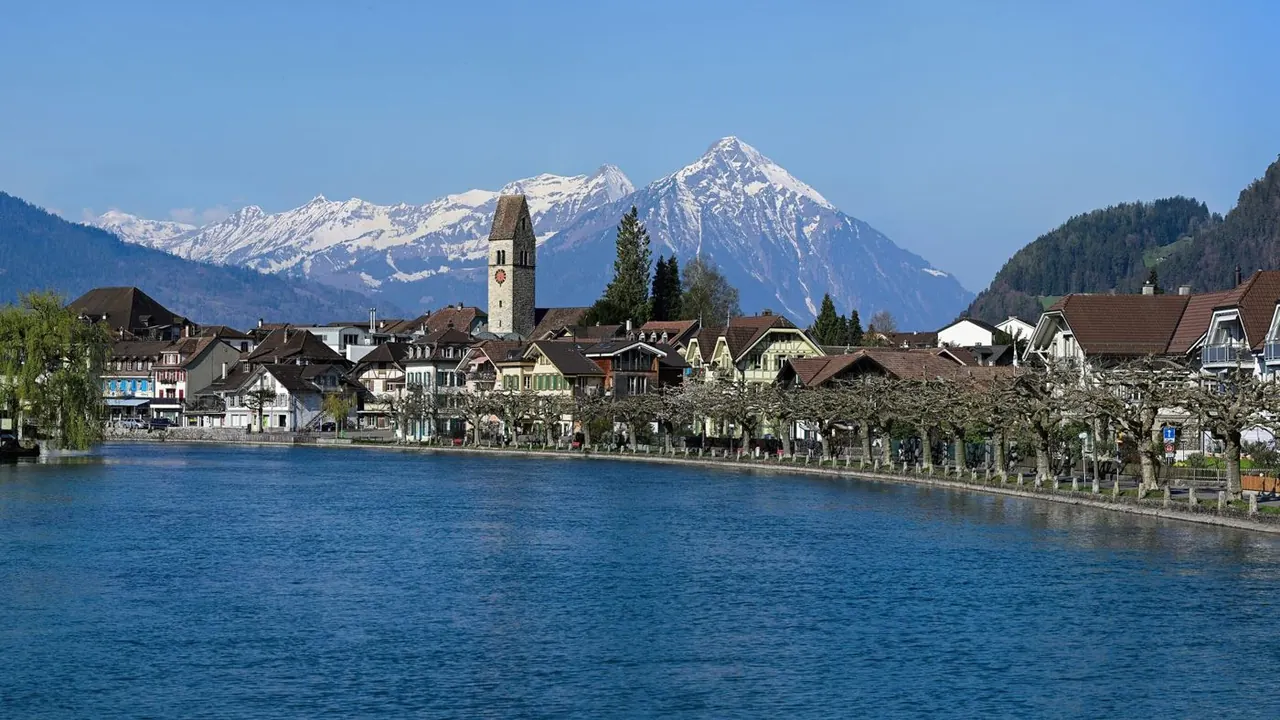
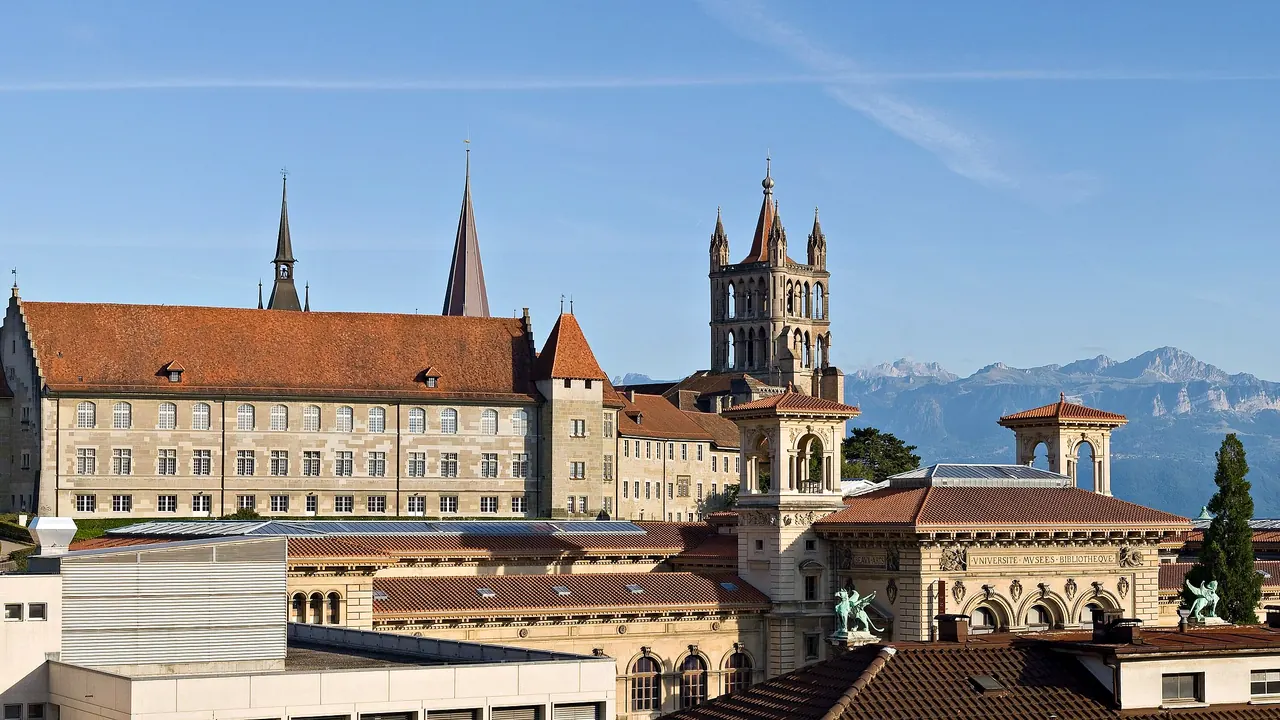
Photos: Interlaken by Roy Egloff, CC BY-SA 4.0, cropped; Lausanne by Christian Mehlführer, CC BY-SA 3.0, cropped.
Interlaken or Lausanne?
Our verdict in twelve categories, each scored against the same fixed benchmark cities, and the climate month by month, so you can choose for your trip.
Choose Interlaken for
- nature and the outdoors
- families
- getting around
Interlaken is the choice when the mountains are the whole point. The Eiger, Mönch and Jungfrau, the Lauterbrunnen valley and the railway up to the Jungfraujoch are all within an hour, and paragliding, canyoning and rafting all start from the town. Pick it if you want to spend your days high on trails and ridges and are happy to come back to a small town that is quiet by ten.
Choose Lausanne for
- culture and sights
- live music and the arts
- food and drink
Lausanne suits travellers who want a real city as well as fine scenery. You get a Gothic cathedral, the Olympic Museum and Plateforme 10, a serious ballet and theatre scene, Lavaux wine and student nights in the Flon. The Alps are still close: they rise across the lake and the ski valleys are an hour away. It is the better base for a mixed trip that moves between culture, food and lakeside walks.
Scoreboard
Twelve categories on one fixed scale from 0 to 100. The shaded stretch is the gap between the two.
Your match
Pick a travel style or drag the sliders, and both match scores follow your weighting.
Wins on nature and the outdoors and families with your weighting.
Wins on culture and sights and live music and the arts with your weighting.
What matters to you?
Category by category
What the scores mean for a trip.
Beaches & swimming
Neither town is a beach destination, but Lausanne makes more of its water. Lake Geneva gets a little warmer, and swimming is part of everyday city life from the lawns at Vidy and the old Bellerive lido, with its pools.
Interlaken's swimming is a reward after a day in the mountains. Lake Thun's lidos at Neuhaus are the warmest spot, while glacial Lake Brienz looks beautiful but is cold. The setting under the snow peaks is the attraction, but the season is short.
Food & drink
Lausanne eats much better. Its cooking has a strong regional character, with lake perch and papet vaudois, and the Lavaux vineyards next door mean good local Chasselas is poured everywhere. There is also a top tier of celebrated restaurants, although mid-range meals can be ordinary.
In Interlaken, town restaurants mostly serve fondue, rösti and international dishes to visitors. The meals worth remembering are up in the mountains: a hut terrace above Grindelwald or cheese bought at an Alpine dairy.
Culture & sights
This is where the two differ most. Lausanne has a Gothic cathedral with a night watchman who still calls the hours, a hilly old town of covered stairways, and enough museums for two or three full days, from the Olympic Museum at Ouchy to Plateforme 10 by the station.
Interlaken offers a row of grand hotels along the Höheweg, the Kursaal and a few timber houses in Unterseen. If you want history, you will find it in Bern or Thun.
Nightlife
Lausanne has a genuine night out, thanks to its large student population. Clubs and late bars fill the old warehouses of the Flon at weekends, and in summer people gather by the lake at Ouchy in the evenings.
Interlaken has a few backpacker pubs, a couple of basement clubs and the casino. Most visitors are up early for trains or paragliding, so the streets are quiet before midnight.
Nature & outdoors
Both are superb, but Interlaken is one of the great Alpine bases. The Jungfraujoch looks out over the Aletsch glacier, the Lauterbrunnen valley has its waterfalls, and lifts take you up to ridges with almost no effort. Adventure sports run from the town every day, and the Jungfrau ski areas take over in winter.
Lausanne's nature is softer and more varied. You can walk the Lavaux vineyard terraces above the lake, sail on Lake Geneva, and hike or ski in the Vaud Alps or the Jura, each about an hour away.
Day trips
Both are good rail hubs, and Lausanne has a slight edge for variety. Vevey, Montreux and Chillon are minutes along the lake, Geneva and Gruyères are easy trips, and boats cross to the French shore.
Interlaken's trips mix towns with mountain villages. Bern is under an hour away, paddle steamers call at the castles of Thun, Spiez and Oberhofen, and Ballenberg's open-air museum is near Brienz. Lucerne is a longer ride over the Brünig Pass.
Good for families
Interlaken is slightly ahead for children, because getting up the mountains is the fun. Gondolas, cog railways, summer toboggan runs and playgrounds at the summit stations keep children busy, and the St Beatus caves and Ballenberg's farm animals are reliable favourites. Wet days and high altitudes are the weak points.
Lausanne has more for rainy days, with the hands-on Olympic Museum, a freshwater aquarium-vivarium and the animal park at Sauvabelin. Its steep streets, however, are hard going with a pushchair.
Getting around
Both are easy without a car, but in different ways. Interlaken is flat and small, and its strength is the regional network: narrow-gauge trains, cog railways, gondolas and steamers connect to cover the whole Jungfrau region.
Lausanne is compact but steep, built in layers linked by stairs and lifts. The m2 metro climbs from the lakeshore to the upper town and does most of the hard work for you.
Shopping & style
Lausanne gives you more to browse. Rue de Bourg has watches, fashion and chocolatiers, the Flon has a few design shops, and there are market stalls in the old town squares. It is still a modest place for shopping.
Interlaken's Höheweg is mostly watch stores for tour groups, army knives and souvenirs. Carved woodwork from Brienz is the one local craft worth taking home.
Affordability
Both are as expensive as Switzerland gets, so the difference is in what drives the bill. In Interlaken it is the mountain railways, with the Jungfraujoch above all, plus adventure activities, all on top of Swiss hotel rates.
In Lausanne the cost goes on restaurants, wine and hotels. Free lakeside promenades and parks make a thrifty day easier to plan, and a tasting in a Lavaux caveau is good value.
Live music & performing arts
Lausanne is far stronger on stage. It is home to the Béjart Ballet and the Prix de Lausanne, the Théâtre de Vidy is known internationally for contemporary work, and the opera and chamber orchestra run full seasons. In July the Montreux Jazz Festival is a short ride along the lake.
Interlaken offers the open-air William Tell in summer and folklore evenings with alphorns, and Bern is the nearest place for serious theatre and orchestral music.
Wellness & relaxation
Lausanne is the better place to slow down. As well as lakeside promenades and hotel spas, it has thermal water within reach: Yverdon-les-Bains is under half an hour by train, and Lavey-les-Bains, with the hottest springs in Switzerland, is up the Rhône valley.
Interlaken has no springs, and its centre is busy with activity. Here the calm comes from early mornings by the lake, slow steamer crossings and quiet nights up in Wengen or Mürren.
When should you go?
Pick your month. The climate figures are measured averages, not a forecast.
Interlaken in July
Lausanne in July
Daytime high, °C
Rainfall in the month, mm
Where the figures come from
Interlaken has no rain gauge within 25 km of the centre, so its rainfall comes from a gridded climate dataset read at the city rather than from a gauge further away.
Interlaken's sunshine is measured 66 km from the centre, at Sion.
Lausanne's temperatures are measured 40 km from the centre, at Payerne.
Lausanne has no rain gauge within 25 km of the centre, so its rainfall comes from a gridded climate dataset read at the city rather than from a gauge further away.
Temperature and rainfall are climate normals, averaged over the years shown. Interlaken: 2005-2020 (sunshine 1961-1990, rainfall 1991-2020) normals, Meiringen / Unterbach (19.3 km from centre). Lausanne: 1991-2020 (sunshine 1961-1990) normals, Payerne (39.7 km from centre).
The two follow the same Swiss pattern, but Lausanne is a little warmer through the year. Both lakes are warm enough to swim in during July and August, when Lausanne reaches about 26°C and Interlaken about 24°C. Summer is also when Interlaken gets its most rain, around 125mm a month from June to August, often as afternoon showers and low cloud that can hide the peaks. In Lausanne the rain is spread more evenly, and July brings the most sun.
For walking, May, June and September are the most comfortable months in both towns. Interlaken cools quickly after that and is cold from November to March, when the ski areas above it take over. Lausanne's winters are grey, with only about 41 hours of sunshine in December, though the mountains nearby are often in sun above the fog.
Which traveller are you?
For an outdoors trip, Interlaken wins clearly. Rack railways and cable cars take you straight onto high trails at Grindelwald First, Schynige Platte and Mürren, and the town is a centre for paragliding, canyoning and rafting. Lausanne's Lavaux and Jura walks are lovely, but they are gentler.
On a culture and arts trip, Lausanne is the obvious pick. It has the cathedral and old town, the Olympic Museum, the Art Brut collection, the Béjart Ballet and the Théâtre de Vidy. Interlaken has almost no sights of its own, and its stage life is a summer staging of William Tell.
For a food and nightlife trip, choose Lausanne. You can drink Chasselas in Lavaux caveaux, shop the Saturday market and go to some celebrated restaurants, then spend late nights in the Flon warehouses. Interlaken's food is hearty but plain, and its evenings end early.
Before you go
| Measure | Interlaken | Lausanne |
|---|---|---|
| Official language | French, German, Italian, Romansh | French, German, Italian, Romansh |
| Currency | Swiss Franc (CHF) | Swiss Franc (CHF) |
| Sockets | CJ230 V, 50 Hz | CJ230 V, 50 Hz |
| Driving side | Right | Right |
| Time zone | UTC+1, UTC+2 in summer | UTC+1, UTC+2 in summer |
| Emergency number | 112 | 112 |
| Elevation | 571 m | 495 m |
| Main airport | Zürich Airport (ZRH)100 km from centre226 non-stop destinations | Geneva International Airport (GVA)52 km from centre150 non-stop destinations |
| Public holidays this year | 10 days | 9 days |
By the numbers
| Measure | Interlaken | Lausanne |
|---|---|---|
| City population | 6,123 | 144,873 |
| People per km² | 1,424 | 3,499 |
| Museums within 10 km | 3 | 31 |
| UNESCO World Heritage sites within 50 km | 2 | 3 |
Where else could you go?
Every comparison below shares a destination with this one, so you can follow Interlaken or Lausanne somewhere new.
- Bernvs Interlaken
- Genevavs Lausanne
- Lucernevs Interlaken
- Chamonixvs Lausanne
- Bernvs Lausanne
- Annecyvs Lausanne