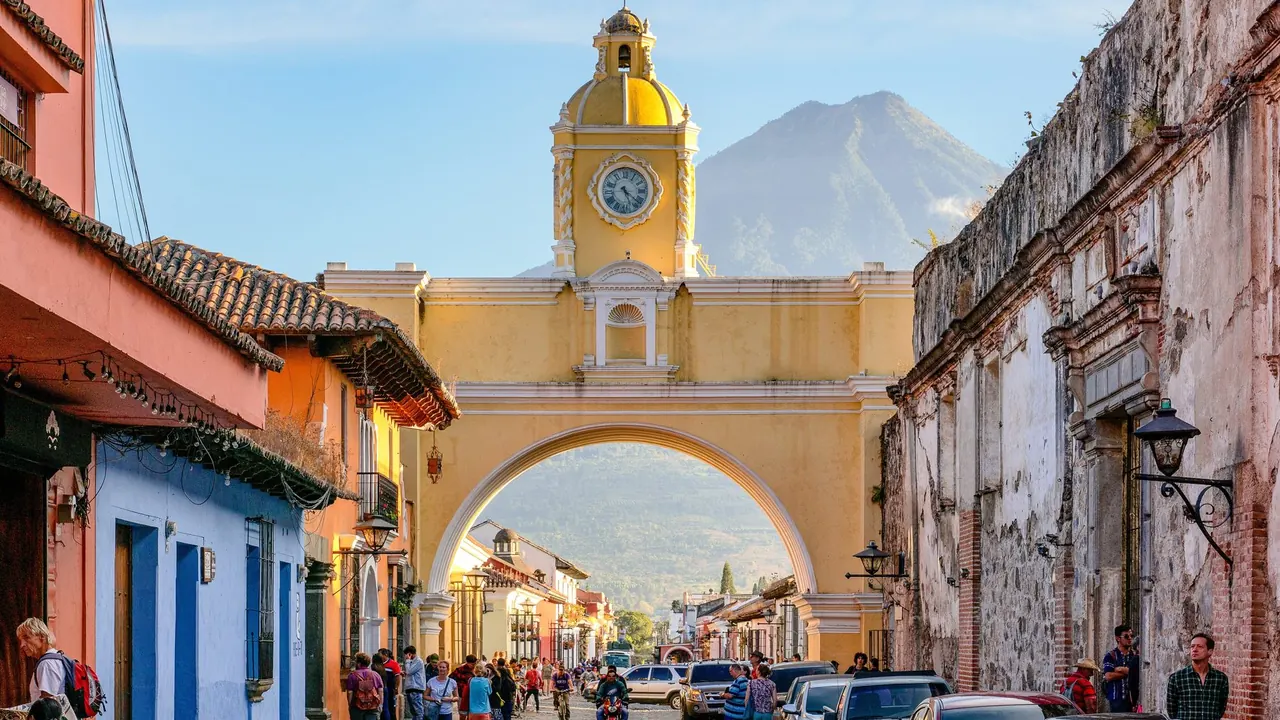
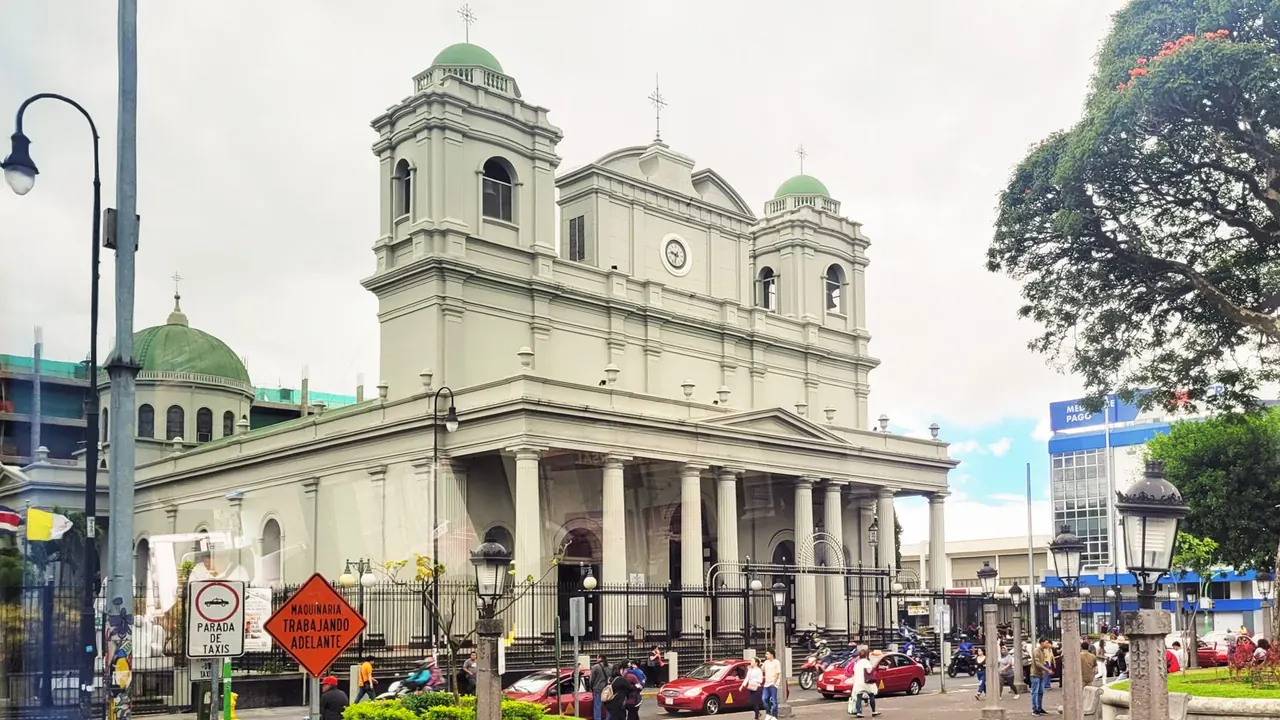
Photos: Antigua Guatemala by Chad Davis, CC BY-SA 2.0, cropped; San Jose, Costa Rica by Bernard Gagnon, CC0.
Antigua Guatemala or San Jose, Costa Rica?
Our verdict in twelve categories, each scored against the same fixed benchmark cities, and the climate month by month, so you can choose for your trip.
Choose Antigua Guatemala for
- culture and sights
- getting around
- wellness
Antigua suits travellers who want the town itself to be the point of the trip. Ruined convents stand on almost every block of a cobbled grid you can cross on foot in a quarter of an hour, and the volcano climbs on Acatenango and Pacaya are a short drive away. Day-to-day costs are lower, and the garden-courtyard hotels make it the easier place to slow down.
Choose San Jose, Costa Rica for
- live music and the arts
- beaches
- nightlife
If you see the city as a gateway rather than the goal, San Jose is the better pick. Most of its appeal lies in the countryside within reach, with crater rims you can drive to, cloud forest, rafting rivers and wildlife. The Teatro Nacional also offers an evening of symphony or ballet that Antigua cannot match. Families who are after nature rather than old buildings will do better here, as long as they plan on taxis or a hire car.
Scoreboard
Twelve categories on one fixed scale from 0 to 100. The shaded stretch is the gap between the two.
Your match
Pick a travel style or drag the sliders, and both match scores follow your weighting.
Wins on culture and sights and getting around with your weighting.
Wins on live music and the arts and beaches with your weighting.
What matters to you?
Category by category
What the scores mean for a trip.
Beaches & swimming
You won't swim in the sea from either city, and both leave you with a hotel pool. San Jose has a slight edge because Jaco and Puntarenas, about two hours away by road, are proper beach towns where people stay on for a few days.
Antigua's nearest coast at Monterrico is a similar distance away, but its black volcanic sand, heavy surf and strong currents make it better for watching the waves than for swimming.
Food & drink
The two are close, and both are at their best with coffee grown on the surrounding volcano slopes. Antigua's cooking has more depth, with slow stews such as pepián and jocón, a long history of cacao and chocolate tastings, and comedor lunches at the market by the bus terminal.
San Jose's home cooking is simpler: gallo pinto, the casado plate in a family-run soda, and lunch counters in the Mercado Central. To make up for it, Barrio Escalante and Escazu offer more modern and international dining than Antigua, where the choice starts to run out after a few days.
Culture & sights
This is where Antigua clearly wins. The whole town is a 16th-century grid of painted houses, with roofless cloisters at Capuchinas, Santa Clara and San Francisco, and trees growing through the cathedral's broken vaults. Simply walking around is the main sight.
San Jose lost most of its old buildings to earthquakes and growth. What it has instead is a handful of good indoor collections: the Teatro Nacional, the Pre-Columbian Gold Museum, the Jade Museum and the National Museum in the bullet-marked Bellavista fortress. They are worth a day, but they do not add up to a historic townscape.
Nightlife
Neither city is a nightlife destination, and San Jose's evenings are only slightly livelier. The two feel very different, though. In Antigua it is a few blocks of rooftop bars facing the volcanoes and mezcal bars behind colonial doorways, mostly full of travellers and language students, and most places close early.
San Jose's nights are more local and centre on dancing, with Ticos taking salsa and merengue seriously. The walled El Pueblo complex stays open late, and San Pedro has cheap student bars. You will need taxis between them, though, because the downtown core is not a place to walk after dark.
Nature & outdoors
Both cities are surrounded by volcanoes, and both are excellent bases for getting outdoors. The difference is in how you experience them. In Antigua, the volcanoes are something you climb. The classic outing is the overnight hike up Acatenango to watch Fuego throw out lava in the dark, while Pacaya is an easier half-day walk.
Around San Jose you can drive to the crater rims of Poas and Irazu. The wider landscape also offers more variety: cloud forest dropping to rainforest in Braulio Carrillo, white-water rafting on the Pacuare, and scarlet macaws at Carara.
Day trips
The two offer a similar number of outings, but Antigua's are more distinctive. You can reach weaving villages such as San Antonio Aguas Calientes by tuk-tuk, the Maya ruins of Iximché are about an hour and a half away, and Lake Atitlán and the Chichicastenango market are worth an overnight trip.
San Jose's outings follow the coffee towns of the Central Valley. Highlights include the basilica and church ruins at Cartago, the colonial church at Orosi, the painted oxcarts of Sarchi and the orchids at Lankester. They are pleasant, but tamer.
Good for families
San Jose is a little better for children, mostly because of what lies outside the city. Near the city there are waterfall gardens with sloths, butterfly farms and crater rims you can reach by car, while in town there is the Museo de los Ninos and space to run in La Sabana.
Antigua is calmer and easier to manage, but children need hands-on activities to stay interested. Chocolate workshops, horse rides and the Pacaya walk help, and so do ruined courtyards they can explore.
Getting around
Antigua is much easier. Its dozen-block grid is walkable from end to end in about fifteen minutes, the volcanoes on the horizon make it hard to get lost, and tuk-tuks handle the short trips. The only real drawback is the cobbles, which tire unsteady walkers.
San Jose has no metro, and its private bus lines run from scattered terminals that are hard for a visitor to work out. Heavy traffic also slows every trip out of the valley, so most visitors end up using taxis, ride-hailing, tours or a hire car.
Shopping & style
Antigua has the better shopping, because Guatemalan weaving is a real craft tradition rather than a souvenir line. Huipiles from the highland villages, jade and embroidered belts fill the market by the bus terminal, and courtyard boutiques sell more refined pieces.
San Jose's best browsing is in the Mercado Central and the craft stalls, which sell Boruca masks and miniature oxcarts. For clothes, locals go to the malls in Escazu. In both cities, local coffee is the easiest thing to take home.
Affordability
Antigua is the cheaper city, even though it is the most expensive place in Guatemala. Hostels, market lunches, chicken buses and modest entry fees to the ruins keep daily costs low, and only boutique hotels and the restaurants around the central park approach Western prices.
San Jose is cheap if you eat at sodas and take the bus. Elsewhere in the city, sit-down meals and alcohol cost close to North American prices, and foreigners pay more at the national parks. A mid-range trip adds up faster here.
Live music & performing arts
San Jose has the stronger formal stage. The National Symphony Orchestra plays its season in the gilded Teatro Nacional, the Melico Salazar puts on dance and folk shows, and there are small theatres, salsa halls and jazz venues in San Pedro.
Antigua has no theatre or concert season, but it does have marimba in the central park and the odd concert in a ruined cloister. Its great spectacle is Holy Week, with brass bands and sawdust carpets laid along the streets.
Wellness & relaxation
Antigua is the more restful place to stay. Quiet evenings, courtyard hotels with fountains and volcano views, plenty of yoga and massage studios, and the occasional temazcal sweat bath make it easy to slow down, even if church bells and saints'-day fireworks sometimes wake you early.
San Jose is a noisy, traffic-bound capital, so rest there means heading out of the city. Lodges in the coffee hills or the simple thermal pools of the Orosi valley are the nearest options, and the well-known hot springs at Arenal are too far for a day trip.
When should you go?
Pick your month. The climate figures are measured averages, not a forecast.
Antigua Guatemala in July
San Jose, Costa Rica in July
Daytime high, °C
Rainfall in the month, mm
Where the figures come from
Antigua Guatemala has no rain gauge within 25 km of the centre, so its rainfall comes from a gridded climate dataset read at the city rather than from a gauge further away.
San Jose, Costa Rica's station stands 241 m below the city centre, so the centre is likely a little cooler than the figures say.
Temperature and rainfall are climate normals, averaged over the years shown. Antigua Guatemala: 1998-2020 (rainfall 1991-2020) normals, Guatemala Aeropuertola Aurora (23.5 km from centre). San Jose, Costa Rica: 1991-2020 normals, Juan Santamaria (16.8 km from centre).
Both cities sit high enough to stay mild all year, but Antigua is the cooler of the two. Its daytime highs stay between about 23°C and 27°C, which is ideal for walking the cobbles at any time of year. San Jose runs several degrees warmer, peaking around 31°C in April, so city sightseeing there is most comfortable in the slightly cooler months either side. Neither city has a beach, so a coastal side trip has to be planned separately.
The dry season is the season that matters in both places. Antigua is almost rainless from December to March and stays fairly dry into April and November. From May the rain sets in hard, with June reaching nearly 300mm. San Jose has a similar dry spell from December to March, but its wet season lasts longer and peaks later, with September and October each bringing around 330mm. For clear volcano views in either place, aim for December to March.
Which traveller are you?
For a short city break, Antigua is the easy choice. A shuttle from the airport drops you in the centre, and after that you need no transport at all. San Jose can fill a day, but it works better as somewhere you pass through.
On a tight budget, plan your spending around the outings. In Antigua, the guided volcano hike is the one real expense, and the rest of your days cost little. In San Jose the city is cheap, but the countryside you came for costs much more.
On a family trip with children, San Jose works better if you plan it as a base rather than a destination. Stay in the quieter western suburbs, hire a car and take one outing into the countryside each day. Antigua suits a few slower days with school-age children.
Before you go
| Measure | Antigua Guatemala | San Jose, Costa Rica |
|---|---|---|
| Official language | Spanish | Spanish |
| Currency | Quetzal (GTQ) | Costa Rican Colon (CRC) |
| Sockets | AB120 V, 60 Hz | AB120 V, 60 Hz |
| Driving side | Right | Right |
| Time zone | UTC-6 | UTC-6 |
| Emergency number | Police 110/120, ambulance 128, fire 123 | 911 |
| Elevation | 1,582 m | 1,161 m |
| Main airport | La Aurora International Airport (GUA)22 km from centre19 non-stop destinations | Juan Santamaría International Airport (SJO)16 km from centre49 non-stop destinations |
| Public holidays this year | 13 days | 11 days |
By the numbers
| Measure | Antigua Guatemala | San Jose, Costa Rica |
|---|---|---|
| City population | 59,091 | 335,007 |
| People per km² | - | 7,511 |
| Museums within 10 km | 2 | 9 |
| UNESCO World Heritage sites within 50 km | 1 | 0 |
Where else could you go?
Every comparison below shares a destination with this one, so you can follow Antigua Guatemala or San Jose, Costa Rica somewhere new.