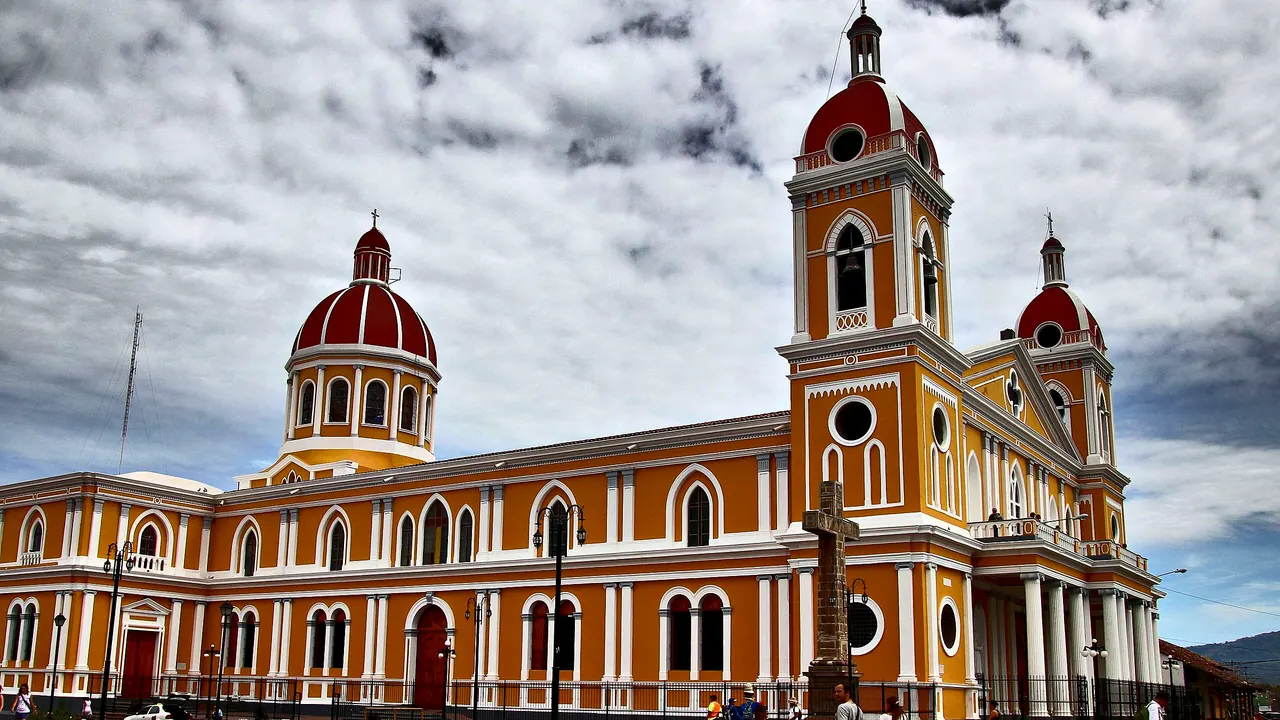
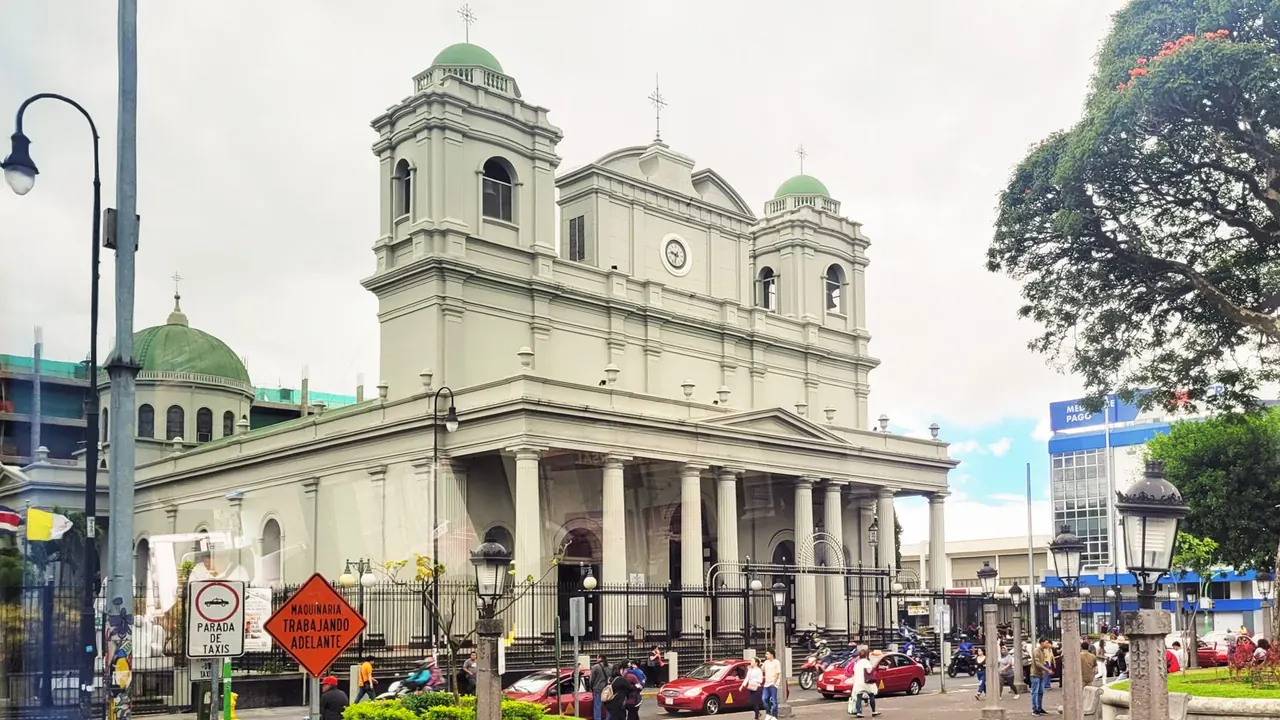
Photos: Granada, Nicaragua by Guillaume Baviere from Uppsala, Sweden, CC BY-SA 2.0, cropped; San Jose, Costa Rica by Bernard Gagnon, CC0.
Granada, Nicaragua or San Jose, Costa Rica?
Our verdict in twelve categories, each scored against the same fixed benchmark cities, and the climate month by month, so you can choose for your trip.
Choose Granada, Nicaragua for
- prices
- beaches
- getting around
Granada suits travellers who want a place that is pleasant in its own right: a colonial town of painted courtyard houses to stroll, with volcanoes, lake islands and a clear crater lake for swimming all close by. It costs very little, and you can walk across the centre in minutes. You give up nightlife, stage culture and much comfort for small children, but for a slow, cheap and photogenic stay it is the better pick.
Choose San Jose, Costa Rica for
- live music and the arts
- nightlife
- families
San Jose works best as a base or a gateway. The city has few charms of its own, but it gives easy access to a wider spread of outdoor country, from crater rims and cloud forest to white-water rivers. It also has more going on after dark, a proper symphony and theatre, and more for children. Choose it if your vacation is really about Costa Rica's landscapes and you want a capital with some evenings out before heading on.
Scoreboard
Twelve categories on one fixed scale from 0 to 100. The shaded stretch is the gap between the two.
Your match
Pick a travel style or drag the sliders, and both match scores follow your weighting.
Too close to call, 2 points apart
Wins on prices and beaches with your weighting.
Wins on live music and the arts and nightlife with your weighting.
What matters to you?
Category by category
What the scores mean for a trip.
Beaches & swimming
Neither city has a beach, but Granada has a much better swim close to town. Laguna de Apoyo, a clear and calm volcanic crater lake about half an hour away, has docks and lodges where you can spend a lazy day in the water. The lakefront in town is for strolling, not swimming.
San Jose is high in the Central Valley, so in the city a swim means a hotel pool. Its nearest Pacific beaches at Jaco and Puntarenas are two hours away or more in traffic, which means a night away rather than an afternoon trip.
Food & drink
The two are much alike at the table: plain, filling home cooking, with gallo pinto in both. The difference is where you eat. In Granada the best meals are on the street, such as vigorón from the kiosks around the central park and grilled meats from evening fritanga stalls. The restaurants on La Calzada are hit and miss.
San Jose eats indoors, at small family sodas and the counters inside the Mercado Central. It also does two things Granada does not: well-made local coffee in proper cafés, and a strip of modern restaurants and craft beer bars in Barrio Escalante.
Culture & sights
In Granada the town itself is the sight. A grid of ochre and blue colonial houses leads to the yellow cathedral, and La Merced's bell tower looks out over tiled roofs to Mombacho. The San Francisco convent holds the basalt statues from Zapatera island.
San Jose lost most of its old buildings to earthquakes and growth, so its interest lies in a handful of indoor places rather than its streets. These are the gilded Teatro Nacional, the Gold and Jade museums, and the National Museum inside the bullet-marked Bellavista fortress. Both need only a day or two, but Granada is the more rewarding place simply to wander.
Nightlife
Granada's nightlife is one street. Tables spill out along Calle La Calzada, hostel bars fill with backpackers, and a few small clubs play reggaeton at weekends. It is friendly, but by the third night you have seen it all.
San Jose spreads its evenings across several districts: cocktails and craft beer in Escalante and California, cheap student bars in San Pedro, and the late clubs and salsa halls of El Pueblo, where locals dance seriously. The catch is that you take a taxi between them rather than walking, because the centre is not safe to walk late at night.
Nature & outdoors
Both are volcano country, and both let you stand at the rim of an active crater, at Masaya near Granada and at Poas and Irazu above San Jose. Granada's wild places are right on its doorstep and lean towards water: Mombacho's cloud forest rises just south of town, and you can kayak among Las Isletas past herons and fishing villages.
San Jose has the wider range within reach. Braulio Carrillo drops from cloud forest to rainforest, the Orosi valley has waterfalls, and Carara has scarlet macaws. The Pacuare and Reventazon rivers offer white-water rafting, which Granada cannot match.
Day trips
The day trips are about as good in each, but they are different in character. From Granada you visit craft towns: the Masaya market and the Monimbó quarter, the pottery workshops of San Juan de Oriente, and the Catarina lookout over Apoyo.
From San Jose the outings are coffee towns and churches, such as Cartago's basilica and ruins, the colonial church in Orosi, Sarchi's painted oxcarts and coffee farm tours. They take longer than the map suggests, because the valley roads clog with traffic.
Good for families
San Jose has more for children. There is a children's museum in a former prison, room to run in La Sabana park, and waterfall gardens with sloths and butterfly farms just outside the city. Families who stay in the western suburbs and travel by car avoid the hardest parts of downtown.
Granada offers a handful of good outings, such as a carriage ride, the boat to the monkey island and a swimming day at Apoyo. Beyond those there is nothing made for children, the heat never lets up and medical care is basic, so it suits older, adaptable children best.
Getting around
Granada is far easier on foot. The centre is a small grid where the cathedral, the lakefront and Xalteva are a few minutes apart, and cheap taxis or horse carriages cover the hot middle of the day. For trips out of town most people use shuttles or drivers rather than the crowded old school buses.
San Jose has no metro, and its private bus companies run from terminals scattered across the city. Heavy traffic slows everything down, so visitors depend on taxis or ride-hailing in town and on a hire car or tours beyond it.
Shopping & style
Both cities sell mainly crafts and coffee, and San Jose has slightly more beyond that. Granada offers hammocks, Pueblos Blancos pottery, rocking chairs and cigars, though the market in nearby Masaya has a better choice than the town itself.
San Jose's Mercado Central is a more absorbing place to browse, with Boruca masks and miniature oxcarts at the craft stalls. For clothes, the big malls in Escazu are the only real option, since neither city has a fashion street.
Affordability
Granada is much cheaper. Courtyard guesthouses, street food, taxis and volcano tours all cost little, and even the restored mansion hotels look like a bargain to North American or European visitors.
San Jose is only cheap if you live like a local, eating at sodas and taking buses. Sit-down dinners in Escalante, alcohol and the higher park and tour prices for foreigners bring costs close to North American levels.
Live music & performing arts
San Jose has a real stage life and Granada does not. The Teatro Nacional is home to the National Symphony Orchestra and also stages ballet, the Melico Salazar puts on dance and folk shows, and you can hear salsa bands or jazz in San Pedro.
In Granada, live performance means marimba players and folkloric dancers entertaining diners on La Calzada, plus the music and costumed dances of the religious festivals.
Wellness & relaxation
Neither city has a bathing tradition or many spas, so the difference is where you find rest. In Granada it is in town: long afternoons in a shaded courtyard and a dip in the hotel pool, with yoga and massage at the Apoyo lodges a short drive away.
In San Jose, a noisy and traffic-bound city, rest means leaving for the cool, quiet hills above Escazu, the coffee-farm lodges or the simple thermal pools of the Orosi valley.
When should you go?
Pick your month. The climate figures are measured averages, not a forecast.
Granada, Nicaragua in July
San Jose, Costa Rica in July
Daytime high, °C
Rainfall in the month, mm
Where the figures come from
Granada, Nicaragua's temperatures are measured 34 km from the centre, at Managua A. C. Sandino.
Granada, Nicaragua has no rain gauge within 25 km of the centre, so its rainfall comes from a gridded climate dataset read at the city rather than from a gauge further away.
San Jose, Costa Rica's station stands 241 m below the city centre, so the centre is likely a little cooler than the figures say.
Temperature and rainfall are climate normals, averaged over the years shown. Granada, Nicaragua: 1961-1990 (sunshine 1991-2020, rainfall 1991-2020) normals, Managua A. C. Sandino (33.7 km from centre). San Jose, Costa Rica: 1991-2020 (sunshine 1971-2000) normals, Juan Santamaria (16.8 km from centre).
Granada is hot all year, and the main question is rain. December to April is the dry, sunny season, ideal for the islets, the volcanoes and swimming at Laguna de Apoyo, where the water stays warm through the year. The catch is heat: April reaches about 35°C, so streets are for early mornings and evenings. From May the rains come in hard and peak in October at around 329mm, then November dries out noticeably.
Sitting much higher, San Jose is several degrees cooler, with highs around 28°C for most of the year, which makes walking far more comfortable. It has the same dry season from December to April, with January to March the sunniest months. Its wet season runs a little longer and is cloudier than Granada's, and November is still properly rainy. That makes late November and December a better time to be in Granada.
Which traveller are you?
On a trip on a tight budget, Granada is the clear choice. Guesthouses and courtyard hotels cost very little, street food is cheaper still, and even the volcano and island tours are affordable. In San Jose, sit-down meals, drinks and park fees add up quickly.
On a family trip with children, San Jose is the easier base. Families can stay in the quiet western suburbs and visit the children's museum, La Sabana park, waterfall gardens and butterfly farms. Granada's constant heat, broken pavements and basic medical care suit only older children.
For a food and nightlife trip, San Jose offers more. Barrio Escalante has modern restaurants, cocktail and craft beer bars, and the El Pueblo complex has salsa bars that run late. Granada's evenings are cheerful but are all on one street, and they soon repeat.
Before you go
| Measure | Granada, Nicaragua | San Jose, Costa Rica |
|---|---|---|
| Official language | Spanish | Spanish |
| Currency | Cordoba Oro (NIO) | Costa Rican Colon (CRC) |
| Sockets | AB120 V, 60 Hz | AB120 V, 60 Hz |
| Driving side | Right | Right |
| Time zone | UTC-6 | UTC-6 |
| Emergency number | Police 118, ambulance 128, fire 115/120 | 911 |
| Elevation | 73 m | 1,161 m |
| Main airport | Augusto C. Sandino (Managua) International Airport (MGA)33 km from centre11 non-stop destinations | Juan Santamaría International Airport (SJO)16 km from centre49 non-stop destinations |
| Public holidays this year | 12 days | 11 days |
By the numbers
| Measure | Granada, Nicaragua | San Jose, Costa Rica |
|---|---|---|
| City population | 105,171 | 335,007 |
| People per km² | 178 | 7,511 |
| Museums within 10 km | 1 | 9 |
| UNESCO World Heritage sites within 50 km | 0 | 0 |
| Swim season, months above 21 °C | 12 months | - |
Where else could you go?
Every comparison below shares a destination with this one, so you can follow Granada, Nicaragua or San Jose, Costa Rica somewhere new.
- Leon, Nicaraguavs Granada, Nicaragua
- Santa Teresa, Costa Ricavs San Jose, Costa Rica
- Tamarindovs Granada, Nicaragua
- Tamarindovs San Jose, Costa Rica
- Santa Teresa, Costa Ricavs Granada, Nicaragua
- Leon, Nicaraguavs San Jose, Costa Rica