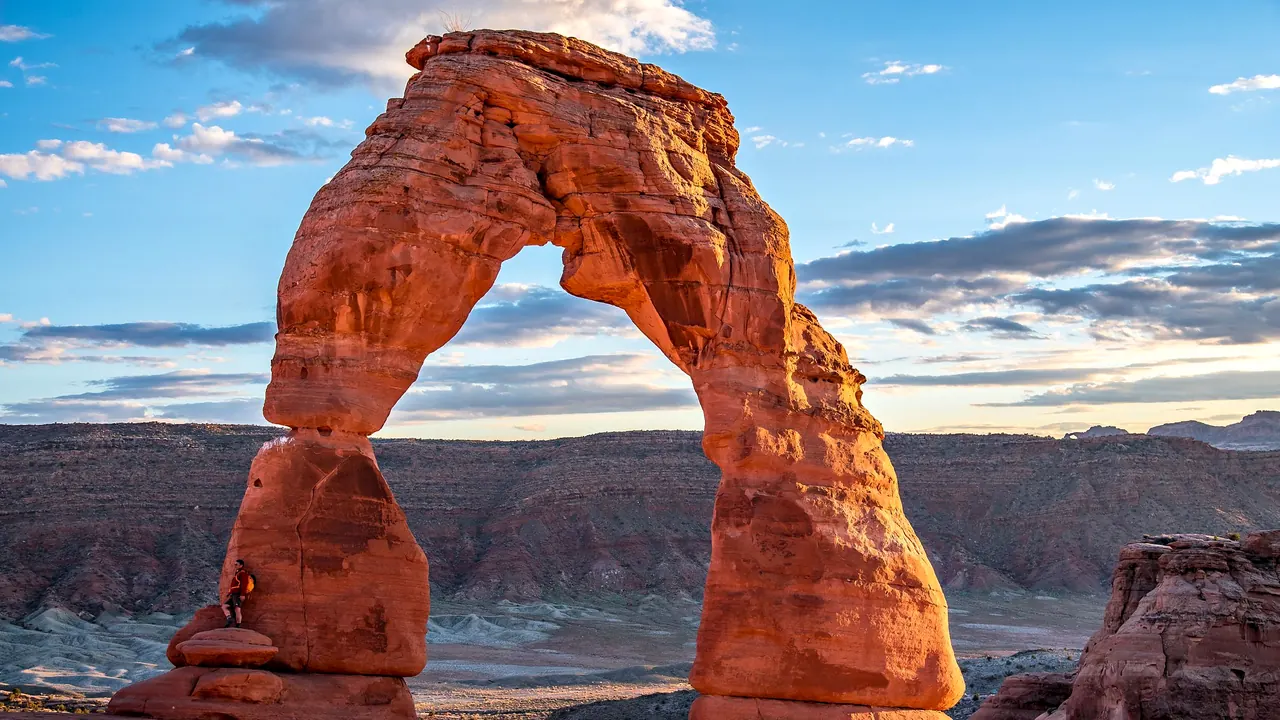
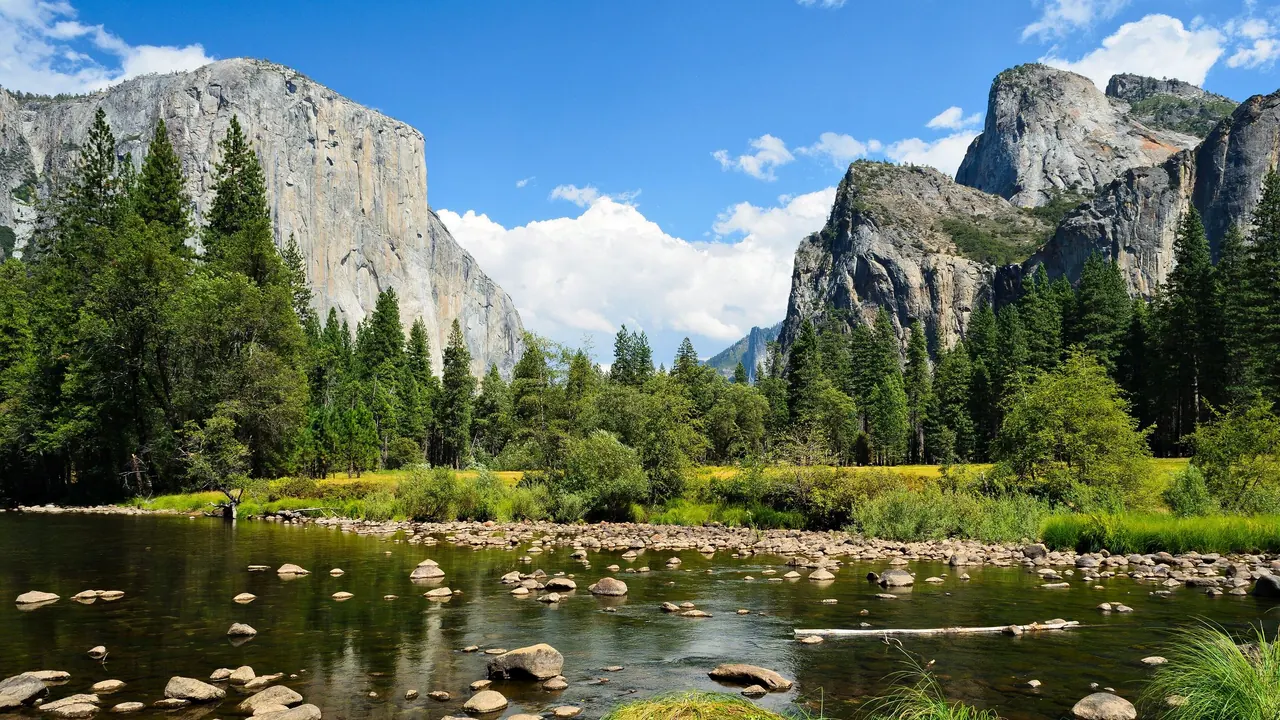
Photos: Arches by Jan Tang, Pexels License; Yosemite by King of Hearts, CC BY-SA 3.0, cropped.
Arches or Yosemite?
Our verdict in twelve categories, each scored against the same fixed benchmark cities, and the climate month by month, so you can choose for your trip.
Choose Arches for
- prices
- getting around
- food and drink
Arches suits travellers who want red-rock desert and plenty to do in it. The park road is short, Moab sits right at the gate, and from one motel or campsite you can walk to Delicate Arch at dawn, ride slickrock in the afternoon and look down into Canyonlands before dinner. It also stretches a budget a little further and has the livelier small town of the two, so it works well for active couples and friends who are happy to drive and come in spring or autumn.
Choose Yosemite for
- day trips
- beaches
- families
Yosemite is the better choice for families and for anyone drawn to granite cliffs, waterfalls and giant sequoias. The flat Valley floor, with its free shuttles and paved cycle paths, is gentler on children than Arches' exposed rock. In summer the high country, river pools and Gold Country towns add variety Arches cannot match. You pay for that in long drives between sights and in stiff competition for rooms and campsites.
Scoreboard
Twelve categories on one fixed scale from 0 to 100. The shaded stretch is the gap between the two.
Your match
Pick a travel style or drag the sliders, and both match scores follow your weighting.
Too close to call, 1 point apart
Wins on prices and getting around with your weighting.
Wins on day trips and beaches with your weighting.
What matters to you?
Category by category
What the scores mean for a trip.
Beaches & swimming
Neither is a swimming destination, but Yosemite at least gives you places to get in the water. In late summer the Merced forms calm pools and sandbars in the Valley, Tenaya Lake has a sandy shore in the high country and Bass Lake, just south of the park, works as a warm summer lake resort.
Around Arches the Colorado is cold, silty and fast, a river for rafts rather than bathers, so on a hot afternoon most visitors end up in the motel pool.
Food & drink
Arches eats better, mainly because everything is concentrated in Moab. Main Street has brewpubs, taco and burger places, Southwestern cooking with green chile and a few more ambitious dinner spots, all within walking distance. Utah's liquor rules make wine with dinner more awkward, though.
In Yosemite you mostly eat at lodge dining rooms, cafeterias and pizza counters, with the grand historic dining room in the Valley as the one memorable setting. Better choice lies in gateway towns such as Mariposa and Groveland, which pour Sierra foothill wines but are a drive away, and options thin out late in the evening.
Culture & sights
Both have little built heritage, and what each does have is quite different. At Arches it is far older: petroglyph and pictograph panels at Courthouse Wash, beside Wolfe Ranch and along Potash Road, plus a pioneer cabin and Moab's small museum of geology and dinosaurs.
Yosemite's heritage is the story of the national park itself. It has the timber-and-stone grand hotel, the Yosemite Museum's Miwok basketry and reconstructed village, Ansel Adams's photographs and the stagecoach-era buildings at Wawona. In both places this fills a few hours between hikes, not whole days.
Nightlife
Evenings are short in both, and the stars are the main event. Moab at least has a small town to go out in, with a few brewpubs and bars where climbers and bikers gather until well before midnight. In Yosemite a night out means a lodge lounge, a ranger talk or a campfire, and the gateway saloons sit far apart along winding roads.
Nature & outdoors
These are two of the great American landscapes, equal in stature but very different. Arches is sandstone desert: more than two thousand arches, fins and balanced rocks, with Canyonlands' drops into the Colorado and Green river canyons nearby and the La Sal Mountains behind. It is also a place to do things, with slickrock biking, rafting, canyoneering and tower climbing at Fisher Towers.
Yosemite is granite, water and forest. El Capitan and Half Dome rise above the Valley meadows, the falls thunder in late spring, the sequoias of Mariposa Grove stand to the south and Tuolumne's domes and alpine lakes open up in summer. Bears and deer are common, and winter adds gentle skiing at Badger Pass, which the desert cannot offer.
Day trips
Yosemite has much more to offer beyond its boundaries. To the west lies the Gold Country: Columbia's preserved gold-rush main street, Sonora and Jamestown's old storefronts and steam railway yard, and the wineries around Murphys. In summer, Tioga Pass opens the way to the ghost town of Bodie and to Mammoth Lakes.
From Moab almost every road leads into more wilderness. The river museum at Green River and the rock art and Puebloan ruins around Bluff make modest outings, while Mesa Verde and Monument Valley are really overnight trips.
Good for families
Yosemite is the more forgiving family trip. The flat Valley floor lets children cycle, run in meadows and walk to the foot of Lower Yosemite Fall, and the giant sequoias impress every age. Fast spring rivers and bears still need watching.
Arches works mainly for children old enough to scramble and carry water. Sand Dune Arch, the dinosaur tracks and gentle Colorado floats are highlights, but the summer heat, unfenced drops and lack of anything to do on a bad day make it harder going with toddlers. Both parks run a Junior Ranger programme.
Getting around
Arches is the simpler place to get around, provided you have a car. Moab is five minutes from the entrance, the park road runs only about 30km and Canyonlands is under an hour away, so the main challenge is reaching trailhead car parks before they fill mid-morning.
Yosemite offers what Arches cannot: a car-free trip, with regional buses from Merced's train station and free shuttles round the Valley. But Glacier Point, Mariposa Grove and Tuolumne are each an hour or more of winding road away, and Tioga Road is closed by snow for much of the year.
Shopping & style
Neither is a shopping trip, but Moab's Main Street gives you more to browse. It has serious bike and outdoor shops, rock and fossil dealers selling geodes, and galleries with Southwestern photography and Native American jewellery and pottery. In Yosemite you are limited to park stores, one long-standing landscape-print gallery in the Valley and a few antique shops in the gateway towns.
Affordability
Both charge gateway prices in season, but Arches is the easier one to do cheaply. Moab's motels and restaurants are dear in spring and autumn and you need a car, but plentiful public-land campgrounds along the river and free hiking keep the basics manageable. The spending comes with guided rafting, canyoneering and jeep tours.
Yosemite has very few rooms inside the park and they go early at high prices, food in the park costs more than it is worth, and its cheap campsites are hard to get. A winter visit or a base lower in the foothills is the way to save.
Live music & performing arts
The Moab Music Festival gives Arches the one performance worth timing a trip around. This long-established chamber music festival comes at the end of summer and takes some of its concerts out into the landscape, as far as a sandstone grotto on the Colorado that the audience reaches by boat. Outside the festival, music means a local band in a brewpub.
Yosemite has nothing to match that. Evenings bring ranger campfire talks and the odd one-person historical show in the Valley. Beyond the park there is a small repertory theatre in Sonora and summer concerts in the foothill towns, worth catching if you are passing but not worth the drive on their own.
Wellness & relaxation
Neither is a spa destination, but in summer Yosemite offers something Arches lacks: open-air hot springs around Bridgeport and Mammoth Lakes, beyond Tioga Pass, plus a couple of resort spas near the southern entrance. The catch is that the Valley in July feels more like a busy town than a retreat.
Arches has no hot springs and only a few small massage studios. Its rest comes from silence, in a quiet campsite evening as the light fades on the red cliffs.
When should you go?
Pick your month. The climate figures are measured averages, not a forecast.
Arches in July
Yosemite in July
Daytime high, °C
Rainfall in the month, mm
Where the figures come from
Arches has no rain gauge within 25 km of the centre, so its rainfall comes from a gridded climate dataset read at the destination rather than from a gauge further away.
Yosemite has no weather station within reach, so its figures come from a gridded climate model rather than a measured record, and read a broad area rather than one spot.
Temperature and rainfall are climate normals, averaged over the years shown. Arches: 2006-2020 (rainfall 1991-2020) normals, Moab / Crescent Junction (19.4 km from centre). Yosemite: 1991-2020 normals, TerraClimate 4 km grid at the town, no weather station within 90 km.
Arches is dry all year, with only light rain in any month, so the deciding factor is temperature. Spring and autumn are the seasons for hiking. By July the afternoons reach 35°C, which pushes walking into the early morning, and in midwinter highs hover around 2°C, though a dusting of snow on the arches has its own appeal.
Yosemite's year runs the other way. Winter is the wet season, with about 157mm in January, while summer is almost rainless and pleasantly warm at around 28°C in the main visitor area. Late spring brings the waterfalls at full strength, and June to September is the window for the high country and river swims. In midsummer, then, Yosemite is far more comfortable than the baking desert around Moab, and Arches is the better pick in the shoulder months, when Yosemite is still cool and wet.
Which traveller are you?
On a family trip with young children, Yosemite is the easier choice. The flat Valley floor has cycle paths, short walks to Lower Yosemite Fall and shallow river edges in late summer, whereas Arches suits only older children who can carry water and cope with heat and drops.
On a trip on a tight budget, Arches goes further. Public-land campgrounds along the Colorado and in the desert offer cheap nights, the hiking is free and the sights are close together. Yosemite's few in-park rooms sell out early and its campsites are hard to secure.
For mountain bikers, Arches is the obvious destination. The slickrock trails and benchland around Moab are among the best-known riding anywhere, and the town is full of bike shops. Yosemite's riding is mostly the Valley's paved paths, pleasant but no reason to travel.
Before you go
| Measure | Arches | Yosemite |
|---|---|---|
| Currency | US Dollar (USD) | US Dollar (USD) |
| Sockets | AB120 V, 60 Hz | AB120 V, 60 Hz |
| Driving side | Right | Right |
| Time zone | UTC-7, UTC-6 in summer | UTC-8, UTC-7 in summer |
| Emergency number | 911 | 911 |
| Main airport | Canyonlands Regional Airport (CNY)2 non-stop destinations | Fresno Yosemite International Airport (FAT)15 non-stop destinations |
| Public holidays this year | 12 days | 13 days |
Where else could you go?
Every comparison below shares a destination with this one, so you can follow Arches or Yosemite somewhere new.
- Canyonlandsvs Arches
- Kings Canyonvs Yosemite
- Sequoiavs Yosemite
- Bryce Canyonvs Arches
- Death Valleyvs Yosemite
- Zionvs Arches