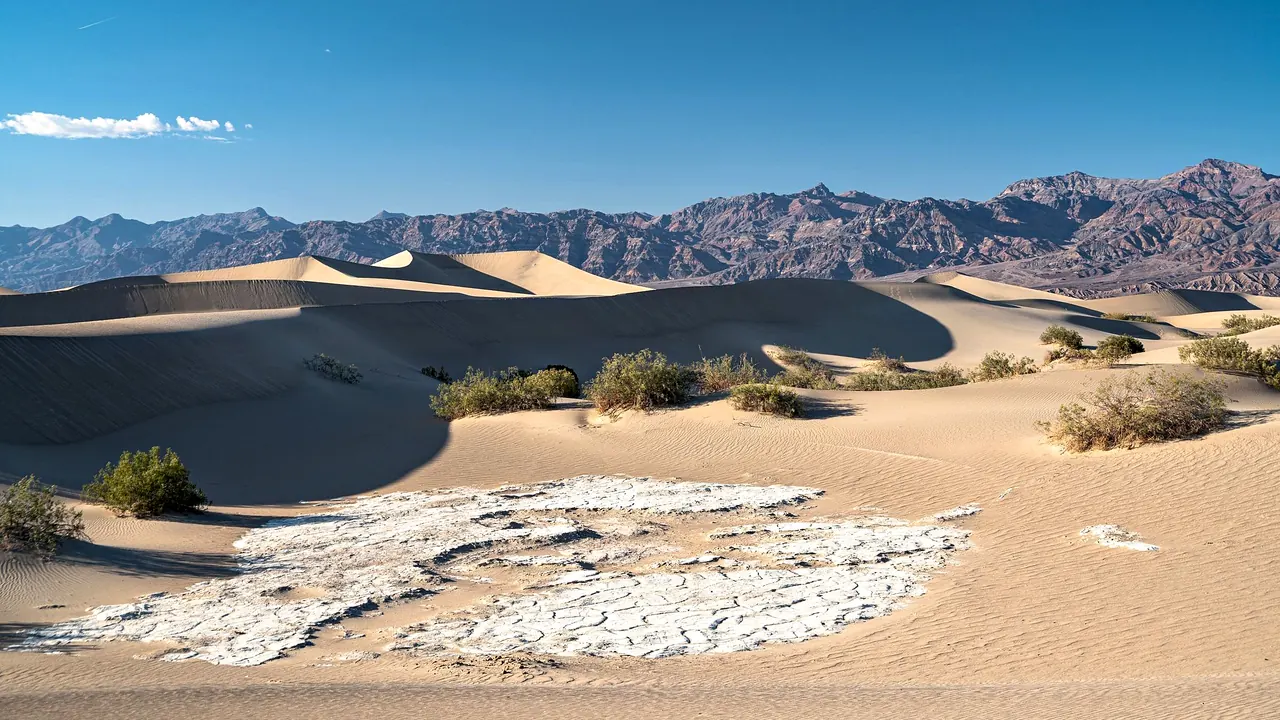
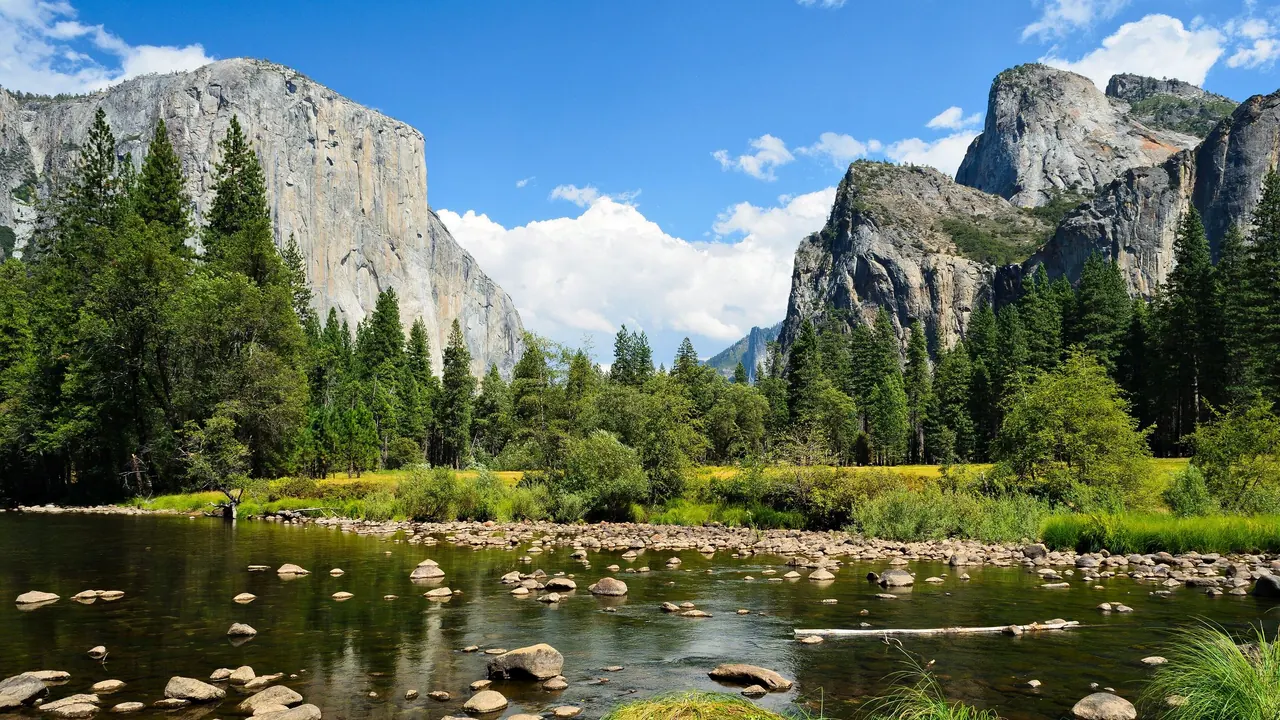
Photos: Death Valley by Anthony Brown, Pexels License; Yosemite by King of Hearts, CC BY-SA 3.0, cropped.
Death Valley or Yosemite?
Our verdict in twelve categories, each scored against the same fixed benchmark cities, and the climate month by month, so you can choose for your trip.
Choose Death Valley for
- wellness
- getting around
- prices
Death Valley suits a winter road trip for travellers who want space, silence and strange geology more than greenery. Salt flats below sea level, badlands, dunes and volcanic craters are linked by long empty drives, and the evenings end in a warm spring-fed pool or a hot-spring soak at Tecopa under a very dark sky. It asks for a car, a full tank and a cool box, and it rewards people who are happy with their own company.
Choose Yosemite for
- families
- beaches
- nature and the outdoors
Yosemite is the stronger pick for hikers, climbers and families who want a mountain vacation built around granite walls, waterfalls and giant sequoias. The flat Valley floor with its shuttles and cycle paths makes it far easier with children, and the summer high country around Tuolumne opens up lakes and long trails. The cost is crowds in peak season and a short window for the eastern side, when Tioga Road is open.
Scoreboard
Twelve categories on one fixed scale from 0 to 100. The shaded stretch is the gap between the two.
Your match
Pick a travel style or drag the sliders, and both match scores follow your weighting.
Wins on wellness and getting around with your weighting.
Wins on families and beaches with your weighting.
What matters to you?
Category by category
What the scores mean for a trip.
Beaches & swimming
Neither is a swimming destination, but Yosemite at least has water. In late summer the Merced River slows into wadeable pools and sandbars, Tenaya Lake has a sandy shore with icy water, and Bass Lake just south of the park feels like a proper summer lake resort.
Death Valley has no open water at all. The only swim is in the spring-fed pools at Furnace Creek, kept for guests, so it is a dip after driving rather than any kind of beach.
Food & drink
Eating is practical in both, and Yosemite offers a little more choice. Death Valley comes down to lodge dining rooms and saloons at Furnace Creek, Stovepipe Wells and Panamint Springs, diners in Beatty and Shoshone, and date shakes from the farm near Tecopa.
Yosemite adds a grand historic dining room in the Valley and gateway towns such as Mariposa, Groveland and Oakhurst with barbecue, Mexican cooking and Sierra foothill wines. In both, a cool box or a campsite picnic is often the best meal.
Culture & sights
Neither is a place to plan around sights, and the heritage differs in theme. Death Valley tells a story of mining and survival, from the borax ruins at Harmony Borax Works and the beehive charcoal kilns at Wildrose to abandoned camps along back roads.
Yosemite's story is about the national parks and conservation: rustic early twentieth-century architecture, the Yosemite Museum's Miwok basketry, Ansel Adams's photographs and the stagecoach-era buildings at Wawona.
Nightlife
There is no nightlife in either, just a beer in a Furnace Creek or Stovepipe Wells saloon, or a lodge lounge, ranger talk or campfire in Yosemite. The night belongs to the sky, and Death Valley's winter darkness, deep enough for the Milky Way to cast shadows, is the more striking.
Nature & outdoors
Both are among the great landscapes of America, and Yosemite is the more complete one. Its sheer granite walls, waterfalls at their peak from April to June, giant sequoias and alpine meadows on Tioga Road offer hiking, climbing, wildlife and even gentle winter skiing at Badger Pass.
Death Valley is barer and stranger: the salt polygons of Badwater 86m below sea level, the badlands of Zabriskie Point, the Mesquite Flat dunes and the Ubehebe crater. It is superb for winter hiking, but there is no water and much of the best ground needs a high-clearance vehicle.
Day trips
Most days in both are spent inside the park, but Yosemite's surroundings give more to fill a spare day. The Gold Country to the west has Columbia's preserved main street, the steam railway yard at Jamestown and wineries around Murphys, and in summer Bodie and Mammoth Lakes lie over Tioga Pass.
Death Valley's outings are fewer and further apart: the ghost town of Rhyolite near Beatty, the hamlets of Tecopa and Shoshone, and Lone Pine and Manzanar about two hours west.
Good for families
Yosemite is the far easier family trip. Flat Valley paths, short waterfall walks, meadows, shallow river edges in late summer and the sequoia groves give children plenty to do, though cliffs, spring rivers and bears need watching.
Death Valley suits only adventurous older children, sliding down the Stovepipe Wells dunes and crunching across the salt at Badwater in winter. The long drives, few shops and serious heat outside the cool months make it hard with young ones.
Getting around
Both are car country, in different ways. Yosemite Valley itself can be done without a car, with free shuttles, bike paths and a regional bus from Merced, but Glacier Point, Mariposa Grove and Tuolumne are long winding drives and summer brings entrance queues and full car parks.
Death Valley has no public transport at all, but its paved roads are quiet and easy, with no queues. The challenges are distance, sparse fuel and the rough dirt tracks to the Racetrack and Titus Canyon.
Shopping & style
There is next to nothing to buy in either. Death Valley offers borax souvenirs and Tecopa dates, while Yosemite adds a Valley gallery of fine-art landscape prints and a few antique and craft shops in the gateway towns.
Affordability
Both are costly to stay in and cheap to camp in, and the cost runs much the same. Death Valley's few lodges charge remote-resort rates and its fuel is dear, so the savings come from camping or driving in from Beatty or Pahrump.
Yosemite's rooms sell out early in summer, and its cheap campsites are hard to book. A winter visit or a base in the foothills brings costs down.
Live music & performing arts
Neither has a real stage scene, but Death Valley has one memorable building. The little adobe Amargosa Opera House at Death Valley Junction, its walls painted with an imaginary audience, is worth a stop even without a show. Yosemite offers ranger talks and the odd historical performance, plus a small repertory theatre in Sonora.
Wellness & relaxation
Death Valley gives the more deliberate kind of rest, and it is a winter one. Here rest means warm water in cool desert air: a soak at Furnace Creek after a day out on the salt flats, or an evening drive south to Tecopa for plain mineral pools in a hamlet that hardly stirs. The calm comes from the emptiness around the water. Still, the sights are far apart, so even a lazy stay involves hours at the wheel.
In Yosemite you rest by walking, not by bathing, and the best season depends on where you go. In summer the peace is up in the Tuolumne meadows and lakes, well away from the Valley floor, and the open-air soaks near Bridgeport and Mammoth Lakes make a day out over Tioga Pass. In winter the Valley under snow becomes quiet itself, but then the only pampering on offer is a spa treatment at a resort hotel near the southern entrance.
When should you go?
Pick your month. The climate figures are measured averages, not a forecast.
Death Valley in July
Yosemite in July
Daytime high, °C
Rainfall in the month, mm
Where the figures come from
Death Valley has no weather station within reach, so its figures come from a gridded climate model rather than a measured record, and read a broad area rather than one spot.
Yosemite has no weather station within reach, so its figures come from a gridded climate model rather than a measured record, and read a broad area rather than one spot.
Temperature and rainfall are climate normals, averaged over the years shown. Death Valley: 1991-2020 normals, TerraClimate 4 km grid at the town, no weather station within 90 km. Yosemite: 1991-2020 normals, TerraClimate 4 km grid at the town, no weather station within 90 km.
The two run on opposite calendars. Death Valley is at its best from November to March, when daytime highs sit around 18°C to 24°C, rain is almost absent and walking the canyons and dunes is comfortable. By May it is already hot, and from June to September the valley floor is dangerous for anything more than short stops from the car, with July highs around 46°C. Any time of year it stays very dry.
Yosemite comes into its own from June to September, when days are warm at about 28°C, rain nearly stops and the high country opens. Late spring brings the waterfalls at full strength, though it is still cool and fairly damp. From November to March it is cold and wet, with around 157mm of rain and snow in January, which suits snowshoeing and quiet Valley walks rather than long hikes. Put simply, go to Death Valley in winter and Yosemite in summer.
Which traveller are you?
On an outdoors trip, Yosemite has the edge for most people: classic day hikes such as the Mist Trail and Half Dome, big-wall climbing on El Capitan and summer backcountry from Tuolumne. Death Valley is the winter alternative, with desert canyons, dunes and salt flats instead of forest and water.
On a family trip with children, Yosemite is the easier choice. The flat Valley floor, paved cycle paths, short walks to Lower Yosemite Fall and the sequoias of Mariposa Grove keep children busy, while Death Valley's distances and heat make it work only for older, adventurous children in winter.
For a relaxing and wellness trip, Death Valley does better. Warm spring-fed pools at Furnace Creek, a resort spa and the rustic hot springs of Tecopa sit in deep desert quiet, whereas Yosemite's Valley can feel crowded in summer and its soaks lie beyond Tioga Pass.
Before you go
| Measure | Death Valley | Yosemite |
|---|---|---|
| Currency | US Dollar (USD) | US Dollar (USD) |
| Sockets | AB120 V, 60 Hz | AB120 V, 60 Hz |
| Driving side | Right | Right |
| Time zone | UTC-8, UTC-7 in summer | UTC-8, UTC-7 in summer |
| Emergency number | 911 | 911 |
| Main airport | Harry Reid International Airport (LAS)160 non-stop destinations | Fresno Yosemite International Airport (FAT)15 non-stop destinations |
| Public holidays this year | 13 days | 13 days |
Where else could you go?
Every comparison below shares a destination with this one, so you can follow Death Valley or Yosemite somewhere new.
- Kings Canyonvs Yosemite
- Sequoiavs Yosemite
- Sequoiavs Death Valley
- Kings Canyonvs Death Valley
- Joshua Treevs Death Valley
- Zionvs Death Valley