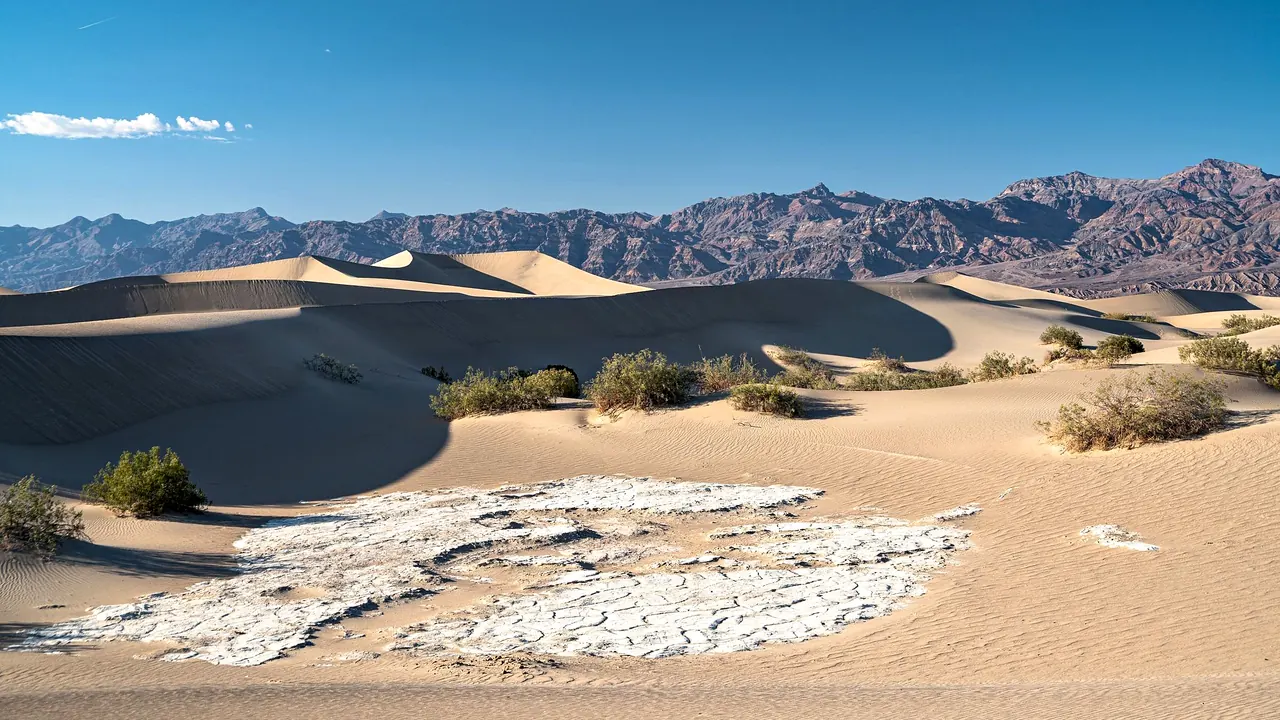
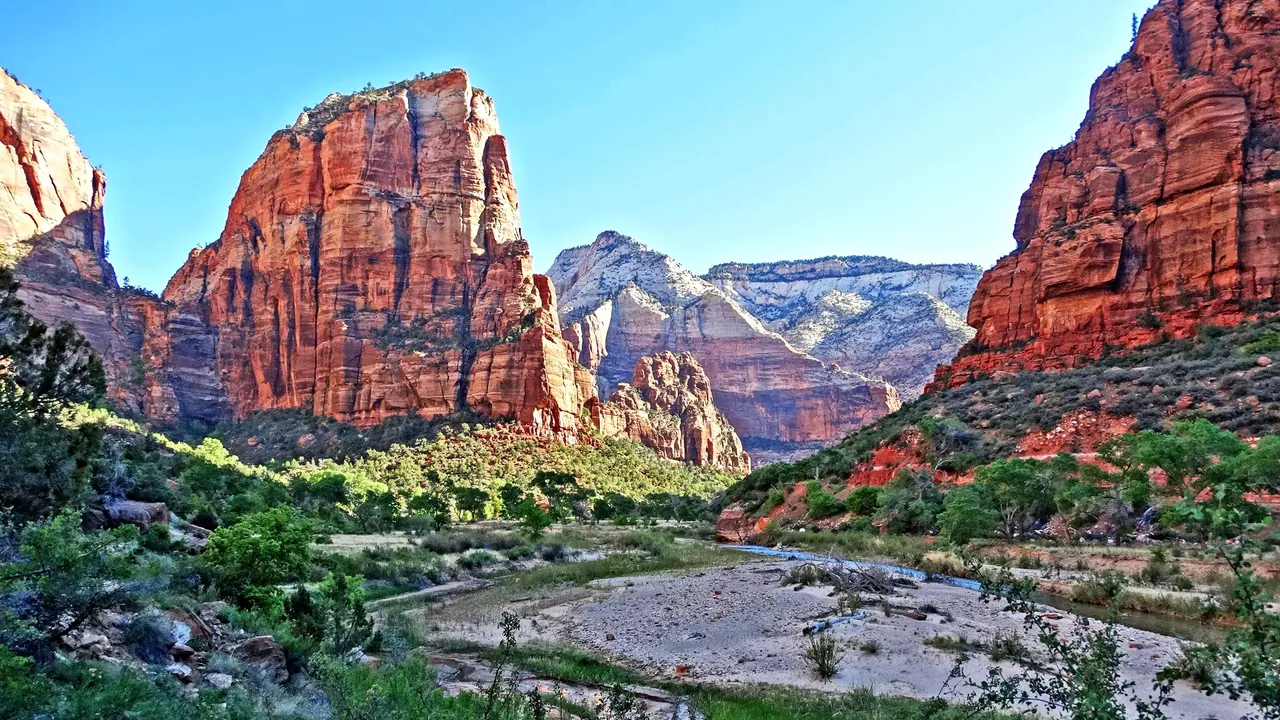
Photos: Death Valley by Anthony Brown, Pexels License; Zion by inkknife_2000 (7.5 million views +), CC BY-SA 2.0, cropped.
Death Valley or Zion?
Our verdict in twelve categories, each scored against the same fixed benchmark cities, and the climate month by month, so you can choose for your trip.
Choose Death Valley for
- wellness
Death Valley suits a traveller who wants the desert at its most extreme and can come in the cool months. Salt flats below sea level, badlands, dunes and a volcanic crater are spread across a vast park and linked by long, empty drives. The reward is space, silence, a hot-spring soak at Tecopa and some of the darkest skies in the country. In return it asks you to look after yourself: bring a car, keep the tank full and carry your own food.
Choose Zion for
- families
- live music and the arts
- beaches
For a first trip into canyon country, or one with children, Zion is the easier and fuller choice. Its famous hikes are close together, from the Narrows to Angels Landing, and a free shuttle does the driving in the main canyon. Springdale at the gate has places to eat and sleep. Summer evenings add real theatre at Tuacahn and the Shakespeare festival in Cedar City, which Death Valley cannot match.
Scoreboard
Twelve categories on one fixed scale from 0 to 100. The shaded stretch is the gap between the two.
Your match
Pick a travel style or drag the sliders, and both match scores follow your weighting.
Wins on wellness with your weighting.
Wins on families and live music and the arts with your weighting.
What matters to you?
Category by category
What the scores mean for a trip.
Beaches & swimming
Neither is a swimming destination, but Zion at least has somewhere to go. The reservoirs around Hurricane, half an hour from the park, are warm enough from June to September, and Sand Hollow's red-sand shore makes a proper afternoon of it.
Death Valley has no open water at all, only the spring-fed pools at Furnace Creek, which are for resort guests. The Virgin River in Zion is cold and only good for wading, so in both places most swimming happens in a hotel pool.
Food & drink
Food is basic in both, though Zion gives you more choice. Springdale's main road has burgers, pizza, Mexican and Southwestern cooking, cafés that open early and a couple of dining rooms with canyon views. St. George adds more places, if not more character, and Utah's liquor rules keep drinking low-key.
In Death Valley you eat in the lodge dining rooms and saloons at Furnace Creek, Stovepipe Wells and Panamint Springs, or at diners in towns such as Beatty. Its one local treat is dates from the farm near Tecopa. Packing a cool box before you drive in matters far more here than it does in Zion.
Culture & sights
Culture is a sideline in both, but the stories differ. Death Valley's history is industrial and harsh: the Harmony Borax Works of the twenty-mule teams, the Wildrose charcoal kilns and abandoned mining camps along the back roads. The Timbisha Shoshone still live in the valley.
Zion's story is about settlement and the park itself. The Human History Museum covers the Southern Paiute and the Mormon settlers, the 1930 tunnel has galleries cut through the cliff, and pioneer St. George has Brigham Young's winter home and dinosaur tracks. That gives Zion a little more for an afternoon off the trails.
Nightlife
There is no night out in either. Zion has a little more, with a couple of brewpub-style places in Springdale and a few bars in St. George, against two saloons in Death Valley that are quiet by mid-evening. In both places the night belongs to the sky, and Death Valley's is the more remarkable: on moonless winter nights the Milky Way is bright enough to cast shadows.
Nature & outdoors
Both are among the great landscapes of the American West, but Zion's is easier to walk into. Its sandstone walls rise up to 600m above the Virgin River, and hikes such as the Narrows, Angels Landing and Observation Point all start from one shuttle route. Kolob Canyons, the slickrock east side and slot-canyon canyoneering lie beyond, and the mild spring and autumn give a long hiking season.
Death Valley is wider and stranger. It has the salt polygons of Badwater 86m below sea level, a snow-capped Telescope Peak above, the badlands at Zabriskie Point, dunes, Ubehebe Crater and the moving rocks of the Racetrack. Much of the best of it needs a high-clearance vehicle and a winter visit.
Day trips
Neither is much of a base for day trips, and most time is spent inside the park. Death Valley's outings are about ruins and history: the ghost town of Rhyolite and the hot-spring hamlet of Tecopa, or Lone Pine and the Manzanar incarceration camp about two hours west. Las Vegas is about two hours east.
From Zion the pull is other landscapes rather than towns. Still, Kanab's film-set heritage, the ranch fort at Pipe Spring and the Grafton and Silver Reef ghost towns can fill a day. Las Vegas, two and a half hours away, is too far for an easy one.
Good for families
Zion is by far the easier place with children. The free shuttle, the flat Pa'rus Trail for bikes, paddling at the end of the Riverside Walk and the ranger programmes give younger children a full day away from cliff edges. Angels Landing is off limits, though, and midsummer is hard going.
Death Valley works mainly for older, adventurous children in winter: sliding down the dunes at Stovepipe Wells, crunching across the salt at Badwater and earning a Junior Ranger badge. The long drives, the lack of fuel and shops, and heat that is a real danger to small children outside the cool months make it a much harder choice.
Getting around
You need a car in both, but Zion takes much of the effort away. In the busy months the scenic drive is shuttle-only, with a free bus stopping at every trailhead and another linking Springdale's hotels to the entrance. The rest of the area is a short drive on good roads.
Death Valley has no public transport at all. Its sights are an hour or more apart, fuel stations are rare, and the Racetrack and Titus Canyon need a high-clearance vehicle. Both depend on Las Vegas for flights, about two hours from Furnace Creek, though Zion also has a smaller airport at St. George.
Shopping & style
Shopping in Death Valley means supplies: general stores, maps and books at the visitor centre and the lodge counters, and borax souvenirs. Anything more is best bought in Las Vegas or Pahrump on the way in.
Zion has a little more to browse. Springdale's outfitters rent dry suits and canyoneering gear for the Narrows, and its galleries sell landscape photography, Southwestern art and Native American jewellery and pottery, which make better keepsakes than anything sold in Death Valley. St. George adds malls and outlet stores, though nobody plans a trip around them.
Affordability
In Death Valley you save money by doing things yourself. The few lodgings at Furnace Creek and Stovepipe Wells charge what remote resorts charge, and fuel in the valley costs far more than outside it. The cheap trip is a park campground, food you bring with you and a tank filled before you drive in. Sleeping in Beatty or Pahrump also costs less, but it means long hours at the wheel every day.
Zion is the easier place to keep costs down. Springdale is expensive in season, but the shuttles are free, one park entry covers several days and the hiking costs nothing. Chain motels and supermarkets in Hurricane or St. George are only half an hour to an hour away, and winter is cheaper everywhere.
Live music & performing arts
Here Zion is well ahead, at least in summer. Tuacahn stages Broadway musicals in an outdoor amphitheatre against red cliffs near Ivins, and the Utah Shakespeare Festival in Cedar City runs a well-regarded repertory from summer into autumn. Springdale also has a small amphitheatre for concerts and films.
Death Valley has one stage, the Amargosa Opera House at Death Valley Junction, an adobe theatre with an audience painted on its walls. It puts on shows only now and then, and many visitors stop just to see the building.
Wellness & relaxation
The two offer different kinds of rest, and neither clearly beats the other. Death Valley's is about warm water in the cool season. At Furnace Creek, spring-fed pools stay warm all winter and there is a resort spa beside them. South at Tecopa, natural mineral springs feed plain soaking pools that are at their best after dark. Around them is a desert silence with almost no traffic, though the sights are so far apart that many days still end behind the wheel.
Zion has no hot springs, so its rest is something you book. Destination spa resorts near Ivins offer guided hikes, yoga and treatments among the red rock, and several Springdale lodges have pools facing the canyon walls. The main canyon is busy, so calm comes at either end of the day, with sunset on the cliffs and dark skies. Spring and autumn are the easiest months for it.
When should you go?
Pick your month. The climate figures are measured averages, not a forecast.
Death Valley in July
Zion in July
Daytime high, °C
Rainfall in the month, mm
Where the figures come from
Death Valley has no weather station within reach, so its figures come from a gridded climate model rather than a measured record, and read a broad area rather than one spot.
Zion's temperatures are measured 26 km from the centre, at Colorado City / Centennial Park.
Zion's station stands 298 m above the place it is measured for, so that place is likely a little warmer than the figures say.
Zion has no rain gauge within 25 km of the centre, so its rainfall comes from a gridded climate dataset read at the destination rather than from a gauge further away.
Temperature and rainfall are climate normals, averaged over the years shown. Death Valley: 1991-2020 normals, TerraClimate 4 km grid at the town, no weather station within 90 km. Zion: 2014-2025 (rainfall 1991-2020) normals, Colorado City / Centennial Park (25.5 km from centre).
Death Valley is a winter destination. From November to March the days are mild, around 19°C in January, and that is the season for hiking the canyons and dunes. By May it is too hot to walk far after mid-morning, and in July the average high is 46°C, which is dangerous rather than just uncomfortable. Rain barely matters at any time of year.
Zion keeps a different calendar. Spring and autumn are its best seasons, and April and October are pleasantly warm for long trails. Summer brings heat in the mid-30s on exposed routes, along with storms that can flood the Virgin River. Winter is cold, around 10°C by day, and much wetter than Death Valley, with snow possible in the canyons. The two fit together well: Death Valley in deep winter, Zion either side of summer, and neither at its best in July.
Which traveller are you?
On an outdoors trip, Zion edges it. Its trails are concentrated in one canyon and include world-famous routes such as the Narrows and Angels Landing, with slot-canyon canyoneering on top. Death Valley's desert is just as striking, but it is spread out and at its best only in winter.
On a family trip with young children, Zion is clearly better. The shuttle, the flat Pa'rus Trail and river paddling make easy days, while Death Valley's long distances, scarce services and dangerous heat suit only older, adventurous children in the cool months.
For a relaxing and wellness trip, Death Valley has the more distinctive offer. There are warm spring-fed pools at Furnace Creek and simple mineral soaks at Tecopa under the stars, all in deep winter quiet. Zion's red-rock spa resorts are more polished, but the park itself is crowded.
Before you go
| Measure | Death Valley | Zion |
|---|---|---|
| Currency | US Dollar (USD) | US Dollar (USD) |
| Sockets | AB120 V, 60 Hz | AB120 V, 60 Hz |
| Driving side | Right | Right |
| Time zone | UTC-8, UTC-7 in summer | UTC-7, UTC-6 in summer |
| Emergency number | 911 | 911 |
| Main airport | Harry Reid International Airport (LAS)160 non-stop destinations | Harry Reid International Airport (LAS)160 non-stop destinations |
| Public holidays this year | 13 days | 12 days |
Where else could you go?
Every comparison below shares a destination with this one, so you can follow Death Valley or Zion somewhere new.
- Bryce Canyonvs Zion
- Grand Canyonvs Zion
- Sequoiavs Death Valley
- Kings Canyonvs Death Valley
- Joshua Treevs Death Valley
- Yosemitevs Death Valley