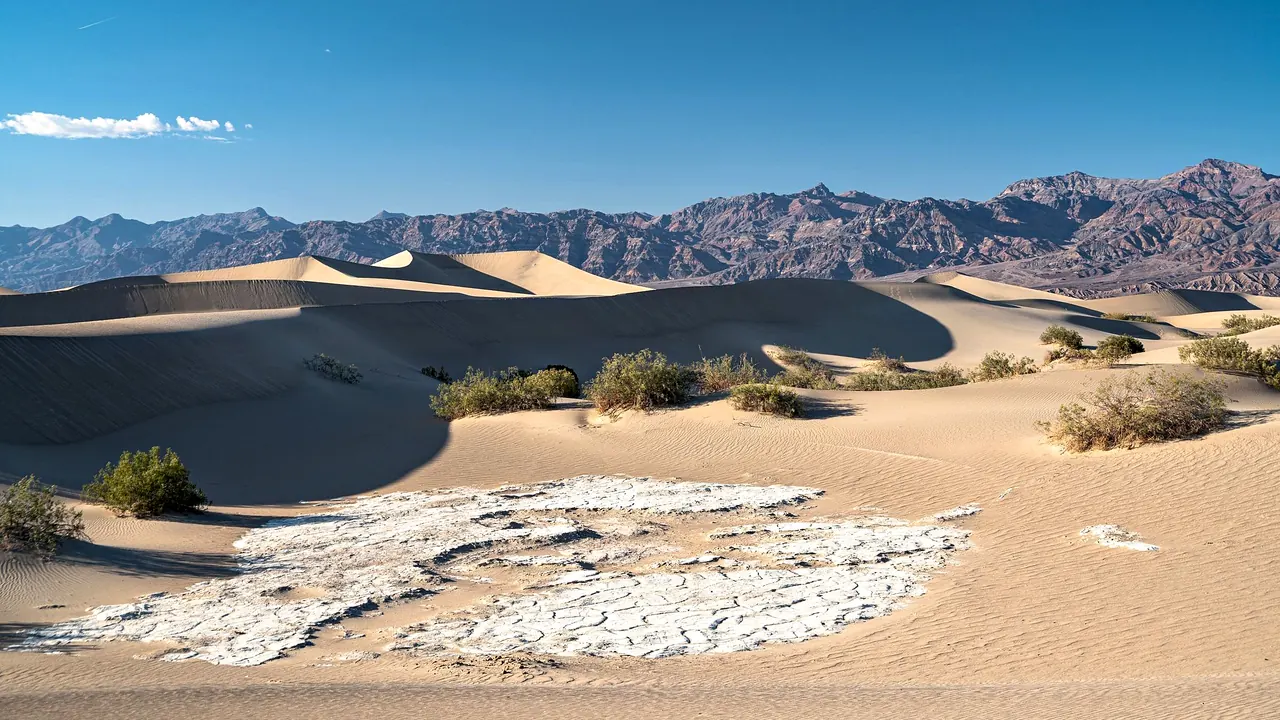
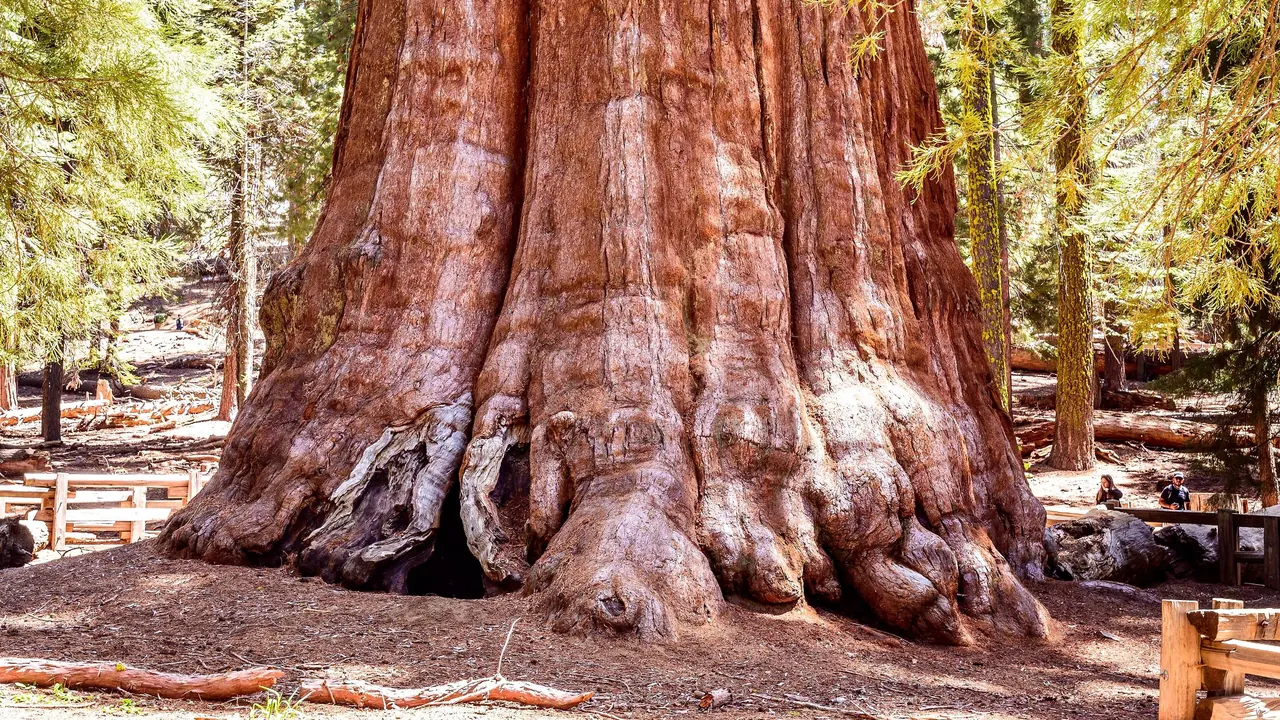
Photos: Death Valley by Anthony Brown, Pexels License; Sequoia by Domenico Convertini from Zurich, Schweiz, CC BY-SA 2.0, cropped.
Death Valley or Sequoia?
Our verdict in twelve categories, each scored against the same fixed benchmark cities, and the climate month by month, so you can choose for your trip.
Choose Death Valley for
- wellness
- getting around
- day trips
Death Valley is the winter choice for travellers who want desert on a grand scale: salt flats below sea level, golden badlands, dunes and marble canyons, most of them reached on quiet paved roads from a base at Furnace Creek. It rewards drivers and photographers, and anyone who likes to end a day of sightseeing in a warm spring-fed pool or a Tecopa hot spring under a very dark sky. Ghost towns such as Rhyolite and the run out to Lone Pine and Manzanar give you more to see beyond the park itself.
Choose Sequoia for
- families
- food and drink
- prices
Pick Sequoia for a summer trip on foot among the largest trees on earth, with granite high country above the groves and Kings Canyon falling away below them. It is the better place for families, whose children take to the short paved trails and the Tunnel Log straight away, and for travellers watching costs, because its pine-forest campgrounds are cheap and the valley towns cut the price of a room. The price is long mountain roads full of hairpins, and very little to do once the walking is over.
Scoreboard
Twelve categories on one fixed scale from 0 to 100. The shaded stretch is the gap between the two.
Your match
Pick a travel style or drag the sliders, and both match scores follow your weighting.
Wins on wellness and getting around with your weighting.
Wins on families and food and drink with your weighting.
What matters to you?
Category by category
What the scores mean for a trip.
Beaches & swimming
Neither is a swimming destination, but Sequoia at least has open water. In Death Valley the only swimming is in the spring-fed pools at Furnace Creek, and those are for resort guests. Sequoia has granite pools on the Kaweah around Three Rivers in late summer and the small sandy shore of Hume Lake in July and August, though its rivers run fast and icy in spring and early summer and call for real caution.
Food & drink
In both places you eat in lodge dining rooms and shop at general stores, so meals will be simple either way. Death Valley is the leaner of the two: saloon meals at Furnace Creek, Stovepipe Wells and Panamint Springs, diners in Beatty and Shoshone, and date shakes from the farm near Tecopa as the one local flavour.
Sequoia has more within reach. Three Rivers has a short row of casual places doing burgers, barbecue and Mexican plates. Down in the San Joaquin Valley you'll find summer fruit stands, taquerias in Visalia and Fresno, and Fresno's Armenian and Hmong cooking, which make a supply run something to look forward to.
Culture & sights
Neither is a place for museums, and both tell their human story through a handful of small sites. Death Valley's story is stark and industrial: the ruins of Harmony Borax Works, the beehive charcoal kilns at Wildrose and the abandoned mining camps along the back roads, with the history of the Timbisha Shoshone explained at Furnace Creek.
Sequoia's story is about the forest and the people who lived beneath it. The Giant Forest Museum tells of the fight to save the sequoias, Hospital Rock has Western Mono rock paintings, and the ranger-led tours of Crystal Cave are the nearest thing either place has to a classic sight.
Nightlife
Evenings end early in both, with a beer at a lodge saloon and then bed. What differs is what takes the place of a night out. In Death Valley it is the sky, one of the darkest in the country and at its best on moonless winter nights. Sequoia fills its evenings with ranger talks and campfires, and has a few bars in Visalia for anyone staying down in the valley.
Nature & outdoors
Both are among the great landscapes of the American West, and the choice is between desert and mountain. Death Valley is bare rock and light: the salt polygons of Badwater Basin below sea level, the badlands of Zabriskie Point, the dunes at Stovepipe Wells, Mosaic Canyon and the Ubehebe crater, with Telescope Peak snow-capped above it all in winter.
Sequoia is green and tall, a place you explore on foot rather than by car. The Giant Forest, the view from Moro Rock, the depths of Kings Canyon and the subalpine valley of Mineral King offer a wider range of hiking, from short grove loops to multi-day routes, with black bears and spring wildflowers along the way. The seasons are mirror images: Death Valley is for hiking in winter, Sequoia's high country for summer.
Day trips
Death Valley has the stronger list of places beyond its borders, though they are far apart. The ghost town of Rhyolite just over the Nevada line, the hot-spring hamlet of Tecopa, the old Western-film town of Lone Pine and the preserved incarceration camp at Manzanar each make a day out with a clear purpose, and Las Vegas is about two hours east.
Sequoia is surrounded by flat farmland, and its outings are quieter: Visalia's tree-lined old downtown, the hand-dug Forestiere Underground Gardens in Fresno, Hanford's old Chinese quarter and Colonel Allensworth State Historic Park. At either one, most days are still spent inside the parks.
Good for families
Sequoia is the easier place to bring children. The paved Big Trees Trail, the Tunnel Log and the General Sherman impress them without long walks, Crystal Cave and the ranger talks hold older children's attention, and Hume Lake is a gentle place to paddle in summer. The catches are the switchback roads that make children carsick, the drops on Moro Rock and the rivers in spring.
Death Valley works mainly for adventurous older children in winter, sliding down the dunes at Stovepipe Wells and crunching across the salt at Badwater, with Furnace Creek's pools as a base. Outside the cool months the heat is a real danger to small children, and with long distances and few shops or fuel stops, every outing has to be planned.
Getting around
You need a car in both, but Death Valley is the easier drive. Its main paved roads are quiet and reach Badwater, Zabriskie Point, Dante's View and the dunes without strain, though an hour or more between areas is normal, and back-country places such as the Racetrack need a high-clearance vehicle.
Sequoia's Generals Highway climbs through dozens of hairpins, long vehicles are restricted on its steepest stretch, and the roads to Cedar Grove and Mineral King close in winter, when chains are often needed. In its favour, a summer shuttle loops around the Giant Forest groves and a seasonal bus runs up from Visalia, which Death Valley has no answer to.
Shopping & style
Neither is a place to shop, and in both the choice runs to visitor-centre bookshops and lodge gift counters. What you take home is different: borax souvenirs and dates from the farm near Tecopa in Death Valley, and valley fruit or a piece from one of the small Three Rivers galleries in Sequoia.
Affordability
Death Valley is the dearer of the two. The park has so few beds that the lodges at Furnace Creek and Stovepipe Wells can set their prices like any isolated resort, and every tank of fuel bought inside the park adds to the bill. Camping and bringing your own food is the way round it. You can also sleep outside the park in the motel towns of Beatty or Pahrump, but they sit well away from the main sights, so whatever you save on the room you pay back in hours at the wheel.
Sequoia gives you more ways to spend less. A campsite under the pines costs about as little as a night anywhere in California, and once you have paid to enter, the groves and trails ask nothing more. Rooms are the catch: the park lodges fill early for summer and charge for it, and Three Rivers at the park gate is hardly any cheaper in high season. The real saving is further down in Visalia, a sizeable valley town with far more choice of rooms than Beatty or Pahrump, though every day then starts with the climb up the switchbacks.
Live music & performing arts
Live performance plays no real part in either trip. Death Valley's one stage, the Amargosa Opera House at Death Valley Junction, is worth a stop for its painted audience alone, even when nothing is on. In Sequoia the nearest thing is the rangers' campfire programme, though Visalia's restored Fox Theatre and Fresno's orchestra and historic theatres put on real concerts for anyone willing to drive down after dark.
Wellness & relaxation
Death Valley has the warm water that Sequoia lacks. The spring-fed pools at Furnace Creek stay warm through the winter and the resort there has a spa, while Tecopa's simple mineral hot springs are best at night under the stars. The long drives between sights, though, keep a stay from ever being truly slow.
Sequoia has no baths or real spas, only the odd massage in Three Rivers. Its kind of rest is quiet: a creekside cottage or a cabin near the Giant Forest, and silent mornings in the groves, best in late spring or September.
When should you go?
Pick your month. The climate figures are measured averages, not a forecast.
Death Valley in July
Sequoia in July
Daytime high, °C
Rainfall in the month, mm
Where the figures come from
Death Valley has no weather station within reach, so its figures come from a gridded climate model rather than a measured record, and read a broad area rather than one spot.
Sequoia has no weather station within reach, so its figures come from a gridded climate model rather than a measured record, and read a broad area rather than one spot.
Temperature and rainfall are climate normals, averaged over the years shown. Death Valley: 1991-2020 normals, TerraClimate 4 km grid at the town, no weather station within 90 km. Sequoia: 2001-2020 normals, NASA POWER reanalysis grid, no weather station within 90 km.
The two run on opposite calendars. Death Valley is a cool-season destination. On the valley floor around Furnace Creek, daytime highs from November to March are a comfortable 18°C to 27°C, and rain is almost absent all year. October and April are still workable. From May the heat builds quickly, and by July it reaches about 46°C, when walking after mid-morning is dangerous and the place is best avoided.
Sequoia is at its best in summer. Around the main visitor areas the winter is cold and wet, with about 90mm of rain in December and the high country snowbound, so only snowshoeing and quiet walks in the groves are left. From June to September it is dry and warm, peaking near 30°C in July, which suits hiking and, in late summer, a swim in the rivers or at Hume Lake. Late spring and September are the calmest times in the forest.
Which traveller are you?
On a family trip with children, Death Valley's heat and long distances suit only hardy older children, and only in winter. Sequoia is the safer bet, because the paved Big Trees Trail, the Tunnel Log and the General Sherman win children over quickly, and Crystal Cave and Hume Lake fill the gaps.
For a relaxing and wellness trip, Death Valley has the edge in the cool months because it has warm water: the guests' pools and spa at Furnace Creek and Tecopa's rustic hot springs under the stars. The bathing is modest, but Sequoia has only quiet cabins and groves.
On an outdoors trip, let the season decide. Death Valley is for winter hiking among dunes, badlands and canyons in mild weather. Sequoia is the summer choice, with giant sequoia groves, Kings Canyon and routes over high passes that are buried in snow all winter.
Before you go
| Measure | Death Valley | Sequoia |
|---|---|---|
| Currency | US Dollar (USD) | US Dollar (USD) |
| Sockets | AB120 V, 60 Hz | AB120 V, 60 Hz |
| Driving side | Right | Right |
| Time zone | UTC-8, UTC-7 in summer | UTC-8, UTC-7 in summer |
| Emergency number | 911 | 911 |
| Main airport | Harry Reid International Airport (LAS)160 non-stop destinations | Fresno Yosemite International Airport (FAT)15 non-stop destinations |
| Public holidays this year | 13 days | 13 days |
Where else could you go?
Every comparison below shares a destination with this one, so you can follow Death Valley or Sequoia somewhere new.
- Kings Canyonvs Sequoia
- Yosemitevs Sequoia
- Kings Canyonvs Death Valley
- Joshua Treevs Death Valley
- Yosemitevs Death Valley
- Zionvs Death Valley