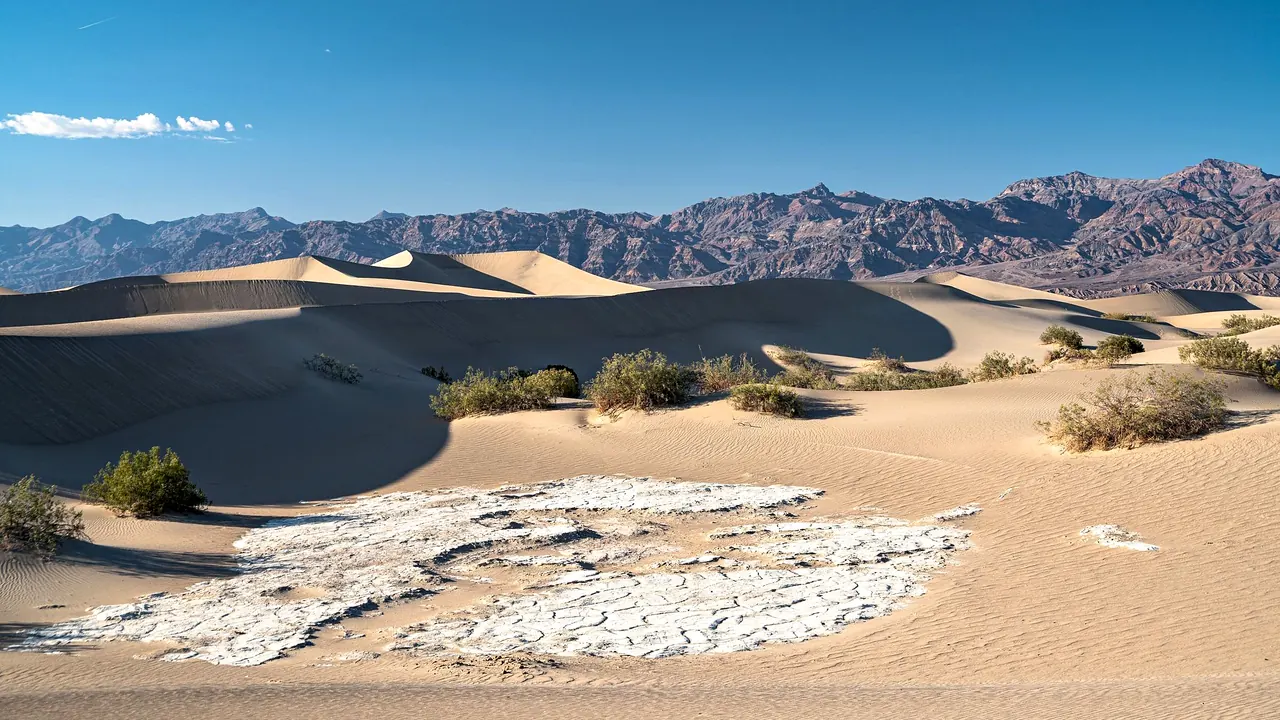
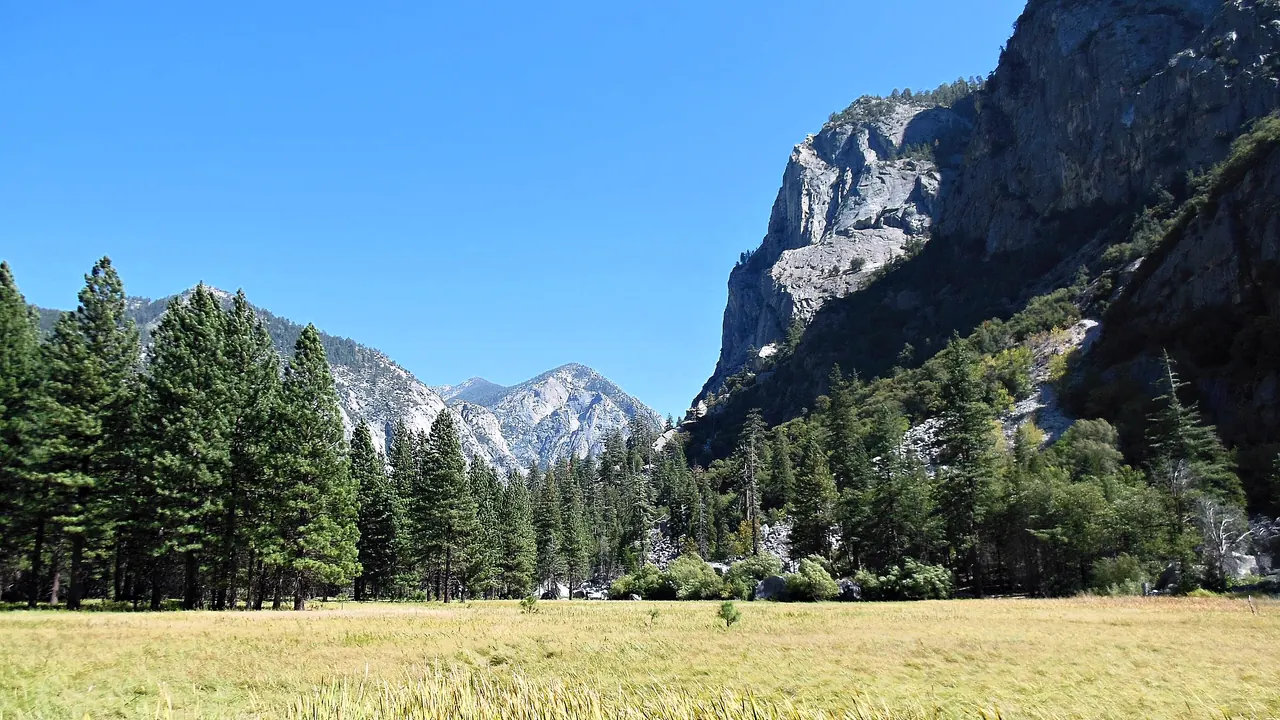
Photos: Death Valley by Anthony Brown, Pexels License; Kings Canyon by Schwaltz, CC BY-SA 3.0, cropped.
Death Valley or Kings Canyon?
Our verdict in twelve categories, each scored against the same fixed benchmark cities, and the climate month by month, so you can choose for your trip.
Choose Death Valley for
- wellness
- day trips
- getting around
Death Valley is a trip for the cool half of the year. From late autumn to early spring its salt flats, badlands and dunes are pleasant to walk, and you can end the day in the warm spring-fed pools at Furnace Creek or the hot springs at Tecopa. It suits travellers who like bare rock, big horizons and very dark skies, and who are happy to drive long stretches of quiet paved road. Las Vegas and a few ghost towns are within reach when you want a change.
Choose Kings Canyon for
- families
- prices
- beaches
If you want trees, granite and running water, and you're travelling in summer, Kings Canyon is the better choice. The giant sequoias of Grant Grove, the glacier-cut valley at Cedar Grove and the trails into the High Sierra make it the stronger pick for campers, families with young walkers and hikers heading for alpine lakes. It is also the cheaper of the two if you camp. The price is slower, twisting roads, very little to do outside the park, and a canyon road that closes for the winter.
Scoreboard
Twelve categories on one fixed scale from 0 to 100. The shaded stretch is the gap between the two.
Your match
Pick a travel style or drag the sliders, and both match scores follow your weighting.
Wins on wellness and day trips with your weighting.
Wins on families and prices with your weighting.
What matters to you?
Category by category
What the scores mean for a trip.
Beaches & swimming
Neither park is a swimming destination, but Kings Canyon at least has natural water. By late summer the Kings River slows and pools such as Muir Rock at Cedar Grove make a cold dip after a hike, and Hume Lake has a small sandy shore with calmer water. Take the river seriously, though, because it runs fast and dangerous during the snowmelt.
Death Valley has no open water at all. Its old lakebeds are dry salt, so your only swim is in the spring-fed pools at Furnace Creek, and only if you stay there as a guest.
Food & drink
You eat simply in both, and most visitors bring a cool box and stock up before driving in. Death Valley has a little more local character. There are saloons and lodge dining rooms at Furnace Creek, Stovepipe Wells and Panamint Springs, diners in Beatty and Shoshone, and dates from the farm near Tecopa in shakes and bread.
Kings Canyon gives you grills and small markets at Grant Grove, Cedar Grove and Hume Lake, serving burgers and breakfast plates with summer queues. For a proper meal you have to drive more than an hour down to Fresno for its Mexican, Hmong and Armenian cooking.
Culture & sights
Death Valley has the more interesting human story, built around borax mining and survival in the desert. The ruins of Harmony Borax Works, home of the twenty-mule teams, stand beside the salt flats, the beehive charcoal kilns at Wildrose are remarkably intact, and the visitor centre tells the story of the Timbisha Shoshone, who still live in the valley.
In Kings Canyon the heritage comes mostly from the trees. The General Grant Tree serves as the Nation's Christmas Tree and a shrine to war dead, and a few logging-era cabins and the Big Stump area recall the loggers and homesteaders. In neither park will history fill more than an afternoon.
Nightlife
Neither has any nightlife to speak of, and both make up for it with the sky. In Death Valley you can have a beer in the saloons at Stovepipe Wells or Furnace Creek, then step out into long, dark winter nights when the Milky Way is bright enough to cast shadows. Evenings in Kings Canyon are summer ones, spent round the campfire under the sequoias, and the lodges go quiet soon after dark.
Nature & outdoors
Both are outstanding, but they are opposite kinds of landscape. Death Valley is bare desert on a huge scale. You can go from the salt polygons of Badwater Basin, below sea level, to the golden badlands of Zabriskie Point, the Mesquite Flat dunes, the marble narrows of Mosaic Canyon and the Ubehebe crater, with snow on Telescope Peak above it all in winter. Many of the best places, the Racetrack among them, are reached only on rough dirt roads.
Kings Canyon is forest, granite and water. Grant Grove holds some of the largest giant sequoias on earth, and the glacier-carved valley at Cedar Grove has easy walks round Zumwalt Meadow and to Roaring River Falls, with the longer climb to Mist Falls for a fuller day. Beyond the road's end lie the High Sierra, the Rae Lakes Loop and alpine passes where black bears roam, along with the rivers and lakes that Death Valley lacks entirely.
Day trips
Death Valley has more to see outside the park. Over the Nevada line, the ruined bank and bottle house of Rhyolite make a striking ghost town, and Tecopa and Shoshone lie to the south. To the west, about two hours away, are Lone Pine and the sobering Manzanar camp, and Las Vegas is a similar distance east.
Below Kings Canyon there is little beyond the hand-dug Forestiere Underground Gardens in Fresno and the foothill galleries of Three Rivers. Yosemite is too far for a comfortable day out, so you'll spend almost every day in the mountains.
Good for families
Kings Canyon is gentler on young families. The paved path round the General Grant Tree, the Zumwalt Meadow boardwalk and the short walk to Roaring River Falls suit small legs, and the campgrounds and cabins at Grant Grove make an easy base. The winding canyon road can upset children who get travel-sick, and the river needs close watching.
Death Valley works better for older children who like adventure, sliding down the Stovepipe Wells dunes and crunching across the Badwater salt. Go in winter, when it is safe for them, and stay at Furnace Creek for the pools. Outside the cool months the heat is a genuine danger to small children.
Getting around
You need a car for both, but Death Valley is the easier drive. It is about two hours from the Las Vegas airport, and the quiet paved roads reach Badwater, Zabriskie Point, Dante's View and the dunes without much effort. Distances inside are long, fuel is scarce, and the Racetrack and Titus Canyon need a high-clearance vehicle.
Getting to Kings Canyon takes more effort. It is an hour and a half from Fresno to Grant Grove, then about another hour of switchbacks down to Cedar Grove, and linking with Sequoia means the slow Generals Highway. The canyon road closes in winter, but once you've parked, the trailheads are within walking distance of the lodges and campgrounds.
Shopping & style
You'll find little to buy in either beyond supplies, so stock up before you arrive, in Las Vegas or Pahrump for Death Valley and in the Central Valley for Kings Canyon. The souvenirs reflect each park: borax keepsakes and Tecopa dates in one, sequoia-themed gifts, firewood and camping basics in the other.
Affordability
Kings Canyon is the cheaper trip. Camping costs little, and a single vehicle pass covers the park and Sequoia National Park next door. The few lodges and the small markets still charge mountain prices, so it is campers who save most.
In Death Valley, the handful of rooms at Furnace Creek and Stovepipe Wells cost what remote resorts charge, and fuel in the valley is far dearer than outside. Campgrounds and food brought from outside keep costs down. Motels in Beatty or Pahrump are cheaper, but you'll spend long hours driving in each day.
Live music & performing arts
Neither is a place for shows. Death Valley at least has one memorable stage, the small adobe Amargosa Opera House at Death Valley Junction, with an imagined audience painted on its walls and occasional performances, and many people stop just to see the building. In Kings Canyon the nearest thing to a performance is a summer ranger talk on bears or night skies at a campground amphitheatre.
Wellness & relaxation
Death Valley is far better for a soak. The spring-fed pools at Furnace Creek stay warm through the winter and there is a resort spa, while Tecopa's simple mineral pools are at their best under the stars. The long drives between sights do keep a stay busier than it sounds.
Kings Canyon offers rest of a different kind: still mornings under the sequoias of Grant Grove, the river at Cedar Grove in the evening, and almost no phone signal. There are no spas, baths or hot springs, so it suits people who want to switch off rather than be pampered.
When should you go?
Pick your month. The climate figures are measured averages, not a forecast.
Death Valley in July
Kings Canyon in July
Daytime high, °C
Rainfall in the month, mm
Where the figures come from
Death Valley has no weather station within reach, so its figures come from a gridded climate model rather than a measured record, and read a broad area rather than one spot.
Kings Canyon has no weather station within reach, so its figures come from a gridded climate model rather than a measured record, and read a broad area rather than one spot.
Temperature and rainfall are climate normals, averaged over the years shown. Death Valley: 1991-2020 normals, TerraClimate 4 km grid at the town, no weather station within 90 km. Kings Canyon: 2001-2020 normals, NASA POWER reanalysis grid, no weather station within 90 km.
The two parks peak at opposite ends of the year. Death Valley is a winter destination. Daytime highs are around 19°C in January, and the months from November to March are ideal for hiking the canyons and dunes. By May the heat is already hard going, and in July highs reach 46°C, too hot to walk safely after mid-morning. Rain is close to nil all year, so the season depends on the heat, not the weather.
Kings Canyon works the other way round. Winter there is cold and wet, with highs in single figures and about 90mm of rain in December, much of it falling as snow higher up, and the canyon road is closed from roughly November until spring. From June to September it is dry, with highs near 30°C at the measuring point. That is good weather for the trails and for a cold dip in the river. Spring and autumn are milder and quieter, but expect rain at both ends of the season.
Which traveller are you?
On a family trip with young children, Kings Canyon is the easier choice. The paved loop round the General Grant Tree, the boardwalk at Zumwalt Meadow and campfires under the sequoias all suit small legs. In Death Valley the heat and long distances make things harder.
For a relaxing and wellness trip, Death Valley comes out ahead. The spring-fed pools and spa at Furnace Creek and the simple mineral soaks at Tecopa give it real warm water. Kings Canyon offers deep quiet and no phone signal, but it has no baths or treatments.
On a trip on a tight budget, Kings Canyon goes further. Camping is cheap, and one vehicle pass also covers neighbouring Sequoia. Death Valley's few lodges charge remote-resort rates and fuel in the valley is dear, so it only stays cheap if you camp.
Before you go
| Measure | Death Valley | Kings Canyon |
|---|---|---|
| Currency | US Dollar (USD) | US Dollar (USD) |
| Sockets | AB120 V, 60 Hz | AB120 V, 60 Hz |
| Driving side | Right | Right |
| Time zone | UTC-8, UTC-7 in summer | UTC-8, UTC-7 in summer |
| Emergency number | 911 | 911 |
| Main airport | Harry Reid International Airport (LAS)160 non-stop destinations | Fresno Yosemite International Airport (FAT)15 non-stop destinations |
| Public holidays this year | 13 days | 13 days |
Where else could you go?
Every comparison below shares a destination with this one, so you can follow Death Valley or Kings Canyon somewhere new.
- Sequoiavs Kings Canyon
- Yosemitevs Kings Canyon
- Sequoiavs Death Valley
- Joshua Treevs Death Valley
- Yosemitevs Death Valley
- Zionvs Death Valley