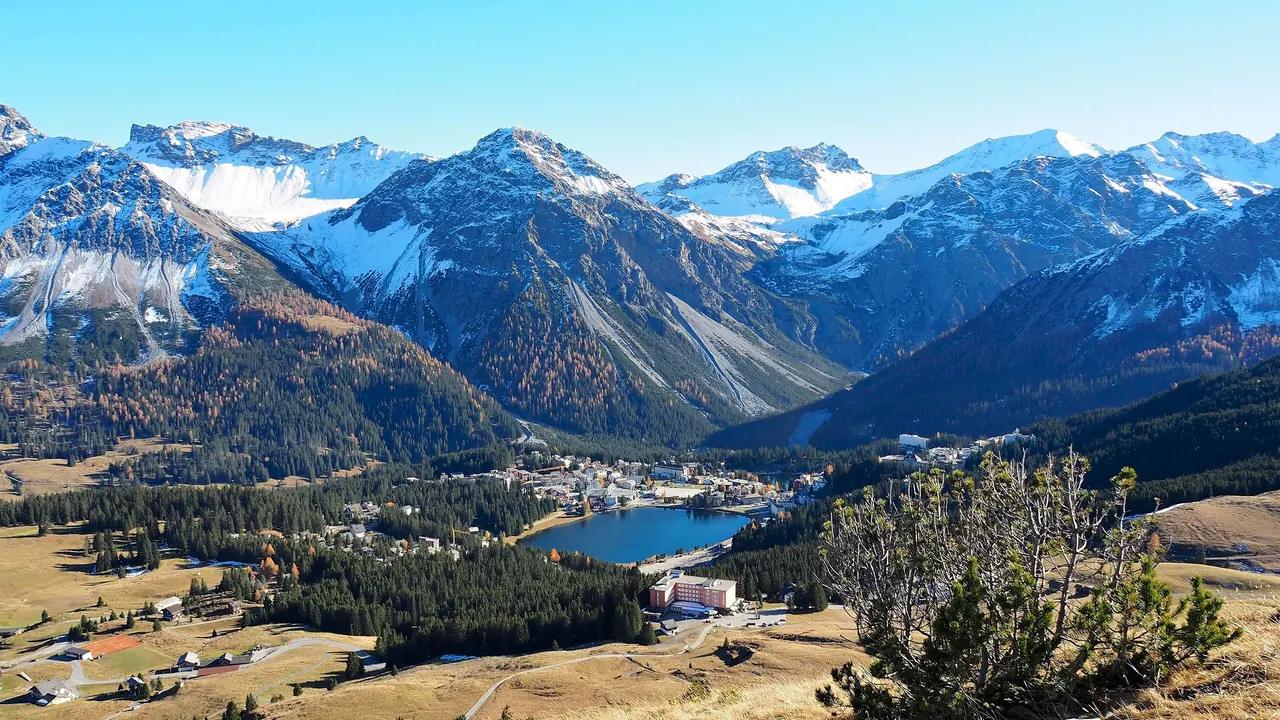
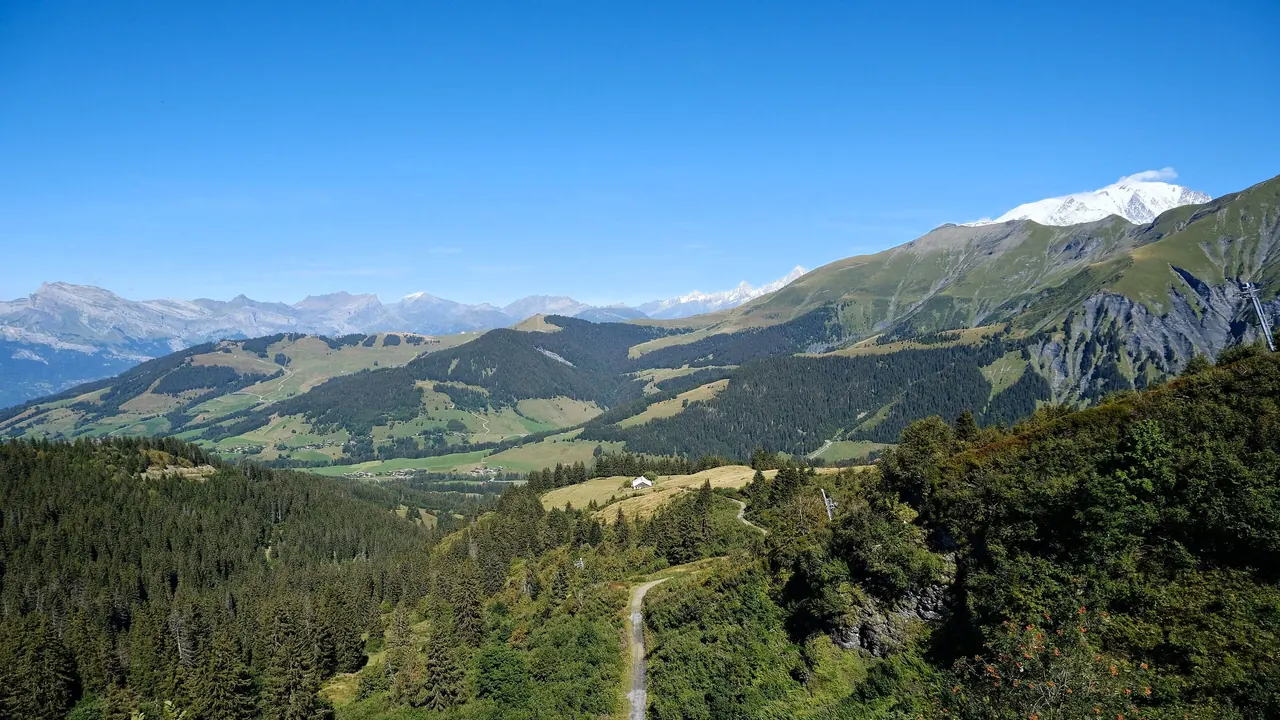
Photos: Arosa by Andres Passwirth, CC BY-SA 4.0, cropped; Megève by Guilhem Vellut, CC BY 2.0, cropped.
Arosa or Megève?
Our verdict in twelve categories, each scored against the same fixed benchmark cities, and the climate month by month, so you can choose for your trip.
Choose Arosa for
- getting around
- live music and the arts
- families
Arosa suits travellers who want a high, self-contained mountain stay with no car. The train climbs up from Chur, free buses and lifts do the rest, and at 1,800m the snow is dependable through the winter. It is the quieter of the two. Expect early nights, walks by the lake and a calendar built around a December comedy festival and summer chamber concerts. Choose it for skiing or hiking straight from the door and a calm that the grander resorts rarely offer.
Choose Megève for
- day trips
- shopping
- food and drink
Megève is the better pick for those who care as much about the table and the town as about the slopes. Its Michelin-starred kitchens, cobbled boutique lanes and Mont Blanc views give it more polish, and with a car it opens up Chamonix, Annecy, Geneva and Aosta. The trade-off is lower, less certain snow at the bottom of the pistes and a stay that depends on driving once you leave the village.
Scoreboard
Twelve categories on one fixed scale from 0 to 100. The shaded stretch is the gap between the two.
Your match
Pick a travel style or drag the sliders, and both match scores follow your weighting.
Wins on getting around and live music and the arts with your weighting.
Wins on day trips and shopping with your weighting.
What matters to you?
Category by category
What the scores mean for a trip.
Beaches & swimming
Neither village is a swimming destination, and the difference is in where the water is. Arosa has its lakes right in the resort: the Untersee lido with its lawn and jetty, and the colder Obersee and Schwellisee above it, all bracing even in August.
Megève has to look further. Its natural bathing ponds sit in the neighbouring valleys, and in the village the Palais pools stand in for them. The warmer, clearer swim is at Lake Annecy, about an hour's drive away.
Food & drink
Megève eats far better. Savoyard cooking such as tartiflette, diots and Reblochon is only the base. Above it sits a cluster of Michelin-starred kitchens in the village and on Mont d'Arbois, rare for a resort this size.
Arosa's best meals are on the hut terraces: capuns, barley soup and Graubünden dried meat with a valley view. Beyond those and a few luxury-hotel dining rooms, the choice narrows to fondue and raclette. Both villages lack cheap food, and both have kitchens that close out of season.
Culture & sights
Arosa's sights tell the story of a health resort. The shingled Bergkirchli has stood alone on its meadow since the late Middle Ages, and the valley museum recalls the sanatoriums where tuberculosis patients came for the thin, dry air. A few grand old hotels survive from that era.
Megève's past shows in its streets and buildings. There is the medieval layout around Saint-Jean-Baptiste and the clock tower, the chapels of the Calvaire climbing the hillside, and the interwar chalets of Henry Jacques Le Même that made it the model of the elegant Alpine resort. Neither has a major museum, and you can see either one in a morning or an afternoon.
Nightlife
Megève offers more after dark, though neither is a party resort. Its evenings move from terrace après-ski to fireside hotel bars, piano and wine bars in the cobbled centre, and a couple of late clubs in the peak weeks. An older, well-off crowd lingers over long dinners.
Arosa's going out is thinner and even more seasonal. It has slope-side après-ski, a few hotel bars and small weekend clubs, and its liveliest week of the year comes in January with the long-running gay ski week. In summer both go quiet, Arosa more so.
Nature & outdoors
Both are first-rate mountain bases, with different strengths. Arosa is higher, at 1,800m under the Weisshorn, so its snow is reliable, and the lift link to Lenzerheide makes one of Graubünden's larger ski areas. In summer it has lake circuits, pass routes toward Davos, marmots and the bear sanctuary, all within a closed valley.
Megève's draw is the Mont Blanc massif in full view and the wide wooded runs of the Évasion Mont-Blanc area, loved by intermediates, though snow at the lower slopes varies. Summer adds paragliding and golf, and the glaciers of Chamonix and Saint-Gervais are less than an hour away.
Day trips
Every outing from Arosa starts with the hour-long train ride down the Schanfigg gorges to Chur, and Chur's old town, Romanesque cathedral and Bündner art museum make a good day out. Maienfeld's vineyards and Vaduz in Liechtenstein are a short way further on. The Albula line to St. Moritz, or Davos and Klosters, means two hours or more each way.
Megève has far more within reach. Chamonix is about forty minutes away, and Annecy's canals and lake, or a city day in Geneva, take about an hour. Through the Mont Blanc tunnel, Courmayeur and Roman Aosta add Italy to the list. Most of these trips need a car.
Good for families
Both work well for a family mountain stay. Arosa's extras are the bear sanctuary, the lake playgrounds and cable cars that put high viewpoints within reach of small legs, with free buses for tired children.
Megève counters with a car-free centre, ski kindergartens, sleigh and pony rides, and the Palais with its pools and climbing wall. Neither has zoos or big attractions, rainy days are hard in both, and both cost a lot as a family.
Getting around
Arosa is far easier without a car. The Rhaetian Railway brings you up from Chur, and free buses link the station, the lake and the lifts. The village's slopes and stairs are the only real effort, though every onward trip runs back down the single line.
Megève's car-free centre is walkable in minutes, but it has no station of its own. You need a bus or taxi from Sallanches, many chalets sit up steep hillside roads, and summer shuttles are sparse, so most visitors end up renting a car.
Shopping & style
Megève is a real shopping village in miniature, with designer ski-wear, cashmere, jewellers and galleries of antler lamps and old wood around the church. Its cheese and charcuterie shops are worth a visit too.
Arosa's main street sells ski gear, rentals, a few boutiques and chocolate, and little else. Anyone wanting a wider choice heads down to Chur.
Affordability
Expect Swiss resort prices in Arosa. Hotels lean upscale, peak ski weeks are priced to match, and lift passes, ski hire and meals out all add up. The free buses, the summer guest card and self-catering apartments help, and summer costs noticeably less than winter.
Megève is just as steep. Christmas and the February school vacation are the dearest weeks, and a cheap bite is hard to find anywhere in the village. You save by timing your stay, in summer or the quieter weeks of January and March, or by sleeping in the valley towns below and driving up.
Live music & performing arts
Arosa has a little more to offer here, thanks to two fixed events. A long-established December comedy festival puts cabaret on stages in the snow, and summer chamber concerts fill its churches, including the Bergkirchli.
Megève relies on its jazz tradition, with live sets in a cellar or piano bar in season and a few open-air summer concerts. Neither has a theatre or a regular concert season.
Wellness & relaxation
Arosa was founded on recovery, and its sanatorium air still sets the pace: dry and sunny, with walks by the lake and early nights. There are no thermal springs. The bathing happens in the spas of the larger hotels, some of them extensive and facing the peaks, and in the village's public indoor pool.
Megève has no thermal water of its own either, but the Saint-Gervais baths, which have used mountain spring water for some two centuries, are about twenty minutes away by car. Add the hotel hammams, Alpine treatments and the public wellness area at the Palais, and Megève is the better choice for a proper spa day.
When should you go?
Pick your month. The climate figures are measured averages, not a forecast.
Arosa in July
Megève in July
Daytime high, °C
Rainfall in the month, mm
Where the figures come from
Arosa's temperatures are measured 31 km from the centre, at Samedan.
Arosa has no rain gauge within 25 km of the centre, so its rainfall comes from a gridded climate dataset read at the destination rather than from a gauge further away.
Megève's temperatures are measured 29 km from the centre, at Bourg-St-Maurice.
Megève's station stands 162 m below the city centre, so the centre is likely a little cooler than the figures say.
Megève has no rain gauge within 25 km of the centre, so its rainfall comes from a gridded climate dataset read at the destination rather than from a gauge further away.
Temperature and rainfall are climate normals, averaged over the years shown. Arosa: 2015-2025 (rainfall 1991-2020) normals, Samedan (31.2 km from centre). Megève: 1999-2020 (rainfall 1991-2020) normals, Bourg-St-Maurice (29.1 km from centre).
Arosa is the colder of the two all year round. Its winter daytime highs hover around freezing, and January and February are its driest months, which suits skiing in crisp conditions. Summer is short and mild, with July highs of about 20°C, ideal for hiking but only just warm enough for a quick dip in the lakes. It is also the wettest season, with around 150mm a month from June to August, so afternoon showers are part of a summer stay.
Megève, lower down, is far milder. July reaches about 27°C, which makes the lakes and pools inviting and the walking hot in the middle of the day, so late May, June and September are the most comfortable months on the trails. Its rain is spread more evenly but peaks in early winter, with December the wettest at around 140mm. Village highs stay above freezing in winter, which fits its less reliable snow low down.
Which traveller are you?
On a food and nightlife trip, Megève is the clear choice. Its starred restaurants and farmhouse auberges far outclass Arosa's hotel dining rooms and fondue, and its piano bars, wine bars and late clubs give evenings more to them than Arosa's sedate après-ski.
For a shopping trip, Megève wins easily. Designer ski-wear, cashmere, jewellers, Alpine interior galleries and the Allard ski-wear house fill its cobbled centre. Arosa offers little beyond rental shops and souvenirs, and serious shopping means an hour on the train to Chur.
On an outdoors trip without a car, Arosa is the better fit. High, snow-sure slopes linked to Lenzerheide, summer routes over the passes and marmot meadows all start from the village by foot, bus or lift. Megève's mountains are just as fine but often need driving to reach.
Before you go
| Measure | Arosa | Megève |
|---|---|---|
| Official language | French, German, Italian, Romansh | French |
| Currency | Swiss Franc (CHF) | Euro (EUR) |
| Sockets | CJ230 V, 50 Hz | CE230 V, 50 Hz |
| Driving side | Right | Right |
| Time zone | UTC+1, UTC+2 in summer | UTC+1, UTC+2 in summer |
| Emergency number | 112 | 112 |
| Elevation | 1,775 m | 1,027 m |
| Main airport | Zürich Airport (ZRH)114 km from centre226 non-stop destinations | Geneva International Airport (GVA)58 km from centre150 non-stop destinations |
| Public holidays this year | 9 days | 11 days |
By the numbers
| Measure | Arosa | Megève |
|---|---|---|
| Population | 3,185 | 2,893 |
| People per km² | 21 | 66 |
| Museums within 10 km | 1 | 2 |
| UNESCO World Heritage sites within 50 km | 2 | 1 |
Where else could you go?
Every comparison below shares a destination with this one, so you can follow Arosa or Megève somewhere new.
- Saint-Gervais-les-Bainsvs Megève
- Lenzerheidevs Arosa
- Davosvs Arosa
- La Clusazvs Megève
- Le Grand-Bornandvs Megève
- Flainevs Megève