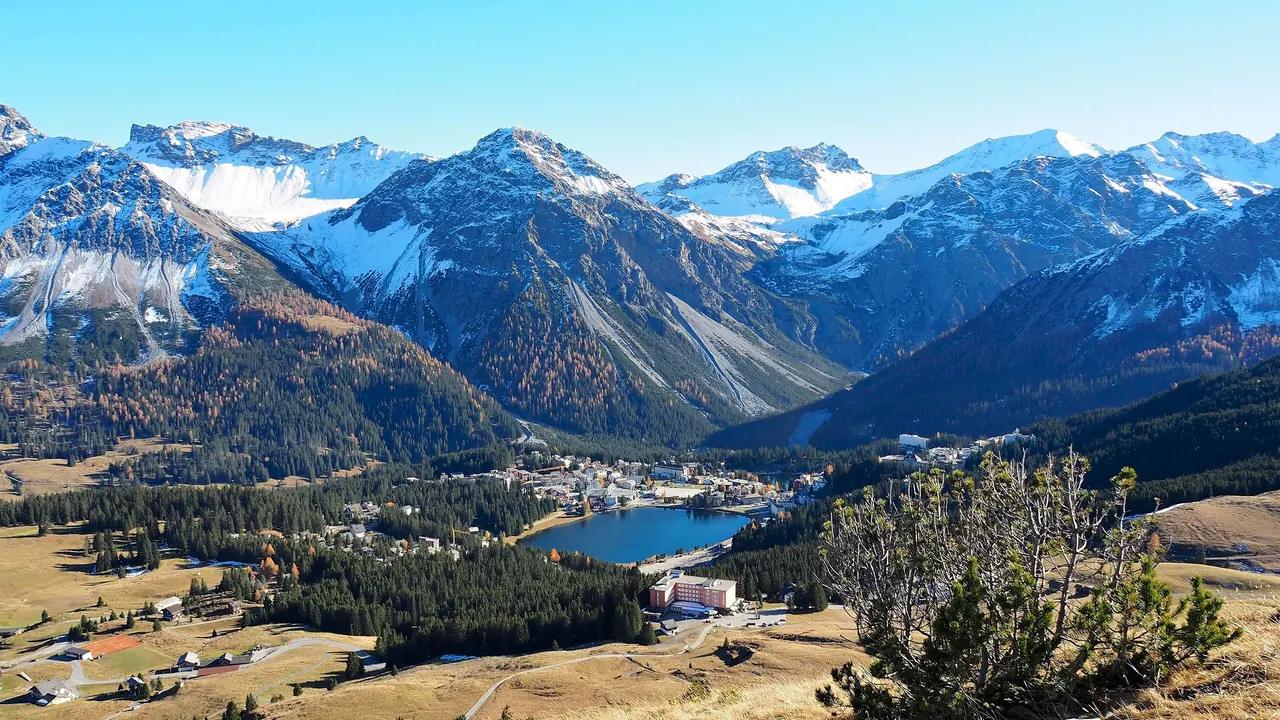
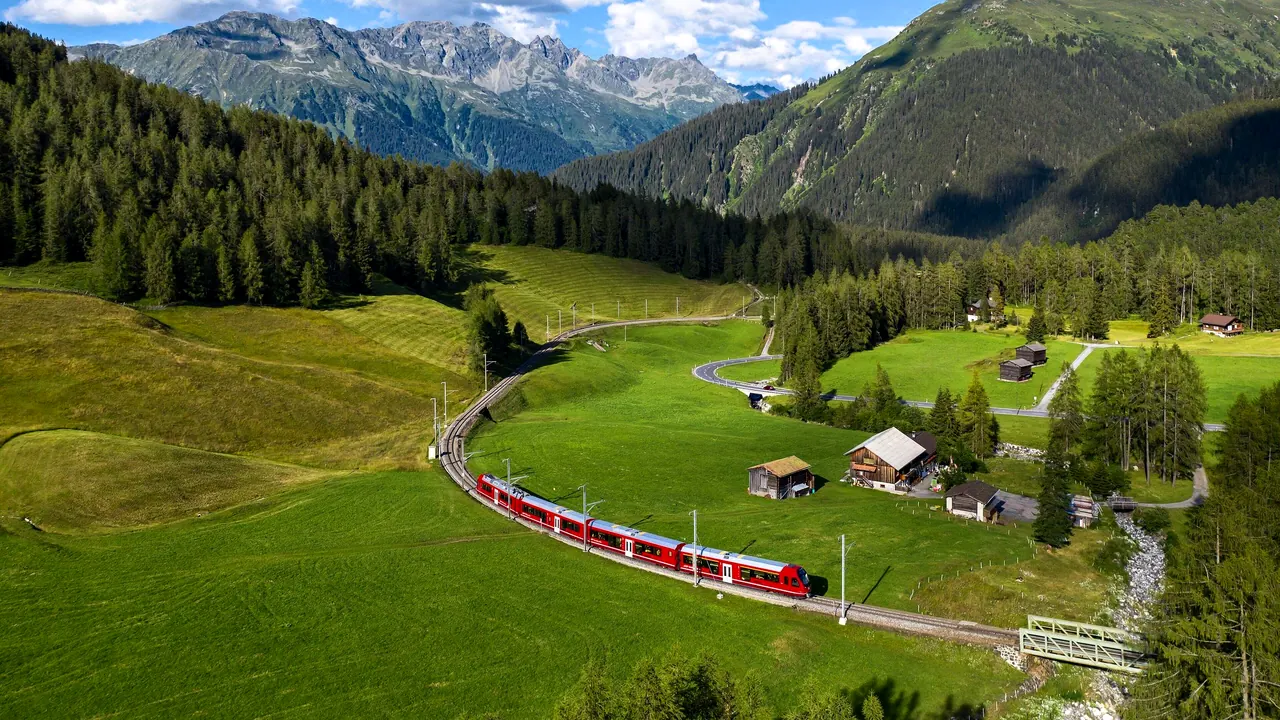
Photos: Arosa by Andres Passwirth, CC BY-SA 4.0, cropped; Davos by Kabelleger / David Gubler, CC BY-SA 4.0, cropped.
Arosa or Davos?
Our verdict in twelve categories, each scored against the same fixed benchmark cities, and the climate month by month, so you can choose for your trip.
Choose Arosa for
- beaches
- live music and the arts
- families
Arosa suits travellers who want a small, self-contained mountain village where everything starts at the door. It sits at the end of the line, which makes it quieter. In summer there are lakes warm enough for a dip and a bear sanctuary for children, and its calendar gets a lift from the December comedy festival and the summer chamber concerts. In return you mostly stay put, because every outing beyond the valley goes by way of Chur.
Choose Davos for
- culture and sights
- day trips
- shopping
Choose Davos if you want more mountain and more to do around it. Its five ski areas and the side valleys running up to glaciers give you more ground to cover. The Kirchner Museum and the old Magic Mountain sanatoria give a grey day some purpose, and the railway makes St Moritz, the Engadine and Scuol easy days out. It is a bigger, busier town, a little livelier after dark in winter.
Scoreboard
Twelve categories on one fixed scale from 0 to 100. The shaded stretch is the gap between the two.
Your match
Pick a travel style or drag the sliders, and both match scores follow your weighting.
Too close to call, 2 points apart
Wins on beaches and live music and the arts with your weighting.
Wins on culture and sights and day trips with your weighting.
What matters to you?
Category by category
What the scores mean for a trip.
Beaches & swimming
Neither town is a place for a swimming vacation, but Arosa does better with what little there is. It has three mountain lakes rather than one: the lido on the Untersee, plus the Obersee and the Schwellisee for a bracing dip. On the best summer days the water reaches about 20°C.
Davos has a single lido on the Davosersee, a few degrees colder, so most swimmers there end up in the indoor leisure pool or a hotel pool.
Food & drink
Both draw on the same Graubünden cooking, with capuns, barley soup and air-dried meat, and both are at their best on a hut terrace at lunchtime rather than in town at night. The difference is size. Davos, the larger town, has a few ambitious kitchens and more pizza and fondue places to fall back on, while Arosa's evenings come down to hotel dining rooms and a little fine dining in the luxury hotels.
Culture & sights
Davos has more of its past to show. The sanatorium era survives in buildings such as the Schatzalp with its sun balconies, the town is the setting of Thomas Mann's The Magic Mountain, and the Kirchner Museum holds the largest collection of the Expressionist painter's work, which makes it a proper art visit.
Arosa shares the tuberculosis history but has much less to see: the late 15th-century Bergkirchli alone on its meadow, the Schanfigg valley museum and a few grand hotels. Arosa takes an afternoon, Davos a day or two.
Nightlife
Both towns go out in step with the ski season and go quiet in summer, so neither is a place to pick for its nightlife. Davos is the noisier of the two, with après-ski at the foot of the Jakobshorn and Parsenn runs carrying on into pubs and small clubs along the Promenade until after midnight at weekends. Arosa is smarter and calmer, with hotel bars doing most of the work, though its long-running gay ski week in January brings the liveliest nights in either place.
Nature & outdoors
Both are first-rate mountain bases, and what sets them apart is their shape rather than their quality. Arosa is a single compact basin of larches, lakes and bare summits under the Weisshorn. In winter the lifts cross the ridge to Lenzerheide to make one large linked ski area, the altitude keeps the snow reliable, and every route starts from the village. In summer marmots are common on the upper meadows, and high trails over the passes lead on foot all the way to Davos.
Davos spreads over more ground. Its five ski areas are separate mountains rather than one linked circuit, and its cross-country trails run for more than 100km along the valley floor and into the Sertig and Dischma valleys. Those quiet side valleys end below glaciers where chamois and ibex appear, and the Swiss National Park is close enough for a day out.
Day trips
Davos is the better base for days out. It sits on the UNESCO-listed Albula line, so the Landwasser Viaduct and St Moritz are an easy ride. The Vereina tunnel puts Guarda and Scuol in the Lower Engadine about an hour away, and Chur is also within reach.
From Arosa every outing starts with the hour on the train down to Chur. Its old town and cathedral make a good day out, and Maienfeld or Vaduz are possible too. The Engadine routes that are easy from Davos become long days of two hours or more each way.
Good for families
Arosa is the smaller, calmer village for young children, and Davos is the one that copes better on a wet day. In Arosa the bear sanctuary, the lakes and the cable cars that take small legs up to viewpoints fill a summer stay. Rainy days come down to the indoor pool and the ice rink.
Davos has the big natural skating rink, the toboggan run down from the Schatzalp and a leisure pool with slides for bad weather. Ski schools, sledging and free buses come with either, and neither has zoos or children's museums. Teenagers who are not into sport may find Davos thin.
Getting around
Neither needs a car, and both rely on the Rhaetian Railway and free buses. The layout is different. Arosa climbs a hillside between Ausserarosa and Innerarosa, so walking means slopes and stairs, while Davos runs along about 4km of valley floor, with two stations and lifts leaving from the town itself.
Arosa's single line down to Chur makes every onward journey slow. Davos has railway routes leaving the valley in more than one direction.
Shopping & style
Neither is a place to plan around shopping, but the Promenade in Davos gives you more to browse. Alongside the gear shops there are watch and jewellery stores and delicatessens selling Bündnerfleisch, mountain cheese and Nusstorte to take home. Arosa's main street covers ski rental, a few boutiques and chocolate, and for anything more you go down to Chur.
Affordability
Both are among the most expensive places for a mountain vacation, and the ways to save are the same in each: free buses with the guest card, vacation apartments and cooking for yourself.
Summer is cheaper in both towns. In Davos, though, some places close in early summer and autumn, and in January the World Economic Forum makes rooms even scarcer and dearer. In Arosa the peak ski weeks are the most expensive time.
Live music & performing arts
Arosa has more live performance than you might expect in a village resort. The long-established comedy festival in December puts stand-up and cabaret on stages around the village, some of them outdoors in the snow. In summer, chamber concerts fill the churches, the Bergkirchli included.
Davos has its summer classical festival of young musicians and the odd concert at the congress centre, but in winter there is little beyond bands in hotel bars.
Wellness & relaxation
Arosa gives the quieter stay. As a dead-end village at the top of its valley it suits lakeside walks, sun terraces and early nights. Davos gets busier in the peak ski weeks, but its leisure pool has a sauna area open to day visitors, and the mineral baths of Scuol are about an hour away if you want proper thermal bathing. Both towns grew up around the dry mountain air, and in each the spa side of things happens mostly in the hotels.
When should you go?
Pick your month. The climate figures are measured averages, not a forecast.
Arosa in July
Davos in July
Daytime high, °C
Rainfall in the month, mm
Where the figures come from
Arosa's temperatures are measured 31 km from the centre, at Samedan.
Arosa has no rain gauge within 25 km of the centre, so its rainfall comes from a gridded climate dataset read at the destination rather than from a gauge further away.
Davos's temperatures are measured 53 km from the centre, at S. Valentino Alla Muta.
Davos has no rain gauge within 25 km of the centre, so its rainfall comes from a gridded climate dataset read at the destination rather than from a gauge further away.
Temperature and rainfall are climate normals, averaged over the years shown. Arosa: 2015-2025 (rainfall 1991-2020) normals, Samedan (31.2 km from centre). Davos: 1991-2020 normals, S. Valentino Alla Muta (53.4 km from centre).
Both are mountain resorts with two seasons, winter snow and summer walking, and they follow much the same pattern through the year. July and August are the warmest months, with highs of about 20°C in both, which is good walking weather. Those are also the only weeks when a lake swim is realistic. Summer is the wettest time of year, though, and Arosa gets more rain, close to 159mm in August against a little less in Davos, so afternoon showers come with hiking days.
Winter is drier, and that is where the two differ most. Arosa sits higher and stays colder, with January highs of about -1°C, while Davos reaches about 2°C. In spring and autumn Davos warms up earlier and stays milder, with May highs of about 15°C, while in Arosa May is still cool. Late spring and November are dull in both.
Which traveller are you?
On a culture and arts trip, Davos is the better choice. The Kirchner Museum, the Schatzalp and the Magic Mountain story give it real depth, and Chur and the Engadine villages are easy outings. Arosa's December comedy festival and church concerts are worth timing a visit around.
On a family trip with children, Arosa has a slight edge. The village is small with little traffic, the bear sanctuary and the lakes fill summer days, and cable cars carry small legs up to viewpoints. Davos has a leisure pool with slides that helps more on wet days.
For an outdoors trip, Davos has more ground to cover: five ski areas, more than 100km of cross-country trails, side valleys ending below glaciers where ibex graze, and the Swiss National Park within a day. Arosa's link to Lenzerheide suits skiers who want everything starting from the village.
Before you go
| Measure | Arosa | Davos |
|---|---|---|
| Official language | French, German, Italian, Romansh | French, German, Italian, Romansh |
| Currency | Swiss Franc (CHF) | Swiss Franc (CHF) |
| Sockets | CJ230 V, 50 Hz | CJ230 V, 50 Hz |
| Driving side | Right | Right |
| Time zone | UTC+1, UTC+2 in summer | UTC+1, UTC+2 in summer |
| Emergency number | 112 | 112 |
| Elevation | 1,775 m | 1,559 m |
| Main airport | Zürich Airport (ZRH)114 km from centre226 non-stop destinations | Zürich Airport (ZRH)122 km from centre226 non-stop destinations |
| Public holidays this year | 9 days | 9 days |
By the numbers
| Measure | Arosa | Davos |
|---|---|---|
| Population | 3,185 | 10,738 |
| People per km² | 21 | 38 |
| Museums within 10 km | 1 | 3 |
| UNESCO World Heritage sites within 50 km | 2 | 2 |
Where else could you go?
Every comparison below shares a destination with this one, so you can follow Arosa or Davos somewhere new.
- Klostersvs Davos
- Lenzerheidevs Arosa
- Klostersvs Arosa
- Lenzerheidevs Davos
- Laaxvs Arosa
- St. Moritzvs Arosa