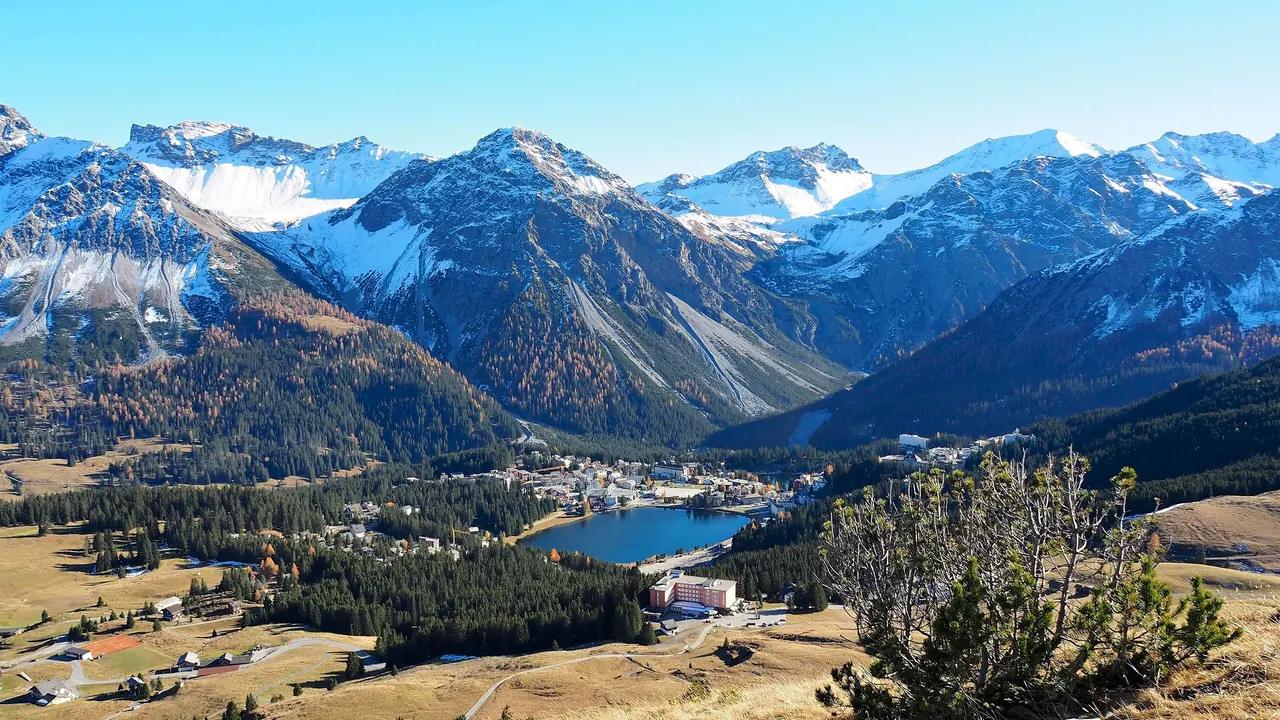
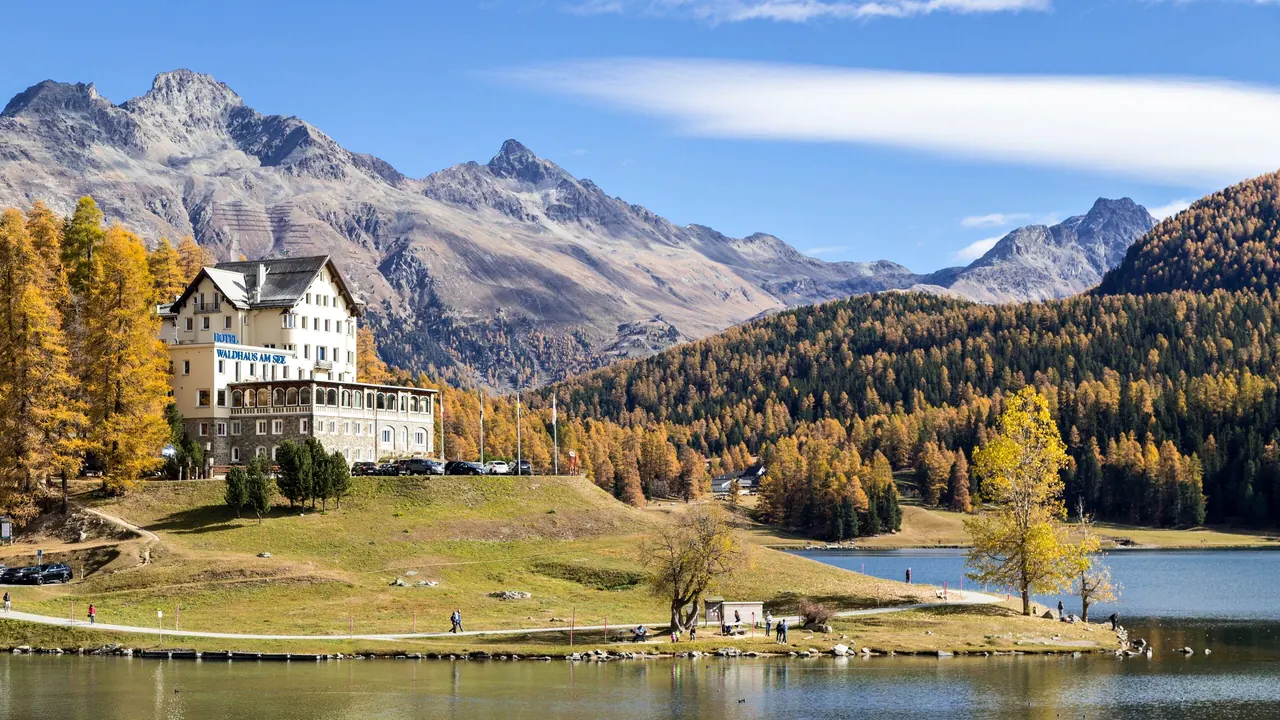
Photos: Arosa by Andres Passwirth, CC BY-SA 4.0, cropped; St. Moritz by JoachimKohler-HB, CC BY-SA 4.0, cropped.
Arosa or St. Moritz?
Our verdict in twelve categories, each scored against the same fixed benchmark cities, and the climate month by month, so you can choose for your trip.
Choose Arosa for
- families
- beaches
- prices
Arosa suits families and anyone after a quieter, more contained mountain stay. Everything happens within one basin at the end of the valley, with free buses, lake lidos, a bear sanctuary and gentle slopes for children, and a lift link over to Lenzerheide for skiers who want more terrain. It is the easier place to settle into with small children, and its evenings are calmer.
Choose St. Moritz for
- shopping
- food and drink
- culture and sights
St. Moritz is the stronger choice for a grander version of the Alps. The peaks are higher, the valley is wider and has more lakes, and in summer there are glaciers, a national park and Lake Silvaplana's kitesurfing wind within reach. It also has the fine dining, luxury boutiques and glamorous winter nights that Arosa lacks, and the Bernina line to Italy makes day trips more varied. Expect adult luxury rather than family comfort.
Scoreboard
Twelve categories on one fixed scale from 0 to 100. The shaded stretch is the gap between the two.
Your match
Pick a travel style or drag the sliders, and both match scores follow your weighting.
Wins on families and beaches with your weighting.
Wins on shopping and food and drink with your weighting.
What matters to you?
Category by category
What the scores mean for a trip.
Beaches & swimming
Neither resort is a swimming destination, but Arosa makes lake bathing easier. The Untersee sits right in the village, with a lido, a lawn and a jetty, and the Obersee and Schwellisee above it draw hardy swimmers on warm afternoons.
In St. Moritz the main lake is for looking at, or for windsurfing in a wetsuit. The nearest proper bathing spot is little Lej da Staz, a walk away through the forest, so most visitors end up in a hotel pool. In both places the water rarely gets much above 20°C, and only for a few summer weeks.
Food & drink
St. Moritz eats far better at the top end. A surprising number of serious kitchens in grand hotels and mountain restaurants make dinner the main event of a winter evening. The old confectioners in the village sell Engadine nut tart, and Italian pizzoccheri appear on menus thanks to the nearby border.
Arosa's best meals are on hut terraces: rösti, barley soup and capuns with a view down the valley. Below a small tier of hotel fine dining, the choice narrows to fondue and raclette. Neither town has markets or street food, and both lose many kitchens out of season.
Culture & sights
One domed museum of Alpine painting is what separates these two. Arosa's sights come down to the shingled Bergkirchli, standing alone on its meadow above Innerarosa since the late 15th century, and the Schanfigg museum's account of valley farming and the sanatorium years. A few grand old hotels from that era complete the picture.
St. Moritz has a little more substance. The Segantini Museum holds the painter's great triptych of life, nature and death, the Engadin Museum shows painted farmhouse rooms, and the leaning tower of a lost church stands above the village. Add two Winter Olympics and the Cresta Run, still in use, and a sightseeing afternoon here is noticeably fuller.
Nightlife
Both resorts are quiet once the snow goes, but St. Moritz has the bigger winter scene. Between Christmas and early March, the grand hotel bars fill with champagne drinkers and a couple of famously exclusive clubs keep late hours. It is glamorous and expensive, and getting in can depend on who you know.
Arosa's winter evenings are more modest: après-ski by the slopes, hotel bars and a couple of small clubs that open late at weekends. Its liveliest week is the long-running gay ski week in January.
Nature & outdoors
The difference is one of scale. Arosa's basin at the head of the Schanfigg is compact: larches, small lakes and the Weisshorn rising straight above the village. The lift link to Lenzerheide makes a large ski area, marmots are common on the upper meadows, and summer routes lead over the passes toward Davos. Everything starts on foot or by lift from the village.
The Upper Engadine around St. Moritz is broader and higher, a wide valley strung with lakes beneath peaks over 3,000m. Skiing spreads across Corviglia, Corvatsch and Diavolezza, and the valley floor holds some of the finest cross-country trails in the Alps. In summer there is the Morteratsch glacier walk, kitesurfing on Lake Silvaplana and the Swiss National Park, with its ibex, less than an hour away. For range and drama, St. Moritz comes out ahead.
Day trips
From Arosa, every outing starts with the hour-long train down to Chur, over curving viaducts above the Schanfigg gorges. Chur is the obvious day out, with its old centre, Romanesque cathedral and the Bündner art museum. The Maienfeld vineyards are a short hop beyond, and Vaduz in Liechtenstein is not much further. The Albula line, Davos and Klosters take two hours or more, so the options thin quickly.
St. Moritz sits in the middle of its valley rather than at the end of one, and that widens the choice. The UNESCO-listed Bernina line crosses the pass to Poschiavo and Tirano in Italy, Sils Maria keeps Nietzsche's summer house, Guarda and Zuoz have sgraffito houses, and stone-built Soglio lies over the Maloja Pass. Most of these are villages rather than towns, but there are more of them.
Good for families
Arosa is the easier choice with children. The lakes, playgrounds, bear sanctuary and short hikes to farm restaurants are all in one village with light traffic and free buses, and cable cars take small legs up to the viewpoints. Rainy days are the weak spot, with little beyond the pool and ice rink.
St. Moritz is just as safe, and its nursery slopes on Corviglia and its natural ice rinks work well for children. But the town is geared to adult luxury, and families with young children often stay in the calmer villages nearby.
Getting around
Neither resort needs a car, and both are reached by the Rhaetian Railway. St. Moritz has the wider network. Buses and trains run the length of the Upper Engadine from Maloja to Zuoz, and escalators and a lift ease the climb from the lakeside station up to Dorf.
Arosa's free buses link the station, the lake, Innerarosa and the lifts. The village climbs a hillside full of stairs, and because it sits at a dead end, every onward journey goes back down the single line to Chur.
Shopping & style
St. Moritz is a real shopping destination, though only for luxury. The streets around Via Serlas hold top watch, jewellery and fashion houses along with furriers and high-end ski wear, but there are no markets or independent design shops.
Arosa covers the basics: ski rental, outdoor gear, a few boutiques and chocolate shops. For anything more, people take the train down to Chur's old town.
Affordability
Both are among the most expensive places in the Alps, and neither can be done cheaply. Arosa offers a little more room to save within the village itself, through simple guesthouses, self-catering apartments and the perks of the summer guest card.
In St. Moritz, many hotels include lifts and public transport in the room rate. Even so, travellers on a budget usually stay elsewhere in the Engadine and visit for the day. In both resorts, summer costs noticeably less than the peak ski weeks.
Live music & performing arts
Neither town has a theatre or a concert season, so in both it comes down to festivals. Arosa's calendar has more humour: a long-established December comedy festival puts stand-up and cabaret on stages around the village, some outdoors in the snow, and summer chamber concerts fill the Bergkirchli.
St. Moritz leans towards music. A summer jazz festival brings well-known names to small rooms, and the Engadin Festival and a winter classical series fill churches and hotel ballrooms across the valley.
Wellness & relaxation
Both towns offer restful stays in dry mountain air, with hotel spas looking out on the peaks, but the bathing is different. Arosa has no springs. Its calm comes from lake walks, sun terraces and early nights, plus some extensive hotel spas and a public indoor pool.
St. Moritz has a real spa tradition. A medical bath in St. Moritz Bad still uses the iron-rich spring water and peat, the hotel spas are among the most elaborate in the Alps, and the thermal baths at Scuol are a train ride away. High winter there is more about being seen than resting.
When should you go?
Pick your month. The climate figures are measured averages, not a forecast.
Arosa in July
St. Moritz in July
Daytime high, °C
Rainfall in the month, mm
Where the figures come from
Arosa's temperatures are measured 31 km from the centre, at Samedan.
Arosa has no rain gauge within 25 km of the centre, so its rainfall comes from a gridded climate dataset read at the destination rather than from a gauge further away.
St. Moritz has no rain gauge within 25 km of the centre, so its rainfall comes from a gridded climate dataset read at the destination rather than from a gauge further away.
Temperature and rainfall are climate normals, averaged over the years shown. Arosa: 2015-2025 (rainfall 1991-2020) normals, Samedan (31.2 km from centre). St. Moritz: 2015-2025 (rainfall 1991-2020) normals, Samedan (5.5 km from centre).
The two resorts sit at the same altitude and share the same temperatures month by month. Winter highs hover around -1°C in January, which is what keeps the ski season reliable from December into March. Summer is mild rather than hot, peaking at about 20°C in July. That is ideal for hiking, and only July and August are warm enough for a cold lake swim. Spring and late autumn fall between seasons, and many places in both resorts close then.
The real difference is rain. Arosa is noticeably wetter all year, and its summer months are the wettest, with August reaching about 159mm against roughly 111mm in St. Moritz. Winter follows the same pattern, as the Engadine gets less snow and rain than the Schanfigg. For a summer of hiking with fewer washed-out afternoons, St. Moritz has the edge. Both resorts are at their best in late June to early September and in the snowy months from January to March.
Which traveller are you?
On a family trip with children, Arosa is the better fit. Lake playgrounds, the bear sanctuary, sledging runs and free village buses are all close together, while St. Moritz is built around adult luxury and has little made for children beyond the slopes.
For a shopping trip, St. Moritz wins easily. Via Serlas has a remarkable number of watch, jewellery and fashion boutiques for such a small town. Arosa offers ski gear and souvenirs, and serious shopping there means a train down to Chur.
On a food and nightlife trip, St. Moritz offers more. Its grand hotels hold serious kitchens and glamorous winter bars, and a couple of exclusive clubs stay open late. Arosa's evenings are mostly fondue, après-ski and hotel bars, though its January gay ski week livens things up.
Before you go
| Measure | Arosa | St. Moritz |
|---|---|---|
| Official language | French, German, Italian, Romansh | French, German, Italian, Romansh |
| Currency | Swiss Franc (CHF) | Swiss Franc (CHF) |
| Sockets | CJ230 V, 50 Hz | CJ230 V, 50 Hz |
| Driving side | Right | Right |
| Time zone | UTC+1, UTC+2 in summer | UTC+1, UTC+2 in summer |
| Emergency number | 112 | 112 |
| Elevation | 1,775 m | 1,822 m |
| Main airport | Zürich Airport (ZRH)114 km from centre226 non-stop destinations | Zürich Airport (ZRH)145 km from centre226 non-stop destinations |
| Public holidays this year | 9 days | 9 days |
By the numbers
| Measure | Arosa | St. Moritz |
|---|---|---|
| Population | 3,185 | 5,027 |
| People per km² | 21 | 175 |
| Museums within 10 km | 1 | 7 |
| UNESCO World Heritage sites within 50 km | 2 | 2 |
Where else could you go?
Every comparison below shares a destination with this one, so you can follow Arosa or St. Moritz somewhere new.
- Lenzerheidevs Arosa
- Davosvs Arosa
- Klostersvs Arosa
- Laaxvs Arosa
- Lenzerheidevs St. Moritz
- Davosvs St. Moritz