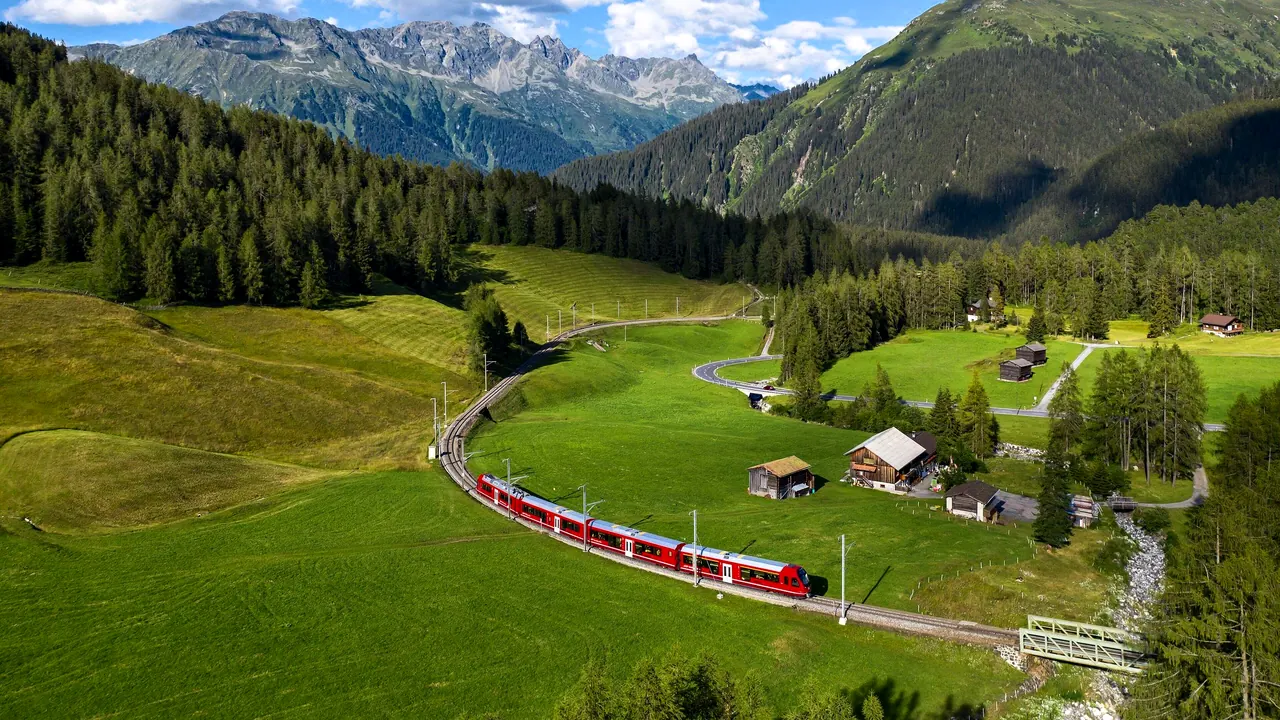
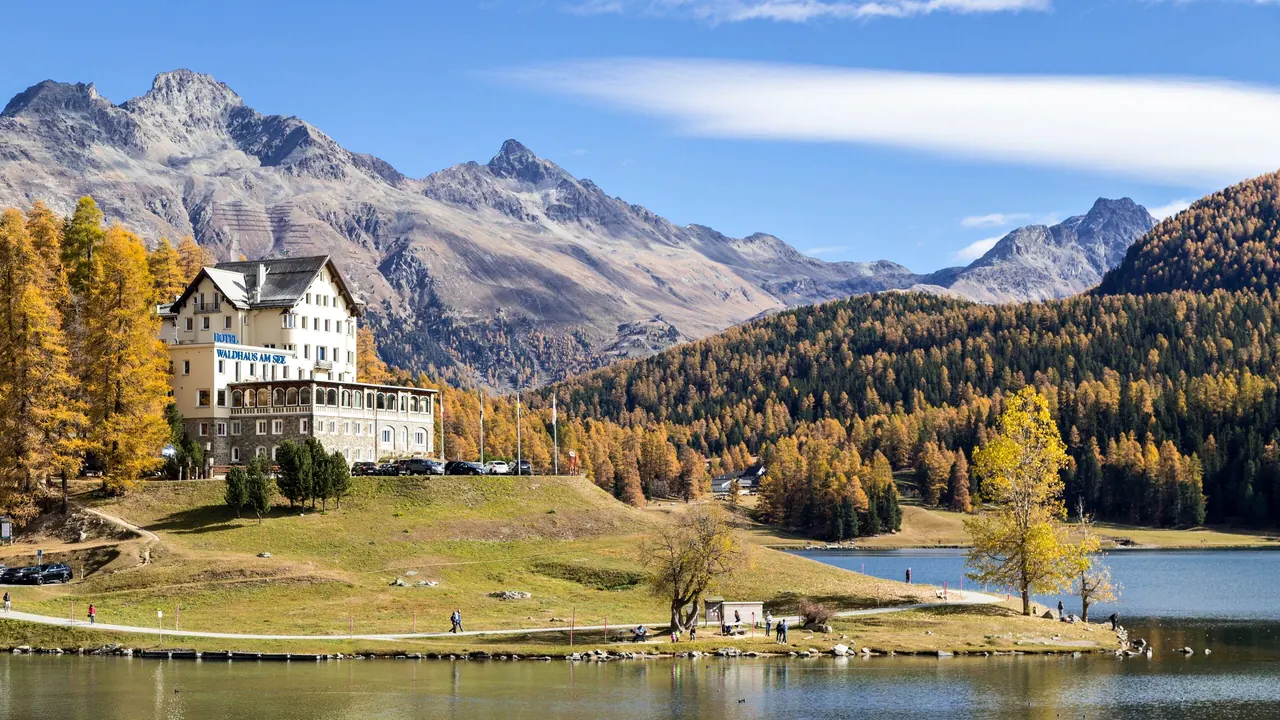
Photos: Davos by Kabelleger / David Gubler, CC BY-SA 4.0, cropped; St. Moritz by JoachimKohler-HB, CC BY-SA 4.0, cropped.
Davos or St. Moritz?
Our verdict in twelve categories, each scored against the same fixed benchmark cities, and the climate month by month, so you can choose for your trip.
Choose Davos for
- families
- day trips
- prices
Davos suits families and active travellers who want a working town as a base, not just a resort. It has children's ski schools, the long toboggan run from the Schatzalp, a leisure pool with slides for bad days, and five ski areas, with Parsenn and Jakobshorn reached by funicular and cable car from the streets. On quieter days there is the old sanatorium history, the Kirchner Museum and the train out to the Landwasser Viaduct.
Choose St. Moritz for
- shopping
- food and drink
- live music and the arts
Pick St. Moritz if the evenings matter as much as the slopes. The grand hotels hold serious kitchens, Via Serlas is lined with luxury boutiques, and the hotel spas facing the peaks are some of the most elaborate in the Alps. The lakes, larch forest and dry, sunny climate of the Upper Engadine are every bit as good as the mountains around Davos. Children are less well catered for, though, and the polish costs at least as much.
Scoreboard
Twelve categories on one fixed scale from 0 to 100. The shaded stretch is the gap between the two.
Your match
Pick a travel style or drag the sliders, and both match scores follow your weighting.
Wins on families and day trips with your weighting.
Wins on shopping and food and drink with your weighting.
What matters to you?
Category by category
What the scores mean for a trip.
Beaches & swimming
Neither town is a place to swim. Both are high Alpine towns far from the sea, and most swimming happens in indoor or hotel pools. Where they differ is the summer lakes. Davos has a proper lido on the Davosersee, with lawns and a jetty. In St. Moritz the best spot is little Lej da Staz in the forest, which warms up slightly more, while Lake St. Moritz itself is left to windsurfers in wetsuits.
Food & drink
Both kitchens rest on the same Graubünden staples: capuns, air-dried beef and the Engadine nut tart. Both are at their best at lunch on a sunny mountain-hut terrace. Davos adds pizokel and barley soup, but in town the choice is mostly hotel dining, fondue, raclette and pizza.
St. Moritz eats better at the top end. Its grand hotels and smart mountain restaurants hold far more serious kitchens than a village its size would suggest, and dinner is the main event of a winter evening. Below that level the choice thins out quickly in both towns, and neither has street food or markets.
Culture & sights
Neither town is a sightseeing destination, and you can see all of either in a short time. What differs is the kind of history. Davos tells the story of the tuberculosis cure, with the old Schatzalp sanatorium above town as the world of Thomas Mann's The Magic Mountain, and the Kirchner Museum holds the largest collection of Kirchner's Expressionist work.
In St. Moritz the main sight is Segantini's Alpine paintings in their domed museum. There is also the Engadin Museum's painted farmhouse rooms and the leaning tower above the village. Its living heritage is sporting: two Winter Olympics, and the Cresta Run and bobsleigh track are still in use.
Nightlife
Both towns go out in winter and fall quiet in summer, and neither suits anyone after a big night. Davos is the more casual of the two: après-ski at the foot of the Jakobshorn and Parsenn runs carries on into pubs and a couple of small clubs on the Promenade. St. Moritz dresses up, with fur and champagne in the grand hotel bars between Christmas and early March, and clubs where getting in matters as much as the music.
Nature & outdoors
This is where both towns earn their place, and there is little to choose between them. Davos has more separate ski areas, five including Madrisa above Klosters, and over 100km of cross-country trails running into the Sertig and Dischma valleys. Those quiet valleys end below glaciers and are good for marmots and ibex.
The Upper Engadine around St. Moritz is wider, with a chain of lakes. It offers Corviglia, Corvatsch and Diavolezza, the Engadin ski marathon trails, the walk to the Morteratsch glacier, and Lake Silvaplana's afternoon wind for kitesurfing. The Swiss National Park is within a day's reach of both.
Day trips
Both towns are bases on the Rhaetian Railway, and the train ride is half the point. From Davos the Albula line crosses the Landwasser Viaduct. Chur, with its medieval centre and cathedral, gives you a proper town to walk around, which St. Moritz's list lacks.
From St. Moritz the Bernina line climbs over the pass and drops into Italy at Tirano, and the Maloja Pass leads to stone-built Soglio and Chiavenna. Closer by, Nietzsche's summer house at Sils Maria and the painted villages of the Lower Engadine fill quieter days, though these are villages rather than towns.
Good for families
Davos is the better fit for children. Besides ski schools and nursery slopes, it has the long toboggan run down from the Schatzalp, playgrounds and adventure trails at the top stations, a lido on the lake and a big leisure pool with slides for bad weather. Free buses run the length of town.
St. Moritz is just as safe, and its Corviglia slopes suit beginners, but beyond that it is built for wealthy adults. Families with small children often stay in the calmer villages nearby. Neither town has zoos or science museums, so teenagers who don't ski may get bored in both.
Getting around
You don't need a car in either town. Both are on the Rhaetian Railway with good bus links, but the layouts differ. Davos is long and flat, about 4km from Dorf to Platz, and the lifts leave from the town itself. St. Moritz is compact but steep: Dorf sits on a hillside above Bad, and escalators and a lift take you up from the station. Watch for icy pavements in winter.
Shopping & style
St. Moritz is the place to shop, as long as luxury is what you want. Via Serlas and its neighbouring streets hold a striking number of fashion, watch and jewellery houses, plus furriers and high-end ski wear.
The Davos Promenade is more practical: ski and outdoor gear, rentals, a few watch shops and delicatessens selling Bündnerfleisch and Nusstorte, which make a pleasant evening browse. Neither town has markets or independent design streets.
Affordability
Both are among the most expensive places to spend a vacation anywhere, so the difference lies in how you keep costs down. Davos has rental apartments for self-catering and free buses with the guest card. It is best avoided during the World Economic Forum in January, when rooms are scarce.
In St. Moritz many hotels include local lifts and public transport in the room rate. Visitors on a budget often stay in simpler guesthouses elsewhere in the Engadine and come in for the day. In both towns summer and the shoulder weeks are easier on the wallet, though some places close then.
Live music & performing arts
Neither town has a theatre or a regular season, but St. Moritz has more to plan a trip around. Its long-running summer jazz festival, the Engadin Festival's chamber concerts in churches across the valley and a winter classical series give it several dates of real quality.
Davos has one main event, the summer classical festival, where young musicians play in churches, hotels and unusual spots. Beyond that there are occasional concerts at the congress centre. For anything more, you have to travel to Zurich.
Wellness & relaxation
Both towns grew up as places to get well, and both offer clear, dry mountain air and quiet summer weeks. Davos built its name on the altitude cure for tuberculosis, and today that means hotel spas and a public leisure pool with a sauna area.
St. Moritz began with a mineral spring, and St. Moritz Bad still runs a medical bath using its water and peat. Its grand hotel spas, with indoor-outdoor pools facing the peaks, are among the most elaborate in the Alps. The thermal baths at Scuol can be reached by train from either town.
When should you go?
Pick your month. The climate figures are measured averages, not a forecast.
Davos in July
St. Moritz in July
Daytime high, °C
Rainfall in the month, mm
Where the figures come from
Davos's temperatures are measured 53 km from the centre, at S. Valentino Alla Muta.
Davos has no rain gauge within 25 km of the centre, so its rainfall comes from a gridded climate dataset read at the destination rather than from a gauge further away.
St. Moritz has no rain gauge within 25 km of the centre, so its rainfall comes from a gridded climate dataset read at the destination rather than from a gauge further away.
Temperature and rainfall are climate normals, averaged over the years shown. Davos: 1991-2020 normals, S. Valentino Alla Muta (53.4 km from centre). St. Moritz: 2015-2025 (rainfall 1991-2020) normals, Samedan (5.5 km from centre).
Both towns have two good seasons: deep winter for snow, and July and August for walking, when daytime highs in both reach about 20°C. Neither is ever warm enough for a real beach day, and the lakes are only good for a short, cold swim. Summer is also the wettest time in both places, but Davos gets noticeably more rain, around 142mm in August against 111mm in St. Moritz, so St. Moritz is the better bet for long hikes.
St. Moritz sits higher and is colder. January highs stay around -1°C, against 2°C in Davos, which keeps its snow and frozen lakes reliable all winter but makes walking around the village a chilly business. Late spring and November are the quiet seasons in both, with cool grey days and many places closed. In St. Moritz, November is also one of the wetter months.
Which traveller are you?
On a family trip with young children, Davos is the easier base. There is enough to do off the slopes that a wet afternoon or a child who has had enough of skiing is easy to handle. St. Moritz is built around adult evenings, which counts for little with a six-year-old.
For a shopping trip, Davos offers little beyond kit for the mountains and something edible to take home, so St. Moritz is the clear choice if your budget runs to luxury. In one short walk you can choose a watch, a piece of jewellery or a winter coat.
On a food and nightlife trip, Davos suits a relaxed fondue and a beer after skiing, but St. Moritz is the town to dress up for. There, an evening is planned around a table at one of the grand hotels, and the night often ends in the same building.
Before you go
| Measure | Davos | St. Moritz |
|---|---|---|
| Official language | French, German, Italian, Romansh | French, German, Italian, Romansh |
| Currency | Swiss Franc (CHF) | Swiss Franc (CHF) |
| Sockets | CJ230 V, 50 Hz | CJ230 V, 50 Hz |
| Driving side | Right | Right |
| Time zone | UTC+1, UTC+2 in summer | UTC+1, UTC+2 in summer |
| Emergency number | 112 | 112 |
| Elevation | 1,559 m | 1,822 m |
| Main airport | Zürich Airport (ZRH)122 km from centre226 non-stop destinations | Zürich Airport (ZRH)145 km from centre226 non-stop destinations |
| Public holidays this year | 9 days | 9 days |
By the numbers
| Measure | Davos | St. Moritz |
|---|---|---|
| Population | 10,738 | 5,027 |
| People per km² | 38 | 175 |
| Museums within 10 km | 3 | 7 |
| UNESCO World Heritage sites within 50 km | 2 | 2 |
Where else could you go?
Every comparison below shares a destination with this one, so you can follow Davos or St. Moritz somewhere new.
- Klostersvs Davos
- Arosavs Davos
- Lenzerheidevs Davos
- Lenzerheidevs St. Moritz
- Arosavs St. Moritz
- Klostersvs St. Moritz