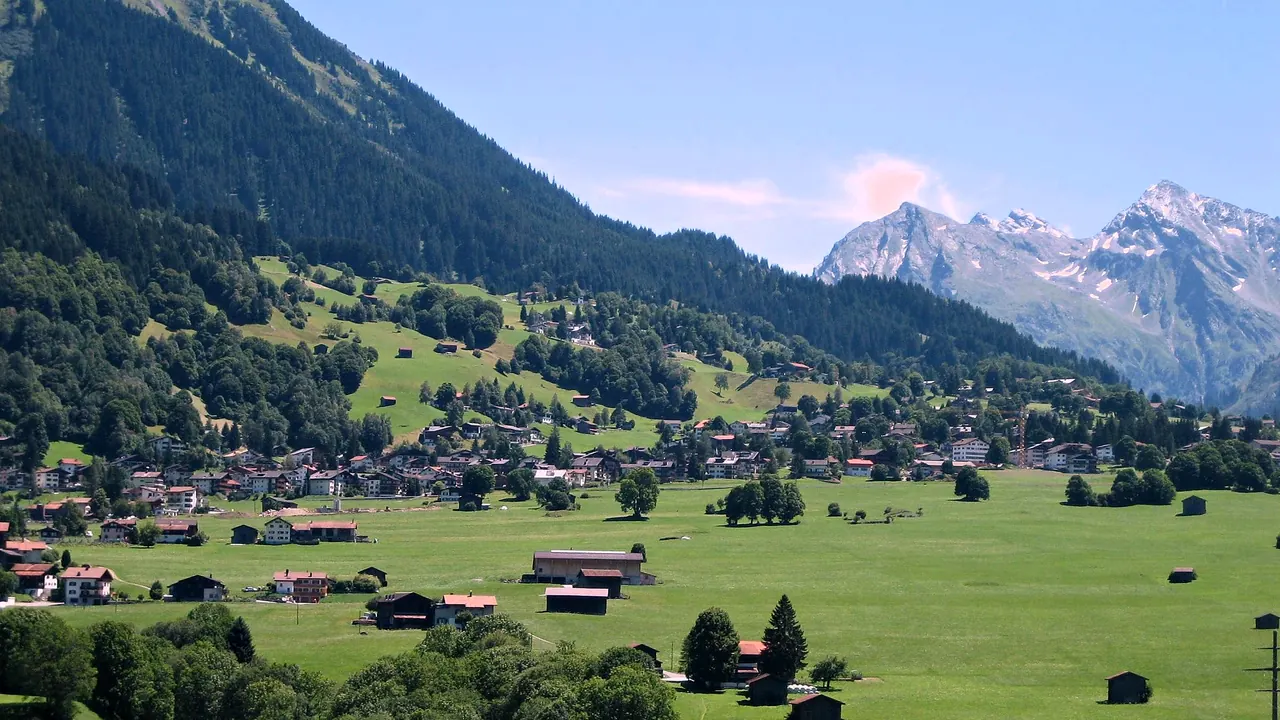
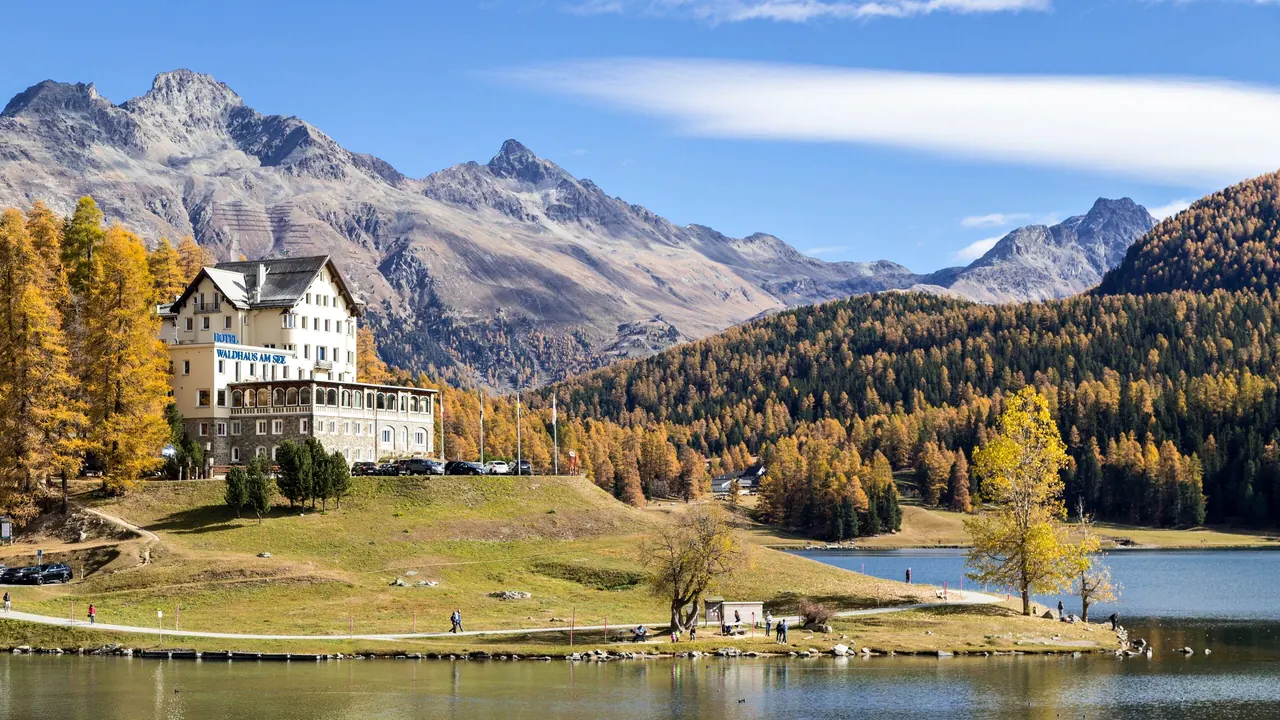
Photos: Klosters by Adrian Michael, CC BY-SA 3.0, cropped; St. Moritz by JoachimKohler-HB, CC BY-SA 4.0, cropped.
Klosters or St. Moritz?
Our verdict in twelve categories, each scored against the same fixed benchmark cities, and the climate month by month, so you can choose for your trip.
Choose Klosters for
- families
- day trips
- prices
Klosters suits families and travellers who want the mountains without the show. The Madrisa side is made for children, the village is quiet and traffic-calm, and the railway puts Chur, the Bündner Herrschaft vineyards and the Lower Engadine within easy reach for days off the slopes.
Choose St. Moritz for
- shopping
- food and drink
- nightlife
For a stay with more polish, St. Moritz is the stronger pick. It eats better, has a street of luxury boutiques, the Segantini Museum and summer music festivals, and pairs its grand hotel spas with a broad, lake-filled valley and some of the best cross-country skiing in the Alps.
Scoreboard
Twelve categories on one fixed scale from 0 to 100. The shaded stretch is the gap between the two.
Your match
Pick a travel style or drag the sliders, and both match scores follow your weighting.
Wins on families and day trips with your weighting.
Wins on shopping and food and drink with your weighting.
What matters to you?
Category by category
What the scores mean for a trip.
Beaches & swimming
Neither village is a place to swim, and the small difference lies in the water on offer. Klosters has an outdoor pool in summer and the bathing area on the lake at Davos, about half an hour away, where the water seldom climbs much past 17°C. St. Moritz has Lej da Staz, a forest lake within walking distance with a lawn, which can reach about 20°C for a few weeks in July, plus an indoor town pool for the rest of the year.
Food & drink
St. Moritz gives a food-minded traveller more to work with. Its grand hotels and mountain restaurants hold a cluster of serious kitchens rare for a town its size, dinner is the evening's main event in winter, and the old confectioners sell the dense Engadine nut tart.
Klosters keeps to the stube: capuns, pizokel, barley soup and Bündnerfleisch in wood-panelled rooms, with Pinot Noir from the Bündner Herrschaft down the valley and only a handful of refined tables. In both, the best lunch is often on a sunny mountain terrace, and neither has markets or street food.
Culture & sights
Neither is a place for sightseeing, but St. Moritz fills a better afternoon. The Segantini Museum, with its triptych of life, nature and death, is a genuine draw, and the Engadin Museum, the leaning tower and the Olympic story of 1928 and 1948 round it out.
Klosters offers the Augusto Giacometti windows in St. Jakob and the rural life collection in the Nutli-Hüschi farmhouse, and after that its interest is the timber chalets of the Prättigau. Anyone hungry for history will be taking the train out.
Nightlife
St. Moritz has the livelier winter evenings, though livelier here means glamorous rather than loud: grand hotel bars, terrace après-ski and a couple of exclusive clubs between Christmas and early March. Klosters is more discreet still, with a few hotel bars and a late spot or two in peak weeks, and regulars who prefer the fireside. Out of season both go to bed early, and from Klosters the fallback is Davos, a short ride up the valley.
Nature & outdoors
Both are first-rate mountain bases, and the choice comes down to landscape. Klosters climbs by the Gotschna cable car into the Parsenn, shared with Davos and known for long runs back to the valley, with the gentler Madrisa opposite and summer trails into the Silvretta.
St. Moritz has the broader, higher setting: a lake-strung valley under peaks over 3,000m, three big ski areas, some of the finest cross-country tracks in the Alps, the Morteratsch glacier walk and Lake Silvaplana's afternoon wind for kitesurfers. The Swiss National Park is within reach of either.
Day trips
Klosters has the wider spread of outings, helped by its railway down towards the lowlands. Chur's old centre is a little over an hour by train, the Bündner Herrschaft wine villages and Maienfeld's Heidi country lie down the same valley, and Liechtenstein's capital Vaduz makes a separate day of its own.
Through the Vereina tunnel, Guarda and Scuol are under an hour away, and a longer day reaches St. Moritz and the UNESCO-listed Albula line. St. Moritz has the single most scenic trip, the Bernina line over the pass to Tirano in Italy, along with Nietzsche's house in Sils Maria, Soglio over the Maloja and Müstair's frescoed convent, but most of its destinations are villages rather than towns.
Good for families
Klosters is the easier choice with children. The Madrisa side is built for them, with a summer play and adventure area, beginner slopes and ski schools, and the traffic-calm village and short hikes to farm huts keep days simple.
St. Moritz is safe and well run, with nursery slopes on Corviglia, sledging and skating on natural ice, but its tone is adult luxury and little is made for children beyond the snow and an indoor pool. Neither has much for a wet day.
Getting around
Both work well without a car, and the difference is in the layout. Klosters runs long along the valley, with two Rhaetian Railway stations and buses between the ends, but the Gotschna cable car leaves right beside the Platz station. St. Moritz is compact yet steep, split between Dorf on the hillside and Bad on the flat, with escalators and a lift up from the station, icy pavements in winter, and buses and trains threading the whole Upper Engadine.
Shopping & style
St. Moritz is the one with shopping worth the name, though only of one kind. Via Serlas and the streets around it hold top fashion, watch and jewellery boutiques, furriers and high-end ski wear, with a few shops for Engadine woodwork, linen and nut tart.
Klosters has a short main street around Platz with gear rental, a few upmarket boutiques and delicatessens for Graubünden cheese and cured meats. For a proper shopping day, its guests head to Zurich.
Affordability
Both are among the costliest places to stay in the Alps, so the useful question is how to soften the bill. In Klosters, a self-catering apartment and the guest card for local transport help a little. In St. Moritz, summer and the edges of the season cost noticeably less, many hotels include lifts and transport in the room, and budget visitors often sleep in simpler guesthouses elsewhere in the valley.
Live music & performing arts
St. Moritz is better for live music, though only on festival dates: a long-running summer jazz festival in small rooms, the Engadin Festival's chamber concerts in churches and hotel halls, and a winter classical series. Klosters has a summer classical series and occasional church recitals, and otherwise a hotel pianist or an après-ski band, with Chur the nearest place for theatre. Neither has a theatre or concert hall of its own.
Wellness & relaxation
St. Moritz has the deeper spa tradition. Its iron-rich spring drew visitors long before skiing, the medical bath in St. Moritz Bad still uses the water and peat, and its hotel spas, with pools facing the peaks, are among the most elaborate in the Alps, though high winter is more social than calm.
Klosters offers rest of a simpler kind: a quiet village, good hotel saunas and pools, the large public complex in Davos up the valley, and Scuol's thermal baths under an hour away through the Vereina tunnel.
When should you go?
Pick your month. The climate figures are measured averages, not a forecast.
Klosters in July
St. Moritz in July
Daytime high, °C
Rainfall in the month, mm
Where the figures come from
Klosters's temperatures are measured 51 km from the centre, at S. Valentino Alla Muta.
Klosters's station stands 280 m above the city centre, so the centre is likely a little warmer than the figures say.
Klosters has no rain gauge within 25 km of the centre, so its rainfall comes from a gridded climate dataset read at the destination rather than from a gauge further away.
St. Moritz has no rain gauge within 25 km of the centre, so its rainfall comes from a gridded climate dataset read at the destination rather than from a gauge further away.
Temperature and rainfall are climate normals, averaged over the years shown. Klosters: 1991-2020 normals, S. Valentino Alla Muta (51.4 km from centre). St. Moritz: 2015-2025 (rainfall 1991-2020) normals, Samedan (5.5 km from centre).
Both villages are high and cool, and they follow the same rhythm through the year: cold enough for winter sport from December to March, mild walking weather from June to September, and no month warm enough for anything like a beach. St. Moritz is the colder of the two in winter, with January highs around -1°C against about 2°C in Klosters, which you will feel walking the village between ski days.
Summer is when they differ most. Both reach about 20°C in July and August, ideal for hiking, but this is also the wettest stretch, and Klosters takes noticeably more rain, around 141mm in August against 111mm in St. Moritz. Late winter is the driest time in both, while in October and November the pattern flips and St. Moritz is the rainier of the two.
Which traveller are you?
On a family trip with children, Klosters is the easier place to settle in. One whole mountain is arranged around young skiers and summer play, the village is quiet enough to let children roam a little, and a train ride makes an easy change when small legs tire.
For a food and nightlife trip, St. Moritz is the clear choice, at least in winter. A week can turn on dinners in serious hotel kitchens and evenings that carry on into the bars and clubs, whereas Klosters means hearty stube cooking and an early night.
On a shopping trip, St. Moritz is the only one of the two worth planning around, as long as luxury labels are the aim rather than markets or bargains. Klosters covers ski gear and local cheese, and little else.
Before you go
| Measure | Klosters | St. Moritz |
|---|---|---|
| Official language | French, German, Italian, Romansh | French, German, Italian, Romansh |
| Currency | Swiss Franc (CHF) | Swiss Franc (CHF) |
| Sockets | CJ230 V, 50 Hz | CJ230 V, 50 Hz |
| Driving side | Right | Right |
| Time zone | UTC+1, UTC+2 in summer | UTC+1, UTC+2 in summer |
| Emergency number | 112 | 112 |
| Elevation | 1,179 m | 1,822 m |
| Main airport | Zürich Airport (ZRH)120 km from centre226 non-stop destinations | Zürich Airport (ZRH)145 km from centre226 non-stop destinations |
| Public holidays this year | 9 days | 9 days |
By the numbers
| Measure | Klosters | St. Moritz |
|---|---|---|
| Population | 4,499 | 5,027 |
| People per km² | 20 | 175 |
| Museums within 10 km | 3 | 7 |
| UNESCO World Heritage sites within 50 km | 1 | 2 |
Where else could you go?
Every comparison below shares a destination with this one, so you can follow Klosters or St. Moritz somewhere new.
- Davosvs Klosters
- Arosavs Klosters
- Lenzerheidevs Klosters
- Lenzerheidevs St. Moritz
- Arosavs St. Moritz
- Davosvs St. Moritz