Australia
Cairns
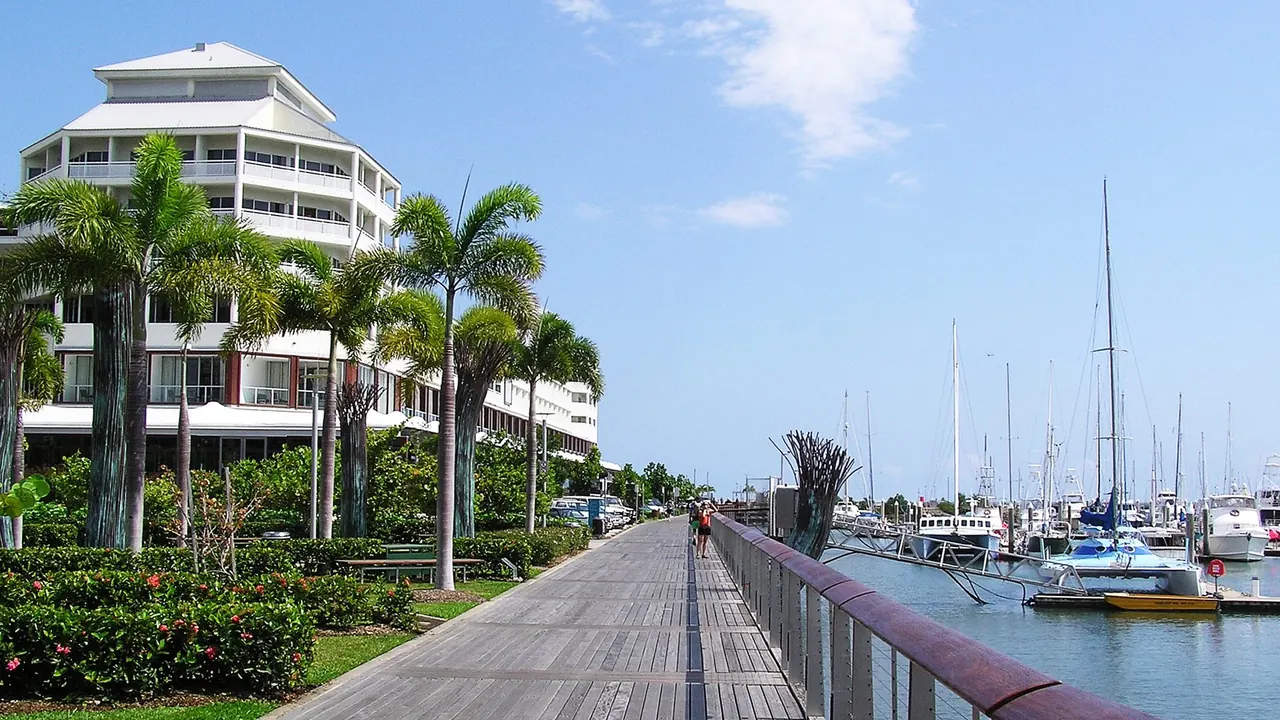
The Esplanade boardwalk and its palms
- Nature & outdoors95
- Families66
- Beaches62
Photo: Donaldytong, Public domain
Match
46
Every category weighted equally
- Beach & sun50
- Culture & arts38
- Food & nightlife39
- Family trip51
- Outdoors54
- Relax & unwind49
- Shopping & style40
- On a budget44
Cairns in twelve categories
Our verdict on each, scored 0 to 100 against the same fixed benchmark cities, so a score means the same thing on every page.
Beaches & swimming. Scores 62 out of 100.
Food & drink. Scores 40 out of 100.
Culture & sights. Scores 22 out of 100.
Nightlife. Scores 42 out of 100.
Nature & outdoors. Scores 95 out of 100.
Day trips. Scores 45 out of 100.
Good for families. Scores 66 out of 100.
Getting around. Scores 45 out of 100.
Shopping & style. Scores 28 out of 100.
Affordability. Scores 35 out of 100.
Live music & performing arts. Scores 22 out of 100.
Wellness & relaxation. Scores 45 out of 100.
Cairns category by category
Beaches & swimming
62Cairns has a waterfront but no beach of its own. The Esplanade faces tidal mudflats, so swimming in town means the large free saltwater lagoon pool on the foreshore. The real beaches start about 20 minutes north: Machans, Holloways, Yorkeys Knob, Trinity Beach, Palm Cove and Ellis Beach, a line of palm-backed sand coves with the rainforested range behind them. The sea is warm all year, around 23°C in winter and 29°C in summer.
The catch is the tropical marine life. From roughly November to May box jellyfish and irukandji come inshore, and swimming is done inside patrolled stinger nets in a wetsuit. Estuarine crocodiles are a lasting caution on this coast too. The best swimming is offshore, at Green Island and Fitzroy Island, where coral sand and clear water sit about an hour away by boat.
Food & drink
40Eating in Cairns is relaxed and casual rather than a reason to come. The strengths are local produce: reef fish such as coral trout and red emperor, prawns and mud crab, and tropical fruit grown in the hinterland. Rusty's Markets, open at the weekend in the city centre, is the place for mangoes, lychees, rambutans and strange fruit you won't see further south. The Esplanade has seafood places and terraces with sea views, and the centre has plenty of cheap Asian food and backpacker pub meals.
The Atherton Tablelands above the city grow coffee, avocados, cheese and tropical fruit wines, which turn up on local menus. Fine dining is thin, and the evening food court at the Night Markets feeds tour crowds more than food lovers.
Culture & sights
22Cairns is a working tropical town, built mostly in the 20th century, and few people come for its sights. The Cairns Art Gallery, in a heritage building near the waterfront, is good on Far North Queensland and Torres Strait Island art, and the small Cairns Museum covers the town's gold-rush port and sugar history. There are a few timber Queenslander houses and Art Deco shopfronts in the centre, plus an aquarium focused on the region's reef and rivers.
The most interesting cultural thread is Aboriginal and Torres Strait Islander art, which you'll find in galleries and arts centres across the city. Overall, a day covers it, and the region's character lies outside town.
Nightlife
42Going out in Cairns means the backpacker scene, and it is louder than you'd expect for a town this size. A few blocks around Shields Street and the Esplanade fill at night with hostel crowds, dive-boat crews and seasonal workers, moving between big pub-style bars, cheap drinks specials and a couple of clubs that stay open until the early hours.
Beyond that the choice is narrow: some waterfront wine and cocktail terraces, the marina bars, and quieter resort bars at Palm Cove. Many visitors go to bed early because the reef boats leave in the morning, and if you're not into the party hostel crowd, evenings are mild.
Nature & outdoors
95This is the reason to come. Cairns is where two World Heritage areas meet: the Great Barrier Reef offshore and the Wet Tropics rainforest on the ranges behind town. Day boats leave the marina each morning for outer reef moorings at Moore, Norman and Saxon Reefs, where snorkellers and divers find coral gardens, giant clams, turtles and reef sharks. The calmest, clearest conditions come in the dry months from about June to November.
On land, Barron Gorge, the Crystal Cascades swimming holes and the rainforest walks around Lake Morris start just outside the suburbs. Further out you'll find crater lakes and waterfalls on the Atherton Tablelands, platypus in the creeks, and the ancient Daintree rainforest running down to the reef at Cape Tribulation. Crocodile-spotting river cruises, white-water rafting on the Tully and Barron, and cassowary sightings round it out.
Day trips
45The places worth visiting within reach of Cairns are few and modest, because the region is mostly wilderness. Kuranda is the classic outing, a village in the rainforest above the Barron Gorge with craft markets and wildlife sanctuaries. Most visitors go up on the Kuranda Scenic Railway, built in the 1880s through tunnels and past waterfalls, and come back down by cableway over the canopy.
Port Douglas, about an hour north along a coast road, is a smarter resort town with a long beach and a Sunday market. On the Tablelands, the villages of Yungaburra and Atherton have a heritage pub and some farm stops. Paronella Park, a romantic ruined Spanish-style castle in the jungle, is about an hour and a half south. Green and Fitzroy islands make easy boat days.
Good for families
66Cairns is an easy, outdoorsy place to bring children. The free Esplanade Lagoon, with lifeguards and shallow edges right on the foreshore, solves the swimming problem in town, and there are long waterfront playgrounds and water-play areas along the same stretch. Reef trips are well set up for families. Green Island has glass-bottomed boats and shallow snorkelling off the beach, and the outer reef pontoons offer underwater observatories and semi-submersibles for children too young to snorkel.
Crocodile parks, koala and wildlife sanctuaries, the aquarium and the train-and-cableway loop to Kuranda give plenty of variety. The limits are the humid wet-season heat, stinger suits for sea swimming in summer, and the absence of big theme parks or major museums.
Getting around
45Cairns is easy to get around on foot, and the hotels, the Esplanade, the Night Markets and the reef fleet terminal at the marina are all a short flat walk apart. That covers much of a typical stay, because reef boats, rafting and rainforest tours usually collect passengers from their accommodation.
Away from the centre things get harder. Local buses run to the northern beaches but not often, and there is no rail network apart from the Kuranda line. Many visitors hire a car to explore Palm Cove, the Tablelands or the road north to Port Douglas and the Daintree. In the wet season, heat and sudden downpours make walking at midday hard work.
Shopping & style
28Shopping isn't much of a reason to visit Cairns. The centre is mostly tour desks, surf and dive gear, and souvenir shops selling opals, crocodile leather and boomerangs, and the Night Markets add more of the same along with massage stalls. Cairns Central, the main mall, covers everyday needs.
The best buys are local. Aboriginal and Torres Strait Islander art galleries sell paintings, prints and carvings from across the Cape York region, and the craft markets at Kuranda and Port Douglas have handmade jewellery, wood and leather. Rusty's Markets is good for local honey, coffee and tropical fruit products to take home.
Affordability
35Cairns is cheaper than Australia's big cities but not cheap. Lots of hostels and apartment hotels keep basic rooms reasonable, especially in the drier months outside school breaks, and the Esplanade Lagoon, the waterfront and the markets cost nothing. Eating out and drinks follow normal Australian price levels.
What drives up the cost is what you came for. Outer reef trips, dives, rainforest tours, the Kuranda train and cableway, and car hire for the Tablelands and the Daintree all cost a lot, and you'll want several of them. If you're planning a reef-and-rainforest week, budget for the activities more than the bed.
Live music & performing arts
22The performing arts in Cairns are small-scale and regional. The Cairns Performing Arts Centre, in the city centre beside the Munro Martin Parklands, hosts touring theatre, comedy, dance and concerts, and the parklands themselves have an open-air stage for evening shows in the dry season. A few kilometres north in Edge Hill, Tanks Arts Centre sits in old wartime fuel tanks beside the Botanic Gardens and puts on gigs, local productions and markets in an atmospheric setting. Pubs in the centre have cover bands and acoustic sets for the backpacker crowd.
Indigenous dance and music are the most distinctive things you can see, at cultural centres and during regional festivals. There is no resident opera, orchestra or theatre company of note, so most visitors fill their evenings in other ways.
Wellness & relaxation
45Cairns has no bathing tradition, but the far north moves slowly and is easy to unwind in. Palm Cove, about 25 minutes north, is the place for it: a short strip of resorts under melaleuca trees, several with large day spas offering massage and treatments that use native botanicals. Port Douglas has similar resort spas.
In town, unwinding means a slow walk along the Esplanade boardwalk at dusk, the lagoon pool, cheap massage at the Night Markets or a stroll through the botanic gardens. The early starts for reef boats and the noisy backpacker blocks work against rest in the centre, so if relaxation is the priority, stay at the northern beaches instead.
When should you go?
Pick a month to see what it is like. The climate figures are measured averages, not a forecast.
Cairns in July
Daytime high, °C
Rainfall in the month, mm
The whole year
Shaded against this city’s own year: the deepest cell is its best month for that figure and the palest its weakest.
Where the figures come from
Cairns's temperatures are measured 27 km from the centre, at Green Island Aws.
Cairns has no rain gauge within 25 km of the centre, so its rainfall comes from a gridded climate dataset read at the city rather than from a gauge further away.
Temperature and rainfall are climate normals, averaged over the years shown. Cairns: 1993-2010 (rainfall 1991-2020) normals, Green Island Aws (27 km from centre).
Before you go
| Measure | Cairns |
|---|---|
| Official language | English |
| Currency | Australian Dollar (AUD) |
| Sockets | I230 V, 50 Hz |
| Driving side | Left |
| Time zone | UTC+10 |
| Emergency number | 000 |
| Elevation | 7 m |
| Main airport | Cairns International Airport (CNS)6 km from centre32 non-stop destinations |
| Public holidays this year | 11 days |
By the numbers
| Measure | Cairns |
|---|---|
| City population | 146,778 |
| People per km² | 301 |
| Museums within 10 km | 1 |
| UNESCO World Heritage sites within 50 km | 1 |
| Swim season, months above 21 °C | 12 months |
Compare Cairns with
Every comparison with a written verdict behind it.