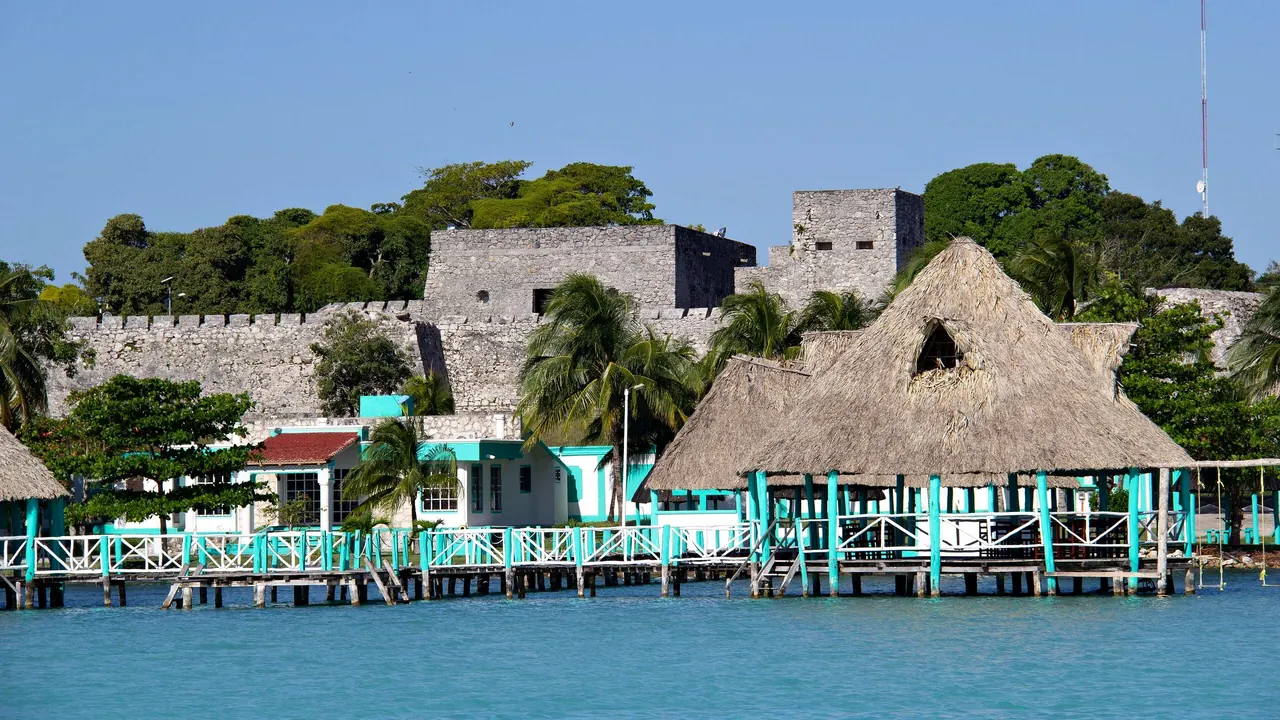
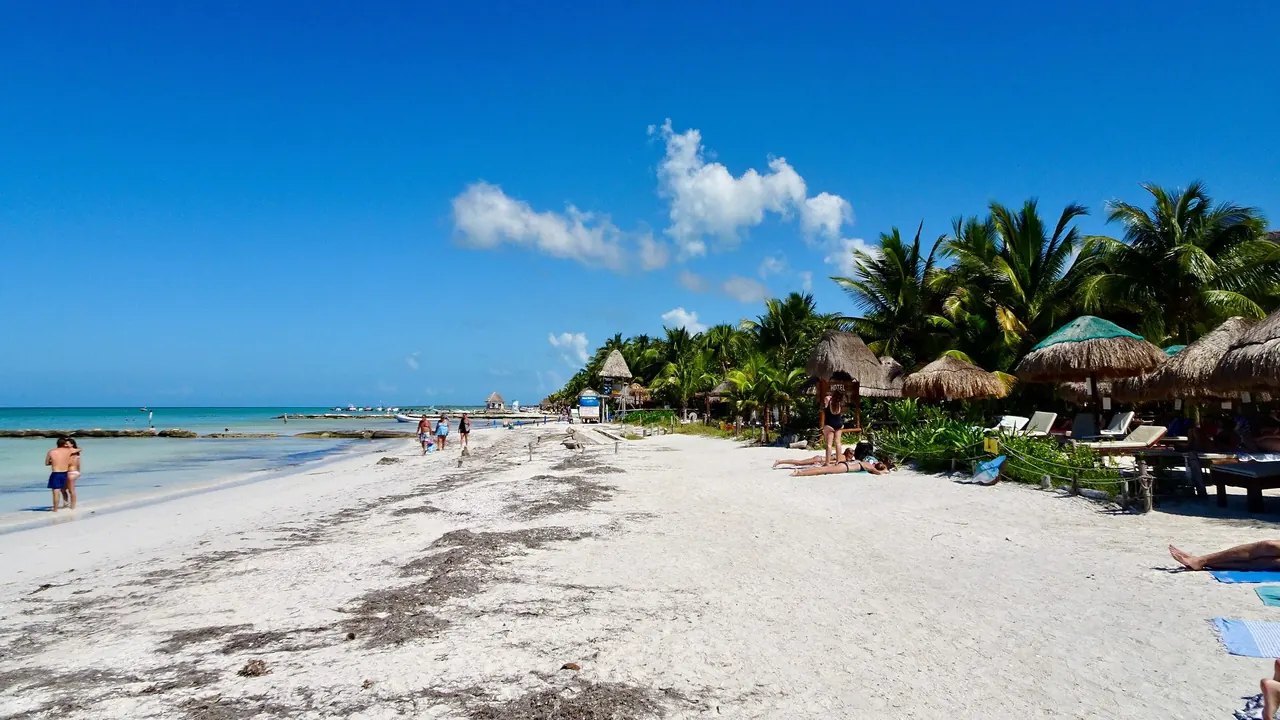
Photos: Bacalar by Gildardo Sánchez, CC BY 2.0, cropped; Holbox by Bruno Rijsman, CC BY-SA 2.0, cropped.
Bacalar or Holbox?
Our verdict in twelve categories, each scored against the same fixed benchmark cities, and the climate month by month, so you can choose for your trip.
Choose Bacalar for
- day trips
- prices
- culture and sights
Bacalar suits travellers who want calm freshwater, a mainland base and some range beyond the water. The lagoon gives warm, clear swimming off wooden docks, and a hire car brings Maya ruins such as Chacchoben and Kohunlich within a day's reach. It is also the easier place to keep costs down, as long as you sleep in town rather than at a lakeside lodge.
Choose Holbox for
- getting around
- nature and the outdoors
- beaches
Choose Holbox if what you picture is a real beach: a long strip of pale sand and shallow sea right behind a car-free village. Wildlife is the other reason to come, with whale sharks in summer, flamingos in the lagoon and glowing plankton on dark nights. In return you accept an island you will rarely leave, higher prices and a longer journey in by road and ferry.
Scoreboard
Twelve categories on one fixed scale from 0 to 100. The shaded stretch is the gap between the two.
Your match
Pick a travel style or drag the sliders, and both match scores follow your weighting.
Too close to call, 1 point apart
Wins on day trips and prices with your weighting.
Wins on getting around and nature and the outdoors with your weighting.
What matters to you?
Category by category
What the scores mean for a trip.
Beaches & swimming
Holbox has the beach in the usual sense. Its whole north shore is fine pale sand on water shallow enough to wade far out, with quieter stretches towards Punta Cocos and the sandbar at Punta Mosquito. The sea is often milky green rather than clear, and seaweed sometimes washes up.
Bacalar swaps sand for freshwater. You swim off jetties into a lagoon of shifting blues, with Cenote Azul for depth and Los Rápidos for a gentle float, but there is no strip of beach to lie on and the Caribbean sand at Mahahual is a long drive away.
Food & drink
Neither place is worth the trip for its food alone, though Holbox has a little more to it. The island's choice is seafood: ceviche, grilled octopus and lobster, including its own lobster pizza, eaten in sand-floored places by the shore, with taco stands around the square at night.
Bacalar's strength is plain Yucatecan home cooking, such as cochinita pibil, salbutes and sopa de lima, in town taquerías, plus a few lakeside kitchens. Both menus start to repeat within a few days.
Culture & sights
Bacalar at least has one proper sight. The eighteenth-century Fuerte de San Felipe has its small museum on the pirate raids and ramparts over the lagoon, and the colonial church stands on the square. Holbox has no monuments or museums at all, and its painted wooden houses and festival murals are the nearest thing to sightseeing.
Nightlife
Holbox has a bit more going on after dark. Sunset drinks on the beach lead into reggae and cocktail bars with sand floors, hostel bars and the occasional beach party on a busy night. Bacalar goes to bed early, with a handful of bars around the square and on the shore for people who will be out paddling at dawn. Neither has a club.
Nature & outdoors
Holbox has the wildlife that people travel a long way for. It lies inside the Yum Balam reserve, with whale sharks offshore in summer, flamingos and frigatebirds in the southern lagoon, bioluminescent plankton on dark nights and winter winds for kitesurfing.
Bacalar's nature is quieter and centres on one spectacle, the lagoon itself. You get sunrise paddles over glassy water, ancient stromatolites, the Pirates' Channel and Bird Island by sailing boat. The forest around it is flat, with few trails.
Day trips
Here Bacalar is far ahead. Chacchoben's jungle temples are under an hour away, Kohunlich's stucco masks and Dzibanché make a full day together, and Chetumal has a good Maya museum. None is a famous site, and a car helps.
From Holbox, the ferry crossing puts Chichen Itza, Ek Balam and Valladolid out of comfortable reach for a day, so outings stay on the water among sandbars and mangroves.
Good for families
Holbox edges it for small children. The sea is warm, very shallow and goes right along the village, and with no cars around, children can roam freely. Bacalar's lagoon is just as gentle and wave-free, and older children can paddle kayaks there.
What tells against each is different. In Bacalar the stays are spread out along a road with few pavements, and the inland heat is tiring. On Holbox, the streets are sand that defeats a pushchair, and the journey in takes most of a day.
Getting around
Once you have arrived, Holbox is simpler. The car-free village and its beach can be covered on foot, by bicycle or by golf-cart taxi. The catch is reaching it, by road to Chiquila and then the ferry.
Bacalar is easy to reach by long-distance bus, but harder to get around. Its small centre is walkable, while the lodges, balnearios and Cenote Azul are strung out for kilometres along the shore, so you need taxis, a bicycle or ideally a hire car.
Shopping & style
Both offer the same short list of hammocks, beachwear and souvenirs from a few stalls around the main square. Bacalar's embroidered cotton is a small extra, and Chetumal is nearby for anything practical. On Holbox, what the island stocks is what you get.
Affordability
Bacalar is noticeably cheaper as long as you stay in town, with inexpensive local food, taxis, bike hire and shared boat trips. Its lakeside lodges with private docks, though, cost as much as anywhere on the Caribbean coast.
Holbox costs more across the board, because goods arrive by ferry and meals and hotels are priced for visitors. The whale shark trip is a large expense in itself. Bring cash, as cash machines are scarce.
Live music & performing arts
Neither has any stage to speak of. Music means a guitarist or small band in a beach bar on Holbox, or the occasional weekend set on Bacalar's plaza, and nobody should plan evenings around either.
Wellness & relaxation
Both are restful for the same reason, a slow pace, though the setting differs. Bacalar's quiet comes from lakeside lodges, dawn paddles and the temazcal steam ceremony. Holbox's comes from car-free sand streets, hammocks over the shallows and beach massages, with a few small hotel spas.
When should you go?
Pick your month. The climate figures are measured averages, not a forecast.
Bacalar in July
Holbox in July
Daytime high, °C
Rainfall in the month, mm
Where the figures come from
Holbox has no weather station within reach, so its figures come from a gridded climate model rather than a measured record, and read a broad area rather than one spot.
Temperature and rainfall are climate normals, averaged over the years shown. Bacalar: 1991-2020 normals, Chetumal, Q. Roo (23.4 km from centre). Holbox: 2001-2020 normals, NASA POWER reanalysis grid, no weather station within 90 km.
Both are at their best from February to April, when the rain is lightest. Around Bacalar this is also the sunniest part of the year, and the lagoon stays warm enough for a long swim in every month. Inland heat is the drawback there, with highs reaching 35°C in August, so walking the streets is heavy going by midday from late spring onwards. Holbox has the gentler air, a few degrees cooler all year, but in midwinter its sea drops to about 24°C, fresh enough that some swimmers will notice it.
The rains begin around May or June and carry on through November rather than stopping in autumn. At Bacalar the wet season is longer and heavier, peaking at about 207mm in October, and November still brings around 116mm, as much as May or July. Holbox's November is lighter but still wetter than its winter months, and its wet season turns the sand streets to mud and brings out the mosquitoes. December and January are the easiest months for walking in both, with only a few showers.
Which traveller are you?
On a beach and sun trip, Holbox gives you the days such a trip is built on: step out of the village onto sand, lie down, wade in and repeat. Bacalar's lagoon is beautiful water, but you swim off a jetty rather than spend a day on the sand.
For a culture and arts trip, Bacalar is the only one of the two that works, although it is still modest. A mainland base means some history can sit beside the swimming. On Holbox the island itself is the whole programme, and leaving it is hard.
On a trip on a tight budget, Bacalar works better because the cheap way to do it is also a good one: stay in town and the lagoon is still yours to swim in. On Holbox, the wildlife that makes the island special is also what costs most.
Before you go
| Measure | Bacalar | Holbox |
|---|---|---|
| Official language | Spanish, Nahuatl, Yucatec Maya | Spanish, Nahuatl, Yucatec Maya |
| Currency | Mexican Peso (MXN) | Mexican Peso (MXN) |
| Sockets | AB127 V, 60 Hz | AB127 V, 60 Hz |
| Driving side | Right | Right |
| Time zone | UTC-5 | UTC-5 |
| Emergency number | 911 | 911 |
| Elevation | 11 m | - |
| Main airport | Chetumal International Airport (CTM)20 km from centre2 non-stop destinations | Cancún International Airport (CUN)136 non-stop destinations |
| Public holidays this year | 9 days | 9 days |
By the numbers
| Measure | Bacalar | Holbox |
|---|---|---|
| Population | 12,527 | 1,841 |
| People per km² | - | 33 |
| Museums within 10 km | 1 | - |
| UNESCO World Heritage sites within 50 km | 0 | - |
| Swim season, months above 21 °C | 12 months | 12 months |
Where else could you go?
Every comparison below shares a destination with this one, so you can follow Bacalar or Holbox somewhere new.
- Isla Mujeresvs Holbox
- Riviera Mayavs Holbox
- Cozumelvs Holbox
- Tulumvs Holbox
- Yucatanvs Holbox
- Tulumvs Bacalar