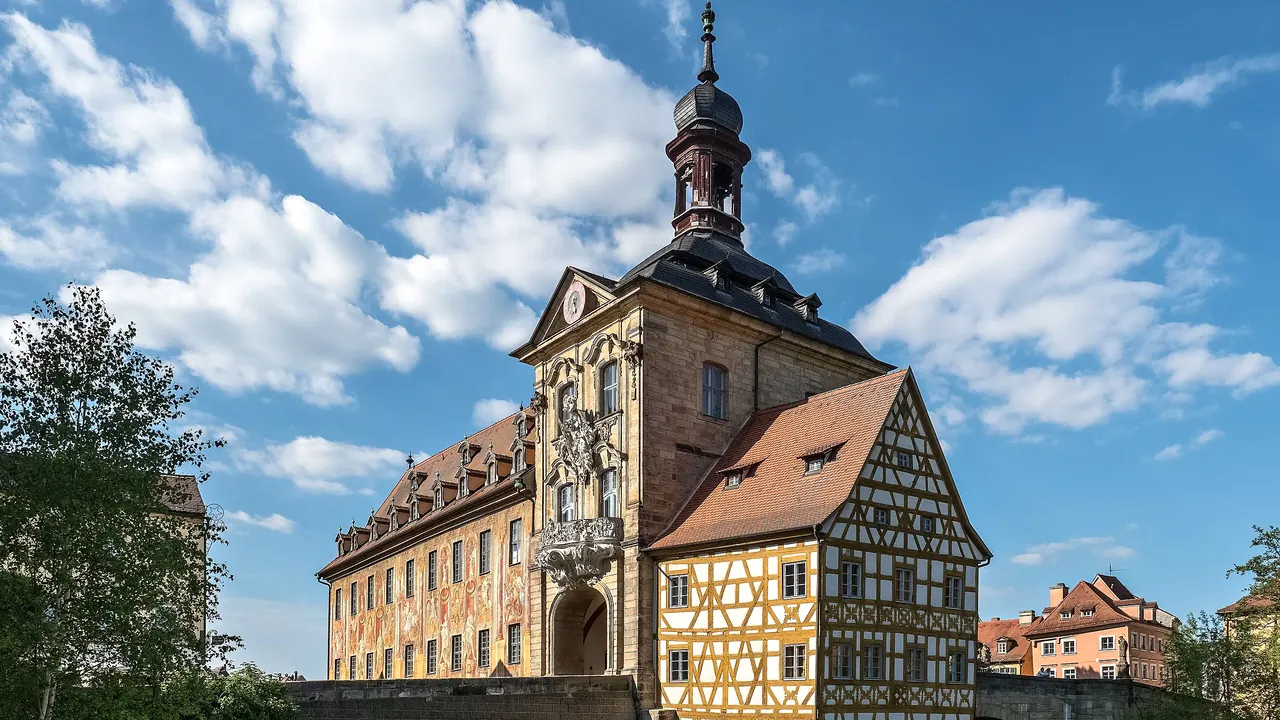
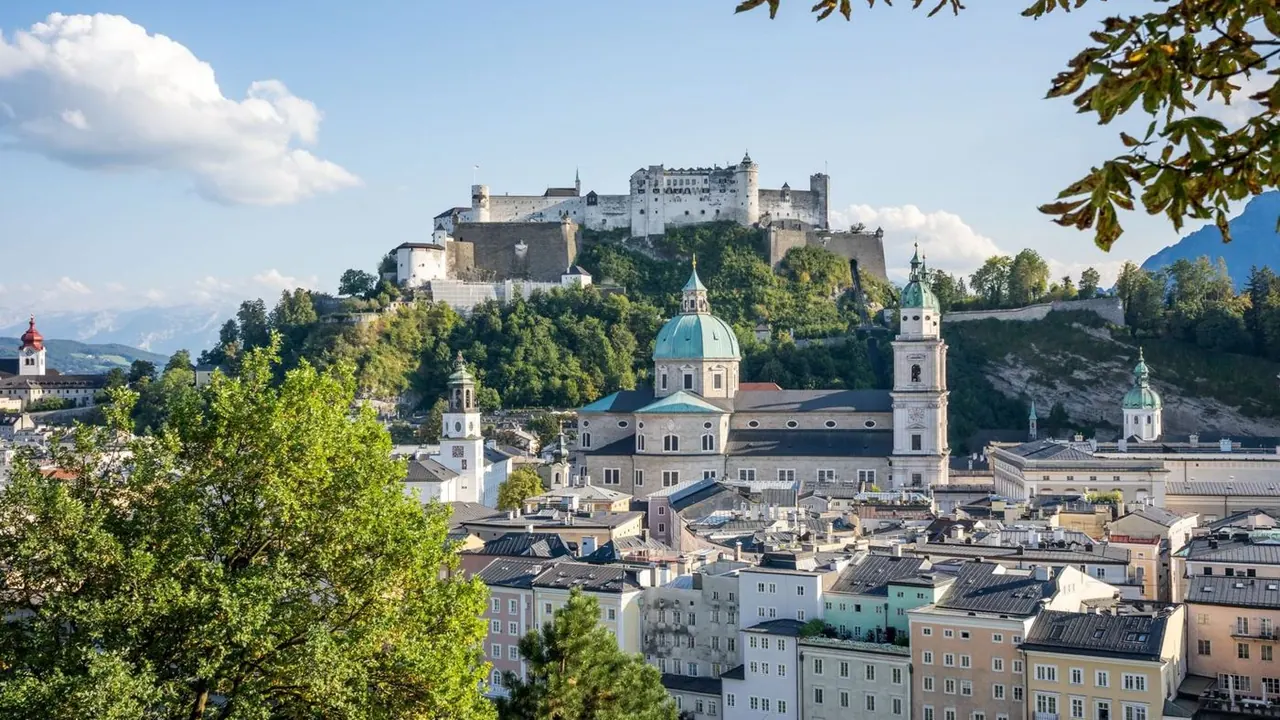
Photos: Bamberg by Ermell, CC BY-SA 4.0, cropped; Salzburg by Leonhard Niederwimmer, Pexels License.
Bamberg or Salzburg?
Our verdict in twelve categories, each scored against the same fixed benchmark cities, and the climate month by month, so you can choose for your trip.
Choose Bamberg for
- prices
- food and drink
- nightlife
Bamberg suits travellers who want an intact old town to wander and a brewery tavern table at the end of the day. Its smoked beer, hillside beer cellars and Franconian cooking make it the better place to eat and drink, it costs noticeably less, and its rail links make it an easy base for Nuremberg, Würzburg and Bayreuth.
Choose Salzburg for
- live music and the arts
- nature and the outdoors
- beaches
For music, mountains or a trip with children, Salzburg is the better pick. Its festival halls and nightly concerts put classical music at the centre of a stay. The Alps and the Salzkammergut lakes begin at the edge of town, and Hellbrunn, the salt mines and the hands-on museum keep families busy. Expect to pay more for all of it.
Scoreboard
Twelve categories on one fixed scale from 0 to 100. The shaded stretch is the gap between the two.
Your match
Pick a travel style or drag the sliders, and both match scores follow your weighting.
Wins on prices and food and drink with your weighting.
Wins on live music and the arts and nature and the outdoors with your weighting.
What matters to you?
Category by category
What the scores mean for a trip.
Beaches & swimming
Neither city is a beach destination, but Salzburg has the better swimming. The clear Salzkammergut lakes, among them Fuschlsee, Wolfgangsee and Mondsee, are within an hour. You swim from jetties, lawns and pebble shores, and the water reaches roughly 20-24°C in high summer.
Bamberg's options are closer and more modest: the old river bathing spot in the Hain park, gravel-pit lakes on the outskirts and the town pools. They are fine for cooling off but not for a day by the water.
Food & drink
Bamberg eats and drinks better, and the reason is beer. It has smoky Rauchbier poured from wooden barrels, a dense network of small breweries and summer Bierkeller under chestnut trees. Schäufele, dumplings and produce from the market gardeners complete the picture.
Salzburg's strengths are its coffee houses, its cakes and the Salzburger Nockerl, along with the Augustiner beer hall in Mülln. Many old-town restaurants serve tour-group menus, so better cooking means going out to the inns on the edge of town. Both cities offer only a narrow range of cuisines.
Culture & sights
Both are UNESCO-listed old towns best seen on foot, so the difference is one of character. Bamberg is medieval and spread over seven church-topped hills, with the four-towered cathedral, the Old Town Hall on its river island and the fishermen's houses of Little Venice. Its museums are small, and the townscape is the point.
Salzburg is Baroque and was built by its prince-archbishops around arcaded squares below the Hohensalzburg fortress. It also has more to see indoors: the Residenz state rooms, the Mozart houses, the St Peter catacombs and the Museum der Moderne on the Mönchsberg.
Nightlife
After dark, Bamberg keeps going a little longer. The brewery taverns fill up straight after work, the student bars in the Sand quarter below the cathedral run late in term time, and on summer nights people stay at the long tables of the hillside beer cellars well into the evening. Clubs are few and small.
A Salzburg evening is more often a concert, a late dinner and a litre mug in a beer hall shared with locals. Rudolfskai and the streets near the university have a handful of later bars, mostly at weekends, but the old town is quiet by midnight. For a proper night out, Bamberg sends you to Nuremberg by train and Salzburg to Munich.
Nature & outdoors
Here Salzburg is in another league. Wooded ridges rise in the middle of the city, and the Untersberg cable car lifts you to about 1,800m for ridge walks. The Gaisberg, the Salzkammergut lakes, the Königssee and the ski areas are all within easy reach.
Bamberg's countryside is gentler. It has river cycle paths through orchard villages, the beech forests of the Steigerwald, and the rock towers and caves of Franconian Switzerland. That is good for walks from one village brewery to the next, but there are no mountains or long views.
Day trips
Both make good bases, and Salzburg has more variety. From there you can reach Hallstatt on its lake, the salt mines at Hallein and Berchtesgaden, the clifftop fortress at Werfen and Munich. Some of the lake villages are much easier to reach by car.
Bamberg's strength is a run of historic towns close by rail. Nuremberg, Würzburg, Coburg and Bayreuth are each about an hour away, and the basilica of Vierzehnheiligen is nearer still. Its list is richer in cities than in landscapes.
Good for families
Salzburg gives children far more to do. There are the trick fountains at Hellbrunn with the zoo next door, the hands-on Haus der Natur, the funicular up to the fortress and the marionette theatre. The salt mines nearby add wooden miners' slides and boat rides underground.
Bamberg is calm and easy with children. The Hain park has playgrounds and boat hire, the leisure pool covers rainy days, and children play between the tables in the beer gardens, but little is aimed at them. In both towns the steep cobbles are hard work with a pushchair.
Getting around
Both are compact and walkable, and neither needs a car in town, so the differences are small. In Bamberg the sights cluster around the island town and the cathedral hill. Buses and bicycles cover longer distances, and the station, a fair walk from the centre, has trains across Franconia.
Salzburg has a dense trolleybus network that reaches Hellbrunn and the Untersberg cable car. Its lake villages and Berchtesgaden are slow to reach by regional bus, though, which is why many visitors hire a car for those outings.
Shopping & style
Salzburg has more to buy, above all Tracht. Old-town workshops sell dirndls, loden jackets and leather goods, often made to measure. There is also Getreidegasse, a lane hung with guild signs, as well as a farmers' market and the long-established Advent market on Domplatz.
Shopping in Bamberg takes an hour or so among chain stores, bookshops and a few boutiques. The best things to take home are bottled smoked beer, produce from the market gardens and finds from the antique dealers near the cathedral.
Affordability
Bamberg is clearly the cheaper place to stay. Beer and tavern meals cost little, rooms are moderately priced for most of the year, and you walk rather than pay for transport. Weekends in the old town and the Christmas market season do push prices up.
Salzburg is expensive for its size. Old-town hotels are costly all year, and rooms are scarce and pricey during the summer festival and Advent. You can save by staying across the river, eating in the inns of the outer districts and buying a city card.
Live music & performing arts
For classical music, Salzburg is one of the great destinations. In summer the Festival fills the Grosses Festspielhaus and the Felsenreitschule with opera and orchestras, and Mozart Week and the Easter Festival add two more seasons. The Mozarteum, the Landestheater and the Marionette Theatre keep the rest of the year busy.
Bamberg's real asset is the Bamberg Symphony and its concert hall on the river. It also has drama at the ETA Hoffmann Theatre and church concerts, but no opera company of its own. For opera it looks to Bayreuth, an hour away.
Wellness & relaxation
Both towns slow down once the day visitors leave, and neither has thermal springs of its own, but Salzburg has more within reach. The Paracelsus Bad is in the city park, and the brine spa town of Bad Reichenhall is twenty minutes away. Further out are the radon springs of the Gastein valley and the spa hotels by the lakes.
Bamberg's calm comes from mornings by the river and long afternoons in the beer gardens. Its leisure pool has a sauna, and the warm brine pools of Bad Staffelstein are about half an hour away by train.
When should you go?
Pick your month. The climate figures are measured averages, not a forecast.
Bamberg in July
Salzburg in July
Daytime high, °C
Rainfall in the month, mm
Temperature and rainfall are climate normals, averaged over the years shown. Bamberg: 1991-2020 normals, Bamberg (2.8 km from centre). Salzburg: 1991-2020 normals, Salzburg (3.4 km from centre).
The two cities have almost the same temperatures, rising from about 4°C in midwinter to around 25°C in July and August. Both are pleasant for walking from May to September, and both are cold, with short days, from November to February. Neither has a real beach season. Salzburg's lakes are warm enough for a swim from June to early September, and in the same weeks Bamberg has its river bathing spot and gravel-pit lakes.
The real difference is rain. Bamberg stays fairly dry all year, with its wettest month at 79mm in July, and its summers are a little sunnier. Salzburg's summer is wet, with around 168mm in June, so a summer trip there needs a plan for rainy afternoons. In winter, though, Salzburg gets more sunshine of the two.
Which traveller are you?
On a trip on a tight budget, Bamberg is the easier choice. Cheap local beer, filling plates in brewery taverns, moderately priced rooms and a centre you can walk keep costs down. Salzburg's old-town hotels and restaurants are expensive all year.
For an outdoors trip, Salzburg wins clearly. The Untersberg cable car, the Gaisberg trails, the Salzkammergut lakes and Berchtesgaden National Park are all close. Bamberg offers gentle cycling, beech woods and the limestone valleys of Franconian Switzerland.
On a food and nightlife trip, choose Bamberg. It has a dense cluster of small breweries, smoked beer poured from the barrel and summer evenings in the hillside beer cellars. The student bars of the Sand quarter also stay livelier than Salzburg's quiet old town.
Before you go
| Measure | Bamberg | Salzburg |
|---|---|---|
| Official language | German | German, Austrian Sign Language |
| Currency | Euro (EUR) | Euro (EUR) |
| Sockets | CF230 V, 50 Hz | CF230 V, 50 Hz |
| Driving side | Right | Right |
| Time zone | UTC+1, UTC+2 in summer | UTC+1, UTC+2 in summer |
| Emergency number | 112 | 112 |
| Elevation | 262 m | 424 m |
| Main airport | Nuremberg Airport (NUE)46 km from centre56 non-stop destinations | Salzburg Airport (SZG)3 km from centre64 non-stop destinations |
| Public holidays this year | 12 days | 16 days |
By the numbers
| Measure | Bamberg | Salzburg |
|---|---|---|
| City population | 77,218 | 155,021 |
| People per km² | 1,414 | 2,360 |
| Museums within 10 km | 11 | 38 |
| UNESCO World Heritage sites within 50 km | 1 | 3 |
Where else could you go?
Every comparison below shares a destination with this one, so you can follow Bamberg or Salzburg somewhere new.
- Nurembergvs Bamberg
- Hallstattvs Salzburg
- Rothenburg ob der Taubervs Bamberg
- Munichvs Salzburg
- Innsbruckvs Salzburg
- Karlovy Varyvs Bamberg