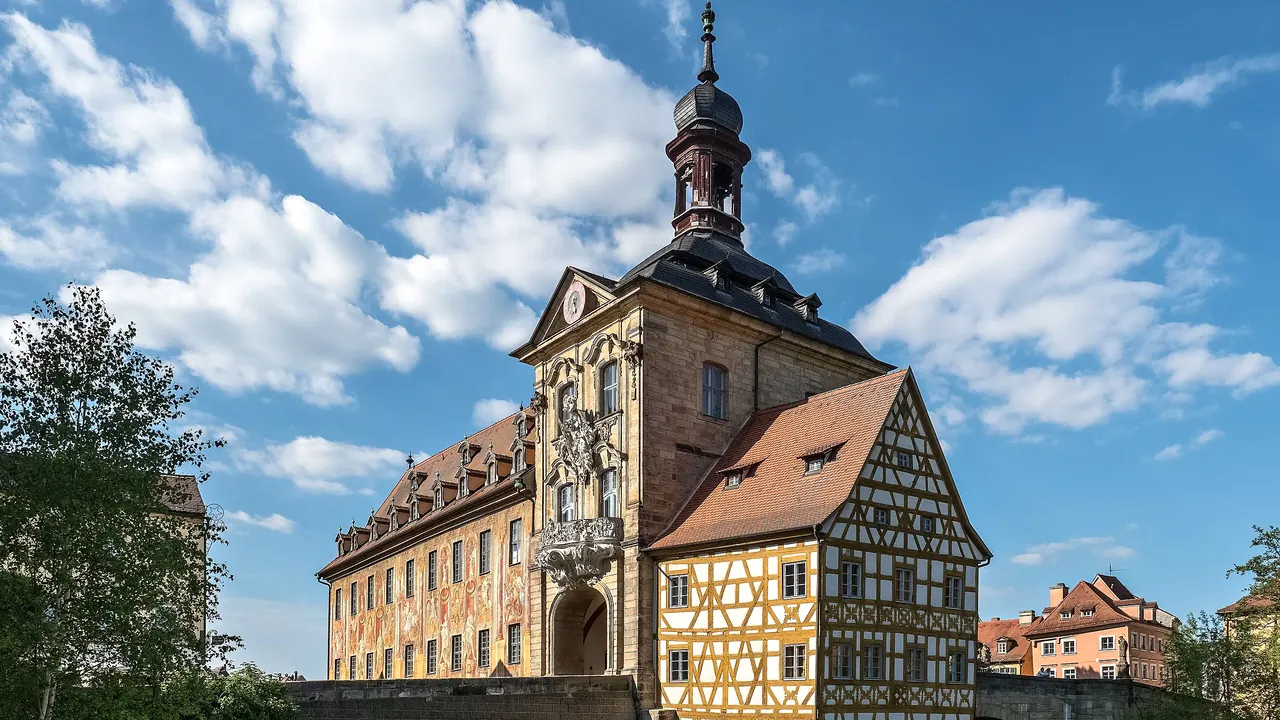
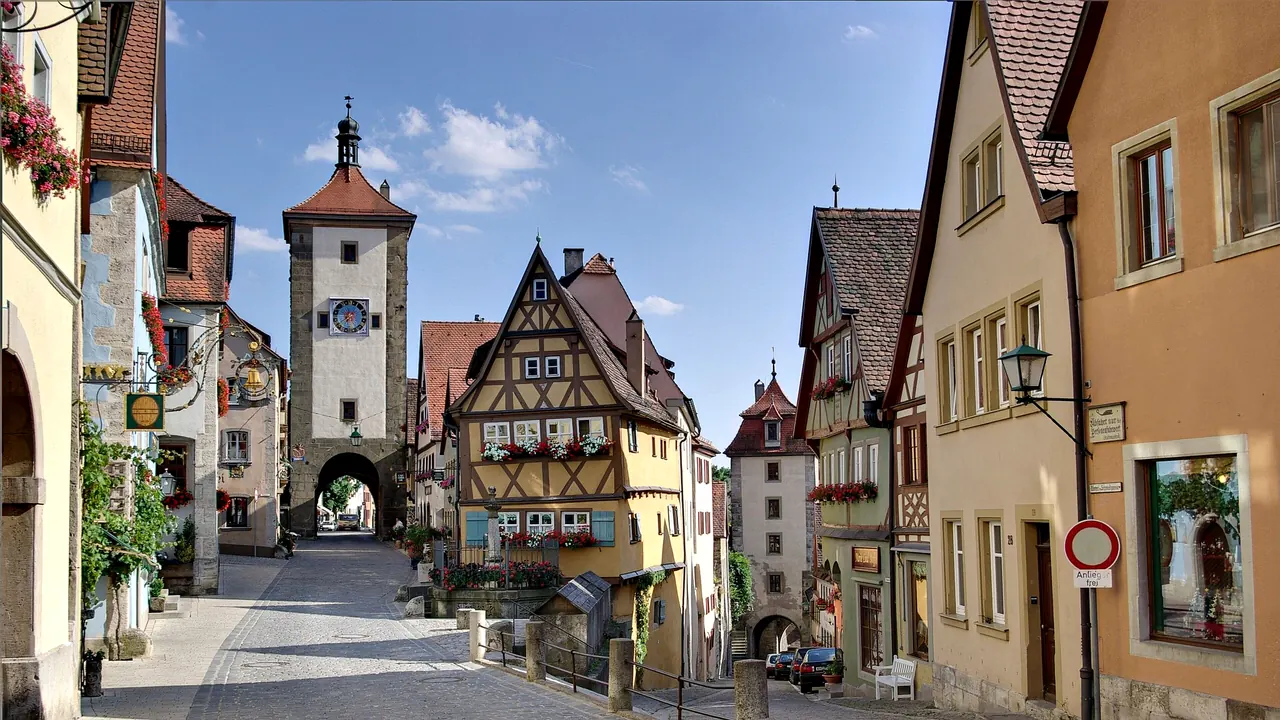
Photos: Bamberg by Ermell, CC BY-SA 4.0, cropped; Rothenburg ob der Tauber by Berthold Werner, Public domain.
Bamberg or Rothenburg ob der Tauber?
Our verdict in twelve categories, each scored against the same fixed benchmark cities, and the climate month by month, so you can choose for your trip.
Choose Bamberg for
- food and drink
- live music and the arts
- nightlife
Bamberg suits travellers who want a historic town that still runs on its own daily life. Its UNESCO-listed centre spreads over seven hills and both banks of the Regnitz, the brewery taverns and hillside beer cellars give it real evenings, and the Bamberg Symphony adds concerts. Because it sits on a main rail line, it also works well as a base for several days in Franconia without a car.
Choose Rothenburg ob der Tauber for
Rothenburg ob der Tauber does not lead in any category we score.
Rothenburg is the choice for anyone who wants the walled medieval town itself: walking the covered ramparts, the view at the Plönlein and the night watchman's tour after dark. It is smaller, quieter and more given over to visitors, and its food and evenings are thinner. It works best as a night or two on a Romantic Road drive, with a car for the walled towns nearby.
Scoreboard
Twelve categories on one fixed scale from 0 to 100. The shaded stretch is the gap between the two.
Your match
Pick a travel style or drag the sliders, and both match scores follow your weighting.
Wins on food and drink and live music and the arts with your weighting.
Has no clear advantage with the weighting you have chosen.
What matters to you?
Category by category
What the scores mean for a trip.
Beaches & swimming
Neither town is a place for swimming, and both are far from any coast. The difference is where the water is. Bamberg has its traditional river bathing spot in the Hain park and gravel-pit lakes on the edge of town, so a cooling swim is close at hand. In Rothenburg it means the town's outdoor pool, or an hour's drive to the grassy shores of the Altmühlsee and the other Franconian lakes.
Food & drink
Bamberg is far stronger on food and drink, and almost entirely because of beer. Dozens of small breweries in and around town pour smoky Rauchbier in centuries-old taverns, and in summer whole evenings move up to the Bierkeller under the chestnut trees. Add the Hörnla potatoes and the market gardeners' stalls on Grüner Markt, and the local food is a reason to come in its own right.
Rothenburg serves the same Schäufele and dumplings, but with more Silvaner wine than beer. Many kitchens around the Marktplatz cater to coach parties, and the sugary Schneeball is more photogenic than good. The better meals are in family guesthouses and Tauber valley wine taverns away from the square. Neither town has much fine dining or international food.
Culture & sights
Both are among Germany's best-preserved historic towns, but they feel different to visit. Bamberg is larger and more varied. The four-towered Imperial Cathedral and Neue Residenz crown one of its seven hills, the frescoed Old Town Hall stands on an island in the Regnitz, and Little Venice and the market gardeners' quarter take several days to explore.
Rothenburg is the more concentrated picture: a complete medieval walled town with a walkway along its ramparts, the Plönlein fork and Riemenschneider's Holy Blood Altar in St Jakob's. The Medieval Crime Museum gives it a stronger single museum, but it is a rewarding day rather than a long stay.
Nightlife
Bamberg is the only one of the two with an evening scene worth the name. The brewery taverns fill after work, the student bars of the Sand quarter stay busy late during term, and summer nights stretch out in the beer cellars. Rothenburg goes quiet once the day visitors leave. The night watchman's tour is the main event, the wine taverns close early and the lanes are silent by eleven. For a real night out, both towns send you to Nuremberg.
Nature & outdoors
Bamberg has more countryside within reach. Franconian Switzerland, with its rock towers, caves and castle-topped crags for climbing and hiking, begins less than an hour east. The Steigerwald's beech forests lie to the west, and cycle routes follow the Main and Regnitz past orchard villages.
Rothenburg's outdoors is smaller in scale but closer to the door. Paths drop straight from the walls into the Tauber valley past mills and the Topplerschlösschen, and the family-friendly Tauber valley cycle path heads downstream through vineyards. Beyond that there is only the gently rolling Frankenhöhe.
Day trips
Both make good bases, but for different kinds of outing. From Bamberg, the main rail line puts Nuremberg, Würzburg, Coburg and Bayreuth each within about an hour without a car, and the baroque basilica of Vierzehnheiligen faces Banz Abbey just up the Main.
Rothenburg's strength is the Romantic Road. Dinkelsbühl, crater-ringed Nördlingen, Schwäbisch Hall and Weikersheim's palace gardens are all near, though trains are poor and these trips really need a car.
Good for families
Neither town is built around children, and both have steep cobbles that are hard on pushchairs. They appeal in different ways. Bamberg offers ordinary outdoor fun: playgrounds and open space in the Hain park, rowing boats on the Regnitz, a leisure pool with slides and beer gardens where children play between the tables.
Rothenburg is more of an adventure for a day or two. Children can walk the ramparts, climb the Rathaus tower and follow the lantern-carrying night watchman, and older ones tend to love the shame masks in the Crime Museum.
Getting around
Both centres are walked rather than driven, but Bamberg is easier once you look beyond the old town. Its city buses, flat lower town for cycling and main-line station connect it to the rest of Franconia, so a visit needs no car at all.
Inside Rothenburg's walls, you can cross the whole town in a quarter of an hour. Beyond them, the town sits at the end of a branch line that usually means changing at Steinach, and village buses are sparse. For most visitors, that makes a car the practical choice.
Shopping & style
The two towns are much of a muchness for shopping, but they suit quite different shoppers. Bamberg is the one for everyday browsing and for things you can eat or drink at home: bottles of smoked beer from the brewery shops, produce grown in the market gardeners' plots inside the town, and an hour in the antique dealers below the cathedral or the independent bookshops among the chains on the pedestrian streets. It rewards someone who picks things up along the way, not anyone hunting for fashion.
Rothenburg is for the visitor who wants Christmas, whatever the month. Its year-round shops of glass baubles, nutcrackers, smoking men and Erzgebirge carvings are reason enough for some people to make the journey, and in December the market on the Marktplatz is one of the most atmospheric in Germany. For clothes, design or ordinary errands it offers even less than Bamberg, and most of what is for sale is made with souvenirs in mind.
Affordability
Bamberg is the easier town on the wallet. Its beer is cheap, a roast pork plate in a brewery tavern costs less than in a big city, and as a walkable town on a main rail line it adds little in transport. Rothenburg puts a tourist premium on rooms inside the walls and meals around the Marktplatz, and a car often becomes part of the cost. Sleeping outside the walls or in a nearby village cuts the bill noticeably. In both towns, prices climb during the Christmas market season.
Live music & performing arts
Bamberg has by far the richer stage. The Bamberg Symphony is an orchestra of international standing with its own concert hall on the Regnitz, the ETA Hoffmann Theatre stages drama through the season and the cathedral holds organ and choral concerts. Bayreuth's Wagner festival is within easy reach by train.
Rothenburg's performances are mostly about its own history. The costumed Meistertrunk play retells the town's rescue in the Thirty Years' War, and there are summer open-air productions and concerts in St Jakob's. On most evenings there is no show at all.
Wellness & relaxation
Both towns relax you through their pace rather than through spas, and neither has a bathing tradition of its own. Bamberg's calm comes from slow mornings by the river and long afternoons in beer gardens. Its leisure pool has a sauna, and the brine pools of Bad Staffelstein are a short train ride away. Rothenburg is most peaceful early and late, when the walls and valley paths empty. Its thermal options, the floating salt pool at Bad Windsheim and the spa town of Bad Mergentheim, are within about an hour's drive.
When should you go?
Pick your month. The climate figures are measured averages, not a forecast.
Bamberg in July
Rothenburg ob der Tauber in July
Daytime high, °C
Rainfall in the month, mm
Where the figures come from
Rothenburg ob der Tauber's sunshine is measured 27 km from the centre, at Feuchtwangen-heilbronn.
Temperature and rainfall are climate normals, averaged over the years shown. Bamberg: 1991-2020 normals, Bamberg (2.8 km from centre). Rothenburg ob der Tauber: 1991-2020 normals, Rothenburg ob der Tauber (0.9 km from centre).
The two towns have almost the same climate, so the season matters more than which of them you pick. Both are at their best from May to September. Highs in the low to mid twenties make the cobbled climbs pleasant and the beer gardens and valley paths inviting. July is the warmest month, reaching about 26°C in Bamberg, and Rothenburg is a little sunnier through high summer. Summer is also the wettest stretch, with showery spells, and Bamberg's July rainfall of around 79mm is the highest in either town.
December to February is the cold core of the year. Highs sit only a few degrees above freezing and the days are short and grey, so this is sightseeing in a warm coat rather than lingering outdoors. November and March are in-between months, with highs of about 8 to 10°C, and April and October are cool but comfortable for walking the streets. Rothenburg is slightly damper through the winter, while Bamberg's spring is a little drier.
Which traveller are you?
For a food and nightlife trip, Bamberg is the clear pick. Its smoked beer, wooden-barrel brewery taverns, summer beer cellars and student bars in the Sand quarter give it a food and evening life that quiet, early-to-bed Rothenburg cannot match.
On an outdoors trip, Bamberg again comes out ahead. The limestone valleys, crags and caves of Franconian Switzerland are under an hour away, and there are river cycle paths and brewery-to-brewery hikes. Rothenburg's Tauber valley is lovely but small and gentle.
On a trip with a tight budget, Bamberg goes further. Cheap local beer and tavern meals, moderate rooms and a walkable town connected by train keep costs down. In Rothenburg, rooms inside the walls carry a tourist premium and you will probably need a car.
Before you go
| Measure | Bamberg | Rothenburg ob der Tauber |
|---|---|---|
| Official language | German | German |
| Currency | Euro (EUR) | Euro (EUR) |
| Sockets | CF230 V, 50 Hz | CF230 V, 50 Hz |
| Driving side | Right | Right |
| Time zone | UTC+1, UTC+2 in summer | UTC+1, UTC+2 in summer |
| Emergency number | 112 | 112 |
| Elevation | 262 m | 430 m |
| Main airport | Nuremberg Airport (NUE)46 km from centre56 non-stop destinations | Nuremberg Airport (NUE)66 km from centre56 non-stop destinations |
| Public holidays this year | 12 days | 12 days |
By the numbers
| Measure | Bamberg | Rothenburg ob der Tauber |
|---|---|---|
| City population | 77,218 | 11,331 |
| People per km² | 1,414 | 272 |
| Museums within 10 km | 11 | 6 |
| UNESCO World Heritage sites within 50 km | 1 | 2 |
Where else could you go?
Every comparison below shares a destination with this one, so you can follow Bamberg or Rothenburg ob der Tauber somewhere new.
- Nurembergvs Bamberg
- Nurembergvs Rothenburg ob der Tauber
- Stuttgartvs Rothenburg ob der Tauber
- Heidelbergvs Rothenburg ob der Tauber
- Frankfurtvs Rothenburg ob der Tauber
- Karlovy Varyvs Bamberg