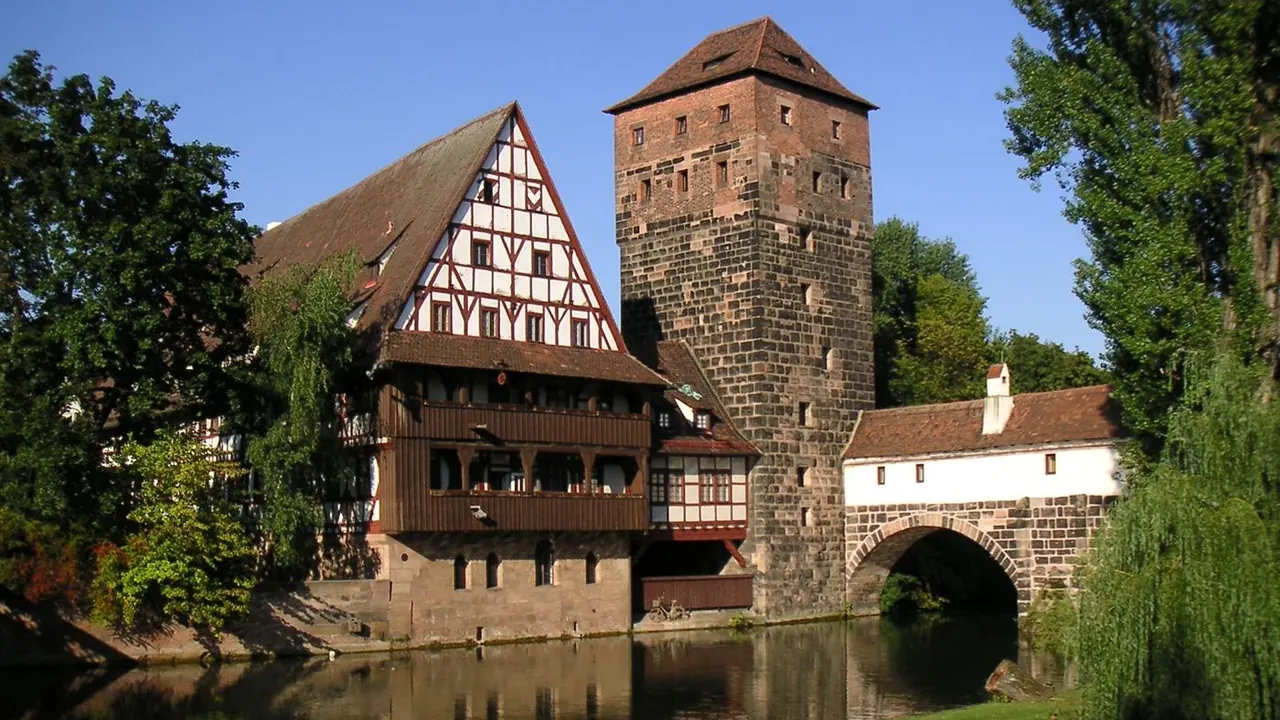
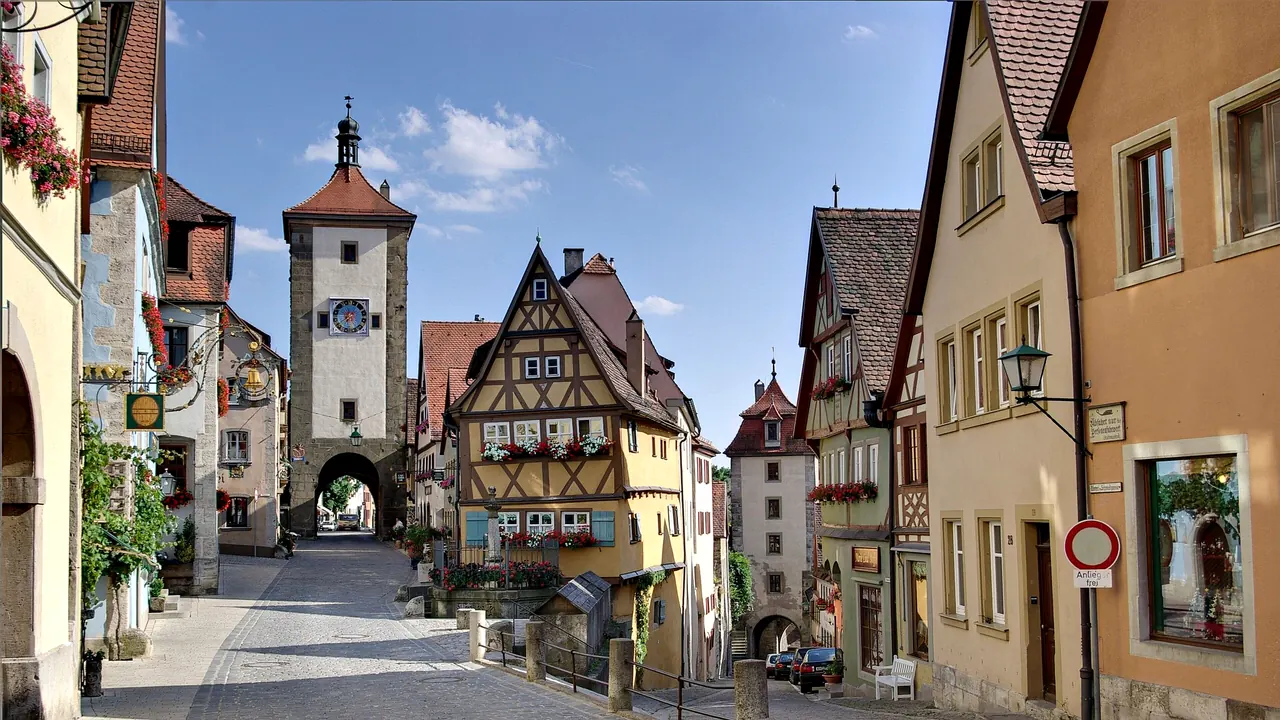
Photos: Nuremberg by Horst Gutmann, CC BY 2.0, cropped; Rothenburg ob der Tauber by Berthold Werner, Public domain.
Nuremberg or Rothenburg ob der Tauber?
Our verdict in twelve categories, each scored against the same fixed benchmark cities, and the climate month by month, so you can choose for your trip.
Choose Nuremberg for
- live music and the arts
- nightlife
- food and drink
Nuremberg is the better base for most trips of more than a couple of days. It pairs a walled old town and an imperial castle with a major museum, the Nazi-era sites, a proper theatre and orchestra programme, beer gardens and a lively bar district. Its rail and U-Bahn network also makes it easy to reach Bamberg, Würzburg, Regensburg and even Rothenburg without a car. Families, food and beer lovers and anyone who wants evenings out will find far more here.
Choose Rothenburg ob der Tauber for
Rothenburg ob der Tauber does not lead in any category we score.
Rothenburg ob der Tauber suits travellers who want the medieval town itself and little else. Its walls, lanes and gate towers are more intact than Nuremberg's rebuilt centre, and early mornings and late evenings are deeply quiet. It is best as a one- or two-night stop on a driving tour of the Romantic Road, with wine taverns at dinner and a walk on the ramparts instead of a night out.
Scoreboard
Twelve categories on one fixed scale from 0 to 100. The shaded stretch is the gap between the two.
Your match
Pick a travel style or drag the sliders, and both match scores follow your weighting.
Wins on live music and the arts and nightlife with your weighting.
Has no clear advantage with the weighting you have chosen.
What matters to you?
Category by category
What the scores mean for a trip.
Beaches & swimming
Neither town is for swimming, but Nuremberg makes it a little easier. It has outdoor pools and leisure baths in the city. The Brombachsee and the other Franconian lakes are about an hour south and can be reached without a car.
Rothenburg has a single outdoor pool. The Altmühlsee and its grassy bathing areas are about an hour away by car, so a hot afternoon by the water takes more planning.
Food & drink
Nuremberg eats better, mostly because of its beer. Franconia's small breweries supply the old-town taverns and the beer gardens on the Pegnitz with lagers and smoky Kellerbier. These go with finger-sized bratwurst on pewter plates and Schäufele, and Lebkuchen is sold all year.
Rothenburg serves the same hearty Franconian dishes, but the choice is narrower and many places around the Marktplatz cater to coach groups. Its strength is wine rather than beer. The best meals are in family-run guesthouses and taverns pouring Tauber valley wines and Silvaner from the Bocksbeutel bottle.
Culture & sights
Nuremberg has more layers. The imperial Kaiserburg, the Gothic churches of St Sebaldus and St Lorenz, Dürer's house and the Germanisches Nationalmuseum cover the medieval and artistic past. The Rally Grounds and Courtroom 600 add a sobering twentieth-century chapter that Rothenburg has nothing to match. Much of the old town was rebuilt after the war, and you can see it.
Rothenburg wins on authenticity rather than range. Its walls, gabled houses and the Plönlein are almost untouched, and St Jakob's holds Riemenschneider's Holy Blood Altar. Once you add the Medieval Crime Museum, though, you have covered most of it in a day.
Nightlife
Nuremberg offers a genuine evening out. There are taverns and wine bars in the old town, students on the riverbanks in summer and a cluster of small bars and alternative venues in Gostenhof. Erlangen's students help fill the few clubs at weekends.
In Rothenburg the night watchman's tour is the main evening event. After that it is a glass of wine in an inn before the lanes fall silent, and anyone wanting more has to travel to Nuremberg or Würzburg.
Nature & outdoors
Pine forest and climbing rock against a quiet river valley sums up the difference. The Reichswald forest begins at Nuremberg's edge, ready for walks and cycling. About an hour north-east, Franconian Switzerland has limestone towers, caves, marked trails between villages and some of Germany's best-known climbing. In summer you can sail and paddleboard on the lakes to the south.
Rothenburg's outdoors starts right at the walls. Paths drop into the Tauber valley past mills and meadows, and the riverside cycle path heads off through vineyards and villages. Beyond that there are orchards and the rolling Frankenhöhe, which make pleasant walking but have nothing rugged to aim for.
Day trips
Both are well placed for touring Franconia, but Nuremberg does it by train. Bamberg is under an hour away. Regensburg and Würzburg are about an hour each, and Munich is reachable on a fast train, with Rothenburg and Dinkelsbühl a little further.
Rothenburg's best excursions run along the Romantic Road. Dinkelsbühl, Nördlingen in its crater, Schwäbisch Hall and the palace at Weikersheim are all close, but the slow branch line means you really need a car to reach them.
Good for families
Nuremberg's toy-making past gives children plenty to do. There is the Toy Museum, a railway museum with full-size locomotives, a zoo in wooded old quarries with a dolphin house, and a big play park in nearby Zirndorf. In Advent there is even a separate children's Christmas market.
Rothenburg feels like a storybook to children, who can walk the covered ramparts and follow the lantern-carrying night watchman. Older children often love the Crime Museum. Little else is made for them, though, and the cobbles and steep valley paths are hard work with a pushchair.
Getting around
Inside the walls both are easy to walk, and Rothenburg's car-free lanes take only about fifteen minutes to cross. Both have a steep, cobbled climb, Nuremberg up to the castle and Rothenburg back up from the valley.
The real difference is beyond the walls. Nuremberg's U-Bahn, trams and S-Bahn trains run on one ticket to the zoo, the Rally Grounds and Fürth, and regional trains take you further. Rothenburg sits at the end of a branch line with a change at Steinach and only sparse buses, so a car is the practical choice.
Shopping & style
Nuremberg has more ordinary shopping: chain stores and department stores along Königstraße, plus Lebkuchen tins, wooden toys and crafts from the Handwerkerhof. In Advent the Christkindlesmarkt on the Hauptmarkt is one of Germany's most famous.
Rothenburg sells almost nothing but souvenirs, but it does Christmas all year. The Herrngasse and Schmiedgasse are lined with baubles, nutcrackers, Erzgebirge carvings and cuckoo clocks. Its own Christmas market is smaller and more atmospheric than Nuremberg's, but there is little everyday or fashion shopping.
Affordability
Costs are broadly similar, but they rise for different reasons. In Nuremberg, hotel rooms become scarce and expensive during the big trade fairs, especially the toy fair, and in the Advent season. At other times tavern meals, beer and public transport are all good value.
Rothenburg adds a tourist premium to rooms and meals inside the walls, which peaks in December and on summer weekends. Staying just outside the gates or in a nearby village brings the cost down a good deal.
Live music & performing arts
Nuremberg has a real season. The Staatstheater stages opera, ballet and drama in its Art Nouveau house, two orchestras play in the Meistersingerhalle and give a large open-air concert in the Luitpoldhain, and in summer the Bardentreffen fills the squares with free folk music.
Rothenburg's performances are mostly about its history. The costumed Meistertrunk play, a small summer open-air theatre and organ concerts in St Jakob's are the occasional highlights, and on most evenings there is no show to go to.
Wellness & relaxation
Nuremberg makes thermal bathing easier. The large spa with sauna gardens in Fürth is a short U-Bahn ride away, and leisure pools on the city's edge have sauna areas, which are nude and mixed. Slow afternoons by the Pegnitz are the local way to unwind.
Rothenburg's calm comes from the town itself: the walls and the Tauber valley are almost empty in the early morning and once the coach groups have left. For spa bathing you need to drive to the salt pools at Bad Windsheim, also within reach of Nuremberg, or to Bad Mergentheim.
When should you go?
Pick your month. The climate figures are measured averages, not a forecast.
Nuremberg in July
Rothenburg ob der Tauber in July
Daytime high, °C
Rainfall in the month, mm
Where the figures come from
Rothenburg ob der Tauber's sunshine is measured 27 km from the centre, at Feuchtwangen-heilbronn.
Temperature and rainfall are climate normals, averaged over the years shown. Nuremberg: 1991-2020 normals, Nuernberg (5.5 km from centre). Rothenburg ob der Tauber: 1991-2020 normals, Rothenburg ob der Tauber (0.9 km from centre).
The two towns have almost the same climate, since they are only about an hour apart. Winters are cold, with daytime highs of around 4°C from December to February. May to September is the comfortable stretch for walking the walls and sitting in beer gardens or wine taverns. July and August reach about 25°C, and that is the only time the Franconian lakes are warm enough for a swim. Summer is also the wettest and sunniest part of the year in both places.
The real difference comes in the cold months. Rothenburg is noticeably wetter in winter, with about 63mm in December against Nuremberg's 49mm, and it gets a little less sun. That matters most if you are planning a trip to the Advent markets, because on a grey, wet day Nuremberg's museums and U-Bahn give you far more to fall back on. September is the easiest month in both towns. It is still warm enough to walk all day, and drier than the peak of summer.
Which traveller are you?
On a food and nightlife trip, Nuremberg is the clear choice. Grilled bratwurst, Schäufele, small-brewery beer and riverside beer gardens lead into bar evenings in Gostenhof. In Rothenburg the menus are narrower and the lanes go quiet by eleven.
For a culture and arts trip, Nuremberg offers more depth: the Kaiserburg, the Germanisches Nationalmuseum, the Rally Grounds and Courtroom 600, plus opera and orchestral concerts. Rothenburg's preserved walls and Riemenschneider altar are worth a day trip from there.
On a family trip with children, Nuremberg has far more made for children: the Toy Museum, the railway museum, a large zoo and a toy-brand play park nearby. Rothenburg's ramparts and night watchman delight children, but they fill a day or two at most.
Before you go
| Measure | Nuremberg | Rothenburg ob der Tauber |
|---|---|---|
| Official language | German | German |
| Currency | Euro (EUR) | Euro (EUR) |
| Sockets | CF230 V, 50 Hz | CF230 V, 50 Hz |
| Driving side | Right | Right |
| Time zone | UTC+1, UTC+2 in summer | UTC+1, UTC+2 in summer |
| Emergency number | 112 | 112 |
| Elevation | 209 m | 430 m |
| Main airport | Nuremberg Airport (NUE)5 km from centre56 non-stop destinations | Nuremberg Airport (NUE)66 km from centre56 non-stop destinations |
| Public holidays this year | 12 days | 12 days |
By the numbers
| Measure | Nuremberg | Rothenburg ob der Tauber |
|---|---|---|
| City population | 531,159 | 11,331 |
| People per km² | 2,848 | 272 |
| Museums within 10 km | 50 | 6 |
| UNESCO World Heritage sites within 50 km | 1 | 2 |
Where else could you go?
Every comparison below shares a destination with this one, so you can follow Nuremberg or Rothenburg ob der Tauber somewhere new.
- Bambergvs Nuremberg
- Bambergvs Rothenburg ob der Tauber
- Stuttgartvs Rothenburg ob der Tauber
- Heidelbergvs Rothenburg ob der Tauber
- Frankfurtvs Rothenburg ob der Tauber
- Munichvs Nuremberg