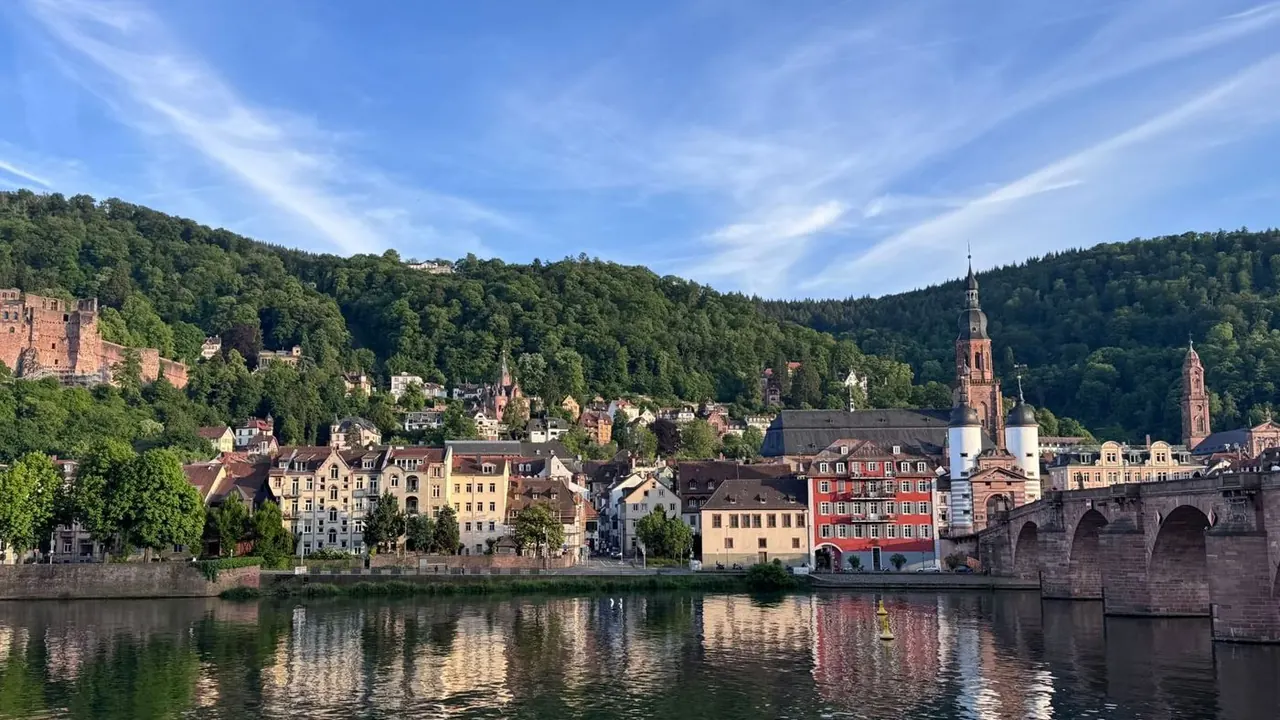
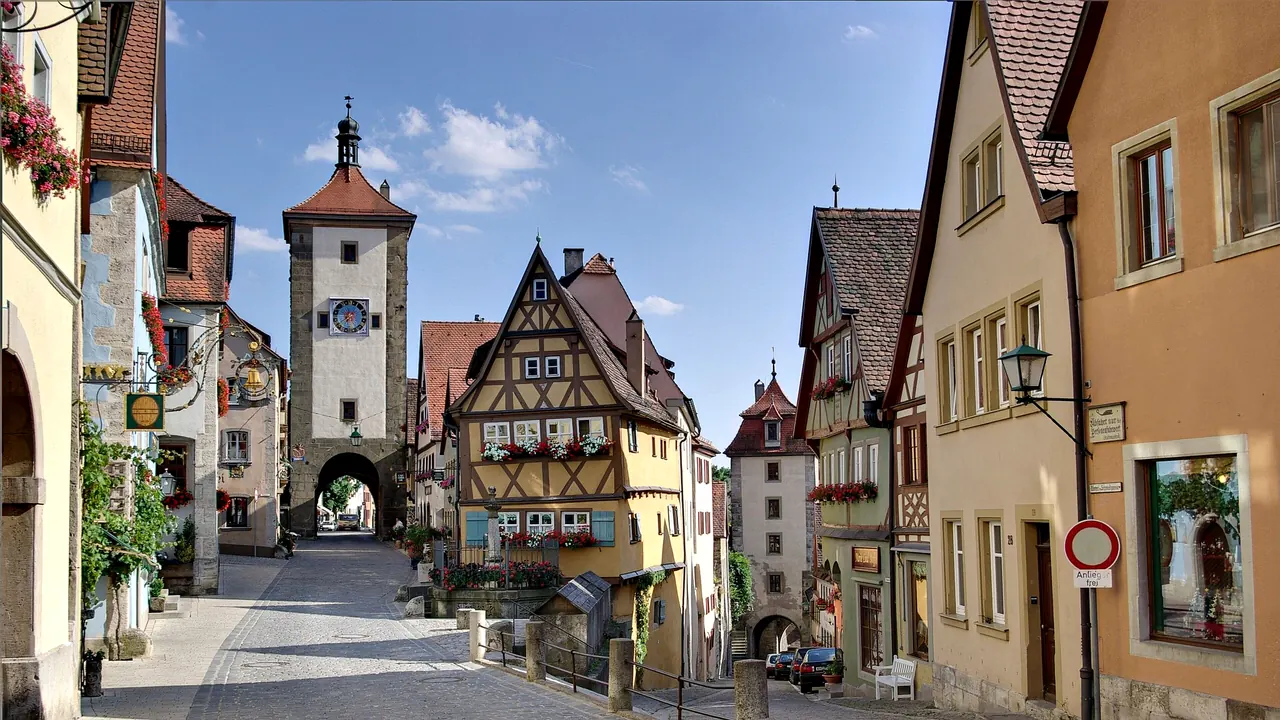
Photos: Heidelberg by Kuanling Chen, Pexels License; Rothenburg ob der Tauber by Berthold Werner, Public domain.
Heidelberg or Rothenburg ob der Tauber?
Our verdict in twelve categories, each scored against the same fixed benchmark cities, and the climate month by month, so you can choose for your trip.
Choose Heidelberg for
- nightlife
- live music and the arts
- nature and the outdoors
Heidelberg is the better choice for a longer or more varied stay. It has a university town's evenings, a theatre and orchestra, forest trails starting at the edge of the Altstadt, and trams and regional trains that reach Speyer, Schwetzingen and Frankfurt without a car. Couples, families and anyone who wants the town to stay lively after dark will find more to do here.
Choose Rothenburg ob der Tauber for
- culture and sights
- prices
Rothenburg ob der Tauber suits travellers who want to step inside one intact medieval walled town and stay overnight to have it nearly to themselves. Its pleasures are the ramparts walk, the Riemenschneider altar and the silent lanes once the day visitors have left. It works best for a short, atmospheric stop on a Romantic Road drive, or for a December trip to its Christmas market, rather than as a base for a week.
Scoreboard
Twelve categories on one fixed scale from 0 to 100. The shaded stretch is the gap between the two.
Your match
Pick a travel style or drag the sliders, and both match scores follow your weighting.
Wins on nightlife and live music and the arts with your weighting.
Wins on culture and sights and prices with your weighting.
What matters to you?
Category by category
What the scores mean for a trip.
Beaches & swimming
Neither town has anywhere to swim in the sea, and both are equally far from a coast. In summer, Heidelberg's choices are its outdoor pools and the flooded gravel-pit lakes on the Rhine plain, about half an hour away. Rothenburg has its own pool, with the grassy bathing shores of the Franconian lake district, such as the Altmühlsee, about an hour's drive away.
Food & drink
Heidelberg eats better, mainly thanks to its wine. The vineyards of the Badische Bergstrasse reach the edge of town and the Palatinate villages are close by, so a good Riesling is never far away. Neuenheim and the Altstadt side streets add some range, as does the white asparagus season in spring. The student population also keeps simple international food easy to find.
Rothenburg serves solid Franconian roast pork, dumplings and Silvaner in Bocksbeutel bottles, but the choice is narrow. Many kitchens around the Marktplatz cater to coach groups, so the best meals are in guesthouses off the square and in Tauber valley wine taverns.
Culture & sights
The two are broadly level, but they offer different experiences. Heidelberg combines landmarks: the red sandstone castle ruin above a baroque old town, the Old Bridge, and Germany's oldest university with its graffiti-covered Student Prison.
Rothenburg's attraction is the whole town. Its walls, towers and gabled lanes survive almost untouched, and you can walk the covered ramparts above the rooftops. Its single great artwork is Riemenschneider's carved altar in St Jakob's. Both towns can be seen in a day or two.
Nightlife
This is one of the widest gaps between the two. Heidelberg has a real, if student-led, night out: the Untere Strasse is lined with small pubs that stay full late in term time, there are old student taverns with carved tables, and a few clubs out towards the station.
Rothenburg has almost nothing after dinner. The main evening event is the night watchman's tour, and the lanes are quiet by eleven, so a proper night out means a trip to Würzburg or Nuremberg.
Nature & outdoors
Heidelberg has the better outdoors on its doorstep. The Odenwald forest starts at the edge of the old town, with the Philosophers' Walk, hours of trails from the Königstuhl and Celtic ramparts on the Heiligenberg. The Palatinate Forest's sandstone crags are about an hour away.
Rothenburg's countryside is gentler and smaller in scale. Paths drop from the walls to mills and meadows in the Tauber valley, and the valley's family cycle route runs through orchards and vineyards. It is lovely for a stroll, but there is no forest or upland as extensive as Heidelberg's.
Day trips
Both towns are good bases, and Heidelberg is the easier one. Speyer's Romanesque cathedral, Schwetzingen's palace gardens, Worms, Lorsch and the Neckar castle villages are all short train rides away, and Frankfurt and Mainz take about an hour.
From Rothenburg, the outings are other Romantic Road towns that rival it, such as walled Dinkelsbühl and Nördlingen in its meteorite crater, plus Würzburg's Residenz and Nuremberg. The catch is the branch-line railway, so a car makes most of these trips far easier.
Good for families
Heidelberg keeps children busy for longer. The funicular is an outing in itself, with a small fairy-tale park at the top, and the zoo and boat trips are easy to add. The aircraft, space shuttle and submarine at the Technik Museum Speyer are within about half an hour.
Rothenburg captivates children for a day: the ramparts, the Rathaus tower, the lantern-lit night watchman and, for older children, the torture devices in the Crime Museum. After that there is little made for them, and the cobbles are hard work with a pushchair in both towns.
Getting around
Both towns have centres you can cover on foot, with cobbles and steep climbs. Heidelberg's Altstadt is a long strip along the Hauptstrasse, with a tram ride in from the station and a funicular up to the castle. Rothenburg's walled centre is smaller still, about fifteen minutes from gate to gate.
The real difference is the wider area. Heidelberg sits in a single Rhine-Neckar fare network of trams, buses and S-Bahn trains, so you can manage without a car. Rothenburg's rail link needs a change at Steinach, and the regional buses are sparse.
Shopping & style
Heidelberg has more ordinary shopping. Its long pedestrian Hauptstrasse has department stores and chains at one end and independent bookshops and boutiques in the side lanes. Bergstrasse wine is the best thing to take home.
Rothenburg sells almost nothing but souvenirs, though it does them memorably. Year-round Christmas shops sell baubles, nutcrackers and Erzgebirge carvings, and the December market on the Marktplatz is among Germany's most atmospheric.
Affordability
Costs are much the same in both, and in both the room is the main expense. In Heidelberg, beds are scarce during congresses, graduations and summer weekends, which is why many visitors stay in Mannheim and take the train in. Student cafés and the regional travel ticket help keep other costs down.
Rothenburg charges extra for sleeping and eating inside the walls, especially in December. A guesthouse just outside the gates or in a nearby village saves a good deal, and beer, wine and the sights stay reasonably priced.
Live music & performing arts
Heidelberg is far ahead here. Its municipal theatre stages opera, drama and dance through the season, its philharmonic orchestra plays regularly, and the Heidelberger Frühling festival and the summer performances in the castle courtyard add more. The larger opera house in Mannheim is twenty minutes away.
Rothenburg's stage is mostly history. There is the costumed Meistertrunk play about the Thirty Years' War, a small summer open-air theatre and church organ concerts, but on most evenings there is no show to go to.
Wellness & relaxation
Neither town has thermal baths of its own, and both rely on spa towns within about an hour. From Heidelberg that means the Kraichgau saline pools or Baden-Baden, while Rothenburg has the floating salt pool at Bad Windsheim and the old spa town of Bad Mergentheim.
The calm also comes at different times. In Heidelberg you find it on the Neckar meadows in Neuenheim and the forest paths above the town. In Rothenburg the whole town becomes peaceful in the early morning and after the coach groups leave.
When should you go?
Pick your month. The climate figures are measured averages, not a forecast.
Heidelberg in July
Rothenburg ob der Tauber in July
Daytime high, °C
Rainfall in the month, mm
Where the figures come from
Rothenburg ob der Tauber's sunshine is measured 27 km from the centre, at Feuchtwangen-heilbronn.
Temperature and rainfall are climate normals, averaged over the years shown. Heidelberg: 1991-2020 (sunshine 1971-2000) normals, Heidelberg (4.5 km from centre). Rothenburg ob der Tauber: 1991-2020 normals, Rothenburg ob der Tauber (0.9 km from centre).
The two towns follow almost the same calendar. June to August are the warm months, with afternoons of about 26°C in Heidelberg and a degree cooler in Rothenburg. Those are the weeks for the outdoor pools and the lakes nearby. May and September are the most comfortable for long days on foot, mild enough for cobbles and hill paths without summer heat. Neither town gets too hot for walking. Summer is also the wettest season in both, with Heidelberg's July rain reaching 80mm, mostly in showers rather than steady rain.
The differences are small but real. Heidelberg, down in the Rhine plain, is a touch milder in winter. Rothenburg, on its Franconian hilltop, is colder from December to February, with January highs of about 3°C, though that suits its Christmas market season. Rothenburg is also the sunnier of the two all year, with about 246 hours of sun in July, so its spring blossom and autumn colour in the Tauber valley often come with clearer skies.
Which traveller are you?
For a food and nightlife trip, Heidelberg is the clear pick. It has Bergstrasse and Palatinate wines, Neuenheim's side-street restaurants, and the Untere Strasse full of student pubs late into the night. Rothenburg's dining is narrower, and its evenings end at a wine tavern table.
On a family trip with children, Heidelberg offers more days of fun. Children get the funicular and the fairy-tale park on the Königstuhl, the zoo, river boats, and the Technik Museum at Speyer nearby. Rothenburg's ramparts and night watchman are good fun, but they are covered in a day or two.
On a culture and arts trip, choose Rothenburg for the complete medieval townscape inside its walls and the Holy Blood Altar. Choose Heidelberg if you want the castle ruin, the old university and nights at the opera or the castle festival as well.
Before you go
| Measure | Heidelberg | Rothenburg ob der Tauber |
|---|---|---|
| Official language | German | German |
| Currency | Euro (EUR) | Euro (EUR) |
| Sockets | CF230 V, 50 Hz | CF230 V, 50 Hz |
| Driving side | Right | Right |
| Time zone | UTC+1, UTC+2 in summer | UTC+1, UTC+2 in summer |
| Emergency number | 112 | 112 |
| Elevation | 114 m | 430 m |
| Main airport | Frankfurt Main Airport (FRA)69 km from centre281 non-stop destinations | Nuremberg Airport (NUE)66 km from centre56 non-stop destinations |
| Public holidays this year | 12 days | 12 days |
By the numbers
| Measure | Heidelberg | Rothenburg ob der Tauber |
|---|---|---|
| City population | 156,092 | 11,331 |
| People per km² | 1,433 | 272 |
| Museums within 10 km | 17 | 6 |
| UNESCO World Heritage sites within 50 km | 4 | 2 |
Where else could you go?
Every comparison below shares a destination with this one, so you can follow Heidelberg or Rothenburg ob der Tauber somewhere new.
- Nurembergvs Rothenburg ob der Tauber
- Bambergvs Rothenburg ob der Tauber
- Frankfurtvs Heidelberg
- Stuttgartvs Heidelberg
- Baden-Badenvs Heidelberg
- Stuttgartvs Rothenburg ob der Tauber