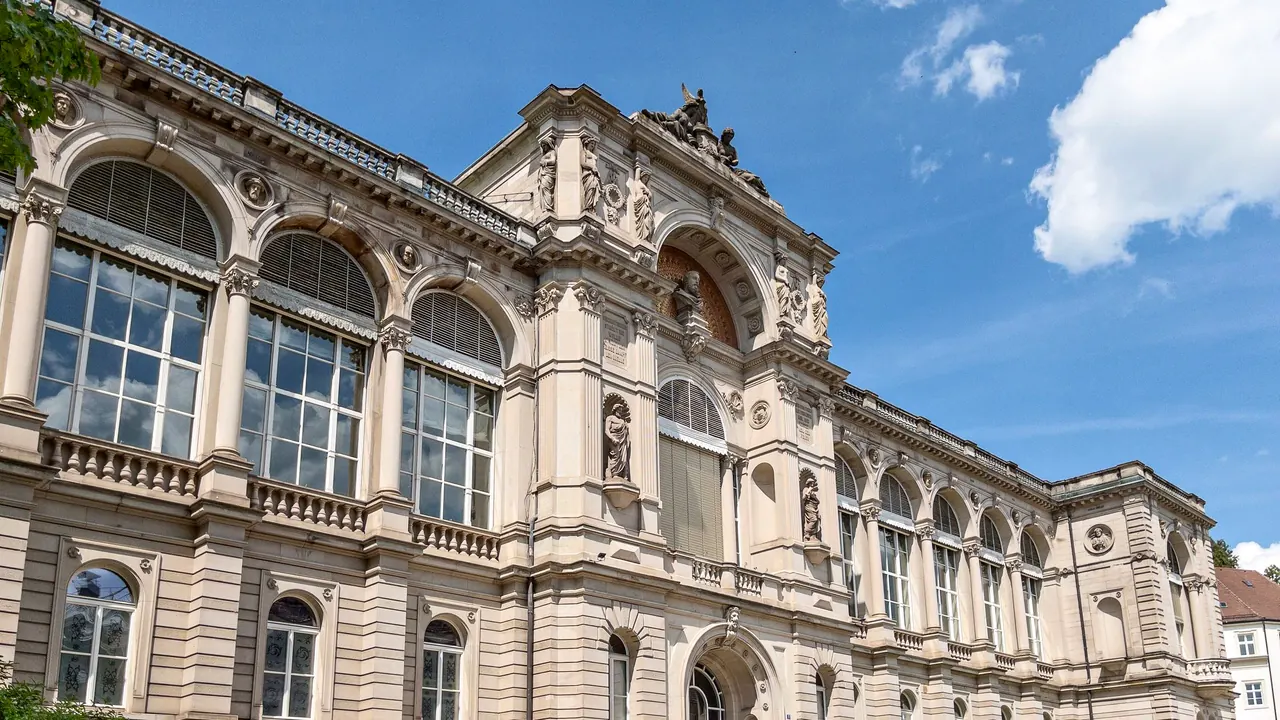
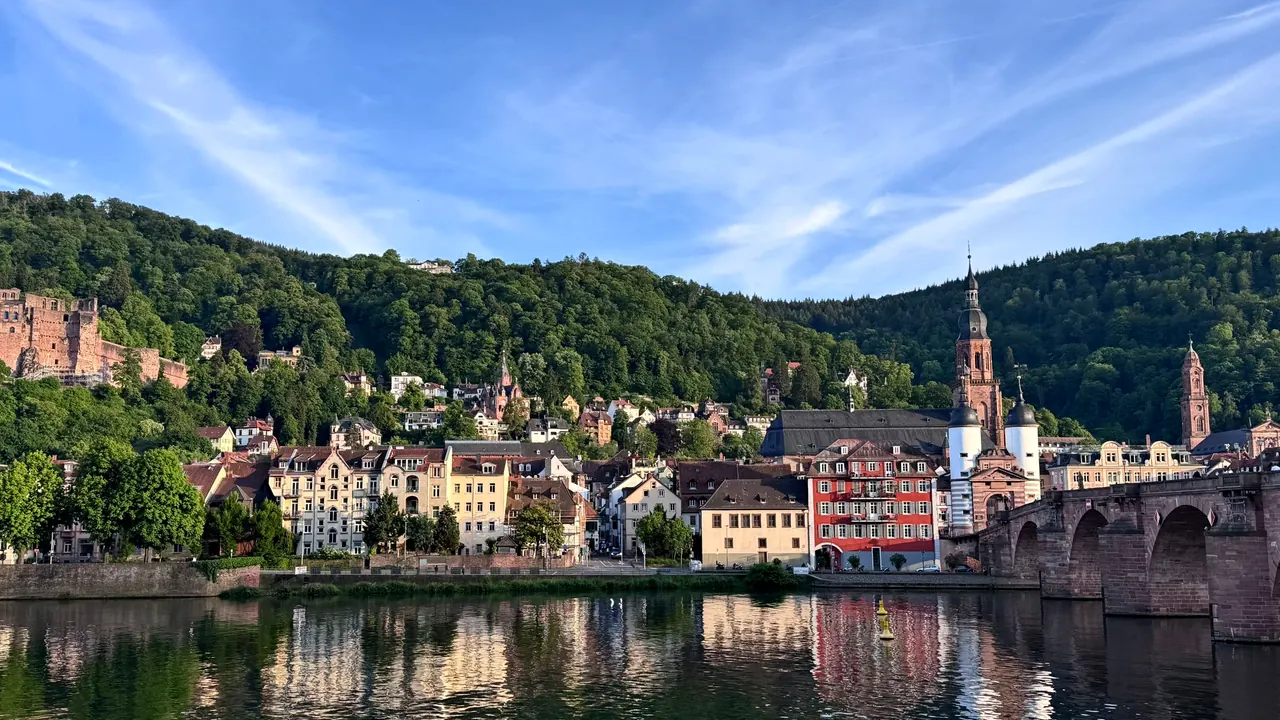
Photos: Baden-Baden by Kent Wang, CC BY-SA 2.0, cropped; Heidelberg by Kuanling Chen, Pexels License.
Baden-Baden or Heidelberg?
Our verdict in twelve categories, each scored against the same fixed benchmark cities, and the climate month by month, so you can choose for your trip.
Choose Baden-Baden for
- wellness
- nature and the outdoors
- live music and the arts
Baden-Baden is for travellers who want to slow down properly. The thermal baths are the whole point of a stay, the Black Forest begins at the edge of town for long walks, and the Festspielhaus fills the evenings with opera and orchestral music. It suits couples and older travellers who are happy to pay for comfort, ideally with a car for Alsace and the Black Forest High Road.
Choose Heidelberg for
- nightlife
- families
- prices
Heidelberg makes more sense for a sightseeing trip with more going on in the evenings and a lighter bill. The castle ruin, Germany's oldest university and the Altstadt along the Neckar give it the more famous landmarks, students keep the bars full in term time, and trams and regional trains reach Speyer, Schwetzingen and the Neckar valley without a car. Families with children will find more to do here too.
Scoreboard
Twelve categories on one fixed scale from 0 to 100. The shaded stretch is the gap between the two.
Your match
Pick a travel style or drag the sliders, and both match scores follow your weighting.
Too close to call, 1 point apart
Wins on wellness and nature and the outdoors with your weighting.
Wins on nightlife and families with your weighting.
What matters to you?
Category by category
What the scores mean for a trip.
Beaches & swimming
Neither town has a beach, and swimming should play no part in choosing between them. In summer both offer the same thing: outdoor pools and the flooded gravel-pit lakes of the Rhine plain. The difference is that water in Baden-Baden means indoor thermal bathing, while Heidelberg's Neckar is for boats and lying on the riverside lawns.
Food & drink
The two eat in much the same way: hearty Baden cooking such as Maultaschen and Flammkuchen, with local Riesling and Pinot from vineyards on the edge of town. Baden-Baden leans more refined, with smart hotel dining, cafés serving Black Forest gateau and the wine taverns of the Rebland villages. Food lovers drive into the northern Black Forest for some of Germany's most celebrated restaurants.
Heidelberg is earthier and cheaper. Spring brings white asparagus, there are Studentenkuss chocolates, and the student population keeps kebab, pizza and Asian food plentiful. Avoid the tourist places on the Hauptstrasse, where quality is uneven, and eat in the Altstadt side streets or in Neuenheim across the river.
Culture & sights
Heidelberg has the more famous set of sights. There is the red sandstone castle ruin with its Great Tun, the Old Bridge, and the university founded in 1386, where you can see the graffiti-covered Student Prison. It all comes together as one of Germany's best-preserved old towns.
Baden-Baden's appeal is different: the whole Belle Époque spa resort is the sight, from the Kurhaus casino rooms and the Trinkhalle to the villas above the Lichtentaler Allee. It is also stronger on art, with the Museum Frieder Burda and the Kunsthalle side by side. Each fills a day or two.
Nightlife
Heidelberg is the livelier choice by some way. The Untere Strasse packs small pubs and bars into one Altstadt lane, there are old student taverns with carved tables, and a handful of clubs sit out towards the station, though it all quietens out of term.
Baden-Baden's evenings are dressed-up and calm. The casino in the Kurhaus is the main night out, followed by hotel and wine bars and an older crowd. For clubs, people from Baden-Baden go to Karlsruhe or Strasbourg, and people from Heidelberg go to Mannheim or Frankfurt.
Nature & outdoors
Baden-Baden has the bigger landscape on its doorstep. The Merkur funicular and the Battert cliffs lead straight into the northern Black Forest. Beyond them the High Road climbs past the Mummelsee to the Hornisgrinde moorland at over 1,100m, with waterfalls, mountain biking and some modest winter skiing.
Heidelberg's countryside is gentler. The Philosophers' Walk and the Königstuhl at 568m give forest walking above the town, and the flat Neckar Valley cycle path and the almond blossom of the Bergstrasse make it the better pick for easy cycling.
Day trips
Both are excellent bases, and each lists the other as an outing. Baden-Baden looks south and west across the border: Strasbourg is about an hour away, and from there the Alsace wine route leads to Riquewihr and Colmar, with Freiburg in reach by train. A car makes most of these much easier.
Heidelberg looks north and along its river. Speyer's cathedral and Schwetzingen's palace are each about half an hour away, Worms and Lorsch Abbey are close, there are castle villages up the Neckar such as Neckarsteinach, and Frankfurt and Mainz are reachable by train. Maulbronn monastery is easy from either.
Good for families
Heidelberg is easier with children. The funicular up to the castle and the Königstuhl, with its small fairy-tale park, makes a day out in itself, and the zoo by the Neckar and the river boats fill an afternoon. The Technik Museum Speyer, with its space shuttle and submarine, is about half an hour away. The cobbled, sloping Altstadt is the main nuisance with a pushchair.
Baden-Baden is safe and pleasant for a walk, but it is made for adults. Young children are not allowed into the Friedrichsbad, and families usually head out for the day to Europa-Park, about an hour south, or to Karlsruhe's zoo.
Getting around
Both centres are compact enough to walk, but Heidelberg is simpler to manage overall. Its sights run along one pedestrianised strip, trams link it to the station, and a single fare system covering the Rhine-Neckar area makes car-free day trips easy.
Baden-Baden's baths, Kurhaus and museums are close together, though some streets climb steeply and the station is out in Oos, a bus ride away. Trains reach Karlsruhe and Freiburg easily, but the wine villages, the High Road and Alsace really call for a car.
Shopping & style
Neither is a shopping destination, and they differ mainly in style. Baden-Baden is small but polished, with jewellers, watchmakers, boutiques and delicatessens on Sophienstraße and Lange Straße, all aimed at a wealthy spa clientele.
Heidelberg's long Hauptstrasse has ordinary high-street chains and department stores at one end and souvenirs, beer steins and cuckoo clocks at the other, with a few independent bookshops in the side lanes. In both towns local wine is the best thing to take home.
Affordability
Heidelberg is the cheaper of the two, at about what you would expect to pay in western Germany. Hotels are the main expense, and they tighten around congresses and summer weekends, so many visitors stay in Mannheim instead. Student cafés and the regional transport ticket keep the rest of the bill down.
Baden-Baden was built for the rich and still prices itself that way. The grand hotels set the tone, and the baths charge for every visit, which adds up quickly over a spa stay. Guesthouses, bakeries and wine taverns are the way to save.
Live music & performing arts
Baden-Baden has the more remarkable stage. The Festspielhaus, built into the old railway station, is one of Germany's largest opera and concert houses and brings leading international orchestras and soloists to the town. The Kurhaus philharmonic, the small nineteenth-century theatre and the memory of Brahms and Clara Schumann add to it.
Heidelberg offers more variety, if less star power. The municipal theatre covers opera, drama and dance. In spring the Heidelberger Frühling brings chamber music, and in summer there are open-air shows in the castle courtyard. Jazz, cabaret, student venues and frequent church concerts also play a bigger part here than in Baden-Baden, where the programme centres on classical music.
Wellness & relaxation
This is where the two are furthest apart. Baden-Baden is built around Roman hot springs, with the domed Friedrichsbad's silent ritual of hot rooms and scrubs and the modern Caracalla pools and saunas right next door. The rest of the town follows that slow rhythm.
Heidelberg has no thermal baths at all, only hotel spas, though the Kraichgau spa towns are about half an hour away and Baden-Baden itself about an hour. Its calm comes from evenings on the Neckar meadows and the forest paths above the Philosophers' Walk.
When should you go?
Pick your month. The climate figures are measured averages, not a forecast.
Baden-Baden in July
Heidelberg in July
Daytime high, °C
Rainfall in the month, mm
Temperature and rainfall are climate normals, averaged over the years shown. Baden-Baden: 1991-2020 normals, Baden-Baden-Geroldsau (3.9 km from centre). Heidelberg: 1991-2020 (sunshine 1971-2000) normals, Heidelberg (4.5 km from centre).
The two towns have almost the same temperatures through the year. From November to February both are cold and grey, with daytime highs around 6°C and little sunshine. April, May, September and October are the comfortable months for walking the streets and the forest trails. July and August are the warmest, at around 25°C, and they are the only months when the outdoor pools and gravel-pit lakes are worth a visit. Neither town gets too hot for sightseeing, and both get long sunny days from June to August.
Where they differ is rain. Baden-Baden is clearly wetter all year, with between half as much again and about double Heidelberg's rainfall. The gap is widest in winter, and December brings 122mm, so an outdoor day there is more likely to be cut short. Heidelberg is the drier of the two in every month, and even its wettest month, July, has only 80mm.
Which traveller are you?
On a relaxing and wellness trip, Baden-Baden lets you build every day around the water. You can bathe in the morning, take a long lunch, walk in the woods in the afternoon and go to a concert in the evening, all without transport. In Heidelberg the same trip means travelling out to another town's spa each day.
For a trip on a tight budget, Heidelberg goes further. If you avoid graduation and congress dates and eat where the students eat, the castle and old town cost little to enjoy. In Baden-Baden the thing you came for is the expense, and without the baths there is little to fill a quiet town.
For a short city break of two or three days, Heidelberg packs more in. You can take in the main sights on one walk along the river, and there is somewhere to go after dinner. Baden-Baden rewards a slower, longer stay, and in a weekend you would barely settle into its pace.
Before you go
| Measure | Baden-Baden | Heidelberg |
|---|---|---|
| Official language | German | German |
| Currency | Euro (EUR) | Euro (EUR) |
| Sockets | CF230 V, 50 Hz | CF230 V, 50 Hz |
| Driving side | Right | Right |
| Time zone | UTC+1, UTC+2 in summer | UTC+1, UTC+2 in summer |
| Emergency number | 112 | 112 |
| Elevation | 181 m | 114 m |
| Main airport | Karlsruhe Baden-Baden Airport (FKB)12 km from centre44 non-stop destinations | Frankfurt Main Airport (FRA)69 km from centre281 non-stop destinations |
| Public holidays this year | 12 days | 12 days |
By the numbers
| Measure | Baden-Baden | Heidelberg |
|---|---|---|
| Population | 56,952 | 156,092 |
| People per km² | 406 | 1,433 |
| Museums within 10 km | 11 | 17 |
| UNESCO World Heritage sites within 50 km | 3 | 4 |
Where else could you go?
Every comparison below shares a destination with this one, so you can follow Baden-Baden or Heidelberg somewhere new.
- Strasbourgvs Baden-Baden
- Stuttgartvs Baden-Baden
- Frankfurtvs Heidelberg
- Stuttgartvs Heidelberg
- Freiburgvs Baden-Baden
- Colmarvs Baden-Baden