Baden-Baden or Strasbourg?
Two destinations compared in twelve categories, each scored against the same fixed benchmark cities. Weight what matters to you and the verdict follows.
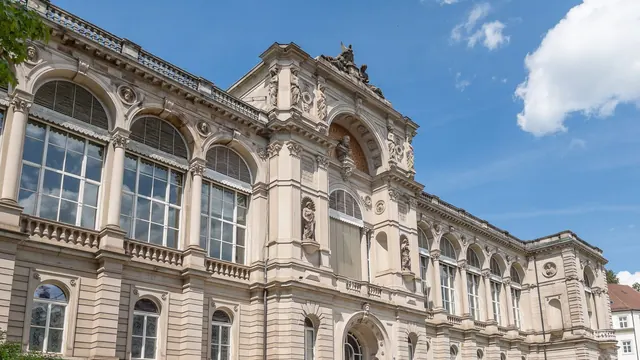
Photo: Kent Wang, CC BY-SA 2.0, cropped
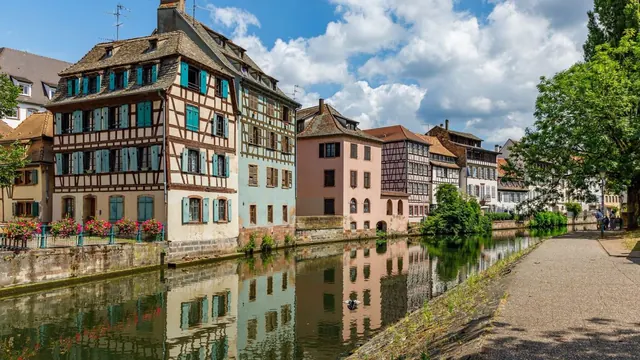
Photo: Edoardo Colombo, Pexels License
Your match
Wins on wellness and nature and the outdoors with your weighting.
Wins on nightlife and food and drink with your weighting.
What matters to you?
Pick a travel style or drag the sliders. The match scores above update as you do.
The verdict
Baden-Baden suits a slow, restorative stay. The thermal baths are the reason to go, from the silent sequence of hot rooms at the Friedrichsbad to the pools and saunas of Caracalla, and the Black Forest begins at the edge of town for walks between soaks. Add opera at the Festspielhaus and an evening in the Rebland wine villages, and it fits couples and older travellers who want quiet nights and don't mind paying for comfort.
Strasbourg gives you more to do in a day and more to eat at night. Its cathedral, the canals of Petite France and the museums of the Palais Rohan make it the fuller sightseeing city, winstub cooking is the better table, and the student bars of Krutenau keep evenings going for longer. It is easier with children, cheaper to stay in and simple to get round by tram and bike, and Baden-Baden's baths are still under an hour away.
Scoreboard
Our verdict on each category, scored 0 to 100 against fixed benchmark cities.
Category by category
What the scores mean for a trip to Baden-Baden or Strasbourg.
Beaches & swimming810
Neither has any sea, and in summer both swim the same way, in old gravel-pit lakes on the Rhine plain. The difference is getting there. Strasbourg's lifeguarded lakes, above all the Baggersee, are a tram ride from the centre. Baden-Baden's are out on the plain to the west, so most visitors settle for an outdoor pool or the warm water of the baths.
Food & drink4566
Both cook from the same Upper Rhine larder. You find tarte flambée, or Flammkuchen, on both sides of the river, and Riesling from nearby slopes. Baden-Baden is too small for much range, though. The centre leans towards hotel dining and cafés serving cake and coffee, and its best evenings are in the wine taverns of the Rebland villages just outside town.
Strasbourg has the fuller table. Winstub cooking, from choucroute garnie to baeckeoffe and foie gras, is a reason to visit in itself, the covered market is good for Munster and charcuterie, and there is a strong tier of fine dining. Just avoid the tourist menus around the cathedral.
Culture & sights5270
In Baden-Baden the main sight is the Belle Époque spa town itself: the Kurhaus, the colonnaded Trinkhalle and the Lichtentaler Allee, with the Museum Frieder Burda and the Kunsthalle for art. It fills a day or two well.
Strasbourg goes back further and runs deeper. The pink sandstone cathedral with its astronomical clock, the timber-framed Grande Ile with Petite France, and the German-built Neustadt together make up a UNESCO ensemble, and the Palais Rohan alone holds three museums. Allow two or three days, with the European institutions as a modern contrast.
Nightlife1540
Neither is a late city, but Strasbourg does have a going-out scene. Students fill the bars and beer cellars of Krutenau and the streets around Place Saint-Étienne, and in summer the terraces on the quays stay busy well into the evening.
Baden-Baden's night out is a dressed-up affair: the gilded casino in the Kurhaus, then a hotel bar or a wine bar, then quiet streets. Clubbers staying there head to Karlsruhe or Strasbourg, though even Strasbourg has only a handful of clubs.
Nature & outdoors7062
Baden-Baden has the forest on its doorstep. The Merkur funicular and the Battert cliffs lead straight onto trails into the northern Black Forest, and the High Road climbs past the Mummelsee to the moorland of the Hornisgrinde at over 1,100m.
Strasbourg is flat, and its green spaces are tame rather than wild: the Orangerie, and riverside forests full of storks and herons. Long, level cycle routes follow the Rhine, but the Vosges and the Black Forest are about an hour away. That makes it a good base for cycling but a weaker one for walking straight out of the door.
Day trips7880
Both are excellent bases, and they share much of the same map; each lists the other as a day out. From Baden-Baden the trips run along the German side. Heidelberg and Freiburg are each about an hour by train, and there are the UNESCO sites of Speyer and Maulbronn and Black Forest towns such as Gengenbach.
Strasbourg's strength is having Alsace on its doorstep. Colmar is half an hour by train, and the wine route runs through Obernai, Riquewihr and Eguisheim below Haut-Koenigsbourg. Basel, Nancy and Mulhouse add further options. From either town, a car makes the vineyard days much easier.
Good for families5066
Strasbourg is the easier place with children. The centre is flat and largely car-free, and there are boat trips around the Grande Ile, rowing boats and nesting storks in the Orangerie, the hands-on Le Vaisseau science centre and the moving figures of the astronomical clock.
Baden-Baden is safe and pleasant for a walk or a ride on the Merkur funicular. But it is built for adults who want to rest, and the Friedrichsbad does not admit young children. Europa-Park is about an hour from either town, so families based in Baden-Baden tend to spend their days elsewhere.
Getting around6279
Strasbourg's island centre is flat and largely pedestrianised. Trams run to the station, the European quarter and across the Rhine to Kehl, and separated bike lanes often make cycling the quickest way about. You won't need a car in the city.
Baden-Baden's centre is compact but steep in places, and the station is a few kilometres out in Oos, so arrivals start with a bus. Trains along the Rhine are easy, but the High Road and the wine villages really call for a car.
Shopping & style3852
Strasbourg has more range. There are chain stores and a large department store around Place Kléber, independent shops and bookshops near the cathedral, and Alsatian pottery, printed linens and kougelhopf moulds to take home. What it lacks is luxury.
That is Baden-Baden's niche. Sophienstraße and Lange Straße are lined with jewellers, watchmakers and boutiques for a well-off spa clientele, good for an unhurried browse. Beyond those two streets there is little, and the local goods come down to cuckoo clocks and wine.
Affordability3044
Neither is cheap, but Strasbourg is easier on a budget. Winstub meals and wine by the pichet are good value, trams and bike hire are cheap, and the cathedral and old town are free to wander. Hotel rooms are the main cost, especially during the Christmas market and the weeks when the European Parliament sits.
Baden-Baden was built for the wealthy and still prices itself that way. Grand hotels set the level and every visit to the baths is paid for. Guesthouses, bakeries and wine taverns soften the bill, but a stay built around the spas soon adds up.
Live music & performing arts5856
Both offer more than their size suggests, but in different directions. Baden-Baden is a classical town. The Festspielhaus, one of Germany's largest opera and concert houses, brings in leading international orchestras and soloists, and the legacy of Brahms and Clara Schumann runs through the place. Beyond classical music there is little.
Strasbourg's programme is broader. The Opéra national du Rhin and the Philharmonic cover the classics, the Théâtre National de Strasbourg is a major drama stage, and the Musica festival, jazz, dance and touring bands add variety. Opera lovers may lean towards Baden-Baden, while theatre-goers and anyone who wants variety will do better in Strasbourg.
Wellness & relaxation9655
Baden-Baden is one of Europe's great spa towns and is in a different league here. The Friedrichsbad's silent, unclothed circuit of hot rooms and pools and the modern Caracalla complex both draw on springs the Romans used, and the whole town moves at a resting pace.
Strasbourg's Bains municipaux, with tiled pools, a hammam and saunas, is a pleasant local bathhouse, and canal walks and riverside cycling keep the pace gentle. Its best wellness option, though, is the trip of under an hour to Baden-Baden.
Which traveller are you?
For a relaxing and wellness trip, Baden-Baden is the clear choice. The Friedrichsbad and Caracalla are among Europe's great thermal baths, and the whole town keeps a slow pace. Strasbourg's tiled municipal bathhouse is pleasant, but it can't compete.
On a food and nightlife trip, Strasbourg wins clearly. A winstub dinner of choucroute or baeckeoffe with a pichet of Riesling leads on to riverside terraces and the student bars of Krutenau. Baden-Baden's evenings end early, after the casino or a hotel bar.
For a culture and arts trip, Strasbourg has far more to see: the cathedral and its astronomical clock, Petite France, the Neustadt and the three museums of the Palais Rohan. Baden-Baden fills a day or two, mainly with Belle Époque spa architecture and concerts at the Festspielhaus.
When should you go?
Pick the month you can travel and see both cities side by side. The climate figures are measured averages, not a forecast.
| July | Baden-Baden | Strasbourg |
|---|---|---|
| Daytime high | 25 °C | 26 °C |
| Night-time low | 14 °C | 15 °C |
| Rainfall in the month | 117 mm | 72 mm |
| Sunshine | 8 hours a day | 8 hours a day |
| Daylight | 16 hours a day | 16 hours a day |
The two towns face each other across the same stretch of the Rhine, and their temperatures run almost in step. Winters are cold and grey, with highs around 6°C, and spring is mild. Summer peaks in July and August at about 25°C in Baden-Baden and 26°C in Strasbourg. Those are the best months for a swim in the gravel-pit lakes, while May, June and September are the most comfortable for walking streets and trails. Sunshine is also nearly identical: long days in summer and very little from November to January.
The real difference is rain. Baden-Baden, at the foot of the Black Forest, gets heavy rain spread across the whole year. Most months bring 100mm or more, and even April, its driest month, is wetter than any month in Strasbourg. Showers are part of any stay, and the baths are a ready plan for wet days. Strasbourg, out on the plain, is far drier. Its winter months see closer to 35mm, and its wettest spell comes in late spring and summer. For a winter trip with dry days on foot, Strasbourg is the safer bet.
The whole year
Each row is shaded against that destination’s own year, so the deepest cell is its best month for that figure and the palest its weakest. Shades are not comparable between the two rows.
Temperature and rainfall are climate normals, averaged over the years shown. Baden-Baden: 1991-2020 normals, Baden-Baden-Geroldsau (3.9 km from centre). Strasbourg: 1991-2020 normals, Strasbourg (9.1 km from centre).
Getting there
| Flying from | Baden-Baden | Strasbourg |
|---|---|---|
| Sao PauloGRU, VCP, CGH, RTE | 12 h 10 m no fares FRA · 143 km | 12 h 0 m no fares ZRH · 137 km |
| PalmaPMI | 2 h 0 m no fares FKB · 12 km | 2 h 0 m no fares FKB · 33 km |
| SingaporeSIN, XSP | 12 h 45 m no fares FRA · 143 km | 12 h 45 m no fares ZRH · 137 km |
| BangkokBKK, DMK | 11 h 15 m €570-612 1 stop FRA · 143 km | 11 h 20 m no fares ZRH · 137 km |
| NiceNCE | 1 h 20 m €81-198 SXB · 51 km | 1 h 20 m €81-198 SXB · 10 km |
| ToulouseTLS | 1 h 30 m no fares SXB · 51 km | 1 h 30 m no fares SXB · 10 km |
| BordeauxBOD | 1 h 35 m no fares SXB · 51 km | 1 h 35 m no fares SXB · 10 km |
| GironaGRO | 1 h 40 m no fares FKB · 12 km | 1 h 40 m no fares FKB · 33 km |
| FezFEZ | 3 h 0 m no fares FKB · 12 km | 3 h 0 m no fares FKB · 33 km |
| AtlantaATL, PDK | 9 h 30 m no fares STR · 72 km | 9 h 30 m no fares STR · 109 km |
The busiest departure cities for these two, with a place kept for each other part of the world. Busiest means arriving passengers where an official count exists, and where none does, the number of non-stop services flown: official route statistics are published by the European reporting countries and by nobody else, so a table ranked on them alone would offer a reader in New York or Tokyo ten European cities. Flying times are estimated from the distance between airports, and every row is a city flown non-stop to both. Where the typical offer connects anyway, the stops are shown. Under each figure is the airport the flight lands at and how far that is from the centre, because the nearest airport is not always the one a route is flown to. Where both columns name the same airport it is one flight, and the difference between the two is the distance printed beside it. Typical return fares for 2026-08 to 2026-10, cached market data up to 7 days old. The figure is the middle half of the offers found, so a single price means they agreed and a range means they did not; for a typical route that middle half spans about a quarter of the median, and for the least settled routes rather more than the median itself.
Before you go
| Measure | Baden-Baden | Strasbourg |
|---|---|---|
| Official language | German | French |
| Currency | Euro (EUR) | Euro (EUR) |
| Sockets | CF230 V, 50 Hz | CE230 V, 50 Hz |
| Driving side | Right | Right |
| Time zone | UTC+1, UTC+2 in summer | UTC+1, UTC+2 in summer |
| Emergency number | 112 | 112 |
| Elevation | 181 m | 132 m |
| Main airport | Karlsruhe Baden-Baden Airport (FKB)12 km from centre43 non-stop destinations | Strasbourg Airport (SXB)10 km from centre43 non-stop destinations |
| Public holidays this year | 12 days | 11 days |
By the numbers
| Measure | Baden-Baden | Strasbourg |
|---|---|---|
| City population | 56,952 | 293,771 |
| People per km² | 406 | 3,752 |
| Museums within 10 km | 11 | 21 |
| UNESCO World Heritage sites within 50 km | 2 | 1 |
Where else could you go?
Every comparison below shares a destination with this one, so you can follow Baden-Baden or Strasbourg somewhere new.