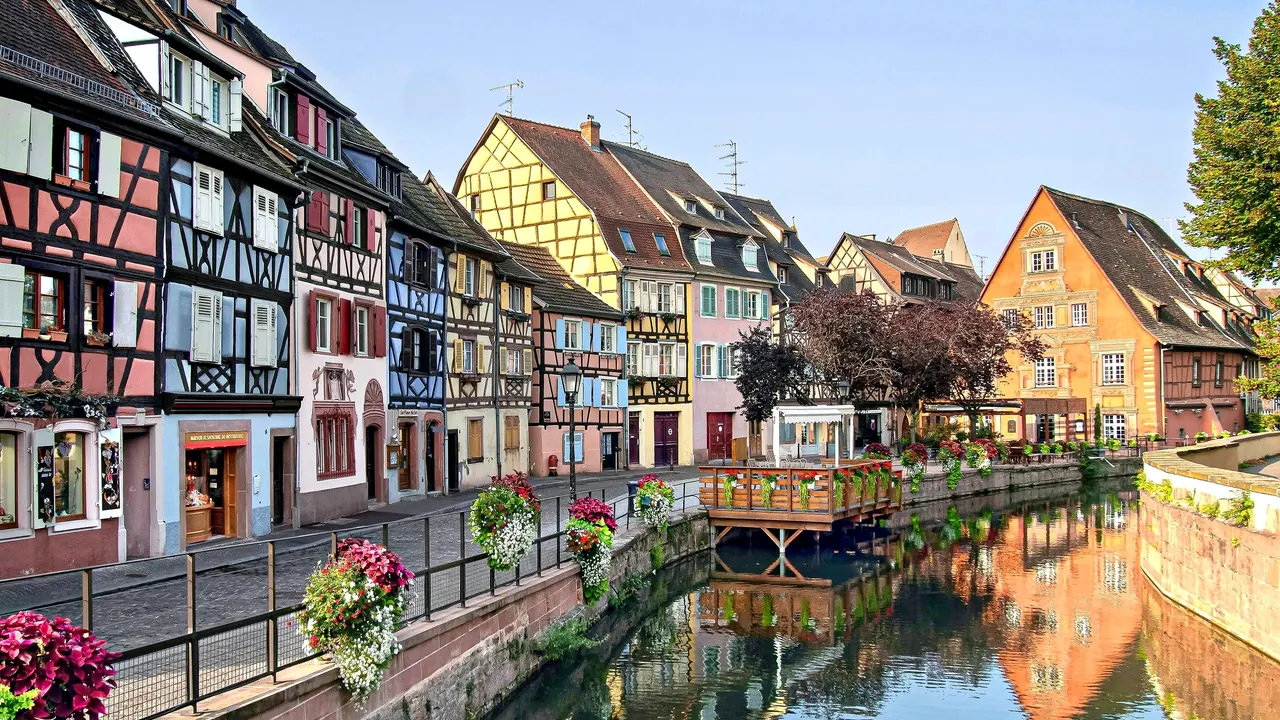
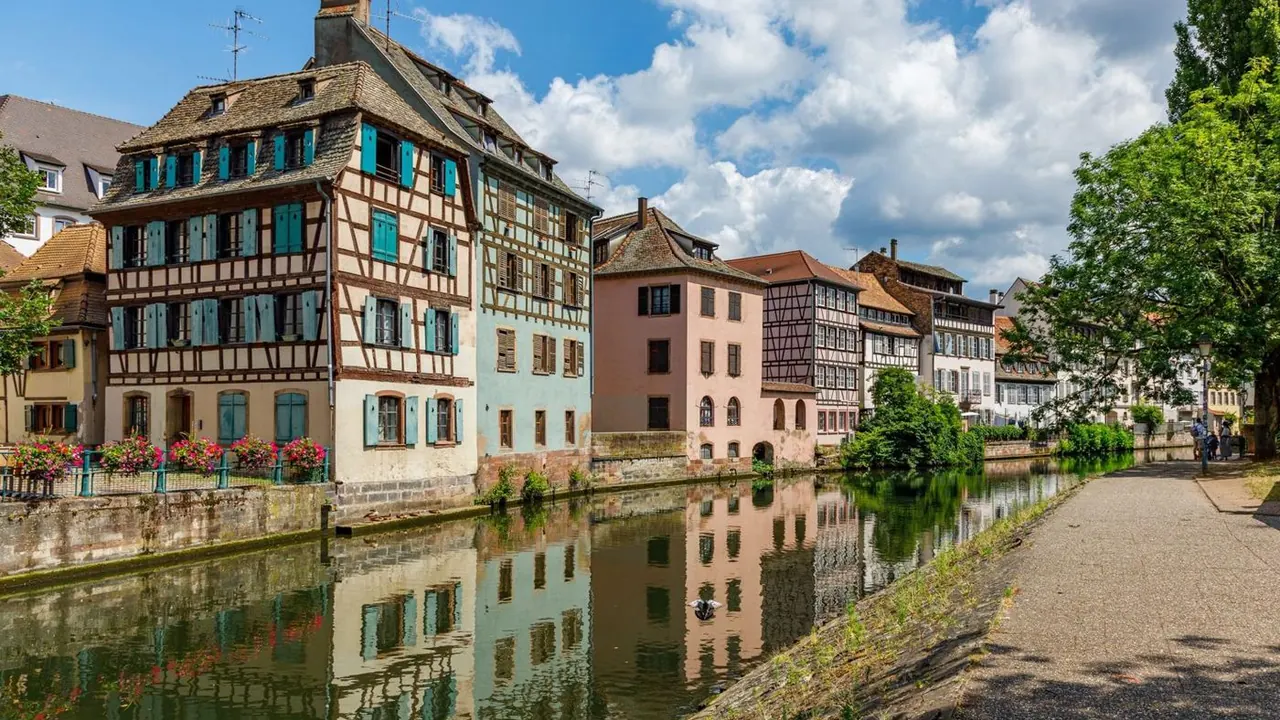
Photos: Colmar by Rolf Kranz, CC BY-SA 4.0, cropped; Strasbourg by Edoardo Colombo, Pexels License.
Colmar or Strasbourg?
Our verdict in twelve categories, each scored against the same fixed benchmark cities, and the climate month by month, so you can choose for your trip.
Choose Colmar for
- nature and the outdoors
- day trips
- prices
Colmar is the better pick for a slow, rural kind of trip, where the town is the base and the vineyards and mountains are the point. The wine villages start at its edge and the high ridges of the Vosges are close behind, so it suits couples and walkers who want cellar tastings, vineyard paths and quiet evenings by the canals. It suits less well anyone who wants a night out, a concert or a spa, and you will want a car or a bike to make the most of it.
Choose Strasbourg for
- live music and the arts
- nightlife
- wellness
Strasbourg works better for travellers who want a proper city around them. The cathedral and the museums of the Palais Rohan give it the deeper cultural offer, the opera, philharmonic and national theatre give it real evenings out, and the student bars of the Krutenau keep it livelier after dark. Trams and cycle lanes mean you never need a car, and Colmar itself is an easy day trip by train.
Scoreboard
Twelve categories on one fixed scale from 0 to 100. The shaded stretch is the gap between the two.
Your match
Pick a travel style or drag the sliders, and both match scores follow your weighting.
Wins on nature and the outdoors and day trips with your weighting.
Wins on live music and the arts and nightlife with your weighting.
What matters to you?
Category by category
What the scores mean for a trip.
Beaches & swimming
Neither city is anywhere near the sea, and the swimming is much the same in both. Colmar has its municipal pools and the small mountain lakes up in the Vosges valleys, which take a drive. Strasbourg's old gravel-pit lakes, such as the Baggersee, have grassy banks and lifeguards in high summer, and you can get to them by tram, which makes a hot afternoon swim easier.
Food & drink
The cooking is the same in both: choucroute, baeckeoffe, tarte flambée and kougelhopf, served in wood-panelled winstubs, and both have tired tourist menus on their prettiest streets. The difference is what surrounds the plate. Colmar is in the middle of the vineyards, with Riesling and Gewurztraminer tastings in the villages a short drive away.
Strasbourg adds a stronger fine-dining tier, foie gras as a local speciality, plenty of beer brewed in the city, and more street markets alongside its covered market. Neither offers much beyond regional food.
Culture & sights
Strasbourg has more to see. Its pink sandstone cathedral, with the astronomical clock and medieval glass, is a landmark Colmar has nothing to match. The Grande Ile, Petite France and the German-built Neustadt make up a large UNESCO-listed ensemble, and the Palais Rohan, the Oeuvre Notre-Dame and the modern art museum fill two or three days.
Colmar is smaller but remarkably complete, an old town that feels like one whole piece, from the Maison Pfister to the canals of Petite Venise. It also holds one masterpiece worth the trip on its own, Grünewald's Isenheim Altarpiece in the Unterlinden Museum. Two days covers it well.
Nightlife
Neither is a party city, but Strasbourg at least has a scene. Its large student population fills the bars of the Krutenau and Place Saint-Étienne, and the riverside terraces stay busy on summer nights, even if there are few clubs.
Colmar's evenings are a long dinner and a few wine bars around Petite Venise, and the streets go quiet early. Its own visitors take the train north to Strasbourg when they want a later night.
Nature & outdoors
Colmar is closer to the landscape. Vineyard paths between wine villages begin within half an hour, and the valleys of Munster and Kaysersberg lead up to the Route des Crêtes and the Grand Ballon, with views to the Black Forest and sometimes the Alps.
Strasbourg is flatter and greener within the city, with the Orangerie, riverside forests full of storks and beavers, and long level cycle routes along the Rhine. Its hiking, at Mont Sainte-Odile or in the Black Forest, lies about an hour away.
Day trips
Both make excellent bases, and each is a half-hour train ride from the other. What differs is the direction of travel. From Colmar, Eguisheim, Riquewihr and Kaysersberg are only a few kilometres away, and Basel is under an hour.
Strasbourg looks more towards Germany and other cities, with Baden-Baden, Freiburg, Heidelberg and Nancy's Place Stanislas all within range, and it has better trains for reaching them. Its wine villages are a longer ride than they are from Colmar.
Good for families
Both are flat, safe and easy with children, with boat rides through their Petite France and Petite Venise quarters and Europa-Park about an hour away. Colmar's attractions for children are mostly in the countryside: the stork and otter park at Hunawihr, the Montagne des Singes and the eagle show at Kintzheim. You need a car for nearly all of them.
Strasbourg keeps more to do in town. The Orangerie has playgrounds and rowing boats, Le Vaisseau is a hands-on science centre, and the astronomical clock's moving figures usually go down well.
Getting around
Strasbourg is much easier without a car. A tram network links the station, the European quarter and the outskirts, with one line running into Germany. Separated cycle lanes run across the city, and the pedestrianised island centre takes about twenty minutes to cross on foot.
Colmar is just as walkable at its core, and fast trains reach Strasbourg and Mulhouse. However, its main attractions, the wine villages and the Vosges, have only thin bus services, so a hire car or bike becomes part of the plan.
Shopping & style
Strasbourg offers more range. It has chain stores and a large department store around Place Kléber and the Rue des Grandes Arcades, plus bookshops and delicatessens near the cathedral. Colmar keeps to regional goods: wine bought straight from the producer, Soufflenheim pottery, printed linen and gingerbread from independent shops along the Grand'Rue. Both peak at their Christmas markets, and neither has much in the way of fashion.
Affordability
Costs are much the same: moderate for Western Europe, with reasonable winstub meals and wine, and rooms as the main expense in both. Colmar's problem is its small size, which pushes hotel prices up in summer and over the Christmas market weeks. Free tastings in the villages and cheaper beds outside town help balance this.
In Strasbourg the expensive weeks also include the European Parliament sessions. On the other hand, cheap trams and free sights such as the cathedral keep day-to-day spending down.
Live music & performing arts
Strasbourg has a full arts calendar. The Opéra national du Rhin plays at Place Broglie, the philharmonic has a full season, the Théâtre National de Strasbourg is one of France's leading stages, and the Musica festival makes autumn a draw for contemporary music.
Colmar has a small Italian-style theatre that the opera company visits on tour. Otherwise it relies on its July classical festival, an autumn jazz festival and the wine fair concerts, so outside those weeks there is little on.
Wellness & relaxation
Strasbourg is the place for proper bathing. Its early twentieth-century Bains municipaux has tiled pools, a hammam and saunas, and the Friedrichsbad and Caracalla baths at Baden-Baden are under an hour away.
Colmar has no spa tradition beyond hotel spas. What it offers is quiet: canal-side evenings once the day-trippers leave and slow walks through the vines, which make for a restful stay without any treatments.
When should you go?
Pick your month. The climate figures are measured averages, not a forecast.
Colmar in July
Strasbourg in July
Daytime high, °C
Rainfall in the month, mm
Temperature and rainfall are climate normals, averaged over the years shown. Colmar: 1991-2020 normals, Ihringen (21.1 km from centre). Strasbourg: 1991-2020 normals, Strasbourg (9.1 km from centre).
The two share almost the same climate, so pick your season rather than your city. Winters are cold and grey in both, with highs around 6°C and little sun, which makes December's Christmas markets the only real draw. Spring warms quickly from April, and May brings the wettest weather of the year, close to 87mm in Colmar and a little less in Strasbourg. July and August peak at about 26°C to 27°C, warm enough for long evenings on terraces and the odd swim in a lake, though rarely too hot to walk around.
Colmar gets slightly more summer sunshine, which suits days out among the vines and on the Vosges ridges. September is the sweet spot for both, still around 21°C to 22°C with the rain easing off. That makes it ideal for hiking above Colmar or cycling along the Rhine from Strasbourg. By November both are back to cold, short days.
Which traveller are you?
On an outdoors trip, Colmar has the edge. Vineyard paths start within half an hour, and the Munster valley climbs to the Route des Crêtes, the Hohneck and glacial lakes. Strasbourg's green space is flatter, and its hills are further away.
For a culture and arts trip, choose Strasbourg. The cathedral, the three museums in the Palais Rohan and the Neustadt make a bigger set of sights. Add the opera, the philharmonic and the Théâtre National de Strasbourg, which Colmar can only match during its festival weeks.
On a food and nightlife trip, Strasbourg wins. Both serve excellent Alsatian cooking in winstubs, but Strasbourg adds beer cellars, cocktail bars and summer terraces by the river. Colmar's evenings end after dinner and a glass of Riesling.
Before you go
| Measure | Colmar | Strasbourg |
|---|---|---|
| Official language | French | French |
| Currency | Euro (EUR) | Euro (EUR) |
| Sockets | CE230 V, 50 Hz | CE230 V, 50 Hz |
| Driving side | Right | Right |
| Time zone | UTC+1, UTC+2 in summer | UTC+1, UTC+2 in summer |
| Emergency number | 112 | 112 |
| Elevation | 185 m | 132 m |
| Main airport | EuroAirport Basel–Mulhouse–Freiburg (BSL)55 km from centre112 non-stop destinations | Strasbourg Airport (SXB)10 km from centre43 non-stop destinations |
| Public holidays this year | 11 days | 11 days |
By the numbers
| Measure | Colmar | Strasbourg |
|---|---|---|
| City population | 66,970 | 293,771 |
| People per km² | 1,006 | 3,752 |
| Museums within 10 km | 9 | 21 |
| UNESCO World Heritage sites within 50 km | 3 | 3 |
Where else could you go?
Every comparison below shares a destination with this one, so you can follow Colmar or Strasbourg somewhere new.
- Baden-Badenvs Strasbourg
- Baselvs Colmar
- Baden-Badenvs Colmar
- Stuttgartvs Strasbourg
- Baselvs Strasbourg
- Heidelbergvs Strasbourg