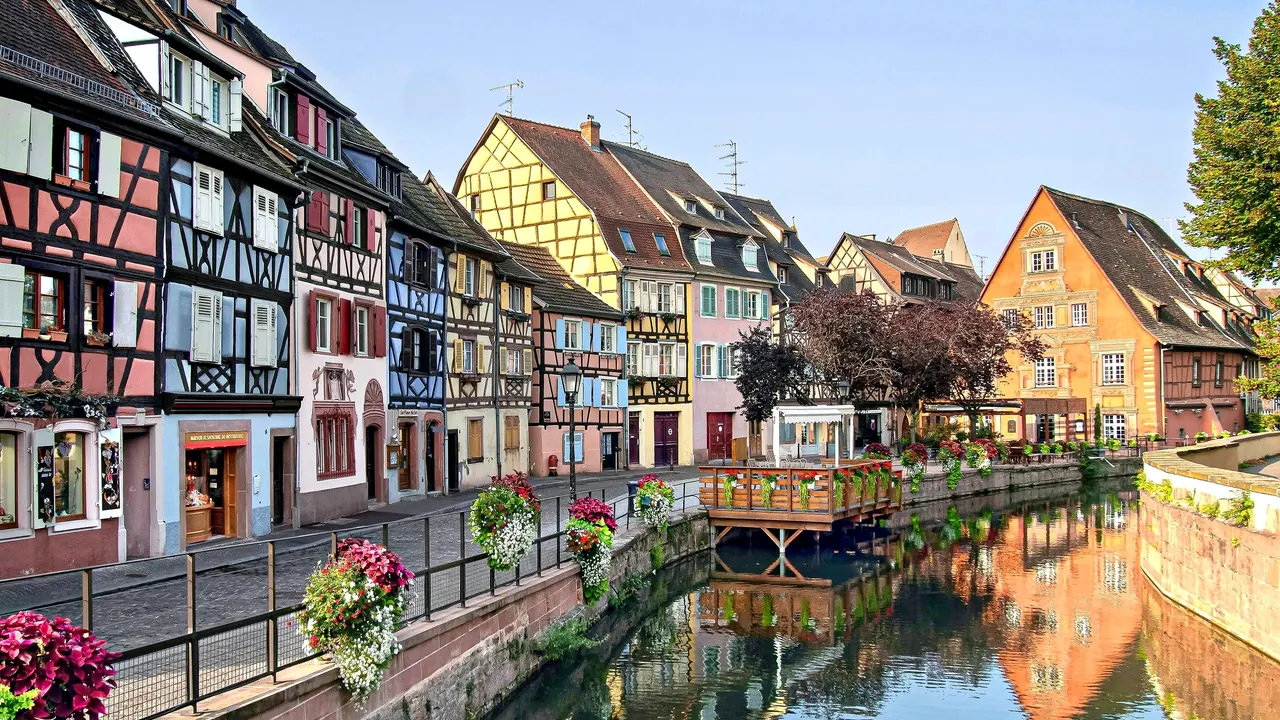
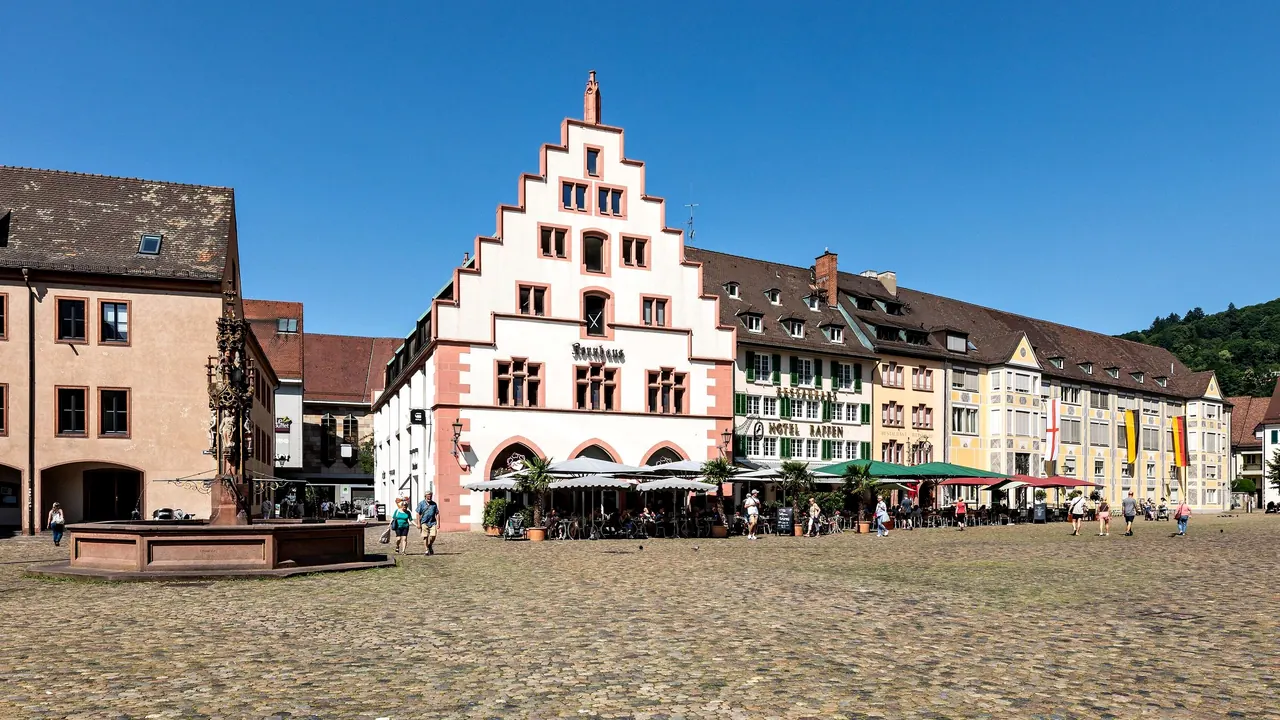
Photos: Colmar by Rolf Kranz, CC BY-SA 4.0, cropped; Freiburg by Dietmar Rabich, CC BY-SA 4.0, cropped.
Colmar or Freiburg?
Our verdict in twelve categories, each scored against the same fixed benchmark cities, and the climate month by month, so you can choose for your trip.
Choose Colmar for
- culture and sights
- day trips
- food and drink
Colmar suits a traveller who wants an old town that survived the wars largely whole, Grünewald's Isenheim Altarpiece at the Unterlinden, and the wine route on the doorstep, with Eguisheim, Riquewihr and Kaysersberg only a few kilometres away. It is best for couples and wine lovers on a short, slow trip of long dinners and village tastings. Bring a car, and expect the evenings to end with a glass of Riesling rather than a night out.
Choose Freiburg for
- wellness
- nightlife
- getting around
Freiburg is the better base for an active trip without a car. The Black Forest starts at the edge of town, trams and bikes cover the city, and thermal baths lie a short ride south. Its large student population keeps the evenings and the stages busier, so families, walkers and anyone who wants a spa day as part of the trip will find more to fill a week.
Scoreboard
Twelve categories on one fixed scale from 0 to 100. The shaded stretch is the gap between the two.
Your match
Pick a travel style or drag the sliders, and both match scores follow your weighting.
Wins on culture and sights and day trips with your weighting.
Wins on wellness and nightlife with your weighting.
What matters to you?
Category by category
What the scores mean for a trip.
Beaches & swimming
Neither city is a place for swimming, but Freiburg makes a summer dip much easier. Colmar has its municipal pools and a few small lakes up in the Vosges valleys, which means a drive.
In Freiburg, locals cycle out to warm, grassy-shored gravel pits on the Rhine plain, the city's open-air pools are close at hand, and Titisee and Schluchsee are about an hour into the Black Forest, cool but scenic.
Food & drink
Both eat well on regional cooking, with French and German influences meeting in different proportions. Colmar is heartier and more Alsatian: winstubs serving choucroute, baeckeoffe and munster cheese, with Riesling, Gewurztraminer and Pinot Gris poured everywhere and cellar tastings in the nearby villages.
Freiburg's Baden cooking is lighter, with Schäufele, Black Forest ham, mountain trout and spring asparagus, Kaiserstuhl Pinot Noir to drink, and the morning market around the Münster with its grilled-sausage stalls. Neither offers much beyond its own region, and Colmar's most photographed lanes have more than their share of tired menus.
Culture & sights
Colmar has the richer sights. Its half-timbered centre, from the Maison Pfister to Petite Venise, came through the wars largely intact, and the Unterlinden Museum holds the Isenheim Altarpiece, with Schongauer's Madonna of the Rose Bush in the Dominican church as well.
Freiburg's red sandstone Münster, with its climbable lace tower, is a real landmark, and the Bächle and the old city gates give the streets character. But much of the centre is a careful post-war rebuild, and the Augustinermuseum aside, there is less to see. Either town takes about two days.
Nightlife
Freiburg is clearly the better choice for an evening out. Thousands of students fill the pubs, wine bars and beer gardens around the Martinstor, summer crowds stay late on the squares and along the Dreisam, and a few clubs play techno and indie, though the semester break is quieter.
Colmar goes to bed early. After a long dinner there are a few wine bars and terraces around Petite Venise and almost no clubs, and the usual advice is to take the train to Strasbourg.
Nature & outdoors
Freiburg has the mountains on its doorstep. The Schlossberg rises behind the old town, the Schauinsland cable car lifts you onto ridge trails, and the Feldberg, about an hour away, offers summer hiking and reliable winter snow. The mountain biking is excellent, and the Kaiserstuhl adds gentle cycling through the vineyards.
Colmar's countryside is lovely but further away. Vineyard paths start within half an hour, and the Route des Crêtes runs past the Hohneck and the Grand Ballon through rounded, forested Vosges with glacial lakes. The skiing is modest, and you will want a car for most of it.
Day trips
Both sit in the corner where France, Germany and Switzerland meet, but Colmar is closer to the best of it. Eguisheim, Riquewihr and Kaysersberg are a few kilometres down the Route des Vins, and Haut-Koenigsbourg looks out over the plain. Strasbourg is about half an hour by train, and Basel and Freiburg are each within about an hour.
From Freiburg, those same Alsace villages are an hour's drive away, and Strasbourg takes roughly an hour and a half. Basel is a little nearer, at about 45 minutes by train. The Baden side also has its own outings: Renaissance Staufen, the abbey of St. Peter in the hills, and the hilltop minster at Breisach with the Kaiserstuhl wine villages beyond.
Good for families
Freiburg is the easier family base. Children paddle in the Bächle and race toy boats along them, the Steinwasen park's suspension bridge and the summer swimming lakes fill the gaps, and Europa-Park is closer than it is from Colmar. The weak point is rainy days, when there is little to do indoors.
Colmar charms children with boat rides through Petite Venise, the little train and storks nesting on its roofs. The stork and otter park at Hunawihr, the macaques at the Montagne des Singes and the Mulhouse car and train museums are all good, but each one means a drive.
Getting around
Both centres are easy to walk, but Freiburg goes much further without a car. A dense tram network, bike lanes everywhere and trains up the Höllental into the Black Forest cover most outings, and many hotels give guests a card for local buses and trains.
In Colmar, regional trains reach Strasbourg and Mulhouse quickly, but buses to the wine villages and the Vosges are thin. Most visitors hire a car, or a bicycle for the pleasant vineyard roads.
Shopping & style
Shopping is a sideline in both towns, and what separates them is the kind of thing you carry home. Colmar's buys are Alsatian and mostly for the table or the kitchen: Riesling or Gewurztraminer chosen at a cellar door in the villages, glazed earthenware from Soufflenheim or Betschdorf with a kougelhopf mould to match, and gingerbread and foie gras from the covered market. December is the time to shop here, when the Christmas stalls take over the old town, but at any time of year clothes and familiar brands are hard to find.
Freiburg is the more practical stop if you need something ordinary, since Kaiser-Joseph-Strasse has the German chains and department stores that Colmar lacks, and the Gerberau and Konviktstrasse lanes add bookshops and organic stores. Its keepsakes come from the Black Forest instead: cuckoo clocks, wood carvings, ham and schnapps from the Münster market. For designer labels, both towns send you to Basel, which is a little closer to Freiburg.
Affordability
The two cost about the same, and in both the expense is the room rather than the day. Colmar's hotels are dearest in the Christmas market weeks, while Freiburg's tighten on summer weekends and during trade fairs. In each case, staying in a nearby village helps.
Day to day, Colmar has set lunches and often free tastings in the villages. Freiburg has cheap market snacks, student-quarter restaurants and a Münster that costs nothing to enter. From either base, a day in Switzerland costs noticeably more.
Live music & performing arts
Freiburg has a real year-round programme. Theater Freiburg puts on opera, drama and dance in repertory, the Konzerthaus is home to the Freiburger Barockorchester, students keep a small jazz scene going, and the Zelt-Musik-Festival fills a tent village each summer.
Colmar's small Italian-style theatre and the touring Opéra national du Rhin offer less, and the town relies on its July classical festival, autumn jazz and the wine-fair concerts. Outside those weeks, it is a trip to Strasbourg or Basel.
Wellness & relaxation
Colmar offers the kind of rest that needs no facilities: long lunches over Alsace wine, an old town that turns calm once the day-trippers have gone, and unhurried walks along the vineyard paths between villages. If you want a sauna or a massage, you will have to choose a hotel that has one.
Freiburg pairs that same easy pace with a real bathing culture. In southern Baden, warm mineral water and saunas are part of the region rather than an extra, so a slow morning on a café terrace or along the Dreisam can turn into an afternoon soaking in a thermal pool. On a trip built around rest, Freiburg gives you far more ways to spend the time.
When should you go?
Pick your month. The climate figures are measured averages, not a forecast.
Colmar in July
Freiburg in July
Daytime high, °C
Rainfall in the month, mm
Temperature and rainfall are climate normals, averaged over the years shown. Colmar: 1991-2020 normals, Ihringen (21.1 km from centre). Freiburg: 1991-2020 normals, Freiburg (0.6 km from centre).
The two cities share almost the same temperatures through the year, which makes sense, since only the Rhine plain lies between them. Summer highs reach about 27°C in July and August, warm enough for the lakes and outdoor pools and pleasant for evenings on terraces. Winters are cold and grey, with highs around 6°C and little sunshine, so December is for Christmas markets rather than long walks. May and September, both around 21°C, are the most comfortable months for walking the streets, hiking and cycling.
The real difference is rain. Freiburg, closer to the Black Forest, is noticeably wetter all year. May is the wettest month in both, at 103mm in Freiburg against 87mm in Colmar, and showers continue through summer. Colmar sits in the rain shadow of the Vosges and stays drier, especially from autumn into early spring. Sunshine is very similar in the two, peaking in July.
Which traveller are you?
For a culture and arts trip, choose Colmar. Its painted old town still reads as one late-medieval whole, and the Unterlinden Museum holds the Isenheim Altarpiece, a painting worth the journey on its own. Freiburg's Münster is superb, but much of the centre around it was rebuilt.
On a family trip with children, Freiburg is easier. Europa-Park is about 40 minutes away, the Mundenhof animal park is free, and the Schauinsland cable car makes a real adventure. Trams take you to most of it, whereas Colmar's best outings for children need a car.
For a relaxing and wellness trip, Freiburg is the clear choice. It has a thermal bath on the city's edge, with Bad Krozingen and Badenweiler a short ride south and Baden-Baden an hour away by train. Colmar offers little beyond hotel spas and quiet evenings by its canals.
Before you go
| Measure | Colmar | Freiburg |
|---|---|---|
| Official language | French | German |
| Currency | Euro (EUR) | Euro (EUR) |
| Sockets | CE230 V, 50 Hz | CF230 V, 50 Hz |
| Driving side | Right | Right |
| Time zone | UTC+1, UTC+2 in summer | UTC+1, UTC+2 in summer |
| Emergency number | 112 | 112 |
| Elevation | 185 m | 278 m |
| Main airport | EuroAirport Basel–Mulhouse–Freiburg (BSL)55 km from centre112 non-stop destinations | EuroAirport Basel–Mulhouse–Freiburg (BSL)50 km from centre112 non-stop destinations |
| Public holidays this year | 11 days | 12 days |
By the numbers
| Measure | Colmar | Freiburg |
|---|---|---|
| City population | 66,970 | 238,299 |
| People per km² | 1,006 | 1,558 |
| Museums within 10 km | 9 | 13 |
| UNESCO World Heritage sites within 50 km | 3 | 2 |
Where else could you go?
Every comparison below shares a destination with this one, so you can follow Colmar or Freiburg somewhere new.
- Baselvs Freiburg
- Baselvs Colmar
- Strasbourgvs Colmar
- Strasbourgvs Freiburg
- Zurichvs Freiburg
- Baden-Badenvs Freiburg