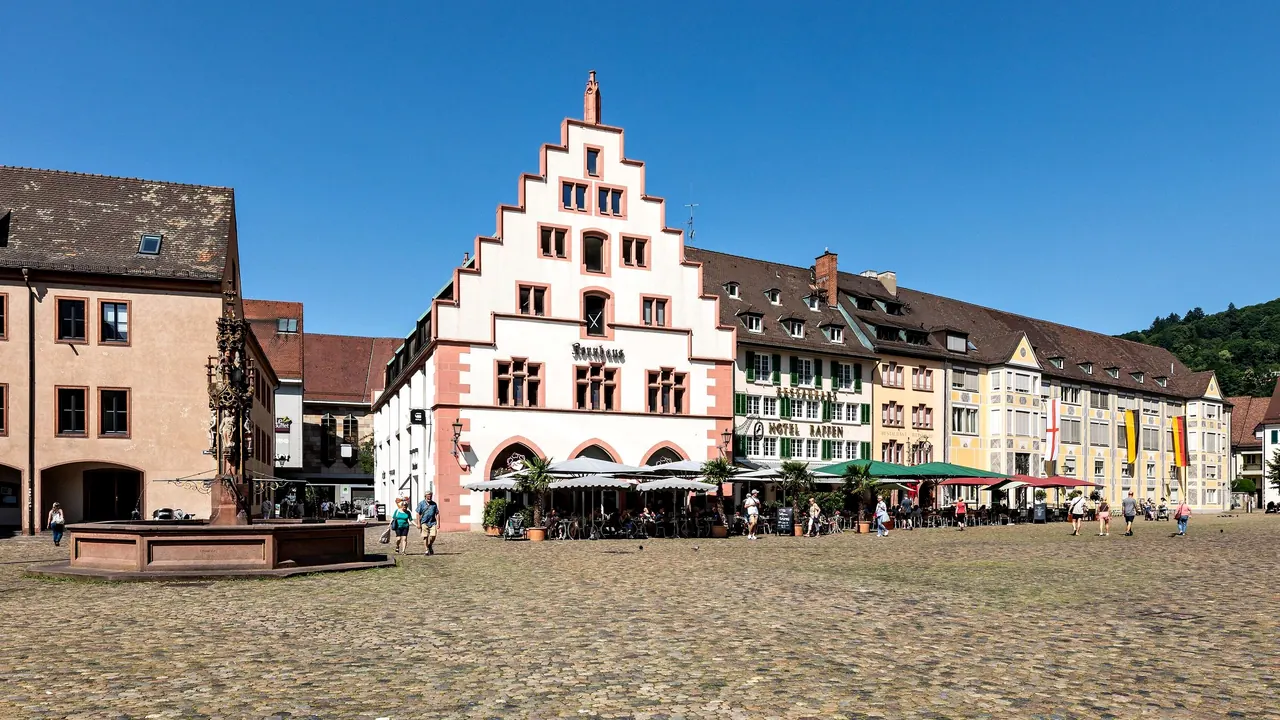
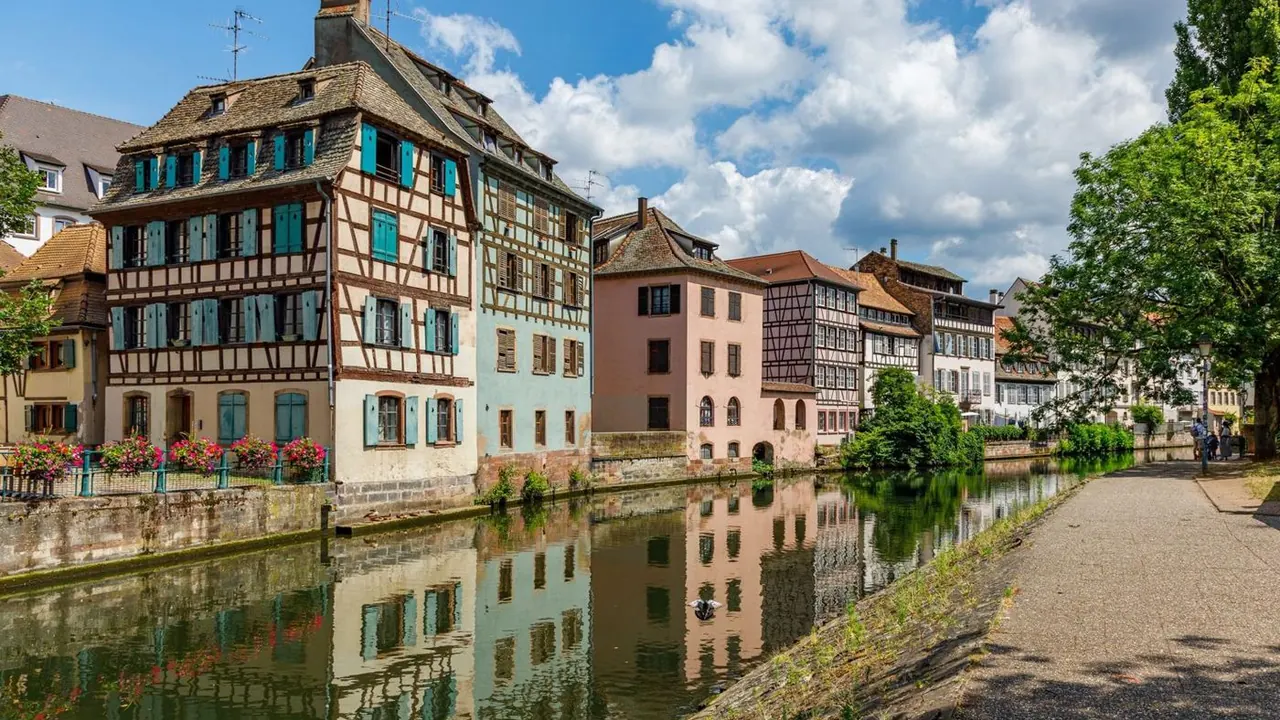
Photos: Freiburg by Dietmar Rabich, CC BY-SA 4.0, cropped; Strasbourg by Edoardo Colombo, Pexels License.
Freiburg or Strasbourg?
Our verdict in twelve categories, each scored against the same fixed benchmark cities, and the climate month by month, so you can choose for your trip.
Choose Freiburg for
- nature and the outdoors
- families
- beaches
Choose Freiburg if you want the outdoors on your doorstep. The Black Forest begins at the edge of town, a cable car lifts you onto a mountain ridge, and lakes, thermal baths and Europa-Park are all close by. It is the gentler, greener base of the two, and the better one for families, hikers, cyclists and anyone who wants a calm week with spa days.
Choose Strasbourg for
- culture and sights
- shopping
- live music and the arts
Strasbourg is the richer city to explore. Its island old town, Petite France and the imperial Neustadt are on the UNESCO list. It has a cluster of serious museums, a national opera and theatre, and the more varied winstub table. Pick it for a city-focused trip of sights, evenings at the opera and Alsatian cooking, with the wine route a short train ride south.
Scoreboard
Twelve categories on one fixed scale from 0 to 100. The shaded stretch is the gap between the two.
Your match
Pick a travel style or drag the sliders, and both match scores follow your weighting.
Too close to call, 1 point apart
Wins on nature and the outdoors and families with your weighting.
Wins on culture and sights and shopping with your weighting.
What matters to you?
Category by category
What the scores mean for a trip.
Beaches & swimming
Neither city has a beach, and in both swimming means a gravel-pit lake on the Rhine plain with grassy banks rather than sand. Freiburg has more choice. Besides the warm lakes west of town, Titisee and Schluchsee in the Black Forest make a much more scenic swim, though the water stays cool.
Strasbourg's lakes are handier but plainer. The Baggersee is on the tram line and the others are lifeguarded in high summer, but there is no mountain lake to go to, and the Rhine itself is off limits for swimming.
Food & drink
Both cities cook in the borderland style and serve it in wood-panelled taverns with local Pinot Gris, but Strasbourg's table is deeper. The winstub tradition brings choucroute, baeckeoffe and tarte flambée, foie gras is a speciality, there is a covered market for Munster cheese and charcuterie, and the city brews its own beer. Just avoid the tourist menus around the cathedral.
Freiburg's Baden cooking is lighter and pleasant: Schäufele, Black Forest trout, spring asparagus and a sausage from the Münster market stalls, with Kaiserstuhl wines to go with it. Away from the market and the taverns, though, the choice starts repeating sooner.
Culture & sights
Strasbourg has much more to see. Its Grande Ile, Petite France and the German-built Neustadt form a UNESCO-listed whole. The Palais Rohan holds three museums, and the cathedral sculpture museum, the Alsatian Museum, a large modern art museum and the European institutions add to them. That fills two or three unhurried days.
Freiburg's highlights are the Münster, whose tower you can climb for views over the Black Forest, the medieval gates, the Bächle channels and the Augustinermuseum's medieval art. Its centre was largely rebuilt after the war, and a day or two covers it.
Nightlife
Two university towns with an evening to match: friendly, mostly bars, and rarely very late in either. The difference is in the setting. Freiburg's nights move outdoors in summer, onto the squares and the Dreisam banks, with wine bars and beer gardens around the Martinstor and a few techno and indie clubs. It goes noticeably quiet when the students are away.
Strasbourg's evenings centre on the Krutenau and Place Saint-Étienne, where you will find beer cellars and a few cocktail bars as well as student haunts. The summer crowd sits on terraces along the quays, but much of the city has gone to bed by midnight on weeknights.
Nature & outdoors
Freiburg is in a different league here. You can walk up the Schlossberg straight from the old town, and a cable car climbs to the Schauinsland at about 1,280m. The Feldberg offers hiking in summer and skiing in winter, and between the Ravenna gorge and the Kaiserstuhl vineyards there is excellent walking and mountain biking.
Strasbourg's own green space is flat: the Orangerie, riverside forests with storks and beavers, and long level cycle routes along the Rhine. For hills you go to the Vosges or the Black Forest, each about an hour away and much easier with a car.
Day trips
The two are about equally good as bases, and each makes a classic day out from the other. Freiburg's strength is the corner where three countries meet. Basel's art museums and Rhine-side old town are about 45 minutes away by train, and Staufen, Breisach's hilltop minster, the abbey of St. Peter and the Kaiserstuhl wine villages are all close by. Colmar and Alsace villages such as Riquewihr take about an hour by car.
Strasbourg sits closer to the heart of French Alsace. Colmar is half an hour away by train, and the wine route runs south through Obernai and Kaysersberg, with the castle of Haut-Koenigsbourg on the ridge above. It also reaches further in other directions: north to Heidelberg's castle ruin, west to Nancy's Place Stanislas, and south by train to the car and railway museums of Mulhouse.
Good for families
Freiburg is the easier family base. Europa-Park is about 40 minutes away rather than an hour, and the free Mundenhof animal park, the cable car ride, the Steinwasen suspension bridge and the swimming lakes keep children busy outdoors. The weak spot is a wet day, when there is little indoors.
Strasbourg covers rainy days better, with the hands-on Le Vaisseau science centre and the moving figures of the astronomical clock. It also has boat trips through Petite France and rowing boats in the Orangerie, where the storks nest. Beyond that, most of its museums are made for adults.
Getting around
There is little to choose between them. In both you can cross the car-free centre on foot in about twenty minutes, and trams and excellent cycle lanes take you further. The extras differ. In Freiburg, many hotels give guests a card for regional buses and trains, which climb the Höllental into the Black Forest. In Strasbourg, bike hire is easy and a tram runs across the Rhine to Kehl in Germany. In both, a car only earns its place for the Alsace wine villages.
Shopping & style
Strasbourg is the better place to shop. The streets around Place Kléber and the Rue des Grandes Arcades have a department store and the main chains, and the lanes by the cathedral hold delicatessens and bookshops. Soufflenheim pottery, printed linens and kougelhopf moulds make distinctive things to take home, and December brings one of Europe's oldest Christmas markets.
Freiburg is more modest. It has chains on Kaiser-Joseph-Strasse, independent and organic shops in the Gerberau and Konviktstrasse, and cuckoo clocks and wood carvings everywhere. For serious retail, locals head to Basel.
Affordability
Costs are much the same, and in both the hotel room is what hurts. When it bites differs. Freiburg's rooms are scarce on summer weekends and during trade fairs, and staying in a Black Forest village is the usual way round it. Strasbourg's are dearest during the Christmas market and the weeks when the European Parliament sits.
Day to day, both are kind. Freiburg has market sausages and student-quarter restaurants, Strasbourg has winstub plates and wine by the pichet, and the great cathedral in each city is free to visit. Just remember that a day trip from Freiburg into Switzerland costs noticeably more.
Live music & performing arts
Strasbourg has the fuller calendar. The Opéra national du Rhin and the Philharmonic both play full seasons, the Théâtre National de Strasbourg is one of France's leading stages, and the autumn Musica festival makes the city a centre for contemporary music. It also has a respected jazz festival and regular dance.
Freiburg's stage is smaller but has its own speciality. The Freiburger Barockorchester is a leading period-instrument ensemble, the municipal theatre runs opera and drama in repertory, and in summer the Zelt-Musik-Festival fills a tent village with concerts.
Wellness & relaxation
Freiburg sits in the middle of spa country, which makes it the better choice. It has a thermal bath on the city's edge, the large warm outdoor pools of Bad Krozingen about twenty minutes south, and Badenweiler with its Roman bath ruins, all before you reach Baden-Baden.
Strasbourg's own bathing house is the tiled Bains municipaux, with its hammam and saunas, and for anything grander you cross the Rhine to Baden-Baden. Its slow canal walks and long winstub lunches are restful, except in December, when the market crowds take over the centre.
When should you go?
Pick your month. The climate figures are measured averages, not a forecast.
Freiburg in July
Strasbourg in July
Daytime high, °C
Rainfall in the month, mm
Temperature and rainfall are climate normals, averaged over the years shown. Freiburg: 1991-2020 normals, Freiburg (0.6 km from centre). Strasbourg: 1991-2020 normals, Strasbourg (9.1 km from centre).
Through the year the two climates are almost twins, which is not surprising when they are only about an hour apart on the same Rhine plain. Summer highs reach about 27°C in July, warm enough from June to August for the lakes and long evenings outdoors. Winters are cold and grey, with highs only a few degrees above freezing and very little sun. April, May and September are the most comfortable months for walking the streets and the hills.
The real difference is rain. Freiburg, under the Black Forest, is noticeably wetter, with about 103mm in May against 77mm in Strasbourg, and it gets more rain in every month of the year. In return, Freiburg gets a little more summer sunshine. Strasbourg is the drier choice in late spring and summer, and its dull Decembers are the darkest of the two.
Which traveller are you?
For an outdoors trip, Freiburg is the clear pick. The Schauinsland cable car, the ridge trails, the Feldberg and the Ravenna gorge are all close at hand, and the Kaiserstuhl is right there for cycling. From Strasbourg, the Black Forest and the Vosges usually mean an hour's drive.
On a culture and arts trip, Strasbourg gives you far more to do. You get the cathedral with its astronomical clock, the three museums of the Palais Rohan and the UNESCO-listed old town and Neustadt. In the evenings there are the Opéra national du Rhin and the Théâtre National de Strasbourg.
On a family trip with children, Freiburg is the easier choice. Europa-Park is closer, and the free Mundenhof animal park and the Bächle channels for toy boats are in town. The cable car ride, the Steinwasen suspension bridge and the swimming lakes fill the rest of a week.
Before you go
| Measure | Freiburg | Strasbourg |
|---|---|---|
| Official language | German | French |
| Currency | Euro (EUR) | Euro (EUR) |
| Sockets | CF230 V, 50 Hz | CE230 V, 50 Hz |
| Driving side | Right | Right |
| Time zone | UTC+1, UTC+2 in summer | UTC+1, UTC+2 in summer |
| Emergency number | 112 | 112 |
| Elevation | 278 m | 132 m |
| Main airport | EuroAirport Basel–Mulhouse–Freiburg (BSL)50 km from centre112 non-stop destinations | Strasbourg Airport (SXB)10 km from centre43 non-stop destinations |
| Public holidays this year | 12 days | 11 days |
By the numbers
| Measure | Freiburg | Strasbourg |
|---|---|---|
| City population | 238,299 | 293,771 |
| People per km² | 1,558 | 3,752 |
| Museums within 10 km | 13 | 21 |
| UNESCO World Heritage sites within 50 km | 2 | 3 |
Where else could you go?
Every comparison below shares a destination with this one, so you can follow Freiburg or Strasbourg somewhere new.
- Colmarvs Freiburg
- Baden-Badenvs Strasbourg
- Baselvs Freiburg
- Colmarvs Strasbourg
- Zurichvs Freiburg
- Baden-Badenvs Freiburg