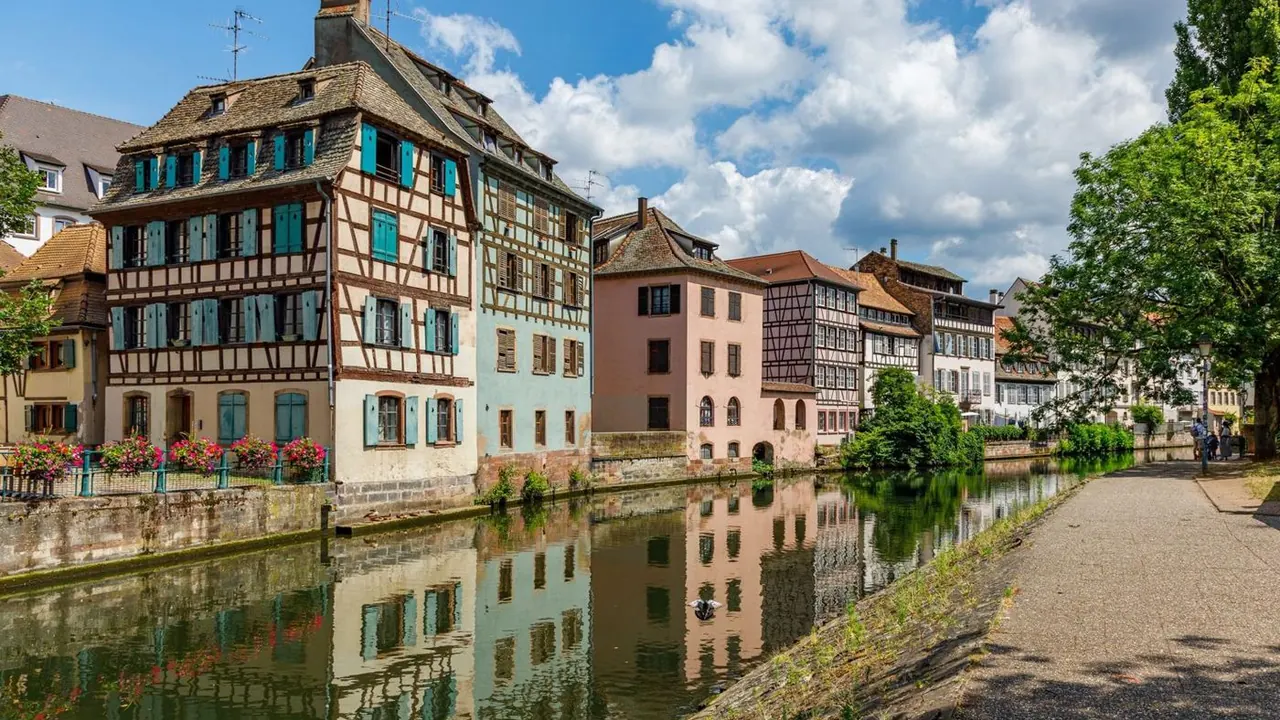
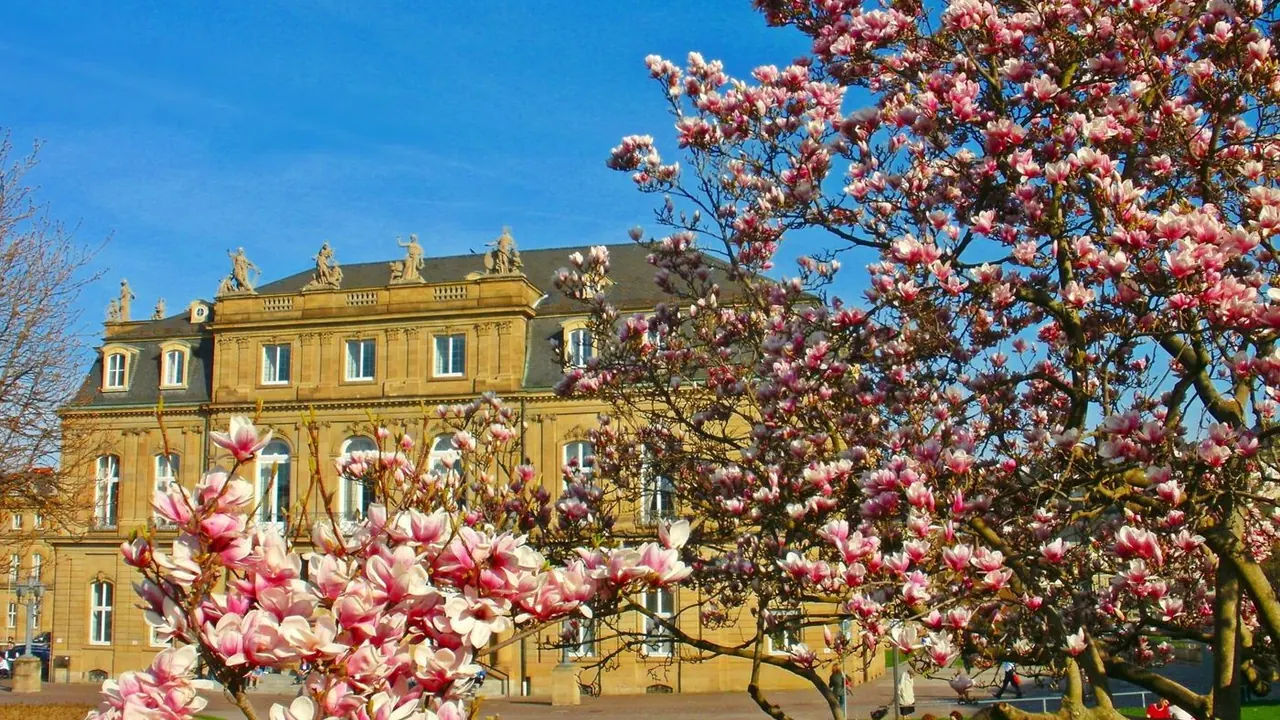
Photos: Strasbourg by Edoardo Colombo, Pexels License; Stuttgart by Baden de, CC BY 3.0, cropped.
Strasbourg or Stuttgart?
Our verdict in twelve categories, each scored against the same fixed benchmark cities, and the climate month by month, so you can choose for your trip.
Choose Strasbourg for
- food and drink
- culture and sights
- getting around
Strasbourg suits travellers who want an old city to wander. The cathedral, the timber-framed lanes of the Grande Ile and the locks of Petite France sit on an island you can cross on foot, and winstub dinners of choucroute and Riesling fill the evenings. It is the better pick for a first visit, a sightseeing weekend or anyone who would rather walk and cycle than use public transport.
Choose Stuttgart for
- live music and the arts
- wellness
- shopping
If your evenings matter more than your sightseeing, Stuttgart is the better fit. It has one of Europe's most respected ballet companies, a bold opera house and a serious concert hall, and mineral baths where you can soak in naturally fizzy warm water. Add the car museums, Königstrasse for shopping and the outlet town nearby, and it suits travellers with planned evenings and a shopping list more than wanderers.
Scoreboard
Twelve categories on one fixed scale from 0 to 100. The shaded stretch is the gap between the two.
Your match
Pick a travel style or drag the sliders, and both match scores follow your weighting.
Too close to call, level with your weighting
Wins on food and drink and culture and sights with your weighting.
Wins on live music and the arts and wellness with your weighting.
What matters to you?
Category by category
What the scores mean for a trip.
Beaches & swimming
Neither city has a beach, and neither is a place for a swimming vacation. Strasbourg has lifeguarded gravel-pit lakes such as the Baggersee, which the tram reaches, with grassy banks and fresh water for a hot afternoon. Stuttgart's summer swimming happens in outdoor pools, some fed by mineral springs, and its nearest proper lake is Lake Constance, more than two hours south.
Food & drink
Strasbourg eats better. Alsatian cooking mixes French and German traditions, from choucroute and baeckeoffe to tarte flambée and foie gras, and the wood-panelled winstub with a pichet of Riesling is one of the best settings in the region. Its markets and December mulled wine add to that, though the restaurants by the cathedral lean on tourist menus.
Stuttgart's Swabian food is just as hearty but has a narrower range: Maultaschen, Käsespätzle and Zwiebelrostbraten in traditional taverns. Its charm is that vines grow inside the city limits, and seasonal Besen taverns pour local Trollinger in the growers' own houses. Neither city offers much international variety.
Culture & sights
Strasbourg is the stronger sightseeing city. The pink sandstone cathedral with its astronomical clock, the Grande Ile and Petite France, and the German-built Neustadt form one intact, UNESCO-listed townscape. The Palais Rohan, the Oeuvre Notre-Dame and the Alsatian Museum fill the gaps between walks.
Stuttgart's heritage was badly damaged by bombing, so its appeal is industry and modern design. The Mercedes-Benz and Porsche museums are world-class, the Staatsgalerie holds fine European painting, and the Weissenhof Estate's Le Corbusier houses are a landmark of modern architecture. Historic buildings survive in pockets around Schlossplatz rather than as a whole old town.
Nightlife
Neither city is built for late nights, but the evenings feel different. Strasbourg's are student-led, with bars and beer cellars in the Krutenau and summer terraces along the river, and only a handful of clubs. Stuttgart has a strip of bars and lounges on Theodor-Heuss-Strasse and basement clubs with a small electronic music following. Its liveliest weeks are the beer tents of the Cannstatter Volksfest and the late-summer wine village.
Nature & outdoors
Both give easy access to the outdoors, but the terrain differs. Strasbourg is flat, which makes it ideal for cycling along the Rhine and the canals, and its riverside forests have storks and beavers. Hills mean going out to the Vosges or the Black Forest.
Stuttgart sits in a basin, so you can walk from the centre up into vineyards and the forests of the Rotwildpark. The Swabian Jura, with cliff-edge trails and caves, and the northern Black Forest are each about an hour away.
Day trips
Both are excellent bases for day trips, and each can visit the other. From Strasbourg, the trips run through Alsace: Colmar by train, the wine villages of Riquewihr and Eguisheim, and Haut-Koenigsbourg on its ridge. Baden-Baden and Freiburg are just across the Rhine, but the vineyards are easier by car or bike.
From Stuttgart, more of the trips work by rail. Ludwigsburg's palace and Esslingen are short S-Bahn rides, Tübingen is under an hour, and the fast train reaches Heidelberg in about forty minutes. Hohenzollern Castle and Ulm's huge spire are further away.
Good for families
The two are equally good with children, but the highlights differ. In Strasbourg, the flat, car-free centre suits pushchairs, the boat trips and the Orangerie's storks are easy wins, and Europa-Park is about an hour away. In Stuttgart, Wilhelma's zoo and gardens can fill a whole day, and the Killesberg railway and rack railway are treats in themselves, though the hills mean some climbing and a big theme park needs a trip out of the city.
Getting around
Strasbourg is the simpler city to get around. Its historic island takes about twenty minutes to cross on foot, much of it is pedestrianised, and separated bike lanes and trams cover everything else, including a line over the Rhine to Kehl.
Stuttgart's flat core is just as walkable, but the city climbs steeply up the sides of its basin, so you rely more on the Stadtbahn and S-Bahn. One ticket covers trains, buses, the rack railway and the funicular. The stepped Stäffele lanes make useful, if tiring, shortcuts.
Shopping & style
Stuttgart is better for shopping, especially for brands. Königstrasse is one of Germany's longest pedestrian shopping streets, Breuninger brings luxury and designer labels, and the Metzingen outlets are half an hour away.
Strasbourg has little fashion of note. Its strength is regional goods: Soufflenheim pottery, printed linens, kougelhopf moulds and Alsace wine from the small lanes near the cathedral, plus the Christmas market in December.
Affordability
Costs are broadly similar, and neither is a budget destination. Strasbourg has the advantages of free sights in its old town and good-value wine by the pichet, but hotels get expensive during the Christmas market and the weeks when the European Parliament sits. In Stuttgart, trade fairs push up hotel prices, while weekends and quieter months are noticeably cheaper.
Live music & performing arts
Stuttgart is far ahead on stage. The Stuttgart Ballet, famous since John Cranko's time, shares the state theatre with an opera company known for bold productions. The Liederhalle hosts orchestras and a strong Bach tradition, and big musicals and a well-known jazz club fill the rest of the week.
Strasbourg has a respectable programme for its size. The Opéra national du Rhin, a full philharmonic season and the Théâtre National de Strasbourg are the core, and the Musica festival makes autumn the time for contemporary music.
Wellness & relaxation
Stuttgart has the better bathing on its doorstep. The Cannstatt and Berg springs are among the most productive mineral sources in Europe and feed public baths with warm, carbonated pools and saunas. The city's pace is businesslike, though.
Strasbourg has the tiled Bains municipaux, with a hammam and saunas, but its real spa day means going to Baden-Baden. In return, it offers a slower pace, with canal-side walks and long winstub lunches, except in December.
When should you go?
Pick your month. The climate figures are measured averages, not a forecast.
Strasbourg in July
Stuttgart in July
Daytime high, °C
Rainfall in the month, mm
Temperature and rainfall are climate normals, averaged over the years shown. Strasbourg: 1991-2020 normals, Strasbourg (9.1 km from centre). Stuttgart: 1991-2020 normals, Stuttgart / Neckartal (2.8 km from centre).
The two cities share almost the same climate, so the time of year shapes the trip more than the choice between them. Both are pleasant for walking from May to September, with summer highs around 26°C in July and August. Summer is also the wettest part of the year, with heavy showers that peak at 77mm in May in Strasbourg and 79mm in July in Stuttgart. Spring and early autumn bring mild days and less rain, which makes April, late September and early October good months for long days on foot.
Winters are cold and grey in both, with highs of about 6°C in December. Stuttgart gets a little more winter sunshine, roughly 60 hours in December against Strasbourg's 42. Strasbourg's December is all about the Christmas market, and its heavy Alsatian food suits cold days best. Stuttgart's warm mineral pools make a cold month more bearable.
Which traveller are you?
For a short city break, Strasbourg is the easier choice. The cathedral, Petite France and the Palais Rohan museums all sit on one walkable island, and trams and bikes cover the rest, so two days go a long way.
On a relaxing and wellness trip, Stuttgart lets you make bathing part of each day: a soak and a sauna in the mineral pools, then a slow walk up through the vineyards. In Strasbourg, the calm comes from canal walks and long lunches instead.
On a shopping trip, Stuttgart suits travellers with a list of labels. Give one day to the centre's department stores and high street, and a second morning to the outlet town by train. Strasbourg is for slow browsing and regional gifts.
Before you go
| Measure | Strasbourg | Stuttgart |
|---|---|---|
| Official language | French | German |
| Currency | Euro (EUR) | Euro (EUR) |
| Sockets | CE230 V, 50 Hz | CF230 V, 50 Hz |
| Driving side | Right | Right |
| Time zone | UTC+1, UTC+2 in summer | UTC+1, UTC+2 in summer |
| Emergency number | 112 | 112 |
| Elevation | 132 m | 245 m |
| Main airport | Strasbourg Airport (SXB)10 km from centre43 non-stop destinations | Stuttgart Airport (STR)10 km from centre124 non-stop destinations |
| Public holidays this year | 11 days | 12 days |
By the numbers
| Measure | Strasbourg | Stuttgart |
|---|---|---|
| City population | 293,771 | 609,365 |
| People per km² | 3,752 | 2,938 |
| Museums within 10 km | 21 | 42 |
| UNESCO World Heritage sites within 50 km | 1 | 3 |
Where else could you go?
Every comparison below shares a destination with this one, so you can follow Strasbourg or Stuttgart somewhere new.