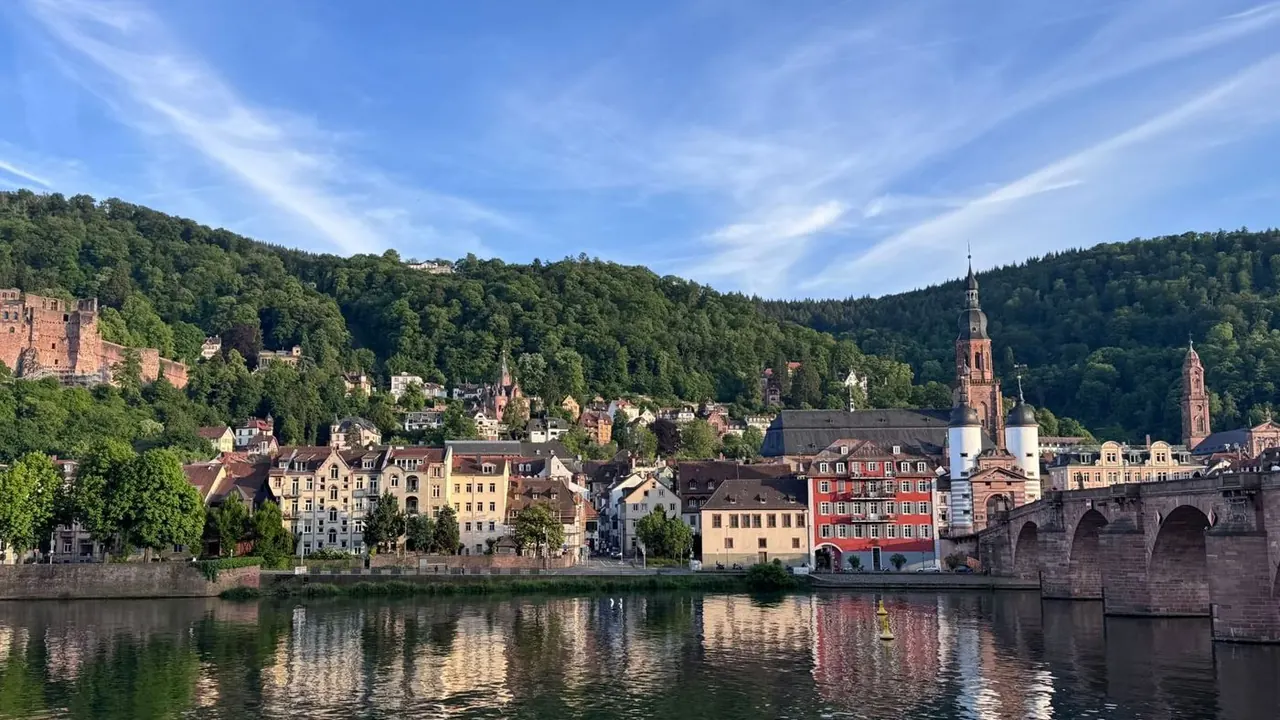
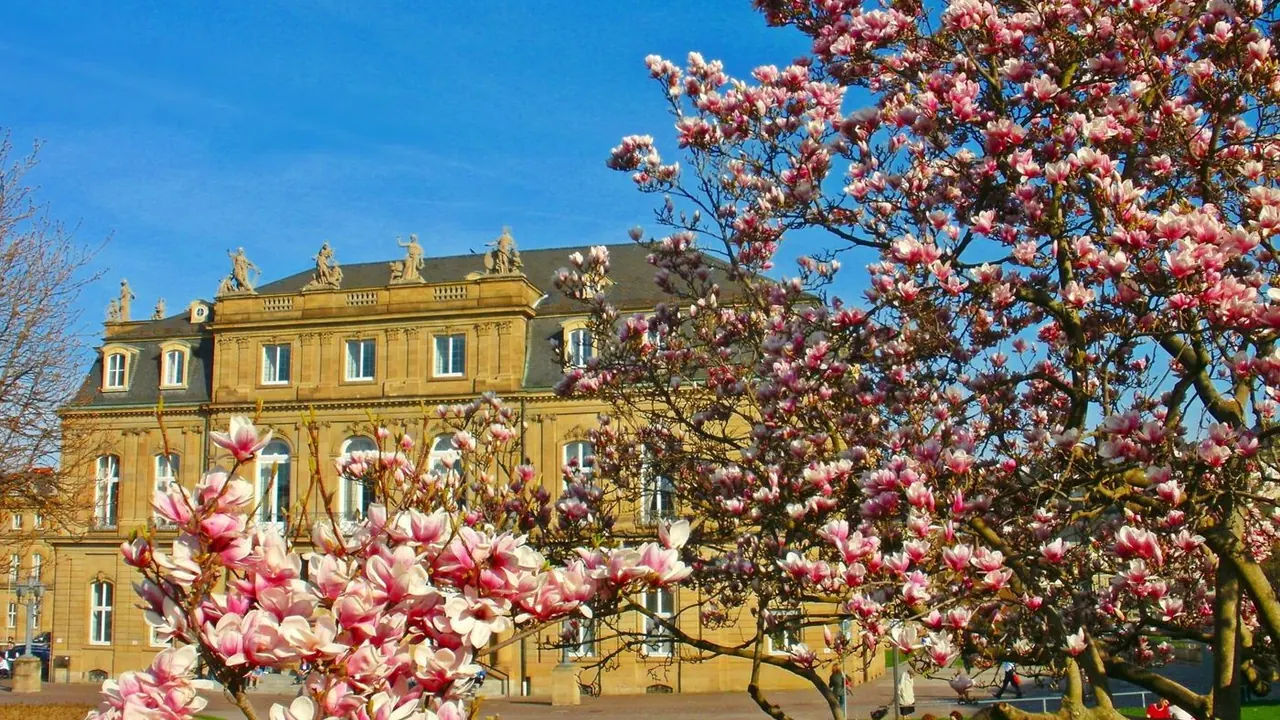
Photos: Heidelberg by Kuanling Chen, Pexels License; Stuttgart by Baden de, CC BY 3.0, cropped.
Heidelberg or Stuttgart?
Our verdict in twelve categories, each scored against the same fixed benchmark cities, and the climate month by month, so you can choose for your trip.
Choose Heidelberg for
- prices
Heidelberg is the choice for a traveller who wants the classic picture of old Germany: a red sandstone castle ruin above a baroque Altstadt, an ancient university with its Student Prison, and a river bend framed by wooded hills. It is small enough to take in over a weekend, and it is a good base for the cathedral towns of the Upper Rhine and the Palatinate wine villages. Come for atmosphere and views rather than for big-city evenings.
Choose Stuttgart for
- live music and the arts
- wellness
- food and drink
Stuttgart rewards people who want more from their evenings and their downtime. The opera and one of Europe's most respected ballet companies share a stage beside the palace gardens, and the mineral baths of Bad Cannstatt make a slow afternoon easy. Swabian food has more depth here, and Breuninger and the Metzingen outlets give shoppers a real reason to go. The old stones are fewer, but the car museums, the Staatsgalerie and the Weissenhof Estate show a modern, design-minded side that Heidelberg does not have.
Scoreboard
Twelve categories on one fixed scale from 0 to 100. The shaded stretch is the gap between the two.
Your match
Pick a travel style or drag the sliders, and both match scores follow your weighting.
Wins on prices with your weighting.
Wins on live music and the arts and wellness with your weighting.
What matters to you?
Category by category
What the scores mean for a trip.
Beaches & swimming
Neither city offers anything like a beach. The difference is in what you do on a hot afternoon. Heidelberg's people head out to the gravel-pit lakes on the Rhine plain about half an hour away, which gives you open-water swimming of a sort. Stuttgart's answer is its outdoor pools, some fed by mineral springs, and its nearest real lake, Lake Constance, is more than two hours south.
Food & drink
Both kitchens are hearty and both share Maultaschen, but Stuttgart eats better overall. It has the Art Nouveau Markthalle for regional produce, seasonal Besen taverns where growers pour Trollinger in their own houses, and a deeper fine-dining tier than a city its size would suggest.
Heidelberg's strength is its wine, from the Bergstrasse on its doorstep and the Palatinate villages nearby, plus spring asparagus. Its main streets lean towards day-tripper menus, so good meals take some seeking out in the side streets and in Neuenheim. The student population keeps cheap food plentiful, which is one thing Stuttgart does less well.
Culture & sights
These two are fairly evenly matched but offer opposite kinds of sightseeing. Heidelberg is about the past as a whole scene: the castle ruin with its Great Tun, the baroque Altstadt, the Church of the Holy Spirit and Germany's oldest university, all compact and very photogenic.
Stuttgart lost most of its old core to bombing, so its strengths are modern. The Mercedes-Benz and Porsche museums, the Staatsgalerie with its postmodern wing and the Le Corbusier houses of the Weissenhof Estate draw people with an interest in design and engineering, with the Schlossplatz palaces as the main historic pocket. Expect one or two days in Heidelberg and two or three in Stuttgart.
Nightlife
Neither is a party destination, and both go quiet early on weeknights. Heidelberg's evenings belong to students, packed into the small pubs of the Untere Strasse and the old fraternity taverns, so the town feels very different in and out of term.
Stuttgart is more grown-up, with weekend bars and lounges along Theodor-Heuss-Strasse, basement clubs with a following for electronic music, and wine bars in the Bohnenviertel. Its big moments are the Cannstatter Volksfest beer tents in autumn and the late-summer wine village.
Nature & outdoors
Both offer gentle, green walking country rather than mountains, and both put woodland within reach of the centre. Heidelberg's is more immediate: the Philosophers' Walk, the funicular up the Königstuhl and the Celtic ramparts on the Heiligenberg start almost from the old town, with the Neckar Valley cycle path heading upstream.
Stuttgart's hills and vineyards ring the basin, with deer and lakes in the Rotwildpark and Schönbuch. Its bigger draw is what lies about an hour away, the limestone cliffs and caves of the Swabian Jura and the fir ridges of the northern Black Forest, which are a little wilder than Heidelberg's Palatinate Forest.
Day trips
Heidelberg and Stuttgart are only about forty minutes apart by fast train, so each is an easy outing from the other. The difference is in the kind of day out each one opens up. Heidelberg's trips lean towards the Rhine valley and its medieval past: the cathedrals of Speyer and Worms, Schwetzingen's palace gardens, Lorsch Abbey, the four castles of Neckarsteinach and the wine villages around Deidesheim.
Stuttgart's list is a little longer and more mixed. Baroque Ludwigsburg and half-timbered Esslingen are a short S-Bahn ride out, and a little further away are the steep lanes of Tübingen, Hohenzollern Castle on its hilltop and Ulm's great spire. Maulbronn, Baden-Baden and a long day in Strasbourg work from either city.
Good for families
Both are safe and manageable with children, and the highlights differ more than the overall appeal. Stuttgart's Wilhelma, a zoo and botanical garden among Moorish pavilions, can fill a whole day, and the Killesberg park railway, the rack railway and Ludwigsburg's fairy-tale garden add easy extras.
Heidelberg works best on outings: the funicular ride up to the Königstuhl's small fairy-tale park, a boat trip past the castles, and the Technik Museum Speyer with its space shuttle and submarine. Unlike Stuttgart, it has a large theme park within an hour. Pushchairs struggle in both, on cobbles in Heidelberg and on hills in Stuttgart.
Getting around
Heidelberg is one long, narrow strip between the river and the castle hill, so the pedestrianised Hauptstrasse takes you from one end to the other on foot. The station sits well west of the old town, so most arrivals take a tram in, and a funicular climbs to the castle. The cobbles and the steep castle approach are the only real effort.
Stuttgart is laid out the other way round. It has a small, flat centre around Königstrasse and Schlossplatz, with hills rising steeply on every side, so the Stadtbahn and S-Bahn do more of the work, reaching the car museums, Wilhelma and the airport. The Stäffele stairways make walking up those hills a local experience in its own right.
Shopping & style
Stuttgart is the better place to shop. Alongside the chains on Königstrasse it has Breuninger for designer fashion, independent shops around Calwer Strasse and the Bohnenviertel, and the Metzingen outlet village half an hour away.
Heidelberg's Hauptstrasse starts with high-street chains and ends in souvenirs, cuckoo clocks and beer steins, with a few bookshops and boutiques in the side lanes. Its best take-home is Bergstrasse wine or a box of Studentenkuss chocolates, and serious shoppers simply take the train elsewhere.
Affordability
Costs are much the same, with hotels the main expense in both and meals in taverns reasonable. What drives the room rates differs. In Heidelberg it is a small hotel stock squeezed by congresses, graduations and summer weekends, and many visitors stay in Mannheim instead.
In Stuttgart, trade fairs push prices up while weekends and quieter months are noticeably cheaper, which suits leisure travellers who can time their trip. Both regional transport tickets are good value for day trips.
Live music & performing arts
Stuttgart is in another league here. The Staatsoper and the Stuttgart Ballet, renowned since the Cranko years, share the grand state theatre, while the Staatsschauspiel, the Liederhalle's orchestras and long-running musicals fill the rest of the week. Ballet tickets go early, so plan ahead.
Heidelberg does well for a small town, with opera and drama at its municipal theatre, the Heidelberger Frühling chamber music festival in spring and open-air performances in the castle courtyard in summer. The setting is the attraction more than the scale.
Wellness & relaxation
Stuttgart has the real advantage: some of Europe's most productive mineral springs feed public baths at Bad Cannstatt and Berg, so a warm carbonated soak and a sauna are a tram ride away. Its pace, though, is businesslike.
Heidelberg has no thermal baths of its own and relies on the Kraichgau spa towns half an hour off, or Baden-Baden. What it offers is a slower mood: evenings on the Neuenheim meadows, forest paths above the Philosophers' Walk and unhurried wine taverns, away from the midday crowds by the castle.
When should you go?
Pick your month. The climate figures are measured averages, not a forecast.
Heidelberg in July
Stuttgart in July
Daytime high, °C
Rainfall in the month, mm
Temperature and rainfall are climate normals, averaged over the years shown. Heidelberg: 1991-2020 normals, Heidelberg (4.5 km from centre). Stuttgart: 1991-2020 normals, Stuttgart / Neckartal (2.8 km from centre).
The two cities share almost the same climate, which is not surprising given how close together they are. Both are cold and grey in winter, with highs of about 5°C to 6°C from December to February, so street walking then is a matter of short outings between warm interiors. Stuttgart is a little drier and slightly sunnier through the winter months. Spring arrives in April, and Heidelberg's Bergstrasse is in blossom early. From May to September days reach the low to mid twenties, peaking at about 26°C in July and August. That is comfortable for walking and hiking but neither city is a beach destination.
Summer is also the wettest season in both, with July bringing about 80mm, mostly as showers rather than long grey spells. Stuttgart gets a little more rain in early summer, and Heidelberg a little more in the late autumn and winter. For most trips the best spells are May to June and September, when it is warm enough to sit outside but not too hot for the steep lanes and hillside stairways, and the autumn colour in the vineyards and forests carries both cities well into October.
Which traveller are you?
On a culture and arts trip, Stuttgart is the stronger pick. Its state theatre stages bold opera and a celebrated ballet, the Liederhalle has a strong Bach tradition, and the Staatsgalerie and car museums add collections of international standing to the evenings.
For a relaxing and wellness trip, Stuttgart wins clearly. Its own mineral springs feed public baths where you can soak in warm, naturally carbonated water indoors and out, whereas Heidelberg means a drive to the Kraichgau spa towns or Baden-Baden.
For a short city break, Heidelberg suits better. The castle, the Old Bridge, the university and the Philosophers' Walk fit neatly into a day or two within one walkable strip, and the setting feels like a complete picture rather than a scattering of pockets.
Before you go
| Measure | Heidelberg | Stuttgart |
|---|---|---|
| Official language | German | German |
| Currency | Euro (EUR) | Euro (EUR) |
| Sockets | CF230 V, 50 Hz | CF230 V, 50 Hz |
| Driving side | Right | Right |
| Time zone | UTC+1, UTC+2 in summer | UTC+1, UTC+2 in summer |
| Emergency number | 112 | 112 |
| Elevation | 114 m | 245 m |
| Main airport | Frankfurt Main Airport (FRA)69 km from centre281 non-stop destinations | Stuttgart Airport (STR)10 km from centre124 non-stop destinations |
| Public holidays this year | 12 days | 12 days |
By the numbers
| Measure | Heidelberg | Stuttgart |
|---|---|---|
| City population | 156,092 | 609,365 |
| People per km² | 1,433 | 2,938 |
| Museums within 10 km | 17 | 42 |
| UNESCO World Heritage sites within 50 km | 4 | 3 |
Where else could you go?
Every comparison below shares a destination with this one, so you can follow Heidelberg or Stuttgart somewhere new.