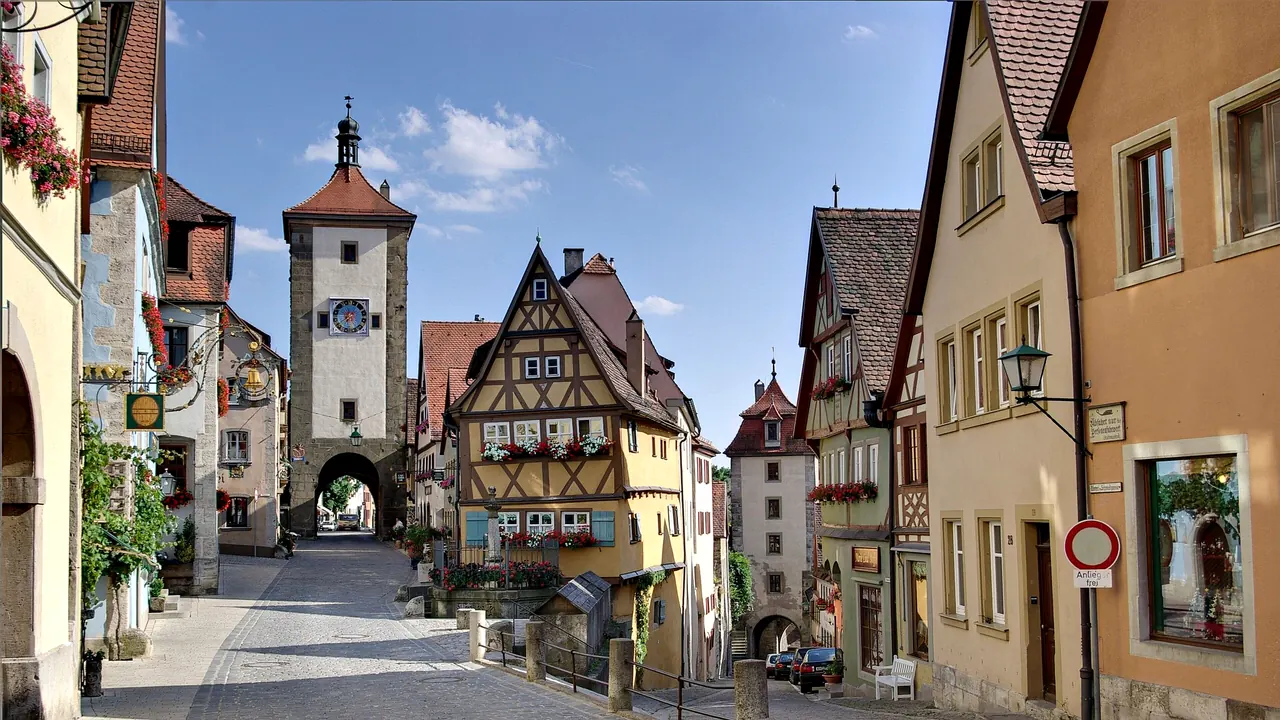
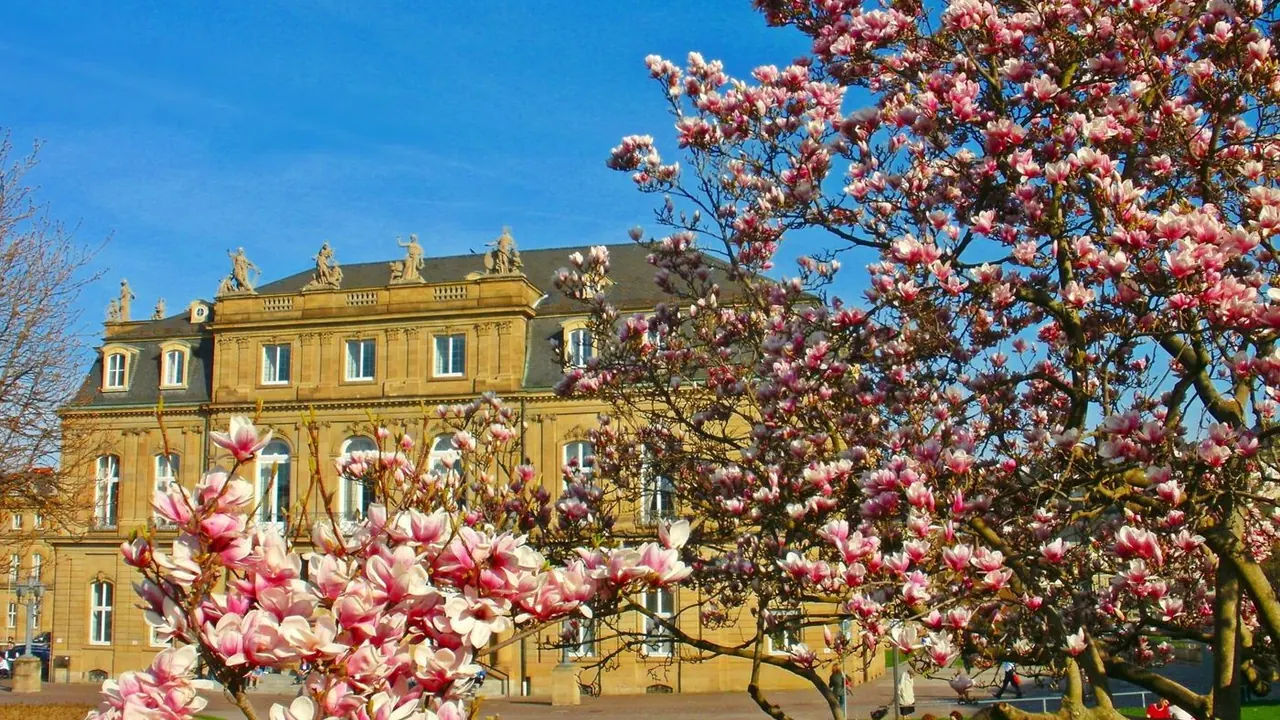
Photos: Rothenburg ob der Tauber by Berthold Werner, Public domain; Stuttgart by Baden de, CC BY 3.0, cropped.
Rothenburg ob der Tauber or Stuttgart?
Our verdict in twelve categories, each scored against the same fixed benchmark cities, and the climate month by month, so you can choose for your trip.
Choose Rothenburg ob der Tauber for
- prices
Rothenburg suits travellers who want to step inside a medieval town and stay there for a night or two. Its gabled lanes, ramparts and gate towers make the place itself the sight, and it rewards a slow walk on the walls once the coach parties leave. It also works as a stop on a Romantic Road drive with walled towns on either side. Expect quiet evenings, plain Franconian food and a car for anything beyond the gates.
Choose Stuttgart for
- live music and the arts
- nightlife
- shopping
Stuttgart is the better choice for a fuller city vacation. It has opera and ballet of European standing, Swabian cooking with a serious fine-dining tier, mineral baths fed by its own springs, and a rail network that reaches Heidelberg, Tübingen and the Swabian Jura without a car. Families, food lovers and anyone staying longer than a weekend will find much more to fill the days and the evenings.
Scoreboard
Twelve categories on one fixed scale from 0 to 100. The shaded stretch is the gap between the two.
Your match
Pick a travel style or drag the sliders, and both match scores follow your weighting.
Wins on prices with your weighting.
Wins on live music and the arts and nightlife with your weighting.
What matters to you?
Category by category
What the scores mean for a trip.
Beaches & swimming
Neither is a place for swimming, and both are far from any coast. The difference is in what replaces the beach. Around Rothenburg it is the town pool or a drive of about an hour to the grassy shores of the Franconian lakes, such as the Altmühlsee. Stuttgart has outdoor pools fed by its mineral springs, but the nearest open water worth swimming in is Lake Constance, more than two hours away.
Food & drink
Stuttgart eats considerably better. Swabian classics such as Maultaschen, Käsespätzle and Zwiebelrostbraten come with Trollinger and Riesling from vineyards inside the city, and the Art Nouveau Markthalle and a deep fine-dining tier add range that a small town cannot match.
Rothenburg offers a narrower Franconian menu of Schäufele, bratwurst and Silvaner from the Bocksbeutel bottle. Many kitchens around the Marktplatz cook for the coach trade, so the good meals are found in family guesthouses and Tauber valley wine taverns off the main square.
Culture & sights
The two places are equally rewarding, but in completely different ways. Rothenburg is a single, intact medieval set piece: the covered wall walk, the Plönlein between its gate towers, and Riemenschneider's carved Holy Blood Altar in St Jakob's. You can see it all in a short visit.
Stuttgart's heritage is modern and industrial. It has the Mercedes-Benz and Porsche museums, the Staatsgalerie's European painting, and the Le Corbusier houses of the Weissenhof Estate, with the old core surviving only in pockets around Schlossplatz after wartime bombing. Come to Rothenburg for atmosphere and to Stuttgart for collections and architecture.
Nightlife
Stuttgart has a real night out on offer, though it is no party city. It has a weekend bar strip on Theodor-Heuss-Strasse, basement clubs with a following for electronic music, and the beer tents of the Cannstatter Volksfest in autumn.
Rothenburg has almost nothing after dinner. The lanes go silent by about eleven, and anyone wanting a club would have to drive to Würzburg or Nuremberg.
Nature & outdoors
Stuttgart has the better outdoors within easy reach. Woods and vineyard trails start at the edge of its basin, and the limestone cliffs and caves of the Swabian Jura and the fir-covered ridges of the northern Black Forest are each about an hour away.
Rothenburg's countryside is gentle and small in scale. Paths drop from the walls to the mills and meadows of the Tauber valley, and the riverside cycle path through vineyards is a lovely easy ride, but there is no wild or hilly country nearby.
Day trips
Both are strong bases, and Schwäbisch Hall is within reach of each. Stuttgart has the edge because so much is reachable by train. Ludwigsburg's baroque palace and Esslingen are an S-Bahn ride away, and Heidelberg, Tübingen and even Strasbourg can be reached by rail.
Rothenburg's excursions follow the Romantic Road to walled Dinkelsbühl and to Nördlingen in its meteorite crater, and reach out to Würzburg's Residenz. Rail connections from the town are poor, so these trips really need a car.
Good for families
Stuttgart gives children a lot more to do. Wilhelma, with its zoo and Moorish-style pavilions, can fill a whole day. Add the Killesberg park with its little railway, playgrounds, beer gardens and the fairy-tale garden at nearby Ludwigsburg.
Rothenburg is a storybook backdrop for a short stay. Children can walk the ramparts, follow the lantern-carrying night watchman, and older ones will enjoy the gruesome exhibits of the Crime Museum. Beyond that, cobbles and steep paths make it hard work with a pushchair.
Getting around
Rothenburg is a place you simply walk. You can cross the whole walled town in about fifteen minutes, and cars stay outside the gates. Only the cobbles and the steep climb back from the Tauber valley slow you down. Leaving is harder: trains need a change at Steinach on the branch line, and buses to the surrounding villages are sparse.
Stuttgart has a centre that is just as easy on foot, but the city climbs steeply around its basin, and an integrated network takes over on the hills. One ticket covers the Stadtbahn, S-Bahn, buses, a rack railway and a funicular, and the Stäffele stairways give walkers shortcuts. The network reaches the car museums, Wilhelma and the airport, so in Stuttgart you only need a car for the countryside.
Shopping & style
These are two very different shopping trips. Rothenburg is a specialist town that does one thing well whatever the month: Christmas ornaments and German keepsakes, from glass baubles to carved nutcrackers and smoking men, sold along Herrngasse and Schmiedgasse. In December the stalls on the Marktplatz bring the real season to what the shops recreate all year. Come looking for clothes, books or anything practical, though, and you will leave empty-handed.
Stuttgart has a much wider range but less that is special to the place. Königstrasse offers a long walk past the major chains, a long-established family department store covers designer labels, and the outlet town of Metzingen is about half an hour away for big brands. What Stuttgart lacks is Rothenburg's sense that the things for sale belong to the town, so buy your nutcracker in Franconia and your coat in Swabia.
Affordability
Costs are much the same, but the pressures on price are different. Rothenburg charges a tourist premium inside the walls that peaks in December and on summer weekends, and staying in a village nearby cuts the bill.
Stuttgart's hotel prices follow the trade-fair calendar, so its weekends are often the cheaper time to stay, the opposite of Rothenburg. In both, a hearty tavern meal is fair value.
Live music & performing arts
Here the gap is wide. Stuttgart has the Staatsoper, a ballet company famous since John Cranko's time, serious drama at the Staatsschauspiel, orchestras and Bach at the Liederhalle, and long-running musicals at Möhringen. Ballet seats need booking well ahead.
Rothenburg's stage is its history. The costumed Meistertrunk play, a small summer open-air theatre and organ concerts in St Jakob's are the occasions, and on most evenings there is no performance at all.
Wellness & relaxation
Stuttgart has its own bathing culture. Warm, naturally carbonated water from the Bad Cannstatt and Berg springs fills public mineral baths with saunas, and locals use them as a matter of routine.
Rothenburg's restorative side is its stillness at dawn and after dusk, when the walls and valley paths empty. For thermal water you have to drive about an hour to the salt-water Franken-Therme at Bad Windsheim or to Bad Mergentheim.
When should you go?
Pick your month. The climate figures are measured averages, not a forecast.
Rothenburg ob der Tauber in July
Stuttgart in July
Daytime high, °C
Rainfall in the month, mm
Where the figures come from
Rothenburg ob der Tauber's sunshine is measured 27 km from the centre, at Feuchtwangen-heilbronn.
Temperature and rainfall are climate normals, averaged over the years shown. Rothenburg ob der Tauber: 1991-2020 normals, Rothenburg ob der Tauber (0.9 km from centre). Stuttgart: 1991-2020 normals, Stuttgart / Neckartal (2.8 km from centre).
The two places follow the same rhythm, but Rothenburg on its Franconian hilltop is always a little cooler. Neither is a beach destination. Late May to September is the warm stretch in both, with July and August highs of about 25°C in Rothenburg and 26°C in Stuttgart, warm enough for long days on foot without being oppressive. Spring and early autumn are the most comfortable months for walking the walls or the vineyard trails.
The rain falls differently. Stuttgart's wettest months are early summer, with June and July near 79mm, while its winters are fairly dry and sunnier than Rothenburg's. Rothenburg's rain is spread more evenly through the year, and its December is both wetter and duller, with highs around 3°C to 4°C. That cold, grey weather suits a Christmas market visit but makes winter sightseeing raw in both places.
Which traveller are you?
On a food and nightlife trip, Stuttgart is the clear pick. It offers Maultaschen in wine taverns, seasonal Besen in growers' houses, fine dining, and bars along Theodor-Heuss-Strasse. Rothenburg's evenings end in an inn dining room or on the night watchman's tour.
For a family trip with children, Stuttgart has far more to fill the days, from Wilhelma's animals and gardens to the Killesberg railway and the rack railway ride. Rothenburg delights children with its ramparts and towers, but they will have seen it all within a couple of days.
For a short city break, Rothenburg is a fine choice if what you want is atmosphere. You can cross the whole walled town on foot in minutes, climb the Rathaus tower and see everything in one or two unhurried days. Stuttgart's highlights are more spread out and need longer.
Before you go
| Measure | Rothenburg ob der Tauber | Stuttgart |
|---|---|---|
| Official language | German | German |
| Currency | Euro (EUR) | Euro (EUR) |
| Sockets | CF230 V, 50 Hz | CF230 V, 50 Hz |
| Driving side | Right | Right |
| Time zone | UTC+1, UTC+2 in summer | UTC+1, UTC+2 in summer |
| Emergency number | 112 | 112 |
| Elevation | 430 m | 245 m |
| Main airport | Nuremberg Airport (NUE)66 km from centre56 non-stop destinations | Stuttgart Airport (STR)10 km from centre124 non-stop destinations |
| Public holidays this year | 12 days | 12 days |
By the numbers
| Measure | Rothenburg ob der Tauber | Stuttgart |
|---|---|---|
| City population | 11,331 | 609,365 |
| People per km² | 272 | 2,938 |
| Museums within 10 km | 6 | 42 |
| UNESCO World Heritage sites within 50 km | 2 | 3 |
Where else could you go?
Every comparison below shares a destination with this one, so you can follow Rothenburg ob der Tauber or Stuttgart somewhere new.
- Nurembergvs Rothenburg ob der Tauber
- Baden-Badenvs Stuttgart
- Bambergvs Rothenburg ob der Tauber
- Heidelbergvs Stuttgart
- Heidelbergvs Rothenburg ob der Tauber
- Strasbourgvs Stuttgart