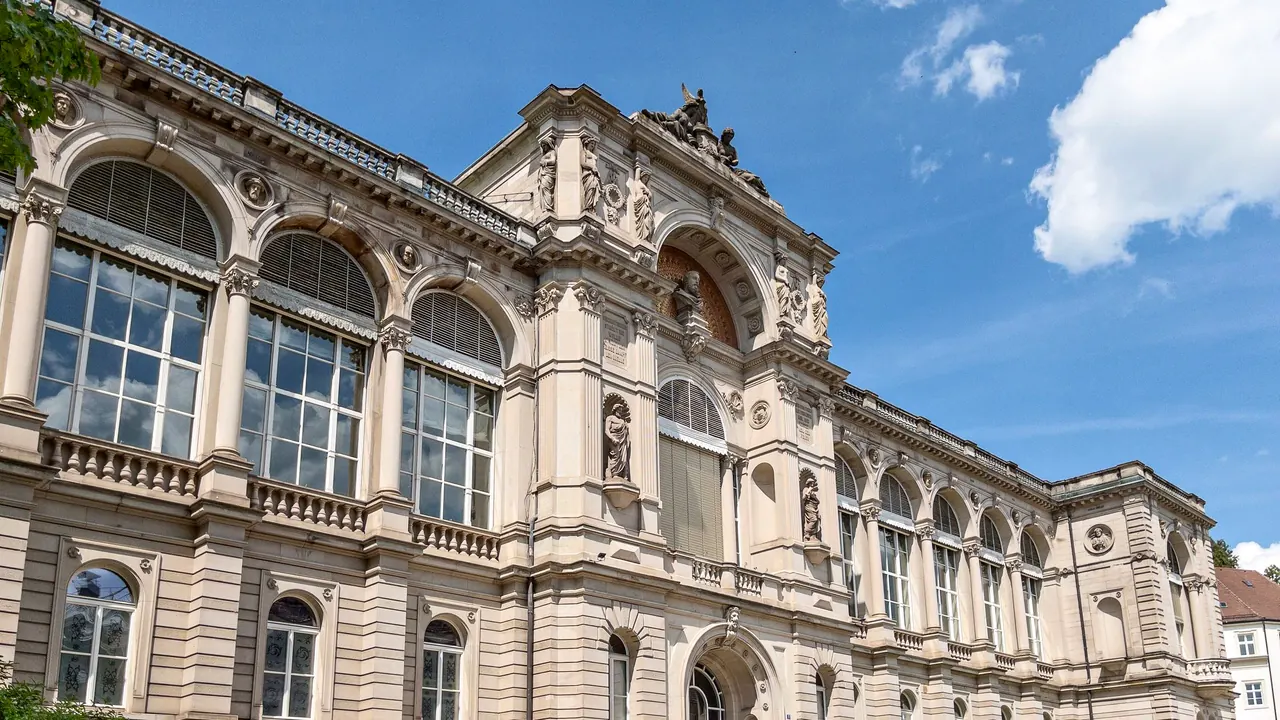
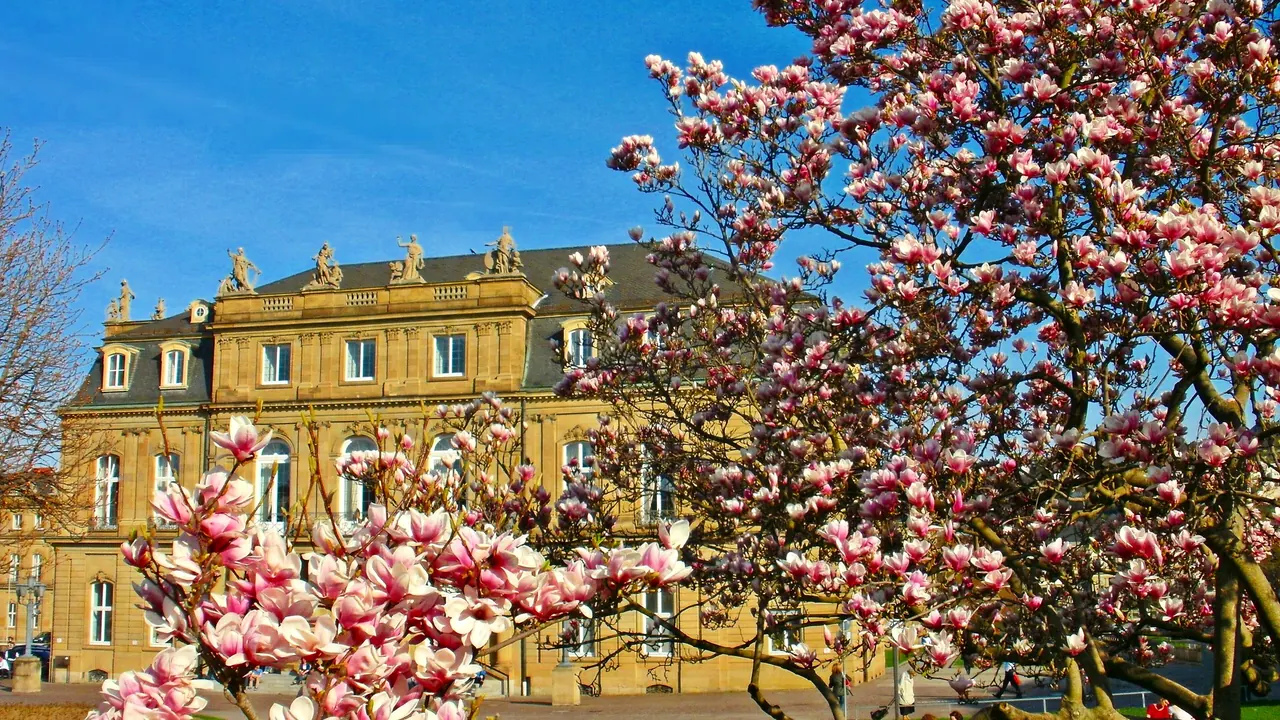
Photos: Baden-Baden by Kent Wang, CC BY-SA 2.0, cropped; Stuttgart by Baden de, CC BY 3.0, cropped.
Baden-Baden or Stuttgart?
Our verdict in twelve categories, each scored against the same fixed benchmark cities, and the climate month by month, so you can choose for your trip.
Choose Baden-Baden for
- wellness
- nature and the outdoors
Baden-Baden is the choice for a slow, restorative trip. Two thermal bathhouses stand on springs the Romans used, the Belle Époque town is all colonnades and park walks, and the Black Forest begins where the streets end. It suits couples and older travellers who want quiet evenings, a concert at the Festspielhaus, a glass of Rebland Riesling, and who don't mind paying for comfort.
Choose Stuttgart for
- nightlife
- shopping
- families
Pick Stuttgart if you want a working city with more to fill your days and evenings. The ballet and opera, the car museums, the Swabian taverns and a proper shopping street give it more range, and a light-rail network makes it easy to get around without a car. Families do better here too, with Wilhelma and Killesberg close at hand, and the stay comes out a little cheaper.
Scoreboard
Twelve categories on one fixed scale from 0 to 100. The shaded stretch is the gap between the two.
Your match
Pick a travel style or drag the sliders, and both match scores follow your weighting.
Wins on wellness and nature and the outdoors with your weighting.
Wins on nightlife and shopping with your weighting.
What matters to you?
Category by category
What the scores mean for a trip.
Beaches & swimming
Neither has a beach, and nobody should choose either one for swimming. In summer, Baden-Baden offers flooded gravel pits on the Rhine plain and outdoor pools. Stuttgart has outdoor pools, some of them fed by its own mineral springs, and Lake Constance is more than two hours' drive away.
Food & drink
Baden-Baden eats well for a small town. You get Baden dishes, French touches from across the Rhine and excellent Riesling and Pinot Noir from the Rebland villages. But the centre is mostly hotel dining and cake cafés, and the celebrated restaurants are a drive away in the northern Black Forest.
Stuttgart has more on the table. Käsespätzle and Zwiebelrostbraten fill its wine taverns, and the Art Nouveau Markthalle is a pleasure to browse. Vineyards inside the city supply Trollinger and the seasonal Besen taverns, and there is a strong fine-dining tier on top.
Culture & sights
Baden-Baden is one well-preserved period piece: the Kurhaus, the Trinkhalle, the Lichtentaler Allee and the hillside villas, with Roman bath ruins underneath and the Frieder Burda museum and Kunsthalle for art. It is charming and hangs together well, but a day or two covers it.
Stuttgart has more weight and more variety. There are the Mercedes-Benz and Porsche museums, the European painting in the Staatsgalerie, Le Corbusier's houses at the Weissenhof Estate and the palaces on Schlossplatz. The old core was bombed, so the extra days here go on modern design and industry rather than old-town atmosphere.
Nightlife
Baden-Baden's night out is the gilded casino in the Kurhaus, with a dress code and perhaps a hotel bar afterwards. The crowd is older and the streets go quiet by late evening. Stuttgart is no party city, but it has a weekend bar strip along Theodor-Heuss-Strasse, basement clubs with a following for electronic music, and wine bars in the Bohnenviertel. In autumn the beer tents of the Cannstatter Volksfest are added to that.
Nature & outdoors
Baden-Baden has the forest on its doorstep. The Merkur funicular, the Battert cliffs for climbers and trails into the fir woods all start from town. The Black Forest High Road, the Mummelsee and the Hornisgrinde moorland are a short drive further, with modest skiing in winter.
Stuttgart's green spaces feel more like parkland: vineyard paths above the Neckar, the Rotwildpark and Schönbuch forests, and easy cycling along the river. The cliffs and caves of the Swabian Jura are a real draw, but they are about an hour away, and so is the Black Forest.
Day trips
Both are excellent bases, and the difference is direction. Baden-Baden looks across the Rhine to Strasbourg's cathedral, the Alsace wine villages and Colmar, and south to Freiburg, though a car helps a lot for Alsace and the Black Forest. Stuttgart looks the other way, to Ludwigsburg's palace and Esslingen on the S-Bahn, to Tübingen, Hohenzollern Castle and Ulm's spire, and nearly all of it is easy by train.
Heidelberg and Maulbronn are within reach of both towns, and Baden-Baden itself makes a good day out from Stuttgart.
Good for families
Baden-Baden is safe and calm, and children enjoy the funicular, the forest trails and the Lichtentaler Allee. But it is a town for adults taking the waters, so families tend to spend their days elsewhere, at the big theme park an hour south or the zoo in Karlsruhe.
Stuttgart works well for a whole family stay. It has Wilhelma's zoo and gardens among Moorish-style pavilions, the Killesberg park with its narrow-gauge railway, car museums for older children and the fairy-tale garden at Ludwigsburg nearby.
Getting around
Baden-Baden's centre is a short, sometimes steep walk from end to end. But the station is a few kilometres out in Oos, and the wine villages, the High Road and Alsace really call for a car.
Stuttgart's flat core is just as walkable. Where the hills begin, the Stadtbahn, S-Bahn, rack railway and funicular take over on one ticket and reach Wilhelma, the car museums and the airport. Here a car is only needed for the countryside.
Shopping & style
Baden-Baden's shopping is small and polished. Jewellers, watchmakers and boutiques along Sophienstraße and Lange Straße cater to a well-off spa crowd, and the souvenirs are cuckoo clocks and local wine.
Stuttgart has the scale that Baden-Baden lacks. There is the long pedestrian Königstrasse, a grand nineteenth-century family department store for designer fashion, independent shops around Calwer Strasse and the Bohnenviertel, and the outlet town of Metzingen half an hour away.
Affordability
Neither is cheap, but Baden-Baden costs more. It was built for the wealthy, grand hotels set the tone and you pay for every visit to the baths, so a stay built around the spas adds up quickly. Guesthouses and wine taverns are the way to keep costs down.
Stuttgart's hotel prices follow business travel, so weekends and the quieter months are the better deal. Its taverns and beer gardens serve generous portions at fair prices.
Live music & performing arts
For a town its size, Baden-Baden does remarkably well on stage. The Festspielhaus, one of Germany's largest opera and concert houses, brings in international orchestras and soloists, the town's philharmonic plays in the Kurhaus, and Brahms's summers here are part of local pride. Outside classical music there is little.
Stuttgart's stage life is wider and deeper. Its ballet, shaped by John Cranko, is among the most admired in Europe, and the Staatsoper is known for bold productions. The Liederhalle, the long-running musicals at Möhringen and a working jazz scene fill the rest of the week.
Wellness & relaxation
Bathing is the reason Baden-Baden exists. A stay revolves around the domed Friedrichsbad, with its silent, unclothed sequence of hot rooms and scrubs, and the pools and saunas of Caracalla next door. Grand hotels with their own spas and slow park walks keep the rest of the day unhurried.
Stuttgart's mineral springs are a real surprise, with naturally carbonated warm water at Bad Cannstatt and the Leuze baths. Still, they make a good afternoon in a businesslike city rather than a reason to travel.
When should you go?
Pick your month. The climate figures are measured averages, not a forecast.
Baden-Baden in July
Stuttgart in July
Daytime high, °C
Rainfall in the month, mm
Temperature and rainfall are climate normals, averaged over the years shown. Baden-Baden: 1991-2020 normals, Baden-Baden-Geroldsau (3.9 km from centre). Stuttgart: 1991-2020 normals, Stuttgart / Neckartal (2.8 km from centre).
The two towns have almost the same temperatures through the year. Winters are cold and grey, with highs around 6°C, and spring is mild. Summer peaks at about 25°C in July and August, which is warm enough for outdoor pools and long walks but never too hot for the streets. Sunshine is also close, with the long bright days running from May to August.
The real difference is rain. Baden-Baden, on the western edge of the Black Forest, gets around 100mm or more in almost every month, and December is the wettest at 122mm. Stuttgart, in its sheltered basin, gets well under half that through winter and spring, and only about 79mm at its July peak. Late spring to early autumn suits both. For a city visit in winter or spring Stuttgart is the drier choice, while Baden-Baden's warm baths are made for its damp months.
Which traveller are you?
For a relaxing and wellness trip, Baden-Baden is in a different league. The Friedrichsbad's ritual sequence and the Caracalla pools sit on hot springs used since Roman times, and the whole town keeps a slow pace. Stuttgart's mineral baths fill an afternoon, not a retreat.
On a food and nightlife trip, Stuttgart gives you far more to do after dark. It has Swabian taverns, seasonal Besen wine rooms, a strong fine-dining tier and a weekend bar strip with clubs nearby. Baden-Baden's evenings revolve around the casino and hotel bars, and they end early.
On a family trip with young children, Stuttgart is the easier base. Wilhelma fills a whole day, Killesberg has its little railway and animal enclosures, and the rack railway is a ride in itself. Baden-Baden feels adult, and the Friedrichsbad turns young children away.
Before you go
| Measure | Baden-Baden | Stuttgart |
|---|---|---|
| Official language | German | German |
| Currency | Euro (EUR) | Euro (EUR) |
| Sockets | CF230 V, 50 Hz | CF230 V, 50 Hz |
| Driving side | Right | Right |
| Time zone | UTC+1, UTC+2 in summer | UTC+1, UTC+2 in summer |
| Emergency number | 112 | 112 |
| Elevation | 181 m | 245 m |
| Main airport | Karlsruhe Baden-Baden Airport (FKB)12 km from centre44 non-stop destinations | Stuttgart Airport (STR)10 km from centre124 non-stop destinations |
| Public holidays this year | 12 days | 12 days |
By the numbers
| Measure | Baden-Baden | Stuttgart |
|---|---|---|
| Population | 56,952 | 609,365 |
| People per km² | 406 | 2,938 |
| Museums within 10 km | 11 | 42 |
| UNESCO World Heritage sites within 50 km | 3 | 3 |
Where else could you go?
Every comparison below shares a destination with this one, so you can follow Baden-Baden or Stuttgart somewhere new.
- Strasbourgvs Baden-Baden
- Heidelbergvs Stuttgart
- Heidelbergvs Baden-Baden
- Freiburgvs Baden-Baden
- Rothenburg ob der Taubervs Stuttgart
- Colmarvs Baden-Baden