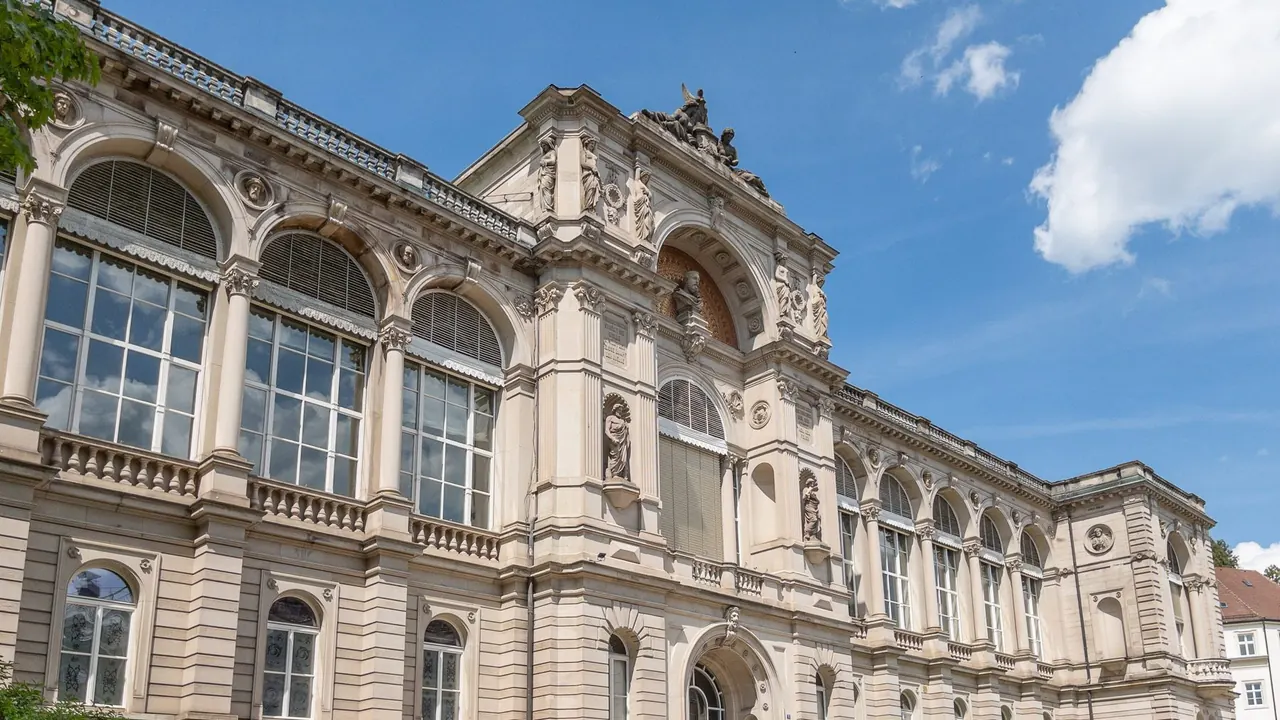
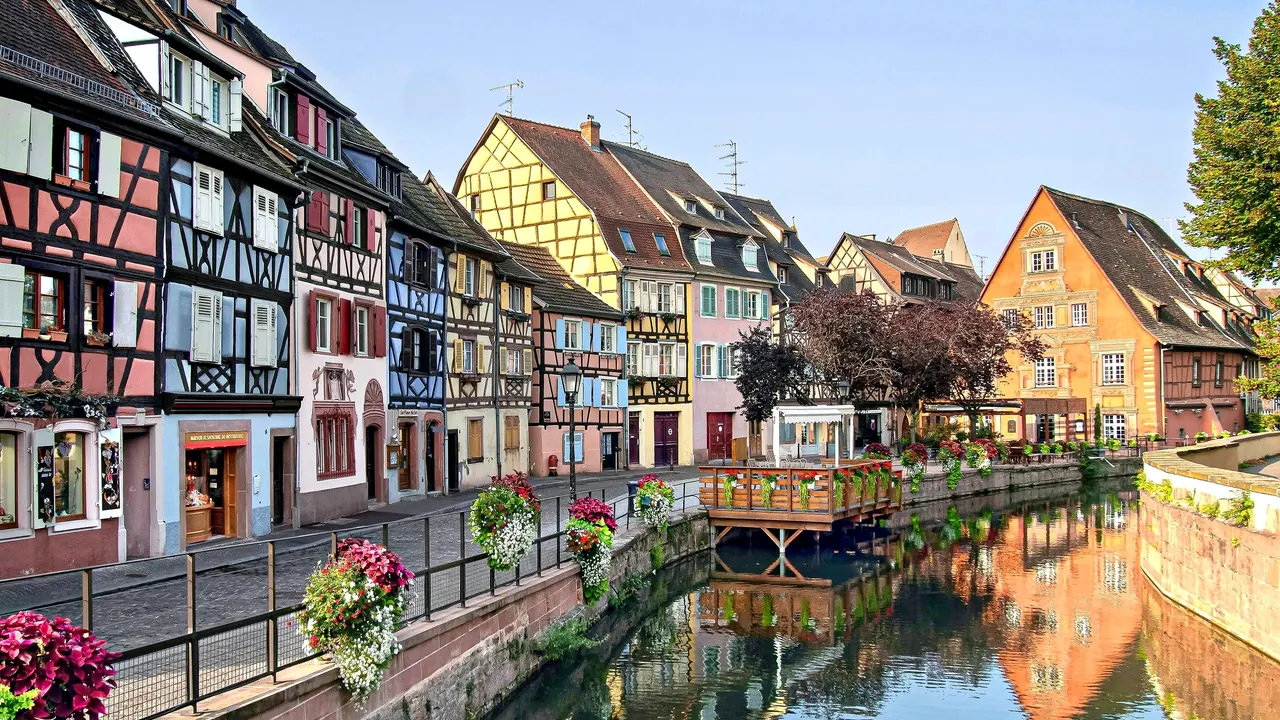
Photos: Baden-Baden by Kent Wang, CC BY-SA 2.0, cropped; Colmar by Rolf Kranz, CC BY-SA 4.0, cropped.
Baden-Baden or Colmar?
Our verdict in twelve categories, each scored against the same fixed benchmark cities, and the climate month by month, so you can choose for your trip.
Choose Baden-Baden for
- wellness
- live music and the arts
- beaches
Baden-Baden suits the traveller who wants to rest properly. The thermal baths are the reason the town exists, from the silent sequence of the Friedrichsbad to the pools and saunas of Caracalla, and the evenings bring opera and orchestral concerts at the Festspielhaus. Expect a slow, polished, rather costly stay, with the Black Forest starting at the edge of town.
Choose Colmar for
- food and drink
- prices
- families
Colmar is the better pick for a sightseeing trip built around old streets, Alsace cooking and wine villages. Its half-timbered centre and the Isenheim Altarpiece give it more to see, its winstubs offer more to eat, and Riquewihr, Eguisheim and Strasbourg are all close by. It also costs less, and it works better for families, thanks to the stork parks, castles and boat rides nearby.
Scoreboard
Twelve categories on one fixed scale from 0 to 100. The shaded stretch is the gap between the two.
Your match
Pick a travel style or drag the sliders, and both match scores follow your weighting.
Too close to call, 2 points apart
Wins on wellness and live music and the arts with your weighting.
Wins on food and drink and prices with your weighting.
What matters to you?
Category by category
What the scores mean for a trip.
Beaches & swimming
Neither town has a beach, and swimming plays no part in a trip to either. In summer, Baden-Baden has outdoor pools and the flooded gravel pits of the Rhine plain. Colmar has municipal pools and small lakes up in the Vosges valleys. In Baden-Baden, water means warm thermal baths, which Colmar has nothing to match.
Food & drink
Both towns eat the cooking of the Upper Rhine, with tarte flambée on menus on both sides of the river and wine grown on the slopes outside town. Baden-Baden's strength is the Rebland villages of Neuweier and Varnhalt, with Riesling and Pinot Noir served in wine taverns. Its centre leans towards hotel dining and coffee and cake, and keen eaters drive into the Black Forest for the best tables.
Colmar is the better place to eat. Wood-panelled winstubs serve baeckeoffe, choucroute and munster cheese, the covered market by the canal is good for cheese and charcuterie, and cellar tastings of Gewurztraminer and Pinot Gris are a short drive away. Watch out for tired menus on the most photographed lanes.
Culture & sights
Baden-Baden's main sight is the town itself. It is a Belle Époque spa town of colonnades, casino rooms and hillside villas, with the Museum Frieder Burda and the Kunsthalle covering modern art. It gives a rewarding day or two of an aristocratic era.
Colmar has more to see. Its painted half-timbered old town survives as a whole, from the Maison Pfister to the canals of Petite Venise. The Unterlinden Museum holds Grünewald's Isenheim Altarpiece, a masterpiece that alone justifies the journey, and Schongauer's Madonna hangs in the Dominican church nearby.
Nightlife
Both towns are quiet after dark, and anyone after clubs heads to Strasbourg. What differs is the kind of evening. Baden-Baden dresses up for the gilded casino in the Kurhaus and its hotel bars, with an older crowd. Colmar's evenings are a long dinner and Alsace wine on summer terraces around Petite Venise.
Nature & outdoors
Both towns have fine wooded uplands at their edge. Baden-Baden has the Black Forest: the Merkur funicular, the Battert cliffs for climbers, and the High Road out to the Mummelsee and the Hornisgrinde moor, some of it reachable without a car.
Colmar looks the other way, to the Vosges. There are vineyard paths between wine villages and the Route des Crêtes over the Hohneck and the Grand Ballon, and the flat wine route makes better cycling country. From Colmar you mostly need a car or a bike to reach the hills.
Day trips
Both towns are good bases for exploring the Upper Rhine, and they share some of the same destinations. Colmar has the edge because its best outings are closer. Riquewihr, Eguisheim and Kaysersberg are only a few kilometres away, Strasbourg is half an hour by train, and Basel is within easy reach.
From Baden-Baden, the same Alsace villages are a longer drive. In return, Heidelberg, Speyer's cathedral, Maulbronn monastery and the baroque palaces of Rastatt and Karlsruhe are within reach, so it suits a German-side itinerary better.
Good for families
Colmar is easier with children. The town is flat and small, and kids enjoy the boat rides and nesting storks. A short drive away are the otter and stork park at Hunawihr, free-roaming macaques, an eagle show and a fairy-tale castle, with Mulhouse's train and car museums further on.
Baden-Baden is safe and has the funicular and forest trails, but the town is made for adults, and young children are not admitted to the Friedrichsbad. Families there tend to treat it as a calm base. Europa-Park, about an hour away, is equally reachable from both.
Getting around
Both centres are compact enough to explore on foot, and in both a car makes the countryside far easier. In Colmar the centre is flat and the station is a short walk away. Baden-Baden's streets climb steeply, and its station is a bus ride away in Oos. In Colmar, cycling between vineyard villages is a pleasure in its own right.
Shopping & style
Neither town is a shopping destination, but they sell different things. On Sophienstraße and Lange Straße, Baden-Baden has jewellers, watchmakers and fashion boutiques for its well-off spa guests. Colmar is better for regional goods to take home, such as wine bought from the producer, Soufflenheim pottery, Alsatian table linen and gingerbread, and its Christmas markets are the high point of its year.
Affordability
Colmar is the cheaper stay. Set lunches and regional wine are reasonably priced, and village tastings often cost little or nothing. Rooms are its weak point in summer and at Christmas, and staying in a nearby village helps.
Baden-Baden was built for the rich and still feels like it. Grand hotels set the tone and each visit to the baths is paid separately, so a spa-centred stay costs more. Simple guesthouses, bakeries and wine taverns help keep the bill down.
Live music & performing arts
Baden-Baden is far stronger for live music. The Festspielhaus, one of Germany's largest opera and concert houses, hosts leading orchestras and soloists through its seasons, and the town's philharmonic plays in the Kurhaus. Brahms and Clara Schumann worked here, and that tradition lives on.
Colmar has a small municipal theatre visited by the Opéra national du Rhin, and its calendar centres on an early-July classical festival and an autumn jazz festival. Outside those weeks, serious concerts mean a trip to Strasbourg or Basel.
Wellness & relaxation
This is where Baden-Baden is in a league of its own. Hot springs used by the Romans feed the nineteenth-century Friedrichsbad, with its silent, unclothed sequence of warm rooms and pools, and the modern Caracalla next door adds outdoor pools and a large sauna area. Taking the waters sets the pace of the whole stay.
Colmar has no bathing tradition, only hotel spas. Its restful side lies in quiet canalside evenings once the day-trippers leave, and in long lunches and walks through the vines.
When should you go?
Pick your month. The climate figures are measured averages, not a forecast.
Baden-Baden in July
Colmar in July
Daytime high, °C
Rainfall in the month, mm
Temperature and rainfall are climate normals, averaged over the years shown. Baden-Baden: 1991-2020 normals, Baden-Baden-Geroldsau (3.9 km from centre). Colmar: 1991-2020 normals, Ihringen (21.1 km from centre).
The two towns warm up on much the same curve. Both are cold and grey from December to February, mild by April and warm from June to August, when Colmar edges ahead at around 27°C in August against 25°C in Baden-Baden. That is pleasant for walking rather than oppressive. Sunshine is also close, with long bright summers and short dull winters in both.
Rain is where they part. Colmar sits in the rain shadow of the Vosges and stays fairly dry all year, with its wettest month in May at 87mm and winters far drier still. Baden-Baden, on the edge of the Black Forest, gets over 100mm in most months, winter included, so umbrellas come along in every season. For both towns, May to September is the best stretch for walking and vineyard outings. Colmar's dry winters suit a December visit better, while a wet Baden-Baden day matters less when the plan is the baths.
Which traveller are you?
For a relaxing and wellness trip, Baden-Baden lets you build whole days around bathing: a long soak in the morning, a slow walk under the trees, an early night, and wet weather hardly matters. In Colmar you would rest well, but proper treatments mean whatever your hotel offers.
On a family trip with children, Colmar gives you easy mornings in a flat, compact old town and a different animal park or castle each afternoon, all a short drive away. In Baden-Baden the children would mostly wait while the adults bathe, so the days tend to happen elsewhere.
On a tight budget, Colmar goes further, especially if you sleep in a nearby wine village and make lunch the main meal of the day. Baden-Baden can be done on simple rooms and plain meals, but the baths you came for charge for every visit, so they become the expensive part of the trip.
Before you go
| Measure | Baden-Baden | Colmar |
|---|---|---|
| Official language | German | French |
| Currency | Euro (EUR) | Euro (EUR) |
| Sockets | CF230 V, 50 Hz | CE230 V, 50 Hz |
| Driving side | Right | Right |
| Time zone | UTC+1, UTC+2 in summer | UTC+1, UTC+2 in summer |
| Emergency number | 112 | 112 |
| Elevation | 181 m | 185 m |
| Main airport | Karlsruhe Baden-Baden Airport (FKB)12 km from centre43 non-stop destinations | EuroAirport Basel–Mulhouse–Freiburg (BSL)55 km from centre112 non-stop destinations |
| Public holidays this year | 12 days | 11 days |
By the numbers
| Measure | Baden-Baden | Colmar |
|---|---|---|
| City population | 56,952 | 66,970 |
| People per km² | 406 | 1,006 |
| Museums within 10 km | 11 | 9 |
| UNESCO World Heritage sites within 50 km | 3 | 3 |
Where else could you go?
Every comparison below shares a destination with this one, so you can follow Baden-Baden or Colmar somewhere new.
- Strasbourgvs Baden-Baden
- Baselvs Colmar
- Strasbourgvs Colmar
- Stuttgartvs Baden-Baden
- Heidelbergvs Baden-Baden
- Zurichvs Colmar