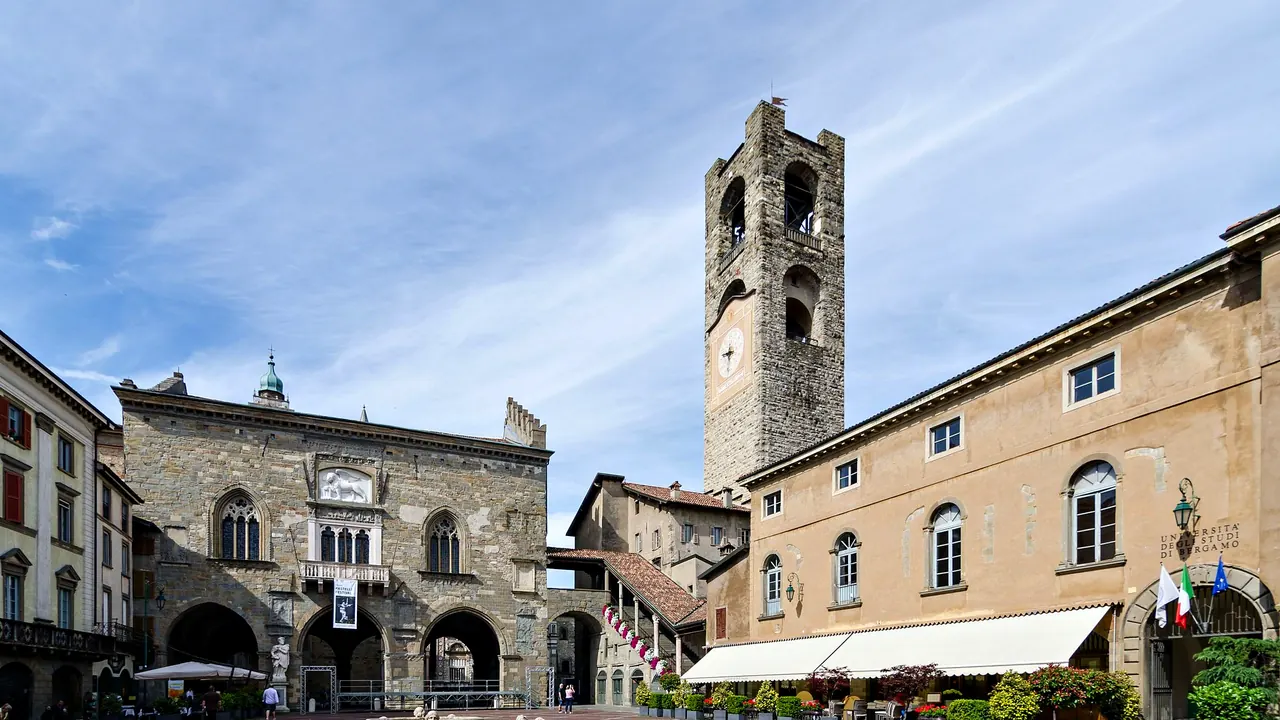
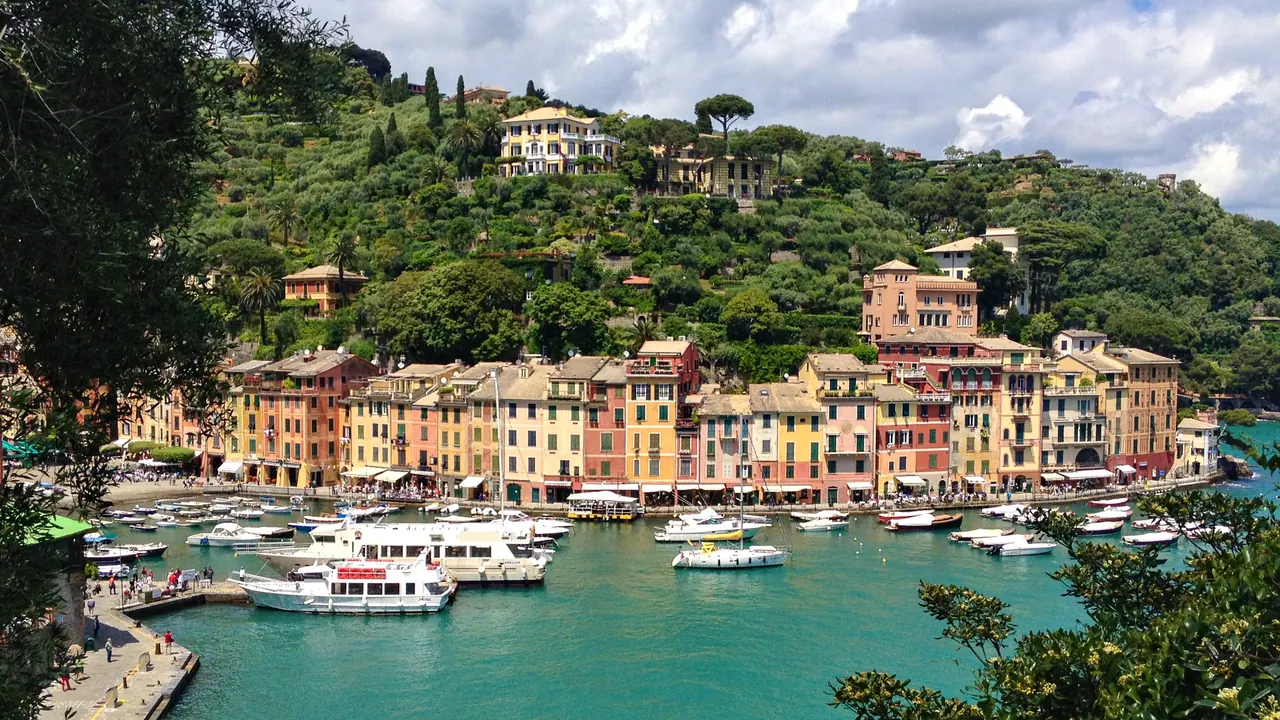
Photos: Bergamo by Steffen Schmitz, CC BY-SA 4.0, cropped; Portofino by Michal Osmenda, CC BY 2.0, cropped.
Bergamo or Portofino?
Our verdict in twelve categories, each scored against the same fixed benchmark cities, and the climate month by month, so you can choose for your trip.
Choose Bergamo for
- culture and sights
- prices
- live music and the arts
Choose Bergamo if you want plenty to see and do. It has a walled Venetian hilltop town, an old-masters gallery of real weight and opera in Donizetti's home city, and Milan, Lake Como and Verona are all within reach by train. It is also far cheaper, easier with children, and its mountain cooking of casoncelli, polenta and valley cheeses makes eating out a pleasure.
Choose Portofino for
- beaches
- nature and the outdoors
Portofino suits a slower, scenic stay where the sea decides the day. You swim off the rocks in clear water, walk the headland to San Fruttuoso and take boats along the Riviera. The price is steep, the food is ordinary for what it costs and evenings end early, so many visitors sleep in Santa Margherita or Camogli and come over for the day.
Scoreboard
Twelve categories on one fixed scale from 0 to 100. The shaded stretch is the gap between the two.
Your match
Pick a travel style or drag the sliders, and both match scores follow your weighting.
Wins on culture and sights and prices with your weighting.
Wins on beaches and nature and the outdoors with your weighting.
What matters to you?
Category by category
What the scores mean for a trip.
Beaches & swimming
Bergamo has no sea at all. Swimming means a day at the lakes, either at Iseo's lidos around Sarnico and Lovere or on the Lecco arm of Como, where you lie on grass, pebbles or concrete platforms. It is a nice escape on a hot day, but it is an outing rather than part of your daily routine.
Portofino gives you the sea itself. Ladders and rock platforms on the way to the lighthouse lead into very clear, deep water, Paraggi's sheltered bay is a short walk away, and you can reach San Fruttuoso's pebble cove by boat or on foot. Just expect small spots, mostly paid loungers at Paraggi and a crowd in high summer.
Food & drink
Bergamo is the better place to eat. Its Lombard mountain cooking gives you casoncelli in butter and sage, polenta with braised meats and game, and cheeses such as Taleggio, Branzi and Strachitunt. You can drink Valcalepio or Franciacorta with them, and you can choose between trattorias in the upper town and everyday places below.
Portofino's Ligurian dishes, such as trofie with pesto, fritto misto and Recco's cheese focaccia, are appealing on paper. But the few harbour terraces charge for the yachts and the view, and the cooking is rarely more than solid. Keen eaters head to Camogli or the hill trattorie.
Culture & sights
There is far more to see in Bergamo. The Città Alta is a nearly complete walled town inside Venetian fortifications. Piazza Vecchia leads to Santa Maria Maggiore and the marble front of the Cappella Colleoni, and below the hill the Accademia Carrara holds Mantegna, Lotto and Raphael.
Portofino is mostly about its setting. You have the painted horseshoe of houses, San Giorgio above the bay, Castello Brown's rooms and gardens, and the medieval abbey at San Fruttuoso, which you can only reach by boat or on foot. There are no museums of any size.
Nightlife
Neither place is for a big night, but Bergamo keeps going longer. After a long aperitivo, people move on to wine bars and pubs around Via XX Settembre and Borgo Santa Caterina, and students keep a few places busy. On summer nights in the upper town, people drink along the walls. Clubs are few and far out, and Milan is close by train.
Portofino's evening is dressing up for a drink and dinner facing the moored yachts. After that there is almost nothing, and outside July and August the village goes quiet early.
Nature & outdoors
Both are excellent for the outdoors, but in very different ways. From Bergamo you walk straight up through the Colli park to San Vigilio. Further north, the Orobie valleys have rifugi, high lakes, serious hiking and small ski areas such as Foppolo, and there is road and gravel cycling in the foothills. For the higher ground, you really need a car.
Portofino's protected headland is small and right beside the sea. Cliff paths, some with chains, cross Monte di Portofino to San Fruttuoso and Punta Chiappa. The marine reserve below offers diving among red coral and to the Christ of the Abyss statue, along with kayaking around the point.
Day trips
From Bergamo you have a wider spread of outings. Milan's Duomo and Last Supper are under an hour by train, and Brescia, Cremona and Verona are all straightforward rail days. Lake Iseo and Lake Como are closer still, and Mantua is a longer trip but worth it. Crespi d'Adda's factory village has no station, but it is about half an hour away by road.
Portofino's outings follow the coast. Camogli, Rapallo and Santa Margherita are a short bus or boat ride away, Genoa's palaces are under an hour, and summer ferries reach the Cinque Terre and Portovenere. Outside the ferry season, it all takes more planning.
Good for families
Children get far more out of Bergamo. Most love the funiculars, the gelato walk along the walls and the city playgrounds. Leolandia's rides for younger children and the Le Cornelle wildlife park are both short drives away, though the cobbled upper lanes are hard work with a buggy.
Portofino is safe, and boats and rock swimming please most children. Still, nothing there is designed for them, Paraggi's sand is mostly taken by paid clubs and the stepped paths defeat a pushchair. Families usually stay in Santa Margherita or Rapallo and go to Genoa for the aquarium.
Getting around
Bergamo works smoothly once you understand its two levels. Funiculars climb to the Città Alta and on to San Vigilio, buses connect the station and the airport, and direct trains run to Milan, Brescia and Lecco. You only need a car for the upper valleys.
Portofino is a few minutes across on foot, but getting in and out is the problem. A single narrow road runs about 5km from Santa Margherita, parking is scarce and the summer buses are packed. From spring to autumn, the ferries are often the most pleasant way in.
Shopping & style
Bergamo offers more real shopping. Its arcaded Via XX Settembre and the Sentierone have Italian chains and mid-range fashion, and the upper town's main lane is the place for Branzi, salumi and Valcalepio to take home. For serious fashion, Milan is close.
Portofino's few lanes are a different world. They are full of big-name fashion and jewellery boutiques and resort wear aimed at the yachts, plus a little Ligurian lace and pesto. You can see it all in under an hour, and for anything ordinary you need to go to Chiavari or Rapallo.
Affordability
Bergamo is comfortable rather than cheap, and the bill depends mostly on where you sleep. Rooms inside the Città Alta, and almost anything on a summer weekend, cost noticeably more than a bed in the lower town. Staying below and riding the funicular up keeps the old town close at a lower price, and the buses and funiculars add very little to the cost.
In Portofino, the hillside hotels in summer charge as much as the priciest addresses in Europe's big cities. Even on a day visit the extras mount up, but some of them can be avoided. You can swim from the rocks on the lighthouse path or claim a place on Paraggi's narrow free strip early, rather than paying for a lounger. Coming by bus or ferry also spares you the cost of scarce parking. A drink on the piazzetta or a hired boat is where you pay for the view, and there is no cheap version of either.
Live music & performing arts
Bergamo has a real stage life for its size, built around Donizetti, who was born there. The Teatro Donizetti runs an opera and concert season and holds an autumn festival of his works, the Teatro Sociale stages smaller productions and Bergamo Jazz comes in spring. La Scala is an easy evening trip.
In Portofino, there is little more than the odd summer concert in the piazzetta or at the castle. For a proper season, you need to go to the Teatro Carlo Felice in Genoa.
Wellness & relaxation
Bergamo has thermal spas within reach. San Pellegrino Terme, a Belle Époque resort famous for its mineral water, is up Val Brembana, and Trescore Balneario's sulphur springs have been used since Roman times. The quiet upper town at dawn and dusk adds to the calm.
Portofino offers no public baths, only the hillside luxury hotels' spas. Its restful side is the pace: long lunches facing the water and shaded paths early or late in the day. It loses that calm at midday in high summer, when the tour boats arrive.
When should you go?
Pick your month. The climate figures are measured averages, not a forecast.
Bergamo in July
Portofino in July
Daytime high, °C
Rainfall in the month, mm
Where the figures come from
Bergamo has no rain gauge within 25 km of the centre, so its rainfall comes from a gridded climate dataset read at the city rather than from a gauge further away.
Bergamo's sunshine is measured 64 km from the centre, at Lugano.
Portofino's temperatures are measured 31 km from the centre, at Genova / Sestri.
Portofino has no rain gauge within 25 km of the centre, so its rainfall comes from a gridded climate dataset read at the city rather than from a gauge further away.
Temperature and rainfall are climate normals, averaged over the years shown. Bergamo: 1991-2020 normals, Bergamo / Orio Al Serio (3.9 km from centre). Portofino: 1991-2020 normals, Genova / Sestri (31 km from centre).
Bergamo is at its best for walking in May, June and September. These months are warm without the full heat of July and August, when afternoons on the Lombard plain reach about 29°C. Rain falls all year but is heaviest in late spring and again from September to November. Winters are cold and grey, with little sunshine and highs around 7°C. That suits the galleries but not the mountains.
Portofino has the milder winter, and its summer is the driest part of the year. The sea is warm enough to swim from June into early October and reaches about 25°C in August. Spring and late September are the best times for the headland trails, which get hot in high summer. Autumn is very wet: October and November both bring well over 200mm, so a late-year stay can lose whole days to rain.
Which traveller are you?
On a beach and sun trip, Portofino is the clear choice. You swim straight off the rocks into deep, clear sea, with Paraggi's sand and the cove at San Fruttuoso nearby. From Bergamo, swimming means a day out to a lake shore.
For a culture and arts trip, Bergamo wins easily. You get the UNESCO-listed walls of the Città Alta, the Cappella Colleoni, Raphael and Bellini at the Accademia Carrara, and opera at the Teatro Donizetti. Portofino's sights are its harbour, a castle-villa and a lighthouse walk.
On a tight budget, Bergamo is the sensible base. Lower-town hotels and trattorias are fairly priced, and cheap trains reach Milan and the lakes. Portofino is among Italy's most expensive places to stay, and only walking and the local bus come cheap.
Before you go
| Measure | Bergamo | Portofino |
|---|---|---|
| Official language | Italian | Italian |
| Currency | Euro (EUR) | Euro (EUR) |
| Sockets | CFL230 V, 50 Hz | CFL230 V, 50 Hz |
| Driving side | Right | Right |
| Time zone | UTC+1, UTC+2 in summer | UTC+1, UTC+2 in summer |
| Emergency number | 112 | 112 |
| Elevation | 249 m | 20 m |
| Main airport | Il Caravaggio International Airport (BGY)4 km from centre146 non-stop destinations | Genoa Cristoforo Colombo Airport (GOA)32 km from centre25 non-stop destinations |
| Public holidays this year | 13 days | 13 days |
By the numbers
| Measure | Bergamo | Portofino |
|---|---|---|
| City population | 119,534 | 355 |
| People per km² | 2,973 | 142 |
| Museums within 10 km | 21 | 14 |
| UNESCO World Heritage sites within 50 km | 6 | 2 |
| Swim season, months above 21 °C | - | 4 months |
Where else could you go?
Every comparison below shares a destination with this one, so you can follow Bergamo or Portofino somewhere new.