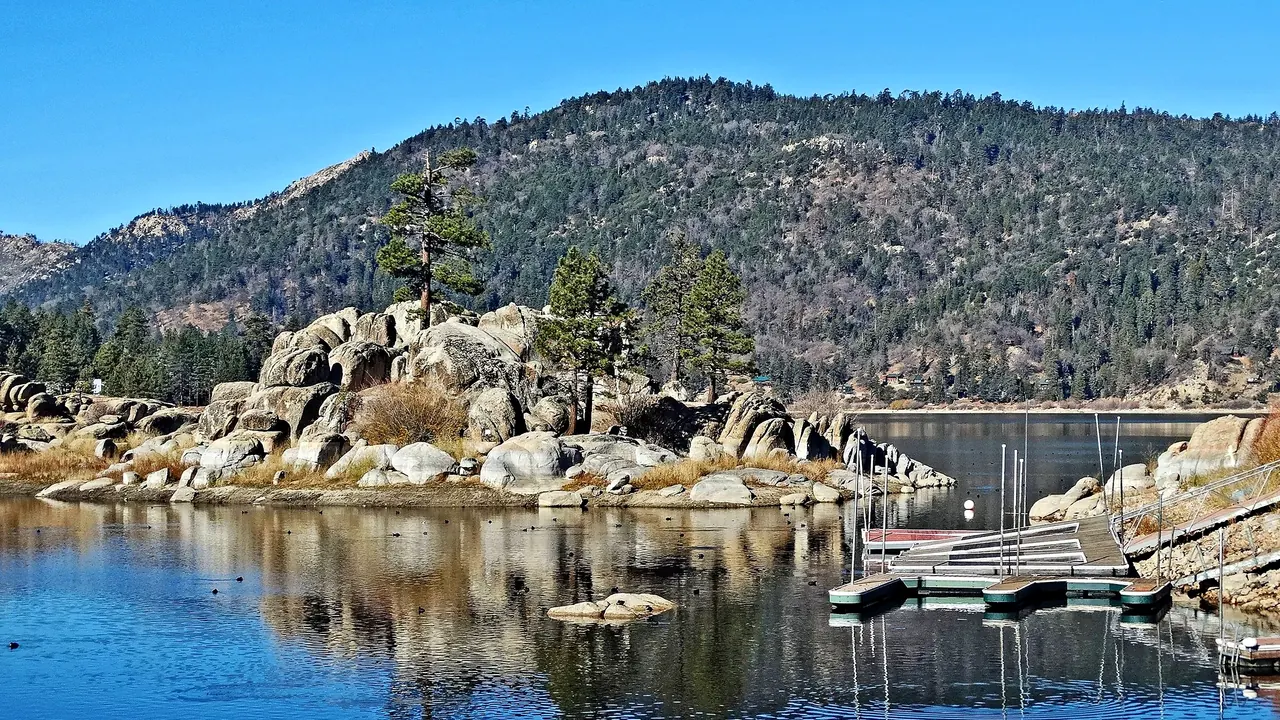
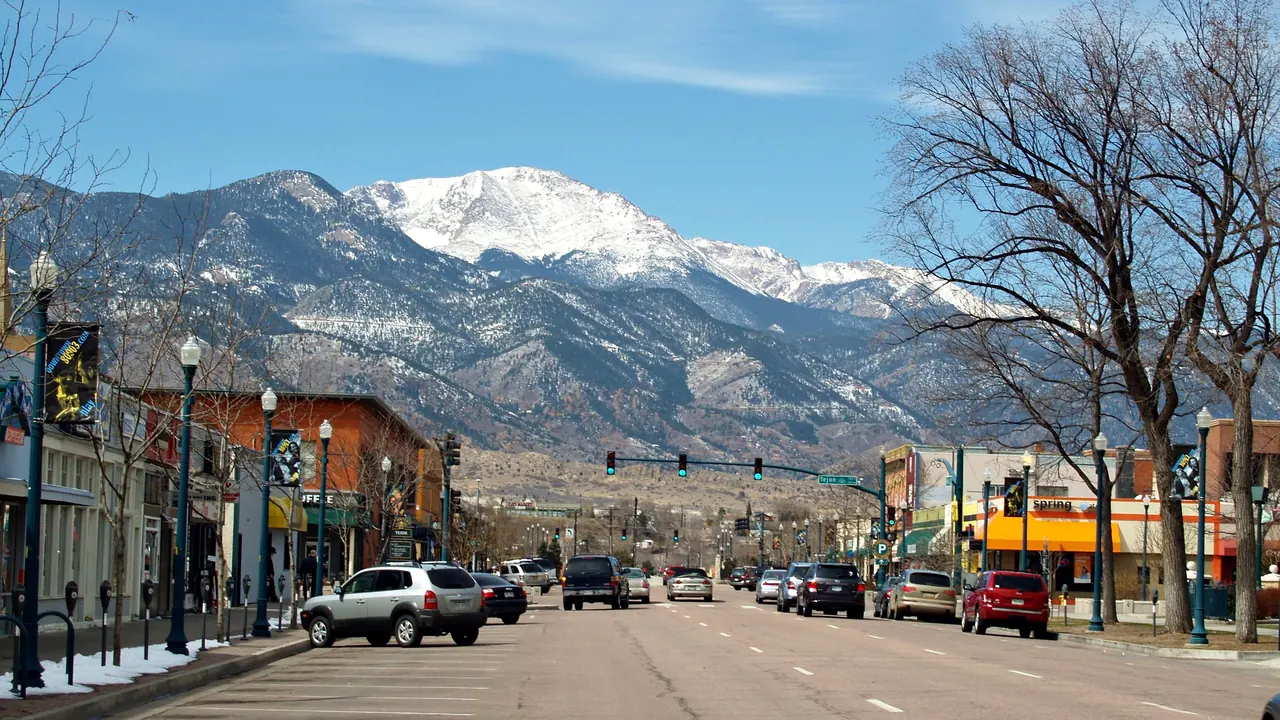
Photos: Big Bear Lake by inkknife_2000, CC BY-SA 2.0, cropped; Colorado Springs by David Shankbone, CC BY-SA 3.0, cropped.
Big Bear Lake or Colorado Springs?
Our verdict in twelve categories, each scored against the same fixed benchmark cities, and the climate month by month, so you can choose for your trip.
Choose Big Bear Lake for
- beaches
- getting around
Big Bear Lake suits travellers who want a cabin in the pines and very little to organise. In winter there is skiing and sledding right above town, in summer there are kayaks, paddleboards and bike trails, and in the evening there is the stove or the hot tub. It is a place to retreat to rather than explore. There are almost no sights, the nights are quiet and the roads out are slow, so it works best for a group or family happy to stay up the mountain.
Choose Colorado Springs for
- day trips
- culture and sights
- live music and the arts
Colorado Springs is the better pick if you want the outdoors with a city attached. Pikes Peak, Garden of the Gods and the canyons give it even bigger scenery. On top of that come museums, the Air Force Academy chapel, a downtown with bars and breweries, and Denver, Cripple Creek and the Royal Gorge all within an easy drive. It makes a stronger base for a varied road trip, though the ski slopes are a long way off.
Scoreboard
Twelve categories on one fixed scale from 0 to 100. The shaded stretch is the gap between the two.
Your match
Pick a travel style or drag the sliders, and both match scores follow your weighting.
Wins on beaches and getting around with your weighting.
Wins on day trips and culture and sights with your weighting.
What matters to you?
Category by category
What the scores mean for a trip.
Beaches & swimming
Neither town is a place for a beach trip, but Big Bear Lake at least has open water on its doorstep. The lake is cool, around 19°C in midsummer, and there is a supervised swim beach at Meadow Park for children, with rocky shoreline and a few sandy patches elsewhere. Colorado Springs has little natural swimming beyond pools and chilly reservoirs, so a day on the water there usually means rafting the Arkansas River.
Food & drink
Big Bear Lake's food is resort fuel: big diner breakfasts, burgers, pizza and a brewpub after the slopes. So many visitors cook in their cabins that eating out is rarely part of the draw.
Colorado Springs eats better, though not by a wide margin. Green chile Southwestern cooking and a strong craft beer scene give it more range. It also has pleasant areas to eat in, from Tejon Street to Old Colorado City and Manitou Springs, and the Broadmoor's dining rooms for a formal evening.
Culture & sights
Here the gap is wide. Big Bear Lake has the Discovery Center, a small history museum and a dirt-road drive past the gold-rush remains of Holcomb Valley, which fill an afternoon at most.
Colorado Springs has a handful of worthwhile stops. They include the aluminium spires of the Cadet Chapel, the Olympic and Paralympic Museum, the Fine Arts Center's Southwestern collection and the Pioneers Museum in the old courthouse, and Manitou Springs adds Victorian streets to wander.
Nightlife
Who you end up drinking with says a lot here. In Big Bear Lake the evening crowd is skiers. In winter they come off the slopes for après-ski in the bars near the lifts or a pint in a Village pub, and by mid-evening most have gone back to a hot tub at the cabin. Outside ski season there is even less, a brewpub or a sports bar and little else.
Colorado Springs has more going on and a younger crowd. At weekends the downtown blocks of Tejon Street fill with college students and soldiers from the nearby bases, which makes Friday and Saturday nights livelier than a mountain resort can manage. Manitou Springs is the place for a calmer drink on its main street. Weeknights are another matter, as the taprooms close well before midnight and the town goes quiet early.
Nature & outdoors
Both are serious mountain bases, so the choice is about which kind you want. Big Bear Lake is built around water and snow. It has two ski areas above town, a lake for kayaks, paddleboards and fishing, the Pacific Crest Trail along the north side and wintering bald eagles.
Colorado Springs has the edge in scale and variety. Pikes Peak rises to more than 4,300m right over the city, the red sandstone of Garden of the Gods draws climbers, and the dry climate keeps the trails open for much of the year, with rafting and the Great Sand Dunes within reach. What it lacks is skiing nearby.
Day trips
From Big Bear Lake, the winding mountain roads slow every outing. Lake Arrowhead and the Oak Glen orchards are manageable, Riverside's Mission Inn is about an hour and a half away, and Palm Springs or Los Angeles makes a long day.
Colorado Springs is the far better base for excursions. Manitou Springs is next door and Denver is a little over an hour away. The mining towns of Cripple Creek and Victor and the Royal Gorge Bridge each make an easy day out.
Good for families
Both work for families, in different ways. Big Bear Lake is about snow play for children who rarely see it, plus the alpine slide, pedal boats and a small zoo of rescued mountain animals, all from a roomy cabin.
Colorado Springs has more to fill a week. Children can hand-feed giraffes at Cheyenne Mountain Zoo, ride the cog railway up Pikes Peak, tour the caves at Cave of the Winds and explore the Manitou Cliff Dwellings. The catch is the time spent driving between them.
Getting around
You need a car for both, but Big Bear Lake is easier once you arrive. The Village is walkable, and a local bus and a seasonal trolley reach the ski areas, although snow chains and weekend traffic can slow the drive up.
Colorado Springs spreads its sights along the foothills and has a thin bus network. Outside the walkable centres of downtown, Old Colorado City and Manitou Springs, you will drive to almost everything.
Shopping & style
Big Bear Lake's Village is good for an hour of browsing among fudge shops, bear-themed souvenirs and ski and lake gear. Colorado Springs has more to look at, with galleries, Western wear and rock and gem shops in Old Colorado City and Manitou Springs, plus outlets on the north side, though it is not a shopping destination either.
Affordability
Neither is a budget destination, though Colorado Springs comes out somewhat cheaper, and what drives the bill differs. In Big Bear Lake it is timing. A shared cabin midweek or in the shoulder seasons can be economical for a group cooking its own meals, while winter weekends and school vacations push rates up sharply, and lift tickets and ski hire add more.
In Colorado Springs, the chain hotels and motels along the interstate are fairly priced, and the best sights, Garden of the Gods and the canyon parks, cost nothing to enter. The cost you can't avoid is car hire, and tipping adds to the price of eating out.
Live music & performing arts
Big Bear Lake's stage life is small and seasonal. It has a community arts centre, free concerts by the lake in summer and Bavarian bands in the beer hall at the autumn Oktoberfest. Beyond that, you might find a guitarist in a bar on a weekend night.
Colorado Springs has a proper local season, though nothing to plan a trip around. The Philharmonic plays at the Pikes Peak Center, the Fine Arts Center's theatre company stages plays and musicals, and touring bands play the outdoor amphitheatre in summer. On the right evening there is a concert or a play worth booking.
Wellness & relaxation
Neither town is a spa destination, and the two are closely matched, so the difference is in kind. In Big Bear Lake, relaxing is a private affair: a hot tub on the cabin deck, a wood stove and quiet midweek days among the pines, with no springs or bathhouses.
Colorado Springs has a spa history in Manitou Springs. You can fill a cup with carbonated mineral water from the public fountains there and soak in outdoor tubs facing the mountains, and the Broadmoor has a full resort spa.
When should you go?
Pick your month. The climate figures are measured averages, not a forecast.
Big Bear Lake in July
Colorado Springs in July
Daytime high, °C
Rainfall in the month, mm
Where the figures come from
Big Bear Lake has no rain gauge within 25 km of the centre, so its rainfall comes from a gridded climate dataset read at the city rather than from a gauge further away.
Temperature and rainfall are climate normals, averaged over the years shown. Big Bear Lake: 2014-2025 (rainfall 1991-2020) normals, Big Bear City (5 km from centre). Colorado Springs: 1991-2020 normals, Colorado Springs Muni (8.3 km from centre).
Both towns have cold winters, with daytime highs around 7°C in January, but their wet seasons fall at opposite times of year. Big Bear Lake gets almost all its rain and snow from November to March, peaking near 135mm in February, and this is what feeds the ski season. From late May it turns dry, and June to September are the warm, settled months, with July reaching about 26°C. This is the only stretch when the lake is pleasant for a quick swim and the trails and boats come into their own.
Colorado Springs is the reverse. Its winters are dry, its wettest months are July and August, with around 79mm in July, and its summer days are hotter, at about 30°C. That makes May, June and September the most comfortable months for hiking and walking the old streets, and October is still mild. In high summer, Big Bear's dry mountain air is the cooler choice.
Which traveller are you?
For a culture and arts trip, Colorado Springs is the clear pick. It has the Fine Arts Center, the Pioneers Museum, the Olympic museum and the Cadet Chapel, with Denver's major museums an hour away. Big Bear offers little more than a small history museum.
On a food and nightlife trip, Colorado Springs again comes out ahead, though neither town is really built for it. Tejon Street has cocktail bars and a few dance spots, and the local craft beer is good. Big Bear evenings end with a brewpub pint and an early night.
For skiers and snowboarders, Big Bear Lake is the obvious choice. Its two ski areas sit just above the south shore, a short bus ride from the Village. From Colorado Springs, the nearest resorts are about two hours' drive into the mountains.
Before you go
| Measure | Big Bear Lake | Colorado Springs |
|---|---|---|
| Currency | US Dollar (USD) | US Dollar (USD) |
| Sockets | AB120 V, 60 Hz | AB120 V, 60 Hz |
| Driving side | Right | Right |
| Time zone | UTC-8, UTC-7 in summer | UTC-7, UTC-6 in summer |
| Emergency number | 911 | 911 |
| Elevation | 2,058 m | 1,839 m |
| Main airport | Ontario International Airport (ONT)67 km from centre28 non-stop destinations | City of Colorado Springs Municipal Airport (COS)10 km from centre17 non-stop destinations |
| Public holidays this year | 13 days | 12 days |
By the numbers
| Measure | Big Bear Lake | Colorado Springs |
|---|---|---|
| City population | 5,046 | 478,961 |
| People per km² | 299 | 944 |
| Museums within 10 km | 1 | 10 |
| UNESCO World Heritage sites within 50 km | 0 | 0 |
Where else could you go?
Every comparison below shares a destination with this one, so you can follow Big Bear Lake or Colorado Springs somewhere new.
- Palm Springsvs Big Bear Lake
- Palm Desertvs Big Bear Lake
- Denvervs Colorado Springs
- Anaheimvs Big Bear Lake
- Laguna Beachvs Big Bear Lake
- Newport Beachvs Big Bear Lake