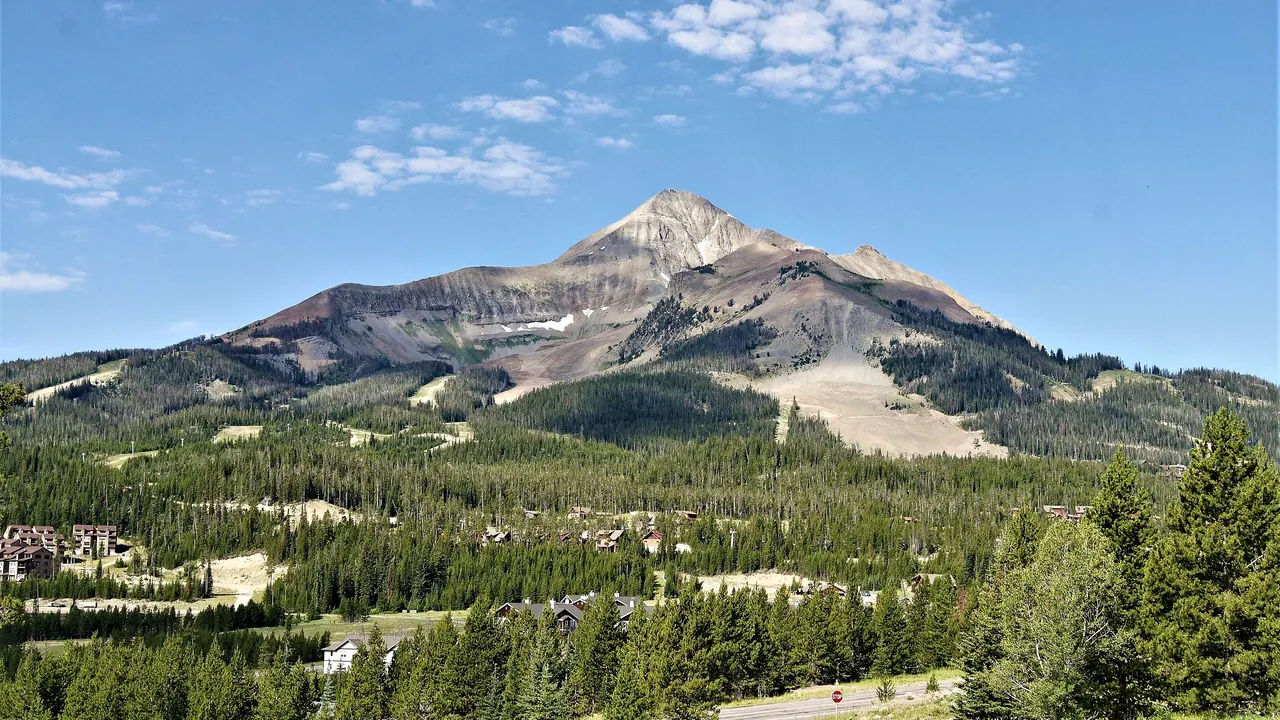
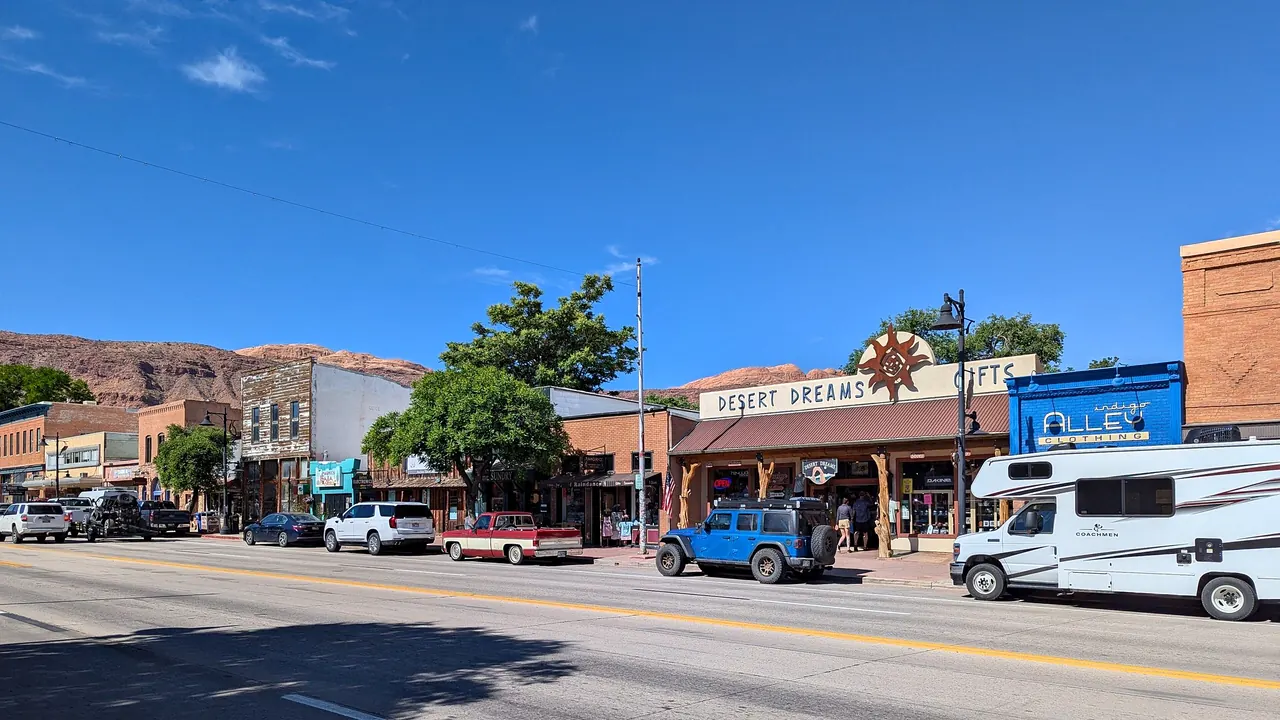
Photos: Big Sky by Greg Gjerdingen, CC BY 2.0, cropped; Moab by G. Edward Johnson, CC BY 4.0, cropped.
Big Sky or Moab?
Our verdict in twelve categories, each scored against the same fixed benchmark cities, and the climate month by month, so you can choose for your trip.
Choose Big Sky for
- wellness
- getting around
- day trips
Big Sky suits travellers who want a mountain resort with everything close at hand: big ski terrain under Lone Peak in winter, and in summer lift-served hiking, fly fishing on the Gallatin and Yellowstone wildlife an hour away. Ski school, a summer adventure park and lodge spas make it easier for families and for anyone who likes a hot tub at the end of the day. Choose it if comfort matters more than cost.
Choose Moab for
- prices
- culture and sights
- beaches
Hikers and mountain bikers who want red rock rather than snow are better off in Moab. Arches begins just outside town, Canyonlands is close, and the Slickrock Trail and the Colorado River fill the rest of the week. It costs noticeably less, thanks to campgrounds and free trails, and the rock art along the cliffs adds a sense of the past that the ski resort lacks. It suits active adults and older children in spring and autumn.
Scoreboard
Twelve categories on one fixed scale from 0 to 100. The shaded stretch is the gap between the two.
Your match
Pick a travel style or drag the sliders, and both match scores follow your weighting.
Wins on wellness and getting around with your weighting.
Wins on prices and culture and sights with your weighting.
What matters to you?
Category by category
What the scores mean for a trip.
Beaches & swimming
Neither is a swimming destination. Both are hundreds of kilometres inland and the rivers are cold and fast.
The difference is in how you cool off. Big Sky offers the chilly Gallatin, small ponds and a hotel pool. In Moab the desert heat makes a dip more appealing, at Mill Creek's shallow pools, Ken's Lake or a sandbar on the Colorado.
Food & drink
The food is much the same in both: hearty, casual and built around a day outdoors. Big Sky leans towards mountain cooking such as bison, elk, trout and big ski breakfasts, spread across three separate villages, with a few lodge kitchens aiming higher.
Moab keeps everything on Main Street, with burgers, tacos, breweries and a few dinner places with Southwestern touches. Utah's alcohol rules make a drink with dinner more formal than in Montana. If you want more choice, Bozeman is an hour from Big Sky, while Moab has no equivalent nearby.
Culture & sights
Moab has more depth here, though it lies in the landscape rather than in town. Ancestral Puebloan and Fremont petroglyphs line the cliffs along Potash Road and Kane Creek, dinosaur trackways are close by, and the small Museum of Moab explains both.
Big Sky was built from the 1970s on and has little beyond the log cabins of the Crail Ranch homestead in Meadow Village. Neither place suits a trip planned around museums.
Nightlife
Big Sky has more going on after dark, mostly in winter. Après-ski fills the sunny decks at the base of the lifts in Mountain Village, a few Town Center taverns stay open after dinner, and old saloons in the Gallatin Canyon have pool tables and a ranch crowd.
Moab is quieter still, with a couple of brewpubs full of rafters and bikers and most of the town asleep by eleven. Neither has clubs. In Moab the best thing to do at night is look at the stars.
Nature & outdoors
These are two of the finest outdoor bases in the American West, and the difference is the terrain. Big Sky is alpine: skiing on Lone Peak, summer trails into the Spanish Peaks and the Lee Metcalf Wilderness, fly fishing and rafting on the Gallatin, and Yellowstone's geysers and wolves about an hour south.
Moab is red-rock desert. You get the arches and fins of Arches National Park, the canyon views from Island in the Sky and Dead Horse Point, mountain biking on Slickrock and the Whole Enchilada, plus canyoneering, climbing and jeep trails. Their best seasons hardly overlap, which helps if you are choosing by date.
Day trips
Big Sky has better outings away from the mountains. Bozeman, an hour down the canyon, is a lively college town with the Museum of the Rockies and its dinosaur fossils. Further out are the preserved gold-rush boardwalks of Virginia City and Nevada City.
From Moab, the towns within reach are small, Bluff being the most appealing. The best cultural outing is the long drive south to the Ancestral Puebloan ruins at Edge of the Cedars and Hovenweep, which takes most of a day.
Good for families
Big Sky is the easier choice with children. Winter has a ski school and gentle slopes, summer turns the base area into an adventure park, and spotting bison on a day in Yellowstone is a real highlight. Its drawbacks are the thin air at around 2,300m and the long winter drives.
Moab delights children who like scrambling over rock, with Sand Dune Arch, dinosaur tracks, calm raft floats and Junior Ranger programmes. However, the summer heat, unfenced drops and constant car journeys make it better for school-age children than for toddlers.
Getting around
Big Sky is easier without your own car. A free local bus links the canyon, Meadow Village, Town Center and Mountain Village, many lodgings are ski-in, and Bozeman airport is an hour away by shuttle. You still need a car for Yellowstone.
Moab's Main Street is easy to walk, and a paved path lets you cycle to the Arches entrance, but that is as far as you get on foot. The parks lie along long desert roads and dirt tracks, so without a vehicle, ideally a high-clearance one, you depend on outfitters' tours.
Shopping & style
Neither is a place to shop, and both mainly sell gear. Big Sky has ski and fly-fishing shops, a few Western-style boutiques and galleries selling wildlife art.
Moab's Main Street has more to take home. Rock shops sell geodes and fossils, and galleries carry Navajo jewellery and weavings alongside the bike and climbing shops.
Affordability
Moab is the cheaper of the two, though not by a wide margin in town, where simple motel rooms charge resort prices in spring and autumn. The real savings are campgrounds, free dispersed camping, a park pass that lasts a week and trails that cost nothing.
Big Sky is among the most expensive stays in the American West. Lift passes, ski school, guided fishing and slopeside lodging make every day costly. Summer is cheaper, and so is staying in Bozeman, but you pay for it in driving.
Live music & performing arts
Big Sky offers a little more through the year. A small arts centre in Meadow Village brings touring musicians, chamber music and theatre in winter, and summer adds free concerts on the Town Center lawn and a short classical festival.
Moab's live music is concentrated in the Moab Music Festival at the end of summer. It is the more memorable event of the two, with some concerts held in canyon grottoes that you reach by boat.
Wellness & relaxation
For a restful stay, Big Sky is the better pick. The large lodges have full-service spas built around tired ski legs, hot tubs on the decks are standard, and natural hot springs are an hour away towards Bozeman.
Moab is an energetic trip of early starts and long hot days, with only a few small day spas and massage studios in town. Rest there comes from quiet desert evenings and the cliffs turning red at sunset, or from a remote ranch or a cabin in the La Sal Mountains.
When should you go?
Pick your month. The climate figures are measured averages, not a forecast.
Big Sky in July
Moab in July
Daytime high, °C
Rainfall in the month, mm
Where the figures come from
Big Sky has no weather station within reach, so its figures come from a gridded climate model rather than a measured record, and read a broad area rather than the city itself.
Moab's temperatures are measured 27 km from the centre, at Moab / Crescent Junction.
Moab's station stands 162 m above the city centre, so the centre is likely a little warmer than the figures say.
Moab has no rain gauge within 25 km of the centre, so its rainfall comes from a gridded climate dataset read at the city rather than from a gauge further away.
Temperature and rainfall are climate normals, averaged over the years shown. Big Sky: 2001-2020 normals, NASA POWER reanalysis grid, no weather station within 90 km. Moab: 2006-2020 (rainfall 1991-2020) normals, Moab / Crescent Junction (27 km from centre).
The two cities run on opposite calendars. Big Sky is a winter place first. Snow lies from late autumn into April and daytime highs stay below freezing from December to February. Its summer is short and pleasant, with July and August reaching about 26°C and nights staying cool, which makes it ideal for hiking and biking. Late spring is the wettest and muddiest time, with around 80mm a month in May and June, and October is often a quiet gap between seasons.
Moab is dry all year, so the deciding factor is heat. April, May, September and October bring highs of roughly 20°C to 29°C, the best conditions for long hikes and rides. From June to August the days climb to about 35°C, too hot for midday walking. Winter is cold, close to freezing in December and January, but the trails are quiet. In practice, go to Big Sky for snow or high summer and to Moab in spring and autumn.
Which traveller are you?
On a trip on a tight budget, Big Sky is hard to make work, because the mountain itself is what you pay for, every day you are there. In Moab most of the expense is optional, and a tent, a park pass and walking boots carry a week.
For a relaxing and wellness trip, Big Sky is the easier choice. Comfort comes with the resort, so after a day outside you come back to warmth, quiet and someone to ease tired legs. Moab is built around early starts and heat, so rest there takes planning.
For skiers, the choice is simple. Big Sky has a mountain big enough to fill a week without repeating a run, with steep terrain for experts and easy slopes for beginners. Moab in winter is good for quiet, cold hikes, not for skiing.
Before you go
| Measure | Big Sky | Moab |
|---|---|---|
| Currency | US Dollar (USD) | US Dollar (USD) |
| Sockets | AB120 V, 60 Hz | AB120 V, 60 Hz |
| Driving side | Right | Right |
| Time zone | UTC-7, UTC-6 in summer | UTC-7, UTC-6 in summer |
| Emergency number | 911 | 911 |
| Elevation | 2,200 m | 1,227 m |
| Main airport | Bozeman Yellowstone International Airport (BZN)59 km from centre27 non-stop destinations | Canyonlands Regional Airport (CNY)27 km from centre2 non-stop destinations |
| Public holidays this year | 12 days | 12 days |
By the numbers
| Measure | Big Sky | Moab |
|---|---|---|
| City population | 3,591 | 5,366 |
| People per km² | 12 | 501 |
| Museums within 10 km | 0 | 1 |
| UNESCO World Heritage sites within 50 km | 0 | 0 |
Where else could you go?
Every comparison below shares a destination with this one, so you can follow Big Sky or Moab somewhere new.
- Telluridevs Moab
- Jackson Holevs Big Sky
- Durango, Coloradovs Moab
- Aspenvs Moab
- Page, Arizonavs Moab
- Deer Valleyvs Moab