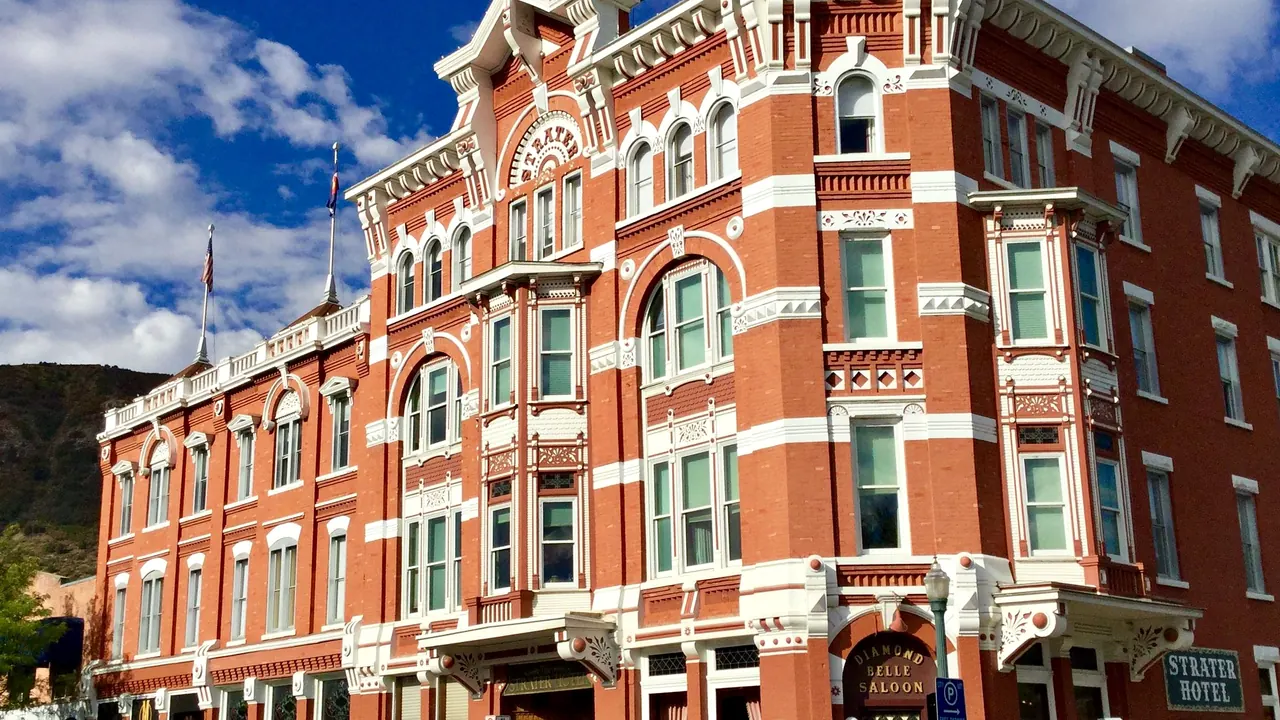
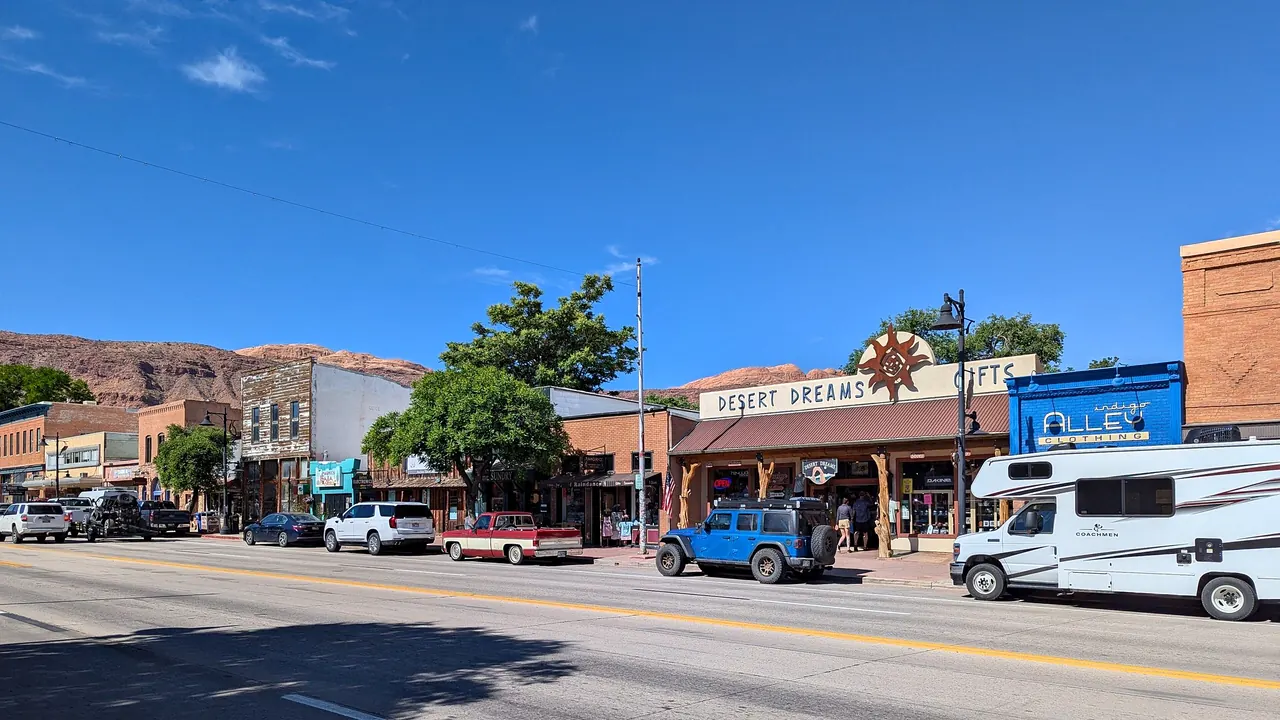
Photos: Durango, Colorado by Adeledstarr, CC BY-SA 4.0, cropped; Moab by G. Edward Johnson, CC BY 4.0, cropped.
Durango, Colorado or Moab?
Our verdict in twelve categories, each scored against the same fixed benchmark cities, and the climate month by month, so you can choose for your trip.
Choose Durango, Colorado for
- day trips
- wellness
- getting around
Durango is the better all-round base. The San Juan trails and a winter ski resort lie to the north. In town there are a steam railway, a Victorian main street, brewery taprooms and hot springs, and Mesa Verde is close enough for a day out. It suits couples and families who want the outdoors but also a decent dinner, a pint in the evening and a soak after the ride.
Choose Moab for
- nature and the outdoors
Pick Moab when the landscape is the whole point. Arches starts at the edge of town and Canyonlands is under an hour away. The slickrock riding, river trips and canyon hikes are among the finest anywhere. Little else competes for your time: the food is fuel, evenings end early and there is almost nothing to see in town. It rewards active travellers who plan to be out from dawn and in bed early.
Scoreboard
Twelve categories on one fixed scale from 0 to 100. The shaded stretch is the gap between the two.
Your match
Pick a travel style or drag the sliders, and both match scores follow your weighting.
Wins on day trips and wellness with your weighting.
Wins on nature and the outdoors with your weighting.
What matters to you?
Category by category
What the scores mean for a trip.
Beaches & swimming
Neither town is a beach destination, and in both, swimming is a way to cool off in summer rather than a day by the water. What differs is the setting. Durango has a small swimming area at Lake Nighthorse, sandy edges at Vallecito Lake and the local habit of tubing the Animas through town. Moab has Mill Creek's shallow pools, Ken's Lake and sandbars on a fast, silty Colorado River where you need to take care.
Food & drink
Durango eats better. Around Main Avenue there are green-chile plates, steakhouses and a few kitchens cooking Colorado lamb and trout. The town also has an unusual number of breweries for its size, which makes the evening pint a highlight.
Moab's Main Street is about refuelling: burgers, tacos, pizza and big portions for hungry hikers. Choice thins in winter, there are queues on busy evenings, and Utah's alcohol rules make a drink with dinner more formal than in a Colorado taproom.
Culture & sights
Durango has a modest but real set of sights. There is the railway depot from the town's founding in 1880 with its roundhouse museum, several blocks of brick and sandstone Victorian hotels and saloons, and a respected Southwestern and Native American collection at the college on the mesa.
Moab itself offers little beyond the small Museum of Moab and a few buildings from the uranium boom. Its history is out on the cliffs, in the Ancestral Puebloan and Fremont petroglyph panels along Potash Road and Kane Creek. They are rewarding, but they fill a morning rather than a stay.
Nightlife
Durango's evenings have more to them. You can have a pint on a patio along Main Avenue or a drink in an old saloon with a piano player and Victorian wallpaper, and student bars fill up at weekends. There is little dancing, though, and the town goes quiet before midnight.
Moab is quieter still. A couple of brewpubs and a few bars fill with bikers and rafters, there are no clubs and most of the town is asleep by eleven. Its best night out is the very dark, star-filled sky.
Nature & outdoors
Both are first-rate, but Moab's landscape is the more extraordinary. Arches begins minutes from town and Canyonlands spreads its maze of canyons below Island in the Sky. The Slickrock Trail, the Whole Enchilada descent, canyoneering and climbing make it a world centre for desert sport.
Durango offers alpine country instead: the San Juan Mountains, the start of the Colorado Trail, high lakes in the Weminuche Wilderness and rafting through the middle of town. It also works in winter, when a full ski resort half an hour north has deep snow, while Moab's winter trails are cold and quiet.
Day trips
Durango is much the better base for days out. Mesa Verde's cliff dwellings are a couple of hours' drive away, and the narrow-gauge steam train climbs the Animas canyon to Silverton. Ouray, the Aztec ruins, Chimney Rock and the hot-spring town of Pagosa Springs each fill a day.
From Moab, the great outings are the national parks themselves. Beyond them the towns are small, such as Green River, Monticello and Bluff. Hovenweep and Edge of the Cedars reward a long drive south, and Grand Junction's wineries take most of two hours each way.
Good for families
Durango is the easier choice with children. The steam train, gentle tubing on the river, the summer alpine coaster and ziplines at the ski area and the ladders at Mesa Verde give younger children plenty to do. The altitude can tire them for the first day or two.
Moab suits older, active children who like scrambling on rock. There are short walks to Sand Dune Arch, dinosaur tracks and Junior Ranger programmes. Summer heat, unfenced drops at viewpoints and long drives make it hard work with toddlers.
Getting around
You need a car in both, but less so in Durango. Its flat centre takes a quarter of an hour to walk from end to end, a paved river trail links parks and neighbourhoods, and a trolley and bus service runs along the main corridor.
Moab has no useful public transport. Main Street is walkable and a paved path takes cyclists to the Arches entrance, but the parks lie along long desert roads and dirt tracks. Visitors without a vehicle rely on shuttles run by outfitters, and a high-clearance car lets you reach much more of the backcountry.
Shopping & style
Durango's Main Avenue has things worth taking home: Navajo and Pueblo silver, turquoise and rugs, Western wear and boots, and art galleries alongside the outdoor shops. It makes a pleasant hour or two, though there is no fashion or luxury shopping.
Moab's Main Street is more practical, with bike, climbing and camping stores, rock shops selling geodes and fossils, and a few galleries. It is better for a spare tyre than a present.
Affordability
Both are expensive small American resort towns, with scarce rooms, full restaurant prices and a hire car to budget for. The savings work differently. In Moab, public campgrounds, free dispersed camping and national park entry that covers a week keep costs down if you sleep outdoors, and winter is much cheaper. In Durango, spring and late autumn are the cheaper times and the trails and river are free, but the steam train and guided trips add up.
Live music & performing arts
Durango has a small but more varied stage. The concert hall at the college hosts touring music and dance, and the community arts centre has a small theatre. Summer adds a chamber and orchestral festival, a Victorian melodrama where the audience boos the villain, and cowboy shows with a chuckwagon supper.
Live performance in Moab mostly comes down to its end-of-summer chamber music festival, with memorable concerts in canyon grottoes reached by boat. The rest of the year there is little beyond a band in a brewpub at the weekend.
Wellness & relaxation
Durango is clearly the place to unwind. Pools fed by a natural mineral spring are minutes north of town, Pagosa Springs and Ouray have more, and slow riverside mornings suit a soak after a ride.
Moab has no hot springs worth the trip and only a handful of day spas, mostly for sore legs. Rest there means stillness: red cliffs at sunset, dark skies, or a ranch or cabin up in the La Sal Mountains.
When should you go?
Pick your month. The climate figures are measured averages, not a forecast.
Durango, Colorado in July
Moab in July
Daytime high, °C
Rainfall in the month, mm
Where the figures come from
Durango, Colorado has no weather station within reach, so its figures come from a gridded climate model rather than a measured record, and read a broad area rather than the city itself.
Moab's temperatures are measured 27 km from the centre, at Moab / Crescent Junction.
Moab's station stands 162 m above the city centre, so the centre is likely a little warmer than the figures say.
Moab has no rain gauge within 25 km of the centre, so its rainfall comes from a gridded climate dataset read at the city rather than from a gauge further away.
Temperature and rainfall are climate normals, averaged over the years shown. Durango, Colorado: 1991-2020 normals, TerraClimate 4 km grid at the town, no weather station within 90 km. Moab: 2006-2020 (rainfall 1991-2020) normals, Moab / Crescent Junction (27 km from centre).
Durango is at its best from June to September. From June to August, highs of 28°C to 30°C are warm enough for tubing the Animas and still comfortable for riding at altitude. September is milder, and late in the month the aspens turn gold. Rain picks up from July, and August is the wettest month at 48mm. From December to February the town turns to skiing, with daytime highs around 5°C.
Moab is best in the months either side of summer. April, May, September and October are good desert hiking weather. From June to August it reaches 33°C or more, and walking in the middle of the day becomes hard work. Moab is the drier of the two all year, but its midwinter is colder, with highs barely above freezing in January and quiet trails.
Which traveller are you?
For an outdoors trip, Moab has the edge. Arches lies minutes from town and Canyonlands and Dead Horse Point are within the hour. Add the Slickrock Trail, canyoneering and paddling on the Colorado, and you can fill a week of full days in a landscape unlike anything around Durango.
On a relaxing and wellness trip, Durango is far easier. A slow day there can mean a late breakfast on Main Avenue, a gentle float down the Animas and an evening on a taproom patio. Moab's days run on early starts and long, hot hours outdoors.
For a culture and arts trip, Durango gives you more to fill the days: the steam railway and roundhouse museum, the Victorian downtown, the college's Native American collection, a summer music festival and Mesa Verde's cliff dwellings nearby. In Moab, culture is mostly its petroglyph panels.
Before you go
| Measure | Durango, Colorado | Moab |
|---|---|---|
| Currency | US Dollar (USD) | US Dollar (USD) |
| Sockets | AB120 V, 60 Hz | AB120 V, 60 Hz |
| Driving side | Right | Right |
| Time zone | UTC-7, UTC-6 in summer | UTC-7, UTC-6 in summer |
| Emergency number | 911 | 911 |
| Elevation | 1,988 m | 1,227 m |
| Main airport | Durango La Plata County Airport (DRO)18 km from centre4 non-stop destinations | Canyonlands Regional Airport (CNY)27 km from centre2 non-stop destinations |
| Public holidays this year | 12 days | 12 days |
By the numbers
| Measure | Durango, Colorado | Moab |
|---|---|---|
| City population | 19,071 | 5,366 |
| People per km² | 739 | 501 |
| Museums within 10 km | 2 | 1 |
| UNESCO World Heritage sites within 50 km | 1 | 0 |
Where else could you go?
Every comparison below shares a destination with this one, so you can follow Durango, Colorado or Moab somewhere new.
- Telluridevs Durango, Colorado
- Telluridevs Moab
- Taosvs Durango, Colorado
- Aspenvs Durango, Colorado
- Aspenvs Moab
- Santa Fevs Durango, Colorado