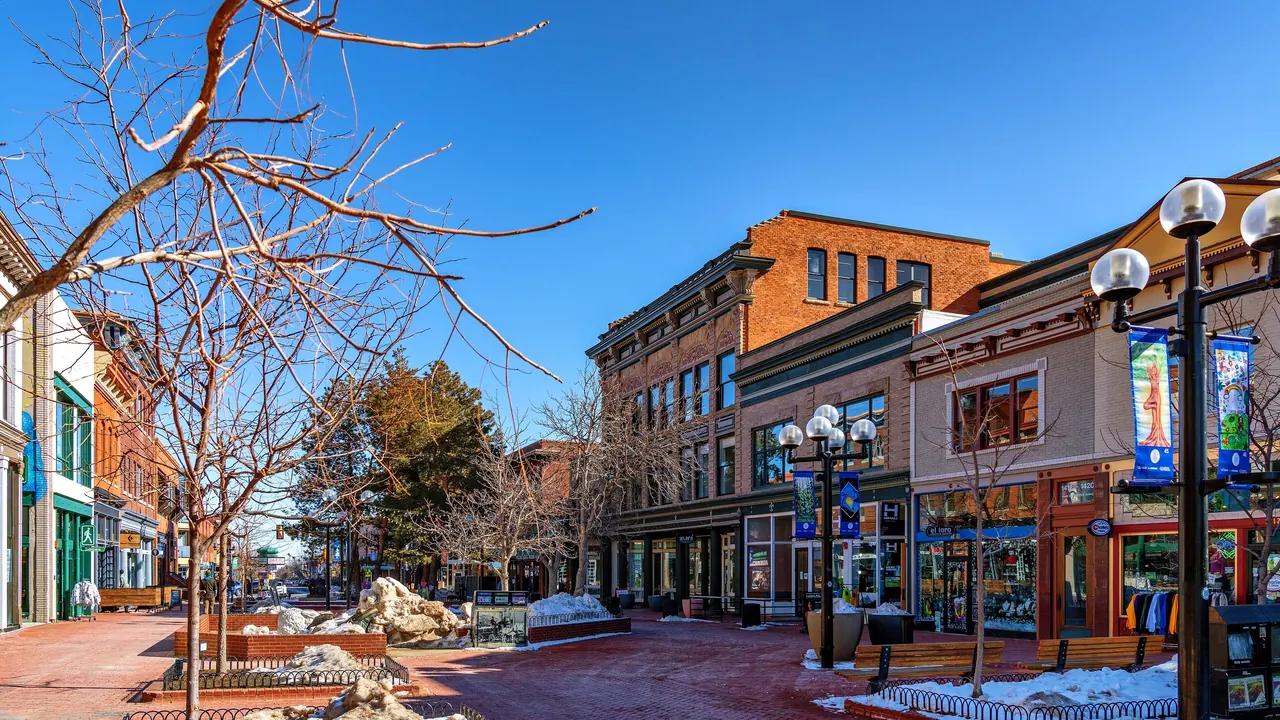
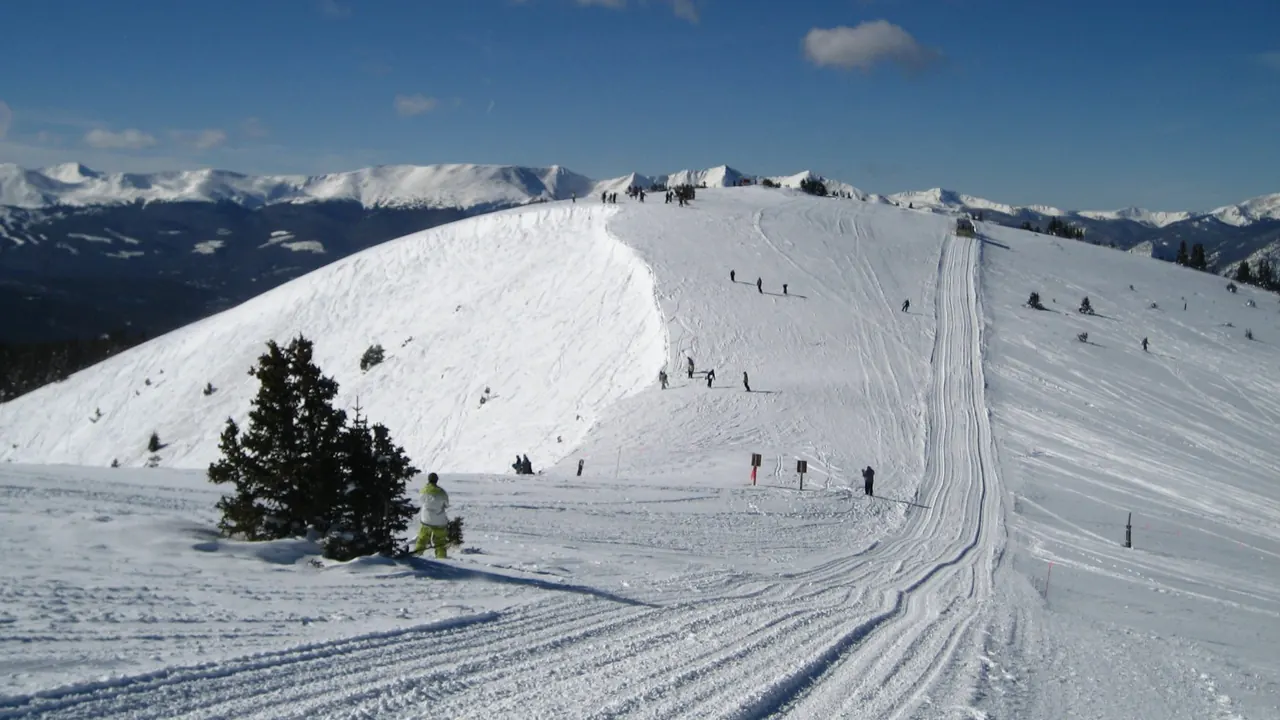
Photos: Boulder by Tony Webster, CC BY 2.0, cropped; Keystone by Rudi Riet, CC BY-SA 2.0, cropped.
Boulder or Keystone?
Our verdict in twelve categories, each scored against the same fixed benchmark cities, and the climate month by month, so you can choose for your trip.
Choose Boulder for
- nightlife
- live music and the arts
- culture and sights
Boulder suits travellers who want the mountains on the doorstep without giving up a proper town. The Flatirons trails, Eldorado Canyon's climbing walls and the canyon cycling roads start at the edge of town. In the evening there are taprooms along Pearl Street, live music on the Hill and summer concerts at the Chautauqua. It is the better base for a warm-weather trip that mixes hiking, climbing and cycling with good meals, and Denver is a short bus ride away.
Choose Keystone for
- families
- day trips
- nature and the outdoors
Keystone is the choice when the trip is about snow. Its three peaks are on the doorstep, Arapahoe Basin is just up the road, and Breckenridge and Vail are within an hour, so it works first and foremost as a ski base. Families do especially well here, with the ski school, gentle lower slopes, the skating lake and free shuttles. Evenings are short and there is little to see apart from the mountains, so come for the days outdoors rather than the nights.
Scoreboard
Twelve categories on one fixed scale from 0 to 100. The shaded stretch is the gap between the two.
Your match
Pick a travel style or drag the sliders, and both match scores follow your weighting.
Wins on nightlife and live music and the arts with your weighting.
Wins on families and day trips with your weighting.
What matters to you?
Category by category
What the scores mean for a trip.
Beaches & swimming
Neither is a place to swim in any serious way, but Boulder at least gets you into the water in summer. It has a small sandy swim area at Boulder Reservoir, and you can float down Boulder Creek on an inner tube. Dillon Reservoir below Keystone is fed by cold snowmelt and mostly closed to swimmers, so it is for sailing and paddleboarding, and a swim there means a hotel pool or hot tub.
Food & drink
Boulder eats noticeably better. It has seasonal farm-to-table cooking, plenty of vegetarian and vegan choice, good bakeries and coffee, a Saturday farmers' market by the creek, and tea at the hand-carved Dushanbe Teahouse. Range is still thin, and serious eaters head to Denver.
Keystone's food is resort food: slopeside grills, pizza and après-ski burgers, plus a few more ambitious rooms, one of them reached by gondola. Many visitors cook in their condo or drive to Frisco or Breckenridge. Both places pour good Colorado craft beer.
Culture & sights
Boulder has enough to fill a pleasant day of sightseeing, while Keystone has almost nothing. In Boulder you can walk through the wooden cottages and auditorium of the 1898 Chautauqua below the Flatirons, then cross the university campus with its sandstone walls and red-tile roofs. Up on the mesa is I.M. Pei's atmospheric research laboratory, which has free exhibits.
Keystone was built for skiing in the 1970s, and River Run Village is modern and practical rather than something to look at. The area's history lies outside the resort, in the old mining cabins and ruins of the Snake River valley and the Victorian towns nearby.
Nightlife
Boulder offers a modest but real night out, with brewery taprooms and cocktail bars around Pearl Street and loud student bars on University Hill during term, and Denver is close for more. Keystone's evenings centre on après-ski at River Run and end soon after dinner, so anyone wanting more goes to Breckenridge's Main Street.
Nature & outdoors
Both places are superb for the outdoors. The difference is that Boulder's trails start at the edge of town, while Keystone's mountains start at the lift. From Boulder, a protected ring of open space runs from Chautauqua up to Bear Peak and the mesas, Eldorado Canyon offers serious rock climbing ten minutes away, and cyclists train on the canyon roads. Rocky Mountain National Park is about an hour's drive.
Keystone sits far higher, at about 2,800m, in true alpine country. It has bowls well above the tree line, and Arapahoe Basin is just up the road. In summer you can climb Grays and Torreys Peaks, two of the state's highest summits, walk the tundra at Loveland Pass or sail on Dillon Reservoir. The thin air takes a day or two to get used to.
Day trips
The choice of outings is broadly similar, but it points in different directions. From Boulder, Denver's art museum and Union Station are an easy bus ride away. Most other trips, such as Golden, Fort Collins or Estes Park, need a car.
Keystone has more variety close at hand. Breckenridge's Victorian centre, the Georgetown loop railway, Leadville's mining-boom streets and Vail's village are all within an hour. Denver, though, is a longer drive and can be slow on winter weekends.
Good for families
Keystone is better set up for children, at least in winter. It has a big ski school, gentle lower slopes, a snow fort on the mountain, a huge skating lake and condos a short walk from the lifts. Off the snow there is less to do.
Boulder is relaxed and safe, with creek paths, easy trails, tubing, the planetarium and street performers on Pearl Street. Its zoo and aquarium days, though, mean going to Denver.
Getting around
Boulder is a compact town you can walk and cycle, while Keystone is a resort of separate bases linked by shuttles. In Boulder, downtown, the campus and Chautauqua are close together, and off-street bike paths run along the creeks. At Keystone, free shuttles connect River Run, Mountain House and Lakeside, and free county buses go on to Frisco and Breckenridge.
Each has its catch. Boulder's trailheads outside town and the national park really need a hire car. Keystone's problem is getting there in the first place: the drive up I-70 from Denver can bring chain rules and slow weekend traffic in winter.
Shopping & style
Boulder is the better place to browse. The brick-paved Pearl Street Mall has independent bookshops, galleries and boutiques, and its climbing and cycling shops are unusually good. Keystone has rental shops and a few stores in River Run Village, and its real draw is the outlet centre in Silverthorne, ten minutes away.
Affordability
Keystone costs more than Boulder, above all in ski season. Lift access, equipment rental, ski school and slopeside rooms add up quickly, although free buses, condo kitchens and the supermarkets in Dillon help. Summer is gentler on the wallet.
Boulder's hotels are still dear and its restaurants charge affluent prices. But its main attraction, the trails and open space, costs almost nothing. Many visitors also save money by staying in Denver and coming in for the day.
Live music & performing arts
Boulder has much more live performance. Small rooms downtown book rock and bluegrass acts most nights, and in summer the Colorado Music Festival plays in the wooden Chautauqua Auditorium and the Shakespeare festival performs outdoors on campus. Red Rocks Amphitheatre is about 45 minutes away.
Keystone's offer is mostly summer festivals on village stages and concerts by the reservoir at Dillon. A professional theatre company in Silverthorne adds plays and musicals all year.
Wellness & relaxation
Boulder makes wellness a way of life. It has yoga and meditation studios everywhere, a contemplative university tradition, massage and acupuncture, and an unhurried morning rhythm, with a spring-fed pool at Eldorado Springs in summer.
Keystone's version is recovery after skiing: resort spas, plus outdoor hot tubs at almost every lodge where you can sit as the snow falls. For real hot springs, both send you to Idaho Springs.
When should you go?
Pick your month. The climate figures are measured averages, not a forecast.
Boulder in July
Keystone in July
Daytime high, °C
Rainfall in the month, mm
Where the figures come from
Boulder has no rain gauge within 25 km of the centre, so its rainfall comes from a gridded climate dataset read at the city rather than from a gauge further away.
Keystone's temperatures are measured 51 km from the centre, at Leadville / Stringtown.
Keystone's station stands 232 m above the city centre, so the centre is likely a little warmer than the figures say.
Keystone has no rain gauge within 25 km of the centre, so its rainfall comes from a gridded climate dataset read at the city rather than from a gauge further away.
Temperature and rainfall are climate normals, averaged over the years shown. Boulder: 2010-2025 (rainfall 1991-2020) normals, Boulder / Valmont (6.1 km from centre). Keystone: 2006-2020 (rainfall 1991-2020) normals, Leadville / Stringtown (50.8 km from centre).
Boulder has four distinct seasons and is pleasant for most of the year. Summer highs reach about 31°C in July, warm enough for the reservoir swim area and tubing on the creek, though the middle of the day is hot for hiking and storms often build in the afternoon. Late spring is the wettest stretch, peaking at about 61mm in May. September and October are the best months for long walks, and the dry winters, with highs around 7°C, often still allow walking in town.
Keystone runs a full season colder. From November to March daytime highs hover around freezing and fall to about -2°C in midwinter, which is exactly what the ski season needs. Summer is short and mild, peaking near 21°C in July, which is ideal for high hikes and biking but never beach weather. Rain and snow are spread fairly evenly through the year, with a little more in late summer.
Which traveller are you?
On a family trip with children, Keystone is the easier choice. A large ski school, gentle lower runs, tubing, the snow fort and the skating lake are all close to condos with kitchens, and free shuttles link the bases.
For a food and nightlife trip, Boulder is clearly ahead. You get farm-to-table menus, the creekside farmers' market, taprooms and cocktail bars around Pearl Street and live bands most nights, whereas Keystone's evenings end soon after après-ski and dinner.
Skiers and snowboarders should pick Keystone. Long groomed runs, tree skiing and bowls start at the resort, with Arapahoe Basin minutes away and several more big areas within an hour. Boulder has only the small Eldora ski area up its canyon.
Before you go
| Measure | Boulder | Keystone |
|---|---|---|
| Currency | US Dollar (USD) | US Dollar (USD) |
| Sockets | AB120 V, 60 Hz | AB120 V, 60 Hz |
| Driving side | Right | Right |
| Time zone | UTC-7, UTC-6 in summer | UTC-7, UTC-6 in summer |
| Emergency number | 911 | 911 |
| Elevation | 1,655 m | 2,796 m |
| Main airport | Denver International Airport (DEN)56 km from centre231 non-stop destinations | Denver International Airport (DEN)116 km from centre231 non-stop destinations |
| Public holidays this year | 12 days | 12 days |
By the numbers
| Measure | Boulder | Keystone |
|---|---|---|
| City population | 108,250 | 1,369 |
| People per km² | 1,628 | 13 |
| Museums within 10 km | 4 | 0 |
| UNESCO World Heritage sites within 50 km | 0 | 0 |
Where else could you go?
Every comparison below shares a destination with this one, so you can follow Boulder or Keystone somewhere new.