United States
Boulder
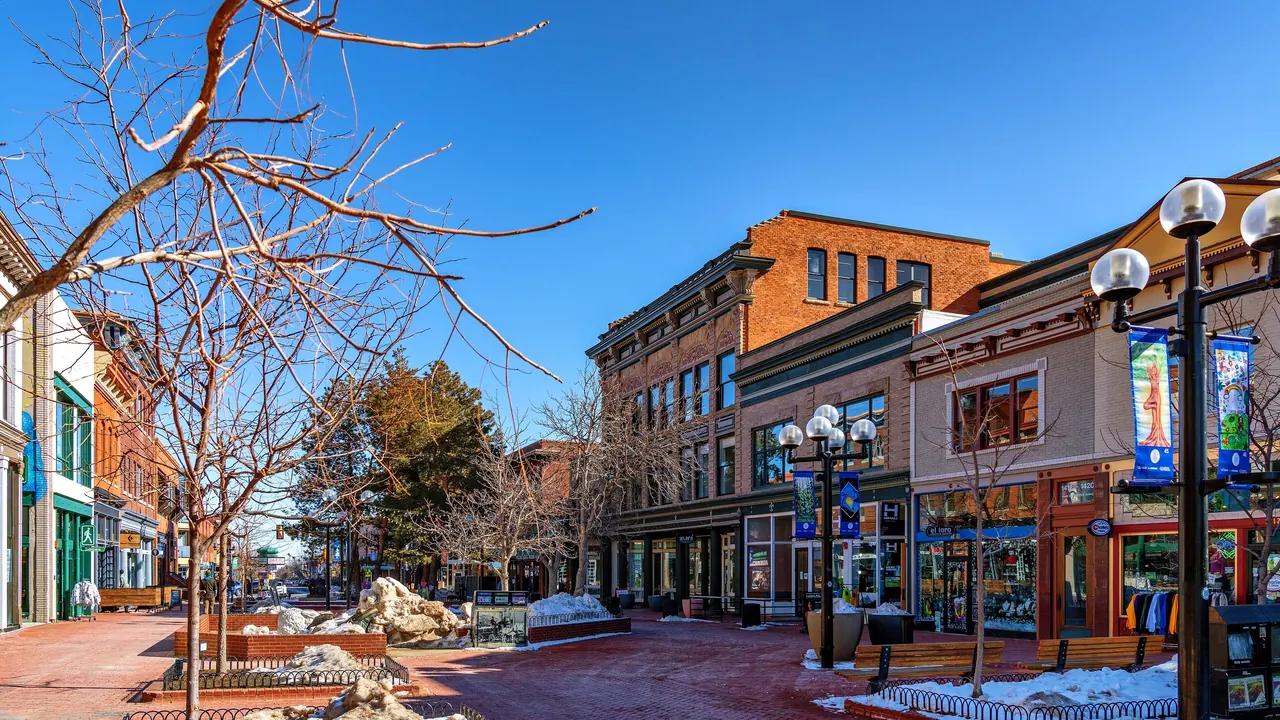
Pearl Street downtown on a clear winter day
- Nature & outdoors91
- Families58
- Getting around55
Photo: Tony Webster, CC BY 2.0, cropped
Match
43
Every category weighted equally
- Beach & sun40
- Culture & arts42
- Food & nightlife40
- Family trip45
- Outdoors49
- Relax & unwind44
- Shopping & style42
- On a budget41
Boulder in twelve categories
Our verdict on each, scored 0 to 100 against the same fixed benchmark cities, so a score means the same thing on every page.
Beaches & swimming. Scores 7 out of 100.
Food & drink. Scores 42 out of 100.
Culture & sights. Scores 26 out of 100.
Nightlife. Scores 35 out of 100.
Nature & outdoors. Scores 91 out of 100.
Day trips. Scores 50 out of 100.
Good for families. Scores 58 out of 100.
Getting around. Scores 55 out of 100.
Shopping & style. Scores 38 out of 100.
Affordability. Scores 23 out of 100.
Live music & performing arts. Scores 45 out of 100.
Wellness & relaxation. Scores 50 out of 100.
Boulder category by category
Beaches & swimming
7Boulder is about 1,600km from the nearest ocean, so there are no beaches here in any real sense. In summer the Boulder Reservoir on the north-east edge of town has a small sandy swim area, and locals cool off by floating Boulder Creek on inner tubes. Both are pleasant for an afternoon, but bring a swimsuit for hotel pools and creeks, not for a beach vacation.
Food & drink
42For a town of around 100,000, Boulder eats well. The style is farm-to-table and health-conscious: seasonal menus built on Front Range produce, plenty of vegetarian and vegan cooking, good bakeries and coffee roasters, and a Saturday farmers' market beside Boulder Creek that is a social event in its own right. Craft beer runs deep, with taprooms scattered across the east side of town, and the Boulder Dushanbe Teahouse, a hand-carved Tajik pavilion given by the sister city, is a lovely place for tea and lunch.
What it lacks is a cuisine of its own and much range. There is little street food, the ethnic choice is thin, and fine dining is limited to a handful of rooms. Visitors who want depth make the trip into Denver.
Culture & sights
26Boulder has charm rather than sights. The Chautauqua, a summer adult-education colony founded in 1898, keeps its wooden cottages, dining hall and auditorium at the foot of the Flatirons and is a National Historic Landmark. The University of Colorado campus has a striking, consistent style of sandstone walls and red-tile roofs, and up on the mesa south of town the National Center for Atmospheric Research occupies a pinkish concrete laboratory by I.M. Pei, with free exhibits on weather and climate.
Add the Museum of Boulder, the university's natural history museum and a small contemporary art museum, and the list is complete. A day covers it comfortably; this is not a city to come to for museums.
Nightlife
35Going out in Boulder means brewery taprooms, cocktail bars and pubs along and around Pearl Street, and the student bars on University Hill next to campus, which are loud and cheerful during term and much quieter in summer. Evenings tend to start early and end early, partly because so many people are heading for a trailhead at dawn. There are only a couple of places that pass for clubs. For a serious night out, Denver is about 40 minutes away.
Nature & outdoors
91Nature is the reason Boulder exists as a destination. The tilted sandstone slabs of the Flatirons rise right behind town, and the city has protected a ring of open space and mountain parks with well over 200km of trails, starting at Chautauqua Park and reaching Green Mountain, Bear Peak and the mesas. Eldorado Canyon, ten minutes south, is one of the country's great rock-climbing walls, and road and gravel cyclists come from around the world to train on the canyon roads at altitude.
Further afield, Boulder Canyon leads to the Indian Peaks Wilderness and the Eldora ski area, and Rocky Mountain National Park, with alpine tundra, lakes and elk, is about an hour's drive away. Summer brings afternoon thunderstorms on the high trails; autumn turns the aspens gold, and winter is often sunny and dry enough for walking in town.
Day trips
50Denver is the obvious outing, about 40 minutes away by express bus, with a large art museum, the domed state capitol, the history of Larimer Square and the restored Union Station. Beyond it, the list is pleasant rather than remarkable. Golden has a small western main street and a mountain-film feel, Fort Collins is a relaxed brewing and university town about an hour north, and Estes Park is the touristy gateway town to the national park.
West along the interstate, the Victorian silver-mining towns of Georgetown and Idaho Springs make a good half-day, and Colorado Springs is near the two-hour limit. A car is needed for almost all of these except Denver.
Good for families
58Boulder is an easy, safe and relaxed place to bring children, especially those who like being outdoors. The creek path, the Chautauqua meadow and gentle trails, the summer swim beach at the reservoir and tubing on Boulder Creek fill days well, and the street performers on the Pearl Street Mall keep younger children happy in the evening. Indoors, the university's planetarium and natural history museum and the free exhibits at the atmospheric research centre are good for curious minds.
There is nothing on a large scale, though: the zoo, aquarium and big science museum are in Denver. The altitude, at 1,655m, and the strong sun call for water and hats on hikes.
Getting around
55Within town, Boulder is easy. Downtown, the Pearl Street Mall, the university and Chautauqua are all within a walk or a short bike ride of each other, and the city has an outstanding network of off-street bike paths and underpasses along Boulder Creek and its tributaries, with bike share stations around the centre. Local buses fill the gaps, and an express bus runs to Denver and on to its airport connections.
The catch is everything beyond the city limits. Trailheads outside town, Eldorado Canyon, the ski area and Rocky Mountain National Park are hard or impossible to reach without a car, so most visitors who come for the outdoors hire one.
Shopping & style
38Shopping centres on the Pearl Street Mall, four pedestrian blocks of brick paving and flower beds lined with independent bookshops, galleries, toy shops and boutiques, with a mall-style shopping district at Twenty Ninth Street to the east. The genuine specialism is outdoor gear: climbing, running, cycling and camping shops are unusually good for a town this size. Beyond that, the range is limited, with no luxury streets or department stores of note, and serious shoppers head to Denver.
Affordability
23Boulder is an expensive place to stay. It is one of the wealthier towns in the country, hotel stock is limited, and rooms cost a lot, especially on university graduation and football weekends and in summer. Restaurant meals and craft beer come at affluent American prices with tips on top. The good news is that the main attraction, the trails and open space, costs almost nothing, and buses are reasonably priced. Staying in Denver or nearby towns and driving in is the usual way to cut costs.
Live music & performing arts
45For its size, Boulder hears a lot of live music. Small and mid-sized rooms downtown and on the Hill book touring rock, bluegrass and roots acts most nights, and the bluegrass and jam-band tradition runs deep in the region. In summer the wooden Chautauqua Auditorium of 1898 hosts the Colorado Music Festival's orchestral season and touring acts, and the Colorado Shakespeare Festival stages outdoor plays on campus. The university adds concerts and recitals during term.
There is no opera house or major theatre, and much of the classical calendar is seasonal. The great nearby asset is Red Rocks Amphitheatre, the natural sandstone venue about 45 minutes south, which draws music lovers from across the country.
Wellness & relaxation
50Boulder is a wellness town in its outlook rather than its baths. Yoga and meditation studios are everywhere, a Buddhist-inspired university gives the contemplative side real roots, and massage, acupuncture and day spas are easy to find. The pace is unhurried, and long, sunny mornings with coffee and a walk are the local rhythm.
Bathing culture is thin. The spring-fed pool at Eldorado Springs, just south of town, is a modest summer pleasure, and the nearest real hot springs, with caves and pools, are at Idaho Springs about an hour away. For a restorative stay the town works well; for serious soaking it does not.
When should you go?
Pick a month to see what it is like. The climate figures are measured averages, not a forecast.
Boulder in July
Daytime high, °C
Rainfall in the month, mm
The whole year
Shaded against this city’s own year: the deepest cell is its best month for that figure and the palest its weakest.
Where the figures come from
Boulder has no rain gauge within 25 km of the centre, so its rainfall comes from a gridded climate dataset read at the city rather than from a gauge further away.
Temperature and rainfall are climate normals, averaged over the years shown. Boulder: 2010-2025 (rainfall 1991-2020) normals, Boulder / Valmont (6.1 km from centre).
Before you go
| Measure | Boulder |
|---|---|
| Currency | US Dollar (USD) |
| Sockets | AB120 V, 60 Hz |
| Driving side | Right |
| Time zone | UTC-7, UTC-6 in summer |
| Emergency number | 911 |
| Elevation | 1,655 m |
| Main airport | Denver International Airport (DEN)56 km from centre231 non-stop destinations |
| Public holidays this year | 12 days |
By the numbers
| Measure | Boulder |
|---|---|
| City population | 108,250 |
| People per km² | 1,628 |
| Museums within 10 km | 4 |
| UNESCO World Heritage sites within 50 km | 0 |
Compare Boulder with
Every comparison with a written verdict behind it.
- Alta, Utah
- Aspen
- Beaver Creek
- Breckenridge
- Colorado Springs
- Copper Mountain
- Deer Valley
- Denver
- Flagstaff
- Keystone
- Las Vegas
- Park City
- Phoenix
- Salt Lake City
- Santa Fe
- Scottsdale
- Sedona
- Snowbird
- Steamboat Springs
- Telluride
- Tucson
- Vail
- Winter Park, Colorado