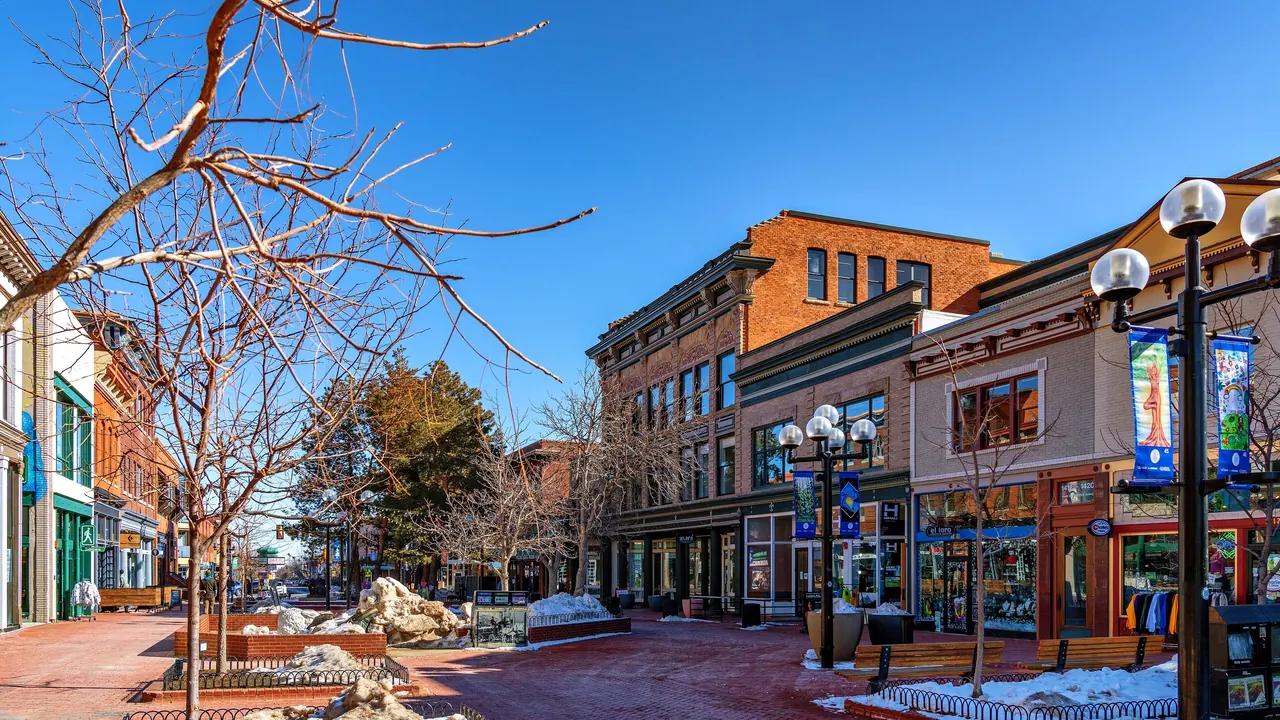
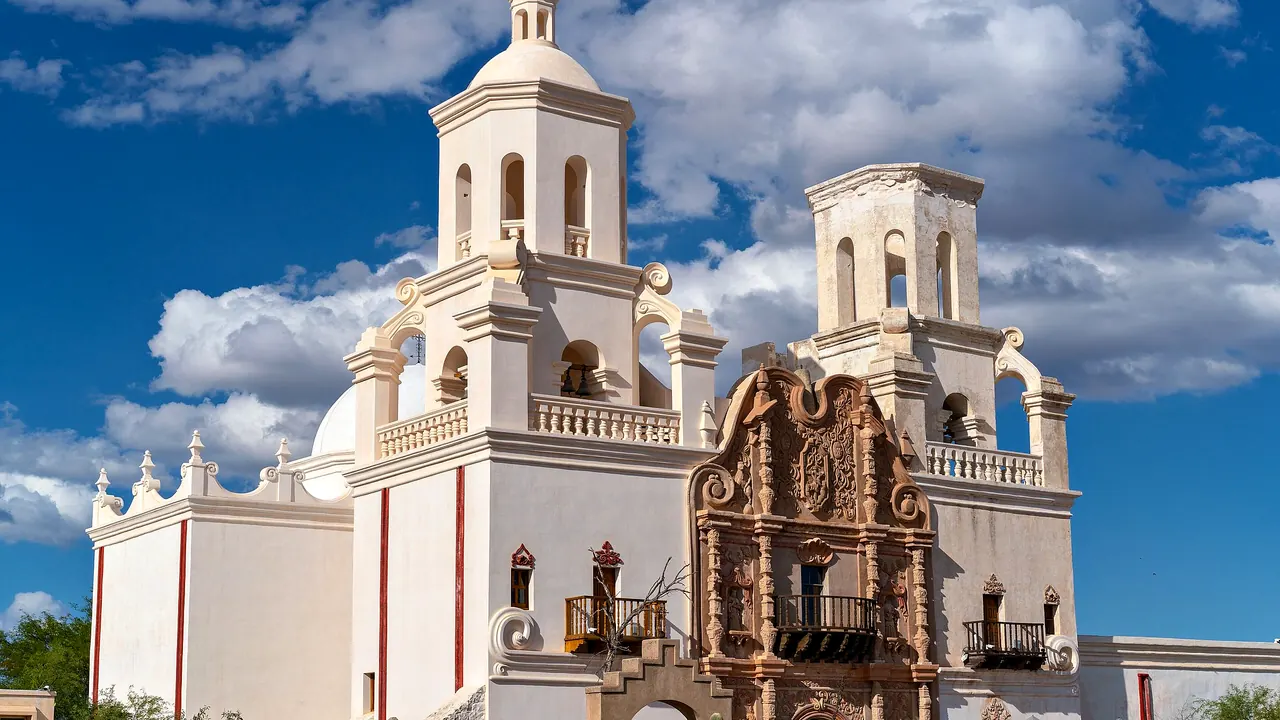
Photos: Boulder by Tony Webster, CC BY 2.0, cropped; Tucson by Steve and Kimberly Rader, CC BY-SA 4.0, cropped.
Boulder or Tucson?
Our verdict in twelve categories, each scored against the same fixed benchmark cities, and the climate month by month, so you can choose for your trip.
Choose Boulder for
- getting around
- nature and the outdoors
- live music and the arts
Boulder suits travellers who want the mountains right on the doorstep and a town small enough to get around on foot or by bike. The Flatirons trails start at the edge of town, and Eldorado Canyon and Rocky Mountain National Park are close by. Summer is the time to go. Rooms are expensive, and the food and sights are pleasant but not deep.
Choose Tucson for
- prices
- food and drink
- culture and sights
Tucson rewards a winter escape into warm desert light, and there is more to see and eat once you arrive. Sonoran Mexican cooking, the mission at San Xavier del Bac, long-established spa resorts and old mining towns within a drive make for a fuller trip, and rooms cost less. The trade-off is a spread-out city where a hire car is not optional, and summers too hot for most daytime outings.
Scoreboard
Twelve categories on one fixed scale from 0 to 100. The shaded stretch is the gap between the two.
Your match
Pick a travel style or drag the sliders, and both match scores follow your weighting.
Wins on getting around and nature and the outdoors with your weighting.
Wins on prices and food and drink with your weighting.
What matters to you?
Category by category
What the scores mean for a trip.
Beaches & swimming
Neither city is anywhere near a coast, so in both of them swimming is only a side pleasure. Boulder at least has a small sandy swim area at the reservoir and inner-tubing down Boulder Creek in summer. Tucson's water is the resort pool, with Sabino Canyon's pools appearing only after rain and the Gulf of California a four-hour drive away in Mexico.
Food & drink
Boulder's cooking is health-minded and farm-to-table. It is strong on vegetarian plates, bakeries, coffee and craft beer, and the Saturday farmers' market by the creek and the Dushanbe Teahouse are its set pieces. It has no cuisine of its own, though, and the range is narrow.
Tucson has the clearer identity. Its cooking is Sonoran Mexican, from mesquite-grilled carne asada and paper-thin flour tortillas to the Sonoran hot dog, and it is done best in the family kitchens along South 12th Avenue and in the older barrios. Desert ingredients such as tepary beans and prickly pear add flavours you will not find in Colorado, which makes Tucson the better place to travel for a meal.
Culture & sights
Boulder's sights are modest and quickly seen. There are the 1898 Chautauqua cottages beneath the Flatirons, the sandstone and red-tile university campus and I.M. Pei's atmospheric research laboratory on the mesa, and a single day covers them.
Tucson has more history to show. Mission San Xavier del Bac, with its painted and gilded interior, is a sight of real stature, and the adobe streets of Barrio Viejo and El Presidio recall the Spanish and Mexican settlement. The Native American collections at the Arizona State Museum and the hundreds of aircraft at Pima Air & Space fill another day or two.
Nightlife
Both are university towns with low-key evenings, few clubs, and a quieter summer once the students leave. Boulder's nights mean taprooms and cocktail bars around Pearl Street and the student bars on University Hill. They end early because so many people are on the trail at dawn, though Denver is less than an hour away for a bigger night.
Tucson's nights run along the dive bars of Fourth Avenue and the rooftops and dance floors of Congress Street. Drinking on a patio on a warm night is much of the appeal.
Nature & outdoors
Both cities sit hard against wild country, but Boulder has the edge: here you walk from town straight onto mountain trails. The Flatirons rise behind the streets with well over 200km of open-space paths, Eldorado Canyon is a climbing wall of world rank ten minutes away, and the alpine tundra and elk of Rocky Mountain National Park are about an hour's drive.
Tucson answers with the Sonoran Desert. There are saguaro forests in the national park on both sides of the city, the trails of Sabino Canyon and the drive up Mount Lemmon from cactus to pine. Its outdoor season runs from autumn to spring, though, and the summer heat pushes hikes to dawn or to the summit.
Day trips
From Boulder, Denver is the easy outing, an express-bus ride away for its art museum and Union Station. Beyond it, the options are pleasant rather than memorable: Golden, Fort Collins and the silver-mining towns of Georgetown and Idaho Springs, all of which need a car.
Tucson's list is longer and has more character. It includes Wild West Tombstone, the steep Victorian copper town of Bisbee, the artists' village of Tubac beside the Tumacácori mission ruins, the Sonoita wine country and Biosphere 2. Every one of them needs a car, but there is more worth driving to.
Good for families
Both suit children who like being outside, and they differ in kind. Boulder's strength is ease. It is a safe, compact town where the creek path, the reservoir swim beach, tubing and the street performers on Pearl Street fill the days. The zoo, aquarium and big science museum are in Denver, and the altitude and strong sun mean water and hats on hikes.
Tucson has more purpose-built attractions within the city. The Arizona-Sonora Desert Museum, with its mountain lions and hummingbirds, comes first. After it come the zoo, the children's museum, the planetarium, the giant aircraft and a western film set with stunt shows. They are spread far apart, though, and summer heat keeps the family season to October through April.
Getting around
Boulder is far easier without a car of your own. Downtown, the university and Chautauqua are a short walk or bike ride apart along an excellent network of off-street paths, and an express bus runs to Denver. Only the trailheads beyond town and the national park push you into a hire car.
Tucson is built for driving. A single streetcar line links downtown, Fourth Avenue and the university, the buses are slow, and almost everything visitors come for lies on the edge of the city or beyond it. At least parking is easy.
Shopping & style
Neither is a shopping destination, and each has its own speciality. In Boulder it is outdoor gear, with climbing, running and cycling shops of unusual quality alongside the bookshops and boutiques of the Pearl Street Mall. Tucson's speciality is regional craft, from Native American jewellery and Tohono O'odham baskets to Mexican folk art, and each winter its gem and mineral show draws collectors from around the world.
Affordability
Boulder is a wealthy town with few hotel rooms, so a stay costs a lot, especially in summer and on university weekends. The trails cost almost nothing, and many visitors save money by sleeping in Denver.
Tucson is noticeably easier on the budget, with cheaper mid-range hotels and taquerías and hot dog stands for meals. The hire car and the resort spas are extra costs. Winter is its expensive season and summer brings bargains, the reverse of Boulder's pattern.
Live music & performing arts
The two are evenly matched but differ in season and sound. Boulder's music is bluegrass, roots and touring rock in small rooms. In summer the Colorado Music Festival plays the wooden Chautauqua Auditorium, the Colorado Shakespeare Festival stages plays outdoors on campus, and Red Rocks Amphitheatre is under an hour's drive away.
Tucson's programme runs from autumn to spring and is more formal. It has a symphony orchestra, Arizona Opera, a theatre company and Broadway tours at Centennial Hall, along with the restored Fox Theatre downtown and a deep mariachi tradition.
Wellness & relaxation
Tucson is the better place to go specifically to unwind. It is one of the original homes of the American destination spa, and its long-established resorts in the Catalina foothills run programmes of fitness, massage and meditation, with pools facing the mountains in the mild winter.
In Boulder, wellness is more a way of life than a resort stay: yoga and meditation studios everywhere, a Buddhist-inspired university and slow mornings of coffee and a walk. Neither city has a real bathing culture, though Boulder has the spring-fed pool at Eldorado Springs and hot springs at Idaho Springs about an hour away.
When should you go?
Pick your month. The climate figures are measured averages, not a forecast.
Boulder in July
Tucson in July
Daytime high, °C
Rainfall in the month, mm
Where the figures come from
Boulder has no rain gauge within 25 km of the centre, so its rainfall comes from a gridded climate dataset read at the city rather than from a gauge further away.
Temperature and rainfall are climate normals, averaged over the years shown. Boulder: 2010-2025 (rainfall 1991-2020) normals, Boulder / Valmont (6.1 km from centre). Tucson: 1991-2020 normals, Tucson International Airport (10.1 km from centre).
Boulder is at its best from June to September. Days are warm then, peaking at 31°C in July, which is warm enough for the reservoir swim area and tubing on the creek. Late spring is the wettest stretch of the year, with May the peak. Winter is cold, with highs around 7°C in January and February, but those are also the driest months.
Tucson runs the other way. October to April is its season, with mild midwinter highs of about 19°C that climb to comfortably warm by spring. That weather suits walking the old barrios and hiking the desert. By June it reaches 39°C, too hot for daytime sightseeing, and the monsoon brings the year's heaviest rain in July and August. The two fit together neatly: Boulder for summer, Tucson for winter.
Which traveller are you?
On an outdoors trip, Boulder is the stronger choice. Trails start at the edge of town, Eldorado Canyon offers world-class climbing and Rocky Mountain National Park is about an hour away. Tucson's desert hiking is best kept to the cooler half of the year.
For a trip on a tight budget, Tucson goes further. Mid-range hotels cost less, taquerías and Sonoran hot dog stands make eating cheaply easy, and summer rates drop sharply. In Boulder, the small number of expensive rooms pushes many visitors to stay in Denver.
On a relaxing and wellness trip, Tucson suits better, especially in winter. Its long-established destination spas in the Catalina foothills build whole stays around massage, meditation and desert walks. Boulder has yoga studios and a calm pace but little to soak in.
Before you go
| Measure | Boulder | Tucson |
|---|---|---|
| Currency | US Dollar (USD) | US Dollar (USD) |
| Sockets | AB120 V, 60 Hz | AB120 V, 60 Hz |
| Driving side | Right | Right |
| Time zone | UTC-7, UTC-6 in summer | UTC-7 |
| Emergency number | 911 | 911 |
| Elevation | 1,655 m | 728 m |
| Main airport | Denver International Airport (DEN)56 km from centre231 non-stop destinations | Tucson International Airport (TUS)12 km from centre18 non-stop destinations |
| Public holidays this year | 12 days | 12 days |
By the numbers
| Measure | Boulder | Tucson |
|---|---|---|
| City population | 108,250 | 542,629 |
| People per km² | 1,628 | 923 |
| Museums within 10 km | 4 | 10 |
| UNESCO World Heritage sites within 50 km | 0 | 0 |
Where else could you go?
Every comparison below shares a destination with this one, so you can follow Boulder or Tucson somewhere new.