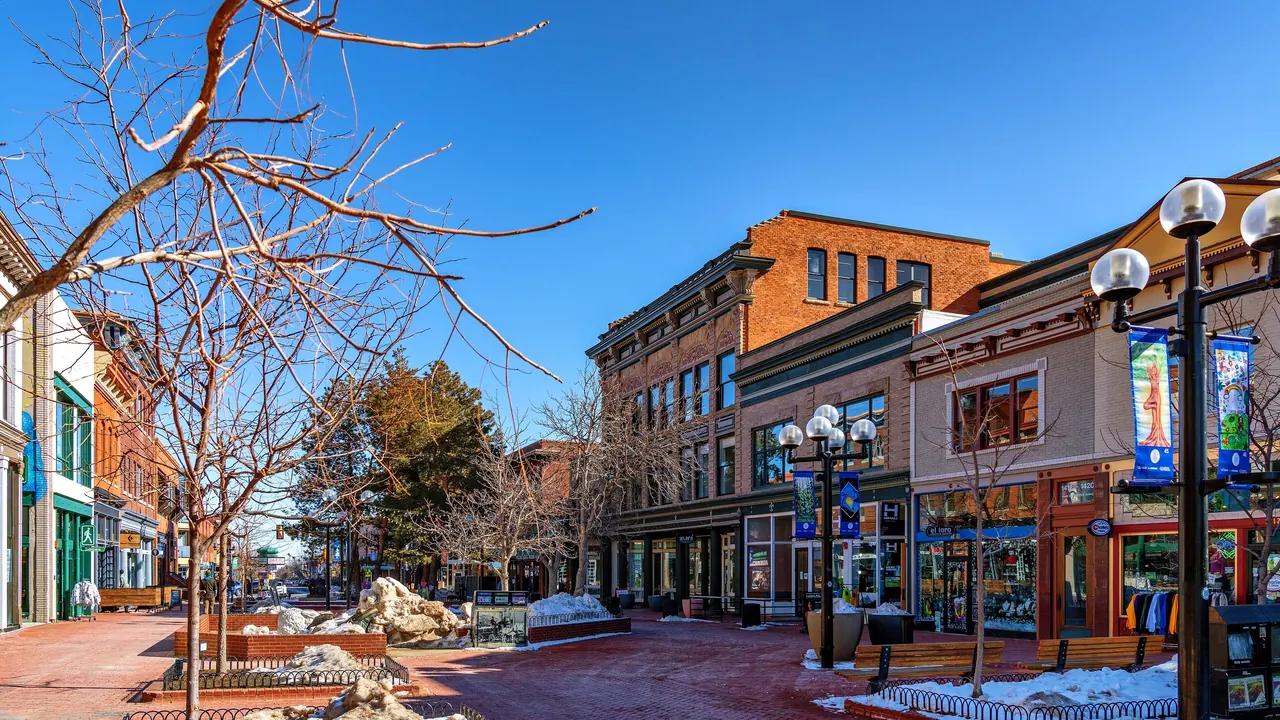
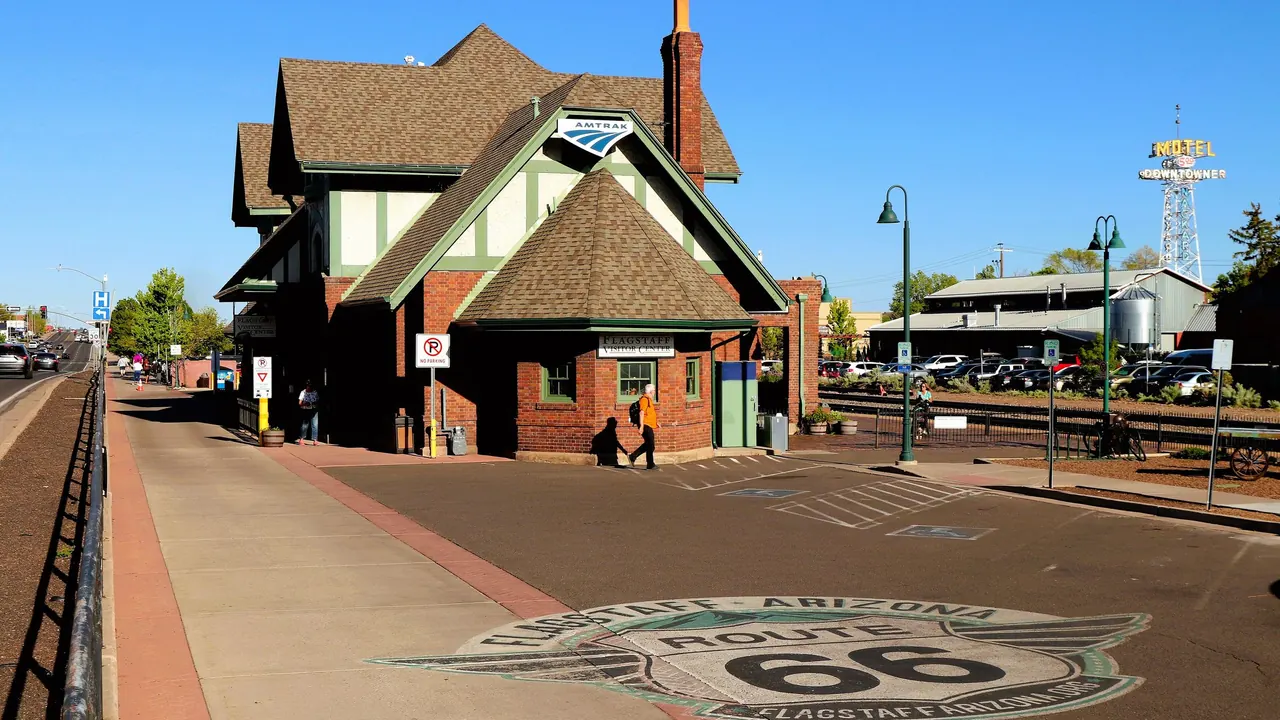
Photos: Boulder by Tony Webster, CC BY 2.0, cropped; Flagstaff by Thank You (25 Millions) views, CC BY 2.0, cropped.
Boulder or Flagstaff?
Our verdict in twelve categories, each scored against the same fixed benchmark cities, and the climate month by month, so you can choose for your trip.
Choose Boulder for
- getting around
- wellness
- live music and the arts
Boulder suits travellers who want the mountains and a proper small town in the same stay. Trails start at the edge of the streets, the centre is easy on foot or by bike, and the evenings have more to offer: farm-to-table cooking, live bluegrass and summer concerts at Chautauqua, and yoga studios on every other block. Denver is a bus ride away when you want a big city. You pay for all this, as rooms here are expensive.
Choose Flagstaff for
- prices
- culture and sights
- day trips
Flagstaff makes more sense as a base for a road trip through canyon country. The Grand Canyon, Sedona's red rock and the ancient pueblo sites are all within reach, and in town the Lowell Observatory and the Museum of Northern Arizona give it more to see than Boulder. Motels are cheaper, but you will need a car for almost everything, and evenings are quieter and simpler.
Scoreboard
Twelve categories on one fixed scale from 0 to 100. The shaded stretch is the gap between the two.
Your match
Pick a travel style or drag the sliders, and both match scores follow your weighting.
Wins on getting around and wellness with your weighting.
Wins on prices and culture and sights with your weighting.
What matters to you?
Category by category
What the scores mean for a trip.
Beaches & swimming
Neither town is anywhere near a coast, so a beach vacation is out in both. The difference is where you swim on a hot day. In Boulder it is in town: the sandy swim area at the reservoir or a float down Boulder Creek on an inner tube. In Flagstaff you drive down into Oak Creek Canyon for the cold, slippery pools at Slide Rock, which get crowded at weekends.
Food & drink
Boulder eats better. Its cooking is seasonal and health-minded, with plenty of vegetarian and vegan food, good bakeries, and a Saturday farmers' market by the creek that doubles as a social occasion. The hand-carved Dushanbe Teahouse is a lovely place for lunch, and Denver is close by when you want more variety.
Flagstaff is simpler: diners, burgers, barbecue and Mexican and New Mexican cooking, with Navajo tacos and green chile adding some local flavour. Both towns pour excellent craft beer, so for drinking there is little between them. The difference is on the plate.
Culture & sights
Flagstaff has more to see. The Lowell Observatory, where Pluto was discovered in 1930, offers historic telescopes and night viewings, and the Museum of Northern Arizona holds a serious collection of Hopi, Navajo and Zuni art. The Riordan Mansion and the railroad-era brick downtown on Route 66 fill out a day or two.
Boulder's sights are about atmosphere rather than collections. You have the wooden Chautauqua colony beneath the Flatirons, the sandstone and red-tile campus, and I.M. Pei's atmospheric research laboratory on the mesa. Pleasant as they are, one day covers all of it.
Nightlife
Evenings in both towns centre on brewery taprooms and finish early, because so many people are up at dawn for the trails. Boulder's going-out is split between the bars around Pearl Street and the loud student strip on University Hill. For a real night out, Denver is about 40 minutes away.
Flagstaff's version is a short walk around downtown and the Southside, with old Route 66 saloons mixed in among the taprooms. The setting has more character, but there is no bigger city nearby for a late night.
Nature & outdoors
These are two of the best outdoor bases in the American West, but the landscapes are very different. Boulder's draw is the Flatirons right behind town, a ring of protected open space with trails starting from Chautauqua, world-class rock climbing in Eldorado Canyon and canyon roads that serious cyclists come to train on. Rocky Mountain National Park is about an hour away.
Flagstaff brings volcanic country and the desert edge. There are alpine trails on the San Francisco Peaks, a huge ponderosa forest, and the lava flows at Sunset Crater. Sedona's red rock and the Grand Canyon's South Rim are both within a short drive, and the dark skies make stargazing part of the trip.
Day trips
Day trips from the two towns are fairly evenly matched, but they take you to different things. From Boulder, the main outing is Denver by express bus, for its art museum, state capitol and Union Station. With a car you can add the old silver-mining towns of Georgetown and Idaho Springs or a relaxed afternoon in Fort Collins.
Flagstaff has no city nearby, but the scattered list goes deeper into history. There are the Sinagua ruins at Walnut Canyon and Wupatki, the cliff dwellings of the Verde Valley, hillside Jerome, the historic railway from Williams and the Hopi mesas. All of them need a car.
Good for families
Both are safe, relaxed towns for children who like being outdoors, so the choice comes down to what they enjoy. Boulder has summer fun close at hand: tubing on the creek, the reservoir swim beach, gentle trails at Chautauqua and street performers on Pearl Street. Denver's zoo and aquarium are nearby for a bigger day out.
Flagstaff appeals to young stargazers and dinosaur fans, and in winter it adds sledding and snow play, while the steam-era train to the Grand Canyon is a treat in itself. It sits higher, though, so small children feel the altitude more for the first day or two, and the drives between outings are longer.
Getting around
Boulder is much easier without a car. Downtown, the university and Chautauqua are all within a walk or short ride of each other, and off-street bike paths with underpasses run along the creeks. An express bus goes to Denver and its airport links. You only need to hire a car for trailheads and parks beyond the city limits.
In Flagstaff, only the compact downtown and Southside work well on foot. The motels are spread along Route 66, and the mountain, the monuments, Sedona and the Grand Canyon are all beyond any useful bus. Most visitors drive or book tours, and winter ice can make the mountain roads difficult.
Shopping & style
Boulder has more to browse. The brick-paved Pearl Street Mall is lined with independent bookshops, galleries and boutiques, and the climbing, running and cycling shops are unusually good for a town of its size.
Flagstaff's strength is narrower but more distinctive: Navajo rugs, Hopi kachina carvings, pottery, and silver and turquoise jewellery. You find these in downtown galleries, the museum shop and trading posts, and it is worth buying from established dealers or directly from the artists.
Affordability
Boulder is the dearer stay of the two, and timing matters. Hotel rooms are few for such a wealthy town, so prices peak in summer and again on university graduation and football weekends, when families and fans fill the town. Eating out comes at affluent American prices with tips on top, and the usual way to soften the bill is to sleep in Denver or a neighbouring town and drive in.
Flagstaff costs less to stay in, though some of the saving goes on the road. Rooms jump on summer weekends and in school breaks, when the town becomes the main bed base for the Grand Canyon, yet staying here is usually still much cheaper than staying in Sedona or at the canyon rim. Budget too for a hire car, fuel and national park and monument fees, since almost every outing here means a drive.
Live music & performing arts
Boulder has the richer music scene. Small downtown rooms book touring rock and bluegrass most nights, and in summer the 1898 Chautauqua Auditorium hosts the Colorado Music Festival while Shakespeare is performed outdoors on campus. Red Rocks Amphitheatre is within easy reach.
Flagstaff's calendar is modest but steady. The local symphony plays in the campus concert hall, the restored Orpheum hosts folk and indie acts, and community theatre and outdoor summer concerts fill the gaps. It is a nice extra for an evening rather than a reason to visit.
Wellness & relaxation
Boulder is the better place for a restful stay. Its yoga and meditation culture has real roots, massage and acupuncture are easy to find, and the spring-fed pool at Eldorado Springs makes a gentle summer outing. For proper hot springs, Idaho Springs is an hour away.
Flagstaff's calm comes from the place itself: cool evenings, the smell of pine and bright stars. There are very few spas, so anyone looking for treatments or retreats heads to Sedona. Its higher altitude can also disturb sleep for the first night or two.
When should you go?
Pick your month. The climate figures are measured averages, not a forecast.
Boulder in July
Flagstaff in July
Daytime high, °C
Rainfall in the month, mm
Where the figures come from
Boulder has no rain gauge within 25 km of the centre, so its rainfall comes from a gridded climate dataset read at the city rather than from a gauge further away.
Flagstaff has no rain gauge within 25 km of the centre, so its rainfall comes from a gridded climate dataset read at the city rather than from a gauge further away.
Temperature and rainfall are climate normals, averaged over the years shown. Boulder: 2010-2025 (rainfall 1991-2020) normals, Boulder / Valmont (6.1 km from centre). Flagstaff: 1991-2020 normals, Flagstaff / Fort Tuthill (7.4 km from centre).
Both towns sit high, so neither is ever humid or sticky, but their summers and their wet seasons follow different patterns. Boulder gets properly hot from June to August, with July highs around 31°C, which suits early starts on the trails rather than midday walks. Flagstaff stays cooler, peaking at about 27°C, so it is the more comfortable of the two in high summer. Late spring is when the two differ most. May and June are Flagstaff's driest months, with June down to about 6mm, while May is Boulder's wettest month.
From July to August Flagstaff gets its monsoon storms, with rainfall up to about 64mm in August, so plan hikes for the morning. Winter splits them again. Boulder's winters are dry, with January at about 15mm, and mild days are good for walking in town. Flagstaff is colder and much wetter from December to March, which up there means real snow. September and early October are the best months in both places: warm days, settled weather and the aspens turning gold.
Which traveller are you?
On a trip on a tight budget, Flagstaff is the better choice. Chain motels along old Route 66 keep a basic stay affordable and brewery meals are reasonable. Boulder is one of the dearest towns in the region, although its trails cost nothing.
For a relaxing and wellness trip, pick Boulder. It has yoga and meditation studios, a contemplative university tradition, massage and day spas, plus a spring-fed pool just south of town. Flagstaff has very little of this, and spa-goers there drive down to Sedona.
For a short city break, Boulder works better. The centre, campus and Chautauqua are all within walking or cycling distance, and the food and live music are better. Flagstaff's main attractions mostly lie out of town and need a car and more days.
Before you go
| Measure | Boulder | Flagstaff |
|---|---|---|
| Currency | US Dollar (USD) | US Dollar (USD) |
| Sockets | AB120 V, 60 Hz | AB120 V, 60 Hz |
| Driving side | Right | Right |
| Time zone | UTC-7, UTC-6 in summer | UTC-7 |
| Emergency number | 911 | 911 |
| Elevation | 1,655 m | 2,106 m |
| Main airport | Denver International Airport (DEN)56 km from centre231 non-stop destinations | Flagstaff Pulliam Airport (FLG)7 km from centre2 non-stop destinations |
| Public holidays this year | 12 days | 12 days |
By the numbers
| Measure | Boulder | Flagstaff |
|---|---|---|
| City population | 108,250 | 76,831 |
| People per km² | 1,628 | 464 |
| Museums within 10 km | 4 | 1 |
| UNESCO World Heritage sites within 50 km | 0 | 0 |
Where else could you go?
Every comparison below shares a destination with this one, so you can follow Boulder or Flagstaff somewhere new.