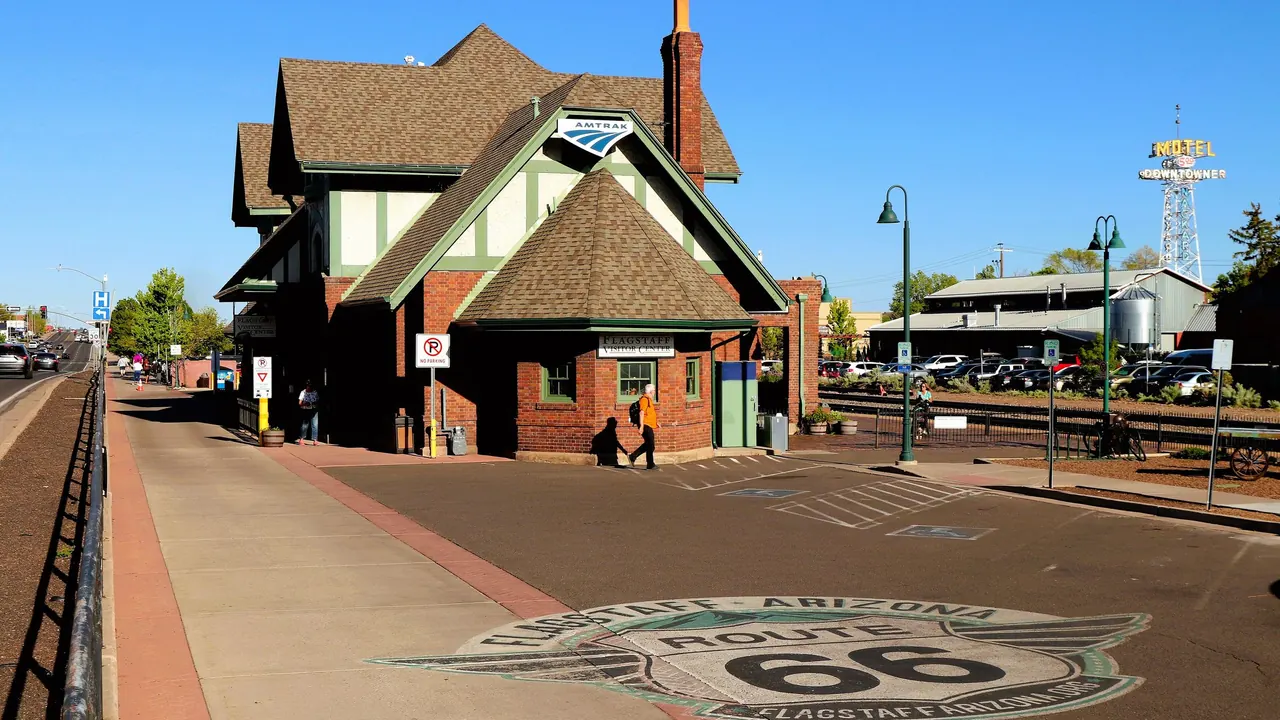
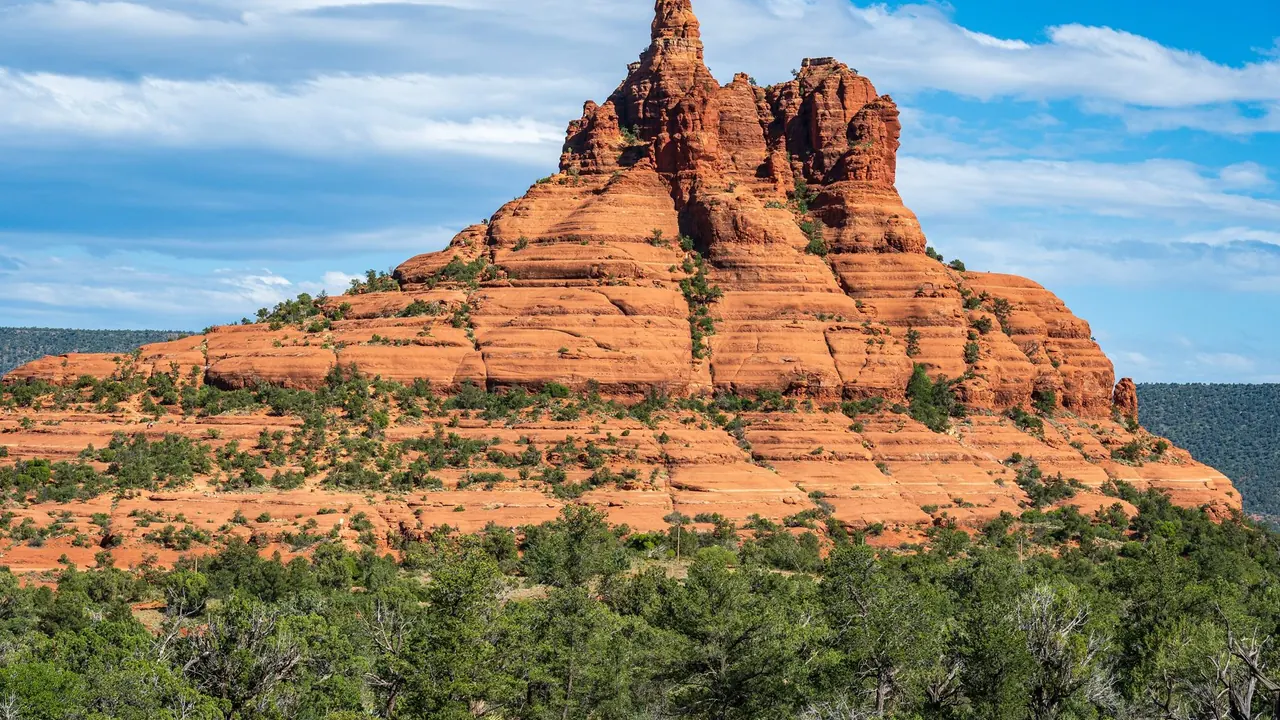
Photos: Flagstaff by Thank You (25 Millions) views, CC BY 2.0, cropped; Sedona by dconvertini, CC BY-SA 2.0, cropped.
Flagstaff or Sedona?
Our verdict in twelve categories, each scored against the same fixed benchmark cities, and the climate month by month, so you can choose for your trip.
Choose Flagstaff for
- prices
- nightlife
- families
Flagstaff is the practical choice: a cooler mountain town with cheaper rooms, a walkable old downtown with brewery evenings, and a short but real list of sights led by the observatory where Pluto was found. It suits families, travellers watching their spending and anyone whose main goal is the Grand Canyon, which is noticeably closer from here.
Choose Sedona for
- wellness
- beaches
- shopping
Sedona is for a slower, more indulgent trip in front of the red rocks. Its spas, yoga studios and sunrise walks to the vortexes have no real counterpart up the hill, the trails start at the edge of town and the creek pools are close by. Couples and anyone after rest will love it, as long as they accept high prices and very quiet evenings.
Scoreboard
Twelve categories on one fixed scale from 0 to 100. The shaded stretch is the gap between the two.
Your match
Pick a travel style or drag the sliders, and both match scores follow your weighting.
Wins on prices and nightlife with your weighting.
Wins on wellness and beaches with your weighting.
What matters to you?
Category by category
What the scores mean for a trip.
Beaches & swimming
Neither town has a beach, and both rely on the same creek. Sedona has the edge because Oak Creek runs right past it. Slide Rock's sandstone chute, Grasshopper Point and Red Rock Crossing are all a few minutes away, with deeper holes for a proper swim below the cliffs.
From Flagstaff, the same pools mean driving down the canyon, and the reservoirs near town are for boats and fishing rather than swimming. In both places the water is cold and the spots are crowded on summer weekends.
Food & drink
Neither town is worth choosing for its food, but they eat in different ways. Flagstaff is about beer and casual meals: craft breweries with patios around downtown and the Southside, diners, Mexican and New Mexican cooking, and Navajo frybread and green chile for regional flavour.
Sedona trades on the view. It has resort terraces facing the red rocks, Southwestern menus and plenty for vegetarian and health-minded eaters, with Verde Valley wine tasting rooms just down the road instead of taprooms.
Culture & sights
Flagstaff has more for a curious visitor. Lowell Observatory on Mars Hill, the Museum of Northern Arizona with its Hopi, Navajo and Zuni collections, the Riordan Mansion and the brick Route 66 downtown easily fill a day or two.
Sedona's list is shorter. It has the Chapel of the Holy Cross set into its butte, a small heritage museum and many galleries. Its most interesting history is out in the backcountry at the Palatki and Honanki cliff dwellings and the V Bar V petroglyphs.
Nightlife
Flagstaff has a modest but real night out. You can walk between taprooms, cocktail bars and old Route 66 saloons downtown and in the Southside, and university students keep term-time weekends lively, though there are few clubs.
Sedona barely has a nightlife. A brewpub, a wine bar or a resort lounge in Uptown will do for a drink after dinner, and then the town goes quiet because everyone is up early for the trails. The best evening entertainment there is looking at the stars.
Nature & outdoors
Both towns have exceptional scenery, but it is very different. Flagstaff is a mountain and forest base, with Humphreys Peak and the alpine trails of the San Francisco Peaks, autumn aspens, a ski area, huge ponderosa pine forests and the lava fields of Sunset Crater, plus the Grand Canyon's South Rim within about an hour and a half.
Sedona is all about red rock. Cathedral Rock, Bell Rock, Devil's Bridge and the West Fork of Oak Creek are on its doorstep, the slickrock is famous among mountain bikers, and jeep roads lead into the backcountry. Go to Flagstaff for cool summer hiking and snow, and to Sedona for walking in spring and autumn.
Day trips
The two towns share much of the same list of day trips, including Jerome, Montezuma Castle, Tuzigoot, Walnut Canyon and Wupatki, and both need a car. What changes is which places are closest.
Flagstaff is better placed for the north and east: the railway from Williams to the Grand Canyon, the Harvey House at Winslow and the Hopi mesas. Sedona is closer to the Verde Valley, with its tasting rooms, the Verde Canyon Railroad from Clarkdale and historic Prescott.
Good for families
Flagstaff is the easier place to take children. Telescope evenings, the museum's dinosaurs, rope courses in summer, snow play on the mountain in winter and the wildlife park and steam-era train near Williams give a range of outings. The thin air tires small children for a day or two, though.
Sedona works for active families who are happy with Slide Rock, the lower Bell Rock paths and a jeep tour. Beyond that, there is little made for children. Many hotels are aimed at couples, and the summer heat on exposed trails needs care.
Getting around
You need a car in both, but Flagstaff is a little easier without one. Its downtown and Southside are compact enough to walk, the paved urban trails are good for cycling, local buses serve the main roads and long-distance trains stop at the historic station.
Sedona is spread out along two highways that meet at the Y. Only Uptown is walkable, and the trailhead shuttle covers just the busiest hikes. Weekend traffic and full trailhead car parks are part of the experience, and most visitors arrive by driving up from Phoenix.
Shopping & style
Sedona is slightly the better place to browse. Tlaquepaque, with its courtyards in the style of a Mexican village, is full of galleries and craft studios, more galleries line the main road, and the crystal and metaphysical shops are a speciality of the town.
Flagstaff's shopping is more down to earth. It has outdoor gear shops, bookshops and Route 66 souvenirs, and its best buys are Native American rugs, kachina carvings and turquoise jewellery from downtown galleries, the museum shop and trading posts outside town. Neither has fashion shopping.
Affordability
Flagstaff is clearly the cheaper base. Chain motels along old Route 66 and casual brewery meals keep costs manageable, although summer weekends and school breaks push room prices up, as it is the main place to stay for the Grand Canyon.
Sedona is mostly resorts and boutique lodges, with restaurants to match, and jeep tours, balloon flights and spa treatments add up quickly. Its trails cost little, so a common approach is to stay in Flagstaff or Cottonwood and drive in for the day.
Live music & performing arts
Flagstaff has a small but steady programme. The symphony orchestra and the university's music school perform in the campus concert hall, the restored Orpheum Theater brings in touring bands, and there are community theatre productions and outdoor concerts in the pines in summer.
Sedona has no concert hall and no regular theatre season. Its year has a few highlights, such as chamber music, the Sedona International Film Festival in late winter and flute players in resort lounges, and people who want more drive up to Flagstaff.
Wellness & relaxation
This is where Sedona pulls far ahead. Its destination spas look out on the canyons, and yoga, meditation, breathwork and alternative therapies are everywhere. Many visitors also make quiet sunrise visits to the vortexes, which they believe carry special energy.
Flagstaff has a handful of massage studios, and it is restful mainly for its pine-scented air, cool evenings and bright stars. Neither town has hot springs, but only Sedona is worth choosing for wellness.
When should you go?
Pick your month. The climate figures are measured averages, not a forecast.
Flagstaff in July
Sedona in July
Daytime high, °C
Rainfall in the month, mm
Where the figures come from
Flagstaff has no rain gauge within 25 km of the centre, so its rainfall comes from a gridded climate dataset read at the destination rather than from a gauge further away.
Sedona's station stands 153 m above the city centre, so the centre is likely a little warmer than the figures say.
Sedona has no rain gauge within 25 km of the centre, so its rainfall comes from a gridded climate dataset read at the destination rather than from a gauge further away.
Temperature and rainfall are climate normals, averaged over the years shown. Flagstaff: 1991-2020 normals, Flagstaff / Fort Tuthill (7.4 km from centre). Sedona: 2009-2025 (rainfall 1991-2020) normals, Sedona / West Sedona (1.3 km from centre).
The two towns are only an hour apart, but the drop in altitude gives them opposite seasons. Flagstaff is at its best from June to September, with warm days peaking around 27°C in July, while Sedona bakes at about 34°C in the same months and walking means starting at dawn. In winter it flips. Flagstaff's highs fall to around 5°C in January and there is real snow, which is good for sledding but cold for walking around town. Sedona stays mild enough for hiking all winter.
Both towns get the same pattern of rain. June is almost completely dry, then afternoon monsoon storms arrive in July and August, at up to 64mm a month in Flagstaff. Sedona is most comfortable in spring and autumn, roughly March to May and October to November. Its creek pools are only pleasant for a dip from about May to September.
Which traveller are you?
On a relaxing and wellness trip, Sedona wins clearly. Destination resort spas face the red rock, and around them are yoga, meditation, massage and quiet vortex walks at sunrise. Flagstaff has only a few day spas, and its own visitors drive down to Sedona for treatments.
For a trip on a tight budget, Flagstaff makes far more sense. Chain motels along old Route 66 and brewery meals keep costs down, and many budget travellers stay here and visit Sedona for the day rather than paying for its resorts and jeep tours.
On a family trip with children, Flagstaff gives young visitors more to do. They get telescope evenings at Lowell Observatory, dinosaurs at the Museum of Northern Arizona, rope courses in the pines and winter sledding. Sedona has Slide Rock and jeep rides but little else built for children.
Before you go
| Measure | Flagstaff | Sedona |
|---|---|---|
| Currency | US Dollar (USD) | US Dollar (USD) |
| Sockets | AB120 V, 60 Hz | AB120 V, 60 Hz |
| Driving side | Right | Right |
| Time zone | UTC-7 | UTC-7 |
| Emergency number | 911 | 911 |
| Elevation | 2,106 m | 1,319 m |
| Main airport | Flagstaff Pulliam Airport (FLG)7 km from centre2 non-stop destinations | Phoenix Sky Harbor International Airport (PHX)160 km from centre149 non-stop destinations |
| Public holidays this year | 12 days | 12 days |
By the numbers
| Measure | Flagstaff | Sedona |
|---|---|---|
| Population | 76,831 | 9,684 |
| People per km² | 464 | 195 |
| Museums within 10 km | 1 | 0 |
| UNESCO World Heritage sites within 50 km | 0 | 0 |
Where else could you go?
Every comparison below shares a destination with this one, so you can follow Flagstaff or Sedona somewhere new.
- Grand Canyonvs Sedona
- Scottsdalevs Sedona
- Phoenixvs Sedona
- Page, Arizonavs Flagstaff
- Scottsdalevs Flagstaff
- Phoenixvs Flagstaff