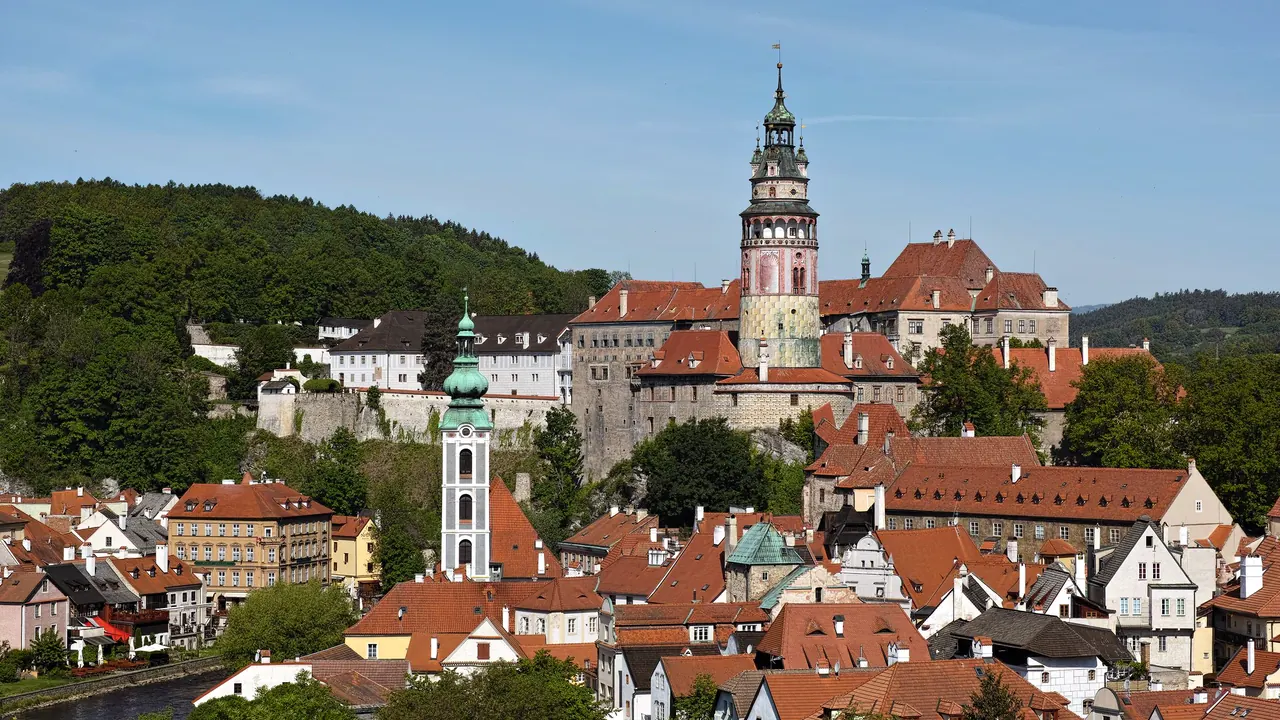
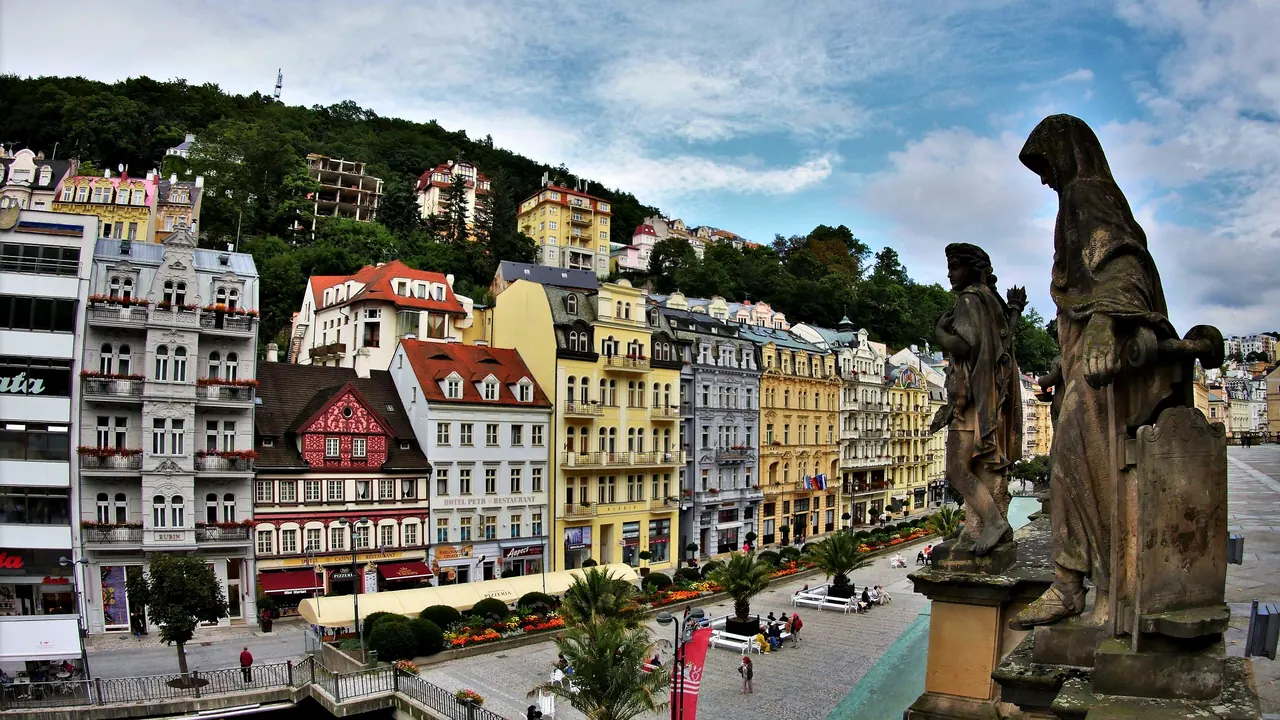
Photos: Cesky Krumlov by Xth-Floor, CC BY-SA 4.0, cropped; Karlovy Vary by Rolf Dietrich Brecher from Germany, CC BY-SA 2.0, cropped.
Cesky Krumlov or Karlovy Vary?
Our verdict in twelve categories, each scored against the same fixed benchmark cities, and the climate month by month, so you can choose for your trip.
Choose Cesky Krumlov for
- beaches
- culture and sights
- families
Cesky Krumlov suits travellers who want a single, complete historic townscape and green country around it. The castle above the Vltava bend, the painted Renaissance houses and the river itself are the whole point, and the outdoors starts at the water's edge with a day's canoeing or a walk in the Bohemian Forest. It is also the better pick with children, thanks to the castle bears, the raft trips and Lipno's lake shores.
Choose Karlovy Vary for
- wellness
- shopping
- getting around
Karlovy Vary is for travellers who want to slow down. Here you sip warm spring water under the colonnades, book treatments in a spa hotel and spend afternoons in a café or on a forest path. It also wins on shopping for Moser crystal and porcelain, on getting around without a car, and on concerts through the year from its own orchestra.
Scoreboard
Twelve categories on one fixed scale from 0 to 100. The shaded stretch is the gap between the two.
Your match
Pick a travel style or drag the sliders, and both match scores follow your weighting.
Wins on beaches and culture and sights with your weighting.
Wins on wellness and shopping with your weighting.
What matters to you?
Category by category
What the scores mean for a trip.
Beaches & swimming
Neither town is a beach destination, but Cesky Krumlov has the better summer swimming. Lipno, half an hour south, is a large lake in the Bohemian Forest with grassy and sandy shores, water that warms to around 20°C in high summer, and sailing and windsurfing as well.
Karlovy Vary's nearest open-water swim is Lake Medard, a flooded former mine near Sokolov, plus a few small reservoirs. Most swimming there happens in the warm spring-fed pools, which at least stay usable in cold weather.
Food & drink
Food is much the same in both towns: hearty Czech roasts, dumplings and svíčková, with good beer, and neither is worth travelling for. Cesky Krumlov leans towards river trout, duck and forest game served in vaulted cellars, with beer brewed in the town for centuries. Karlovy Vary adds its own treats, warm spa wafers from the colonnade stalls and Becherovka liqueur distilled in town, and its promenade cafés are a bigger part of the day than the restaurants.
Culture & sights
Cesky Krumlov has the stronger sights. Its whole medieval and Renaissance core curls around a bend of the Vltava under one of the largest castles in the country. Inside the castle is a Baroque theatre that keeps its original stage machinery, a rare survival in Europe, and the town also has the Egon Schiele art centre.
Karlovy Vary's appeal is later and grander. Pastel Belle Époque hotels rise up the Teplá valley, the colonnades are built of stone and carved timber, and the Vřídlo geyser shoots up indoors. Its museums are small, devoted to glass and Becherovka, and in both towns the buildings matter more than the collections.
Nightlife
Both towns are quiet after dinner, but in different ways. In Cesky Krumlov, the evening means riverside terraces in summer and a few cellar bars popular with backpackers. Karlovy Vary has hotel bars, wine bars and casinos, and is asleep by eleven, except during the film festival week in early summer, when parties and outdoor bars fill the valley.
Nature & outdoors
Cesky Krumlov has the slightly better outdoors. It offers a full day floating down the Vltava through wooded meanders, and the Bohemian Forest national park, with its bogs, ridges and long cycle routes, begins half an hour away. Klet hill, close by, looks towards the Alps on clear days.
Karlovy Vary's forest starts right at the edge of town, on graded spa paths up to the Diana tower and other lookouts. In winter it has the advantage of downhill skiing at Klínovec in the Ore Mountains, which Cesky Krumlov's cross-country trails cannot match.
Day trips
Both towns have a good spread of outings, of different kinds. From Cesky Krumlov the choice runs to castles and old towns: the arcaded square of České Budějovice, white Hluboká, the farmhouse village of Holašovice and Zlatá Koruna monastery, and most of these are much easier with a car.
Karlovy Vary has Loket's castle twenty minutes away, its two sister spa towns, the St Maurus reliquary at Bečov and the brewing city of Plzeň. Prague is possible from Karlovy Vary in a long day by coach, which is not true of Cesky Krumlov.
Good for families
Cesky Krumlov gives children more to do. The castle feels like a storybook with bears in the moat and a tower to climb, the family raft trip on the river is the highlight, and Lipno's treetop walk and lake shores fill another day.
Karlovy Vary is safe and pleasant, but it is built around adults taking cures. Children enjoy the geyser, the spouted spa cups, the funicular and the outdoor thermal pool, and after that there is little left for them. Both towns are steep in places and hard work with a pushchair.
Getting around
Karlovy Vary is the easier base without a car. Local buses and the funicular deal with the steep valley sides, regional trains reach Loket, Cheb and Mariánské Lázně, and coaches run to Prague in about two hours.
Cesky Krumlov's centre is smaller, and you can cross it on foot in a quarter of an hour over the cobbles. Beyond České Budějovice, though, public transport thins out, and reaching the forest or the smaller castles usually means hiring a car or joining a tour.
Shopping & style
Karlovy Vary is clearly better for shopping. Moser crystal is made in the town and sold from its own showroom, local factories make porcelain, and the promenades have jewellers and fashion boutiques aimed at well-off spa guests.
Cesky Krumlov's lanes mostly sell souvenirs: Bohemian glass, garnets, marionettes, wooden toys and green moldavite, plus a few ceramics workshops. It has no fashion shops at all.
Affordability
Costs are about the same in both, and in both the setting is what puts prices up. In Cesky Krumlov that means rooms with a castle view, restaurants on the main lanes and castle tours charged one by one, while guesthouses in the old houses and a bed just outside the centre keep a stay cheap. Karlovy Vary costs more than an ordinary Czech town because of its grand spa hotels, but pubs one street back from the colonnades charge local prices, and the festival week is the dearest time to come.
Live music & performing arts
Karlovy Vary has more to attend through the year. Its symphony orchestra, which grew out of the old spa bands, plays regular light classical concerts, some outdoors on the colonnades in summer. The Fellner and Helmer theatre hosts touring drama and operetta, and an autumn Dvořák festival adds a few highlights.
Cesky Krumlov's performances happen almost entirely in summer: plays and opera in the castle garden's revolving open-air theatre, and an international music festival. For the rest of the year there is very little to see.
Wellness & relaxation
This is where the two towns differ most. Karlovy Vary exists for the cure. Guests sip from the springs with porcelain cups, spa hotels and sanatoria offer carbonated baths, peat wraps and medical stays, and the outdoor thermal pool sits above the river. Booking a spa hotel stay gives you far more than the few public bathhouses.
Cesky Krumlov has only hotel wellness rooms and beer baths. What it does offer is a still old town once the day visitors leave, and Třeboň's peat baths are a day trip away.
When should you go?
Pick your month. The climate figures are measured averages, not a forecast.
Cesky Krumlov in July
Karlovy Vary in July
Daytime high, °C
Rainfall in the month, mm
Where the figures come from
Cesky Krumlov's temperatures are measured 50 km from the centre, at Grainet-Rehberg.
Cesky Krumlov has no rain gauge within 25 km of the centre, so its rainfall comes from a gridded climate dataset read at the city rather than from a gauge further away.
Karlovy Vary's station stands 156 m above the city centre, so the centre is likely a little warmer than the figures say.
Karlovy Vary has no rain gauge within 25 km of the centre, so its rainfall comes from a gridded climate dataset read at the city rather than from a gauge further away.
Karlovy Vary's sunshine is measured 37 km from the centre, at Cheb.
Temperature and rainfall are climate normals, averaged over the years shown. Cesky Krumlov: 1991-2020 normals, Grainet-Rehberg (50.3 km from centre). Karlovy Vary: 1999-2020 (sunshine 1981-2010, rainfall 1991-2020) normals, Karlovy Vary (4.6 km from centre).
The two towns have almost the same climate, so their best months line up. From May to September the days are mild to warm, reaching about 23°C in July and August, which is comfortable for walking the lanes and the promenades. Summer is also the wettest time of year, with showers and thunderstorms peaking in July, and Cesky Krumlov gets noticeably more rain then, up to 111mm in July. July and August are the only months warm enough to swim, at Lipno or at Lake Medard near Sokolov.
Cesky Krumlov gets a little more sunshine for most of the year. The difference is clearest in late autumn and winter, when Karlovy Vary's valley gets far fewer sunny hours, about half as many in November. By November it is already chilly, with highs of about 7°C in Cesky Krumlov and 5°C in Karlovy Vary, and from December to February both stay around 2°C. That is cold for sightseeing in Cesky Krumlov, but it matters less on a spa stay in Karlovy Vary, where most of the day is spent in warm springs and indoor pools.
Which traveller are you?
For a relaxing and wellness trip, Karlovy Vary is the clear choice. It has thirteen springs to drink from, spa hotels with medical treatments and thermal pools, and a slow daily round of promenades and forest walks. Cesky Krumlov offers quiet evenings but little in the way of actual spa care.
On a family trip with children, Cesky Krumlov works better. Bears live in the castle moat, a gentle raft trip on the Vltava is easy to arrange, and Lipno has a treetop walk and sandy shores. Karlovy Vary has the geyser and the funicular, but little else for children.
On a shopping trip, choose Karlovy Vary. The promenades of Stará louka and Tržiště have jewellers and boutiques as well as Moser crystal and local porcelain sold at the source. In Cesky Krumlov, the lanes sell mostly souvenirs: glass, marionettes and moldavite.
Before you go
| Measure | Cesky Krumlov | Karlovy Vary |
|---|---|---|
| Official language | Czech | Czech |
| Currency | Czech Koruna (CZK) | Czech Koruna (CZK) |
| Sockets | CE230 V, 50 Hz | CE230 V, 50 Hz |
| Driving side | Right | Right |
| Time zone | UTC+1, UTC+2 in summer | UTC+1, UTC+2 in summer |
| Emergency number | 112 | 112 |
| Elevation | 492 m | 447 m |
| Main airport | Václav Havel Airport Prague (PRG)143 km from centre178 non-stop destinations | Václav Havel Airport Prague (PRG)100 km from centre178 non-stop destinations |
| Public holidays this year | 13 days | 13 days |
By the numbers
| Measure | Cesky Krumlov | Karlovy Vary |
|---|---|---|
| City population | 12,797 | 49,073 |
| People per km² | 576 | 830 |
| Museums within 10 km | 4 | 2 |
| UNESCO World Heritage sites within 50 km | 2 | 3 |
Where else could you go?
Every comparison below shares a destination with this one, so you can follow Cesky Krumlov or Karlovy Vary somewhere new.
- Dresdenvs Karlovy Vary
- Praguevs Karlovy Vary
- Leipzigvs Karlovy Vary
- Praguevs Cesky Krumlov
- Salzburgvs Cesky Krumlov
- Hallstattvs Cesky Krumlov