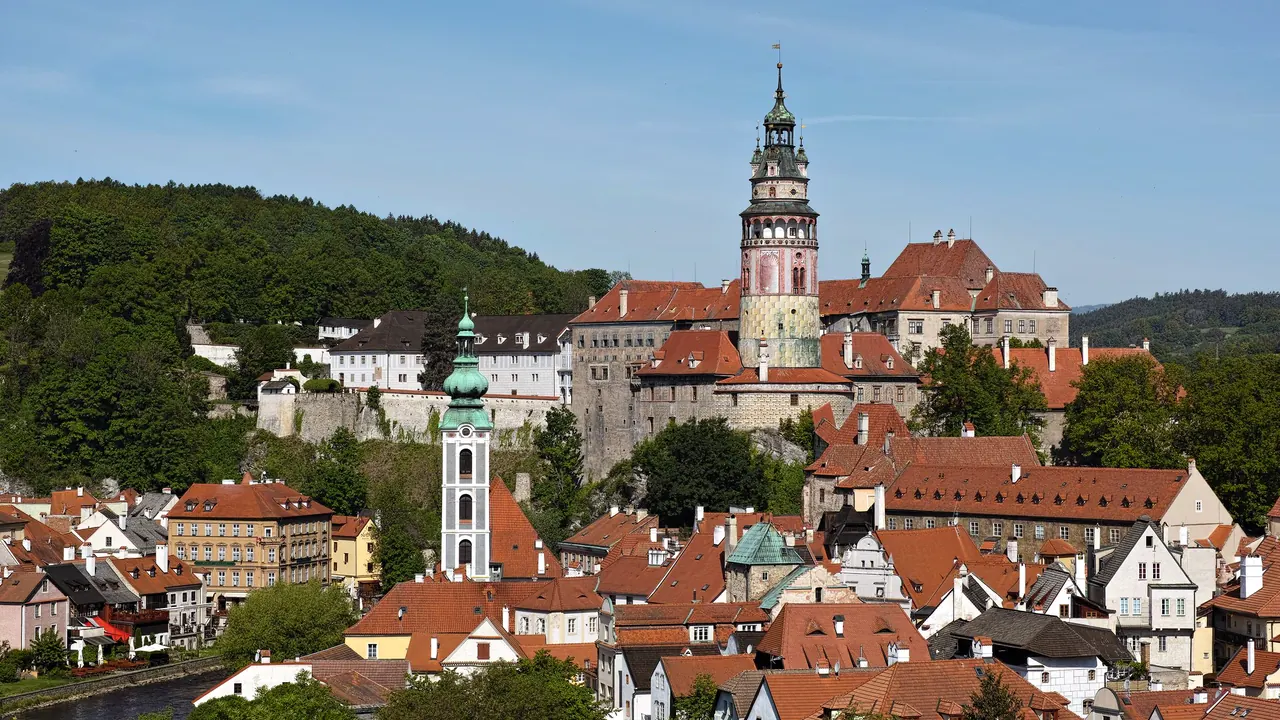
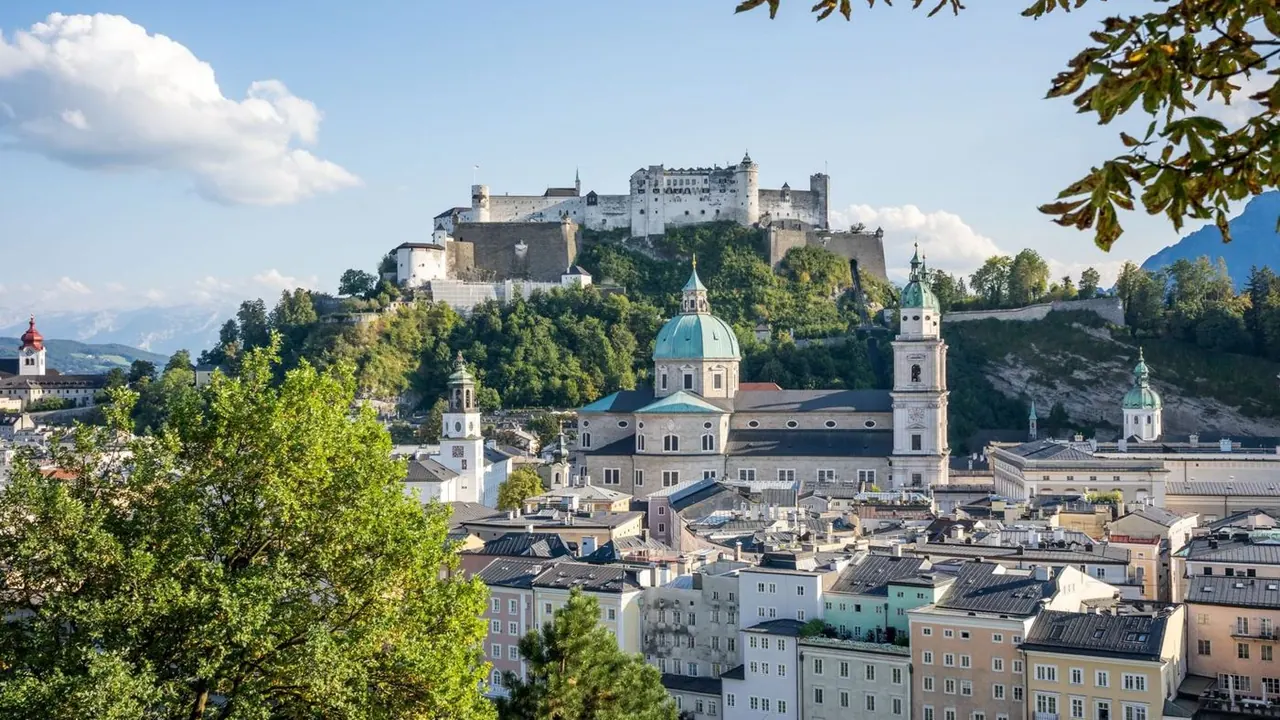
Photos: Cesky Krumlov by Xth-Floor, CC BY-SA 4.0, cropped; Salzburg by Leonhard Niederwimmer, Pexels License.
Cesky Krumlov or Salzburg?
Our verdict in twelve categories, each scored against the same fixed benchmark cities, and the climate month by month, so you can choose for your trip.
Choose Cesky Krumlov for
- prices
Cesky Krumlov suits a slower, cheaper trip built around one small town: a castle above a tight bend of the Vltava, a day floating downriver by canoe, and quiet evenings by the water once the coaches have gone. It is best for couples and travellers who want two calm days of townscape and country air without big-city prices, and who are content with simple Bohemian cooking and little to do after dark.
Choose Salzburg for
- live music and the arts
- shopping
- wellness
If you want more to do each day and can pay for it, choose Salzburg. Its music is in a different league, and the Alps begin at the edge of town, so a morning among the cathedral squares can become an afternoon on the Untersberg or beside a Salzkammergut lake. Families, walkers, concertgoers and anyone planning a longer stay with day trips will find far more to fill the time.
Scoreboard
Twelve categories on one fixed scale from 0 to 100. The shaded stretch is the gap between the two.
Your match
Pick a travel style or drag the sliders, and both match scores follow your weighting.
Wins on prices with your weighting.
Wins on live music and the arts and shopping with your weighting.
What matters to you?
Category by category
What the scores mean for a trip.
Beaches & swimming
Neither is a swimming destination, and in both places swimmers leave town in summer. From Cesky Krumlov the place to go is Lipno, a large reservoir in the Bohemian Forest with grassy and sandy shores, about half an hour by car. The Vltava in town is for rafting, not bathing.
Salzburg has more choice. There are three clear lakes in the Salzkammergut, Fuschlsee, Wolfgangsee and Mondsee, as well as ponds and open-air pools on the edge of the city. You swim from lawns and jetties rather than sand, and the lake water tends to get a little warmer.
Food & drink
Both kitchens are heavy and meat-based, with roast pork and dumplings on the Czech side and schnitzel and Kasnocken on the Austrian side. Neither is a reason to travel. Cesky Krumlov's strength is its beer, brewed in the town for centuries and drunk in vaulted cellars and on river terraces, but the menus are short and often written for day-trippers.
Salzburg gives a food lover a bit more to do. It has a real coffee-house culture, the Salzburger Nockerl, and the monastery beer hall in Mülln with its chestnut garden. Better inns on the surrounding hills and a few serious fine-dining kitchens add more. In both towns, the old-town tourist menus are best avoided.
Culture & sights
Both are UNESCO-listed old towns on a river, but they differ in scale. Cesky Krumlov is a single intact Renaissance and Baroque townscape wrapped round a bend of the Vltava. A huge castle with a Baroque theatre that keeps its original stage machinery stands above it, and the town is the main attraction rather than its collections.
Salzburg has more to see indoors. There are the cathedral, the Residenz state rooms and gallery, the Hohensalzburg fortress, Mirabell, the two Mozart houses, the catacombs of St Peter and a modern art museum on the Mönchsberg, with Hellbrunn a bus ride away. That makes for two or three varied days, where Cesky Krumlov is often seen in one.
Nightlife
Cesky Krumlov's evenings are simpler: a beer in a cellar bar or on a riverside terrace, with a few backpacker pubs keeping going after dinner. Outside summer, the lanes empty early.
Salzburg has a bit more going on. Its beer halls have long wooden tables full of locals, and the student pubs along Rudolfskai and near the university stay open later at weekends. For clubs, people take the train to Munich.
Nature & outdoors
Cesky Krumlov's outdoors is soft and green. The classic day is floating down the Vltava by canoe or raft. The spruce woods and peat bogs of the Bohemian Forest, half an hour away, are good for walking, cycling and cross-country skiing, and the forested hill of Klet gives wide views.
Salzburg sits in a much larger landscape. Wooded ridges rise inside the city, a cable car climbs onto the limestone ridge of the Untersberg, and the Gaisberg is used for hiking and paragliding. The Salzkammergut lakes, the Königssee at Berchtesgaden and ski areas within an hour make it the clear choice for mountain days.
Day trips
Both towns make good bases, but Salzburg's day trips cover more. From Cesky Krumlov you can see the arcaded square of České Budějovice, Hluboká castle, the Baroque farmhouses of Holašovice and the fish ponds of Třeboň. Most of these are easiest by car, and Prague is too far for a comfortable day.
From Salzburg you can reach Hallstatt on its lake, the salt mines at Hallein and Berchtesgaden, the clifftop fortress at Werfen and lake villages such as St Wolfgang. Munich is close enough for a day by train, so a German city fits into the trip as well.
Good for families
Cesky Krumlov is a good day out for children. There are bears in the castle moat, a tower to climb and a gentle raft trip on the river, with Lipno's treetop walk nearby. Its interior tours suit adults more than children, though.
Salzburg keeps children busy for longer. They can try the trick fountains and visit the zoo at Hellbrunn, explore the hands-on Haus der Natur, ride the fortress funicular, watch the marionettes and go down the miners' slides in the nearby salt mines. In both towns, steep cobbled lanes are hard work with a pushchair.
Getting around
On foot the two are much alike. You can cross either centre in about a quarter of an hour, mostly away from cars, though there are cobbles to manage and a climb to the castle or fortress. The real difference starts at the edge of the old town.
Salzburg has dense trolleybus and bus routes, flat riverside cycle paths and main-line trains to Munich and Vienna, so you only need a car for the lake villages. Cesky Krumlov's trains and buses run mainly to České Budějovice, and most of the surrounding region needs a hire car or a tour.
Shopping & style
Cesky Krumlov's lanes sell mainly souvenirs: Bohemian glass, garnet jewellery, marionettes and moldavite, the green stone found in the region, along with a few ceramics and print workshops.
Salzburg has more of real interest, above all Tracht, with dirndls and loden jackets made to measure. There are also the shops in old burgher houses along Getreidegasse, a farmers' market and the long-established Christmas market on Domplatz. Neither suits luxury or fashion shopping.
Affordability
Cesky Krumlov is much the cheaper stay. Family guesthouses fill its old houses, and Czech meals and local beer stay moderately priced. Only rooms with views and restaurants on the main lanes add a premium.
Salzburg is expensive for its size. Central hotel prices are high all year and climb further during the festival and Advent. Staying across the river or in the suburbs, eating at inns in the outer districts and using a city card help keep costs down.
Live music & performing arts
This is where the two differ most. Cesky Krumlov has a summer season only, with plays and opera in the castle garden's revolving open-air theatre and a classical music festival in the castle and churches. Its rare Baroque castle theatre is mostly seen on a tour rather than at a performance.
Salzburg is a music city all year. The summer festival fills the Grosses Festspielhaus and the Felsenreitschule, and Mozart Week and the Easter Festival add two more seasons. Between the festivals, the Mozarteum, the Landestheater and the marionette theatre keep a steady programme going, and there are chamber concerts most evenings.
Wellness & relaxation
Neither town has thermal springs of its own, and both become restful once the day visitors leave. Cesky Krumlov has little beyond hotel wellness rooms and beer baths, with the peat baths of Třeboň as a day out.
Salzburg has much more for a relaxing trip. In town there are the saunas and pool of the Paracelsus Bad and quiet walks in the gardens and on the ridges. Proper spa towns are close by: Bad Reichenhall's brine baths are about twenty minutes away, and the radon springs of the Gastein valley are further south.
When should you go?
Pick your month. The climate figures are measured averages, not a forecast.
Cesky Krumlov in July
Salzburg in July
Daytime high, °C
Rainfall in the month, mm
Where the figures come from
Cesky Krumlov's temperatures are measured 50 km from the centre, at Grainet-Rehberg.
Cesky Krumlov has no rain gauge within 25 km of the centre, so its rainfall comes from a gridded climate dataset read at the city rather than from a gauge further away.
Temperature and rainfall are climate normals, averaged over the years shown. Cesky Krumlov: 1991-2020 normals, Grainet-Rehberg (50.3 km from centre). Salzburg: 1991-2020 normals, Salzburg (3.4 km from centre).
Cesky Krumlov has a short warm season. June to August are the months for rafting on the Vltava and swimming at Lipno, with highs reaching about 23°C in July and August, which are also its sunniest months. May and September are cooler, nearer 18°C, and better for walking than for the water. Rain peaks in July but stays moderate. From December to February highs sit just above freezing and the days are short and dim, so winter suits only a very quiet stay.
Salzburg is warmer for longer. Highs reach 20°C from May to September and about 25°C at the height of summer. The catch is rain: May to August are much wetter than in Cesky Krumlov, with about 168mm in June, so keep indoor plans in reserve. Its winter is a little milder, with February already noticeably less cold, more winter sun and often snow in town for crisp walks. April and October are far drier than the summer months and good for exploring the streets.
Which traveller are you?
On a trip with a tight budget, Cesky Krumlov lets you sleep inside the old town itself, and its best sights, the lanes, river views and castle courtyards, cost nothing. In Salzburg, saving usually means a bus ride in from the suburbs.
For a culture and arts trip, Salzburg wins clearly. The Baroque cathedral quarter, the fortress and the Mozart houses are only the start. Its festivals, opera and concerts on most evenings give you music all year, while Cesky Krumlov offers performances mainly in summer.
On an outdoors trip, Salzburg puts you at the foot of the Alps, with the Untersberg cable car, Berchtesgaden and the Salzkammergut lakes all close by. Cesky Krumlov's river rafting and Bohemian Forest trails are lovely, but the country is softer and less varied.
Before you go
| Measure | Cesky Krumlov | Salzburg |
|---|---|---|
| Official language | Czech | German, Austrian Sign Language |
| Currency | Czech Koruna (CZK) | Euro (EUR) |
| Sockets | CE230 V, 50 Hz | CF230 V, 50 Hz |
| Driving side | Right | Right |
| Time zone | UTC+1, UTC+2 in summer | UTC+1, UTC+2 in summer |
| Emergency number | 112 | 112 |
| Elevation | 492 m | 424 m |
| Main airport | Václav Havel Airport Prague (PRG)143 km from centre178 non-stop destinations | Salzburg Airport (SZG)3 km from centre64 non-stop destinations |
| Public holidays this year | 13 days | 16 days |
By the numbers
| Measure | Cesky Krumlov | Salzburg |
|---|---|---|
| City population | 12,797 | 155,021 |
| People per km² | 576 | 2,360 |
| Museums within 10 km | 4 | 38 |
| UNESCO World Heritage sites within 50 km | 2 | 3 |
Where else could you go?
Every comparison below shares a destination with this one, so you can follow Cesky Krumlov or Salzburg somewhere new.
- Hallstattvs Salzburg
- Munichvs Salzburg
- Innsbruckvs Salzburg
- Praguevs Cesky Krumlov
- Hallstattvs Cesky Krumlov
- Cortina d'Ampezzovs Salzburg