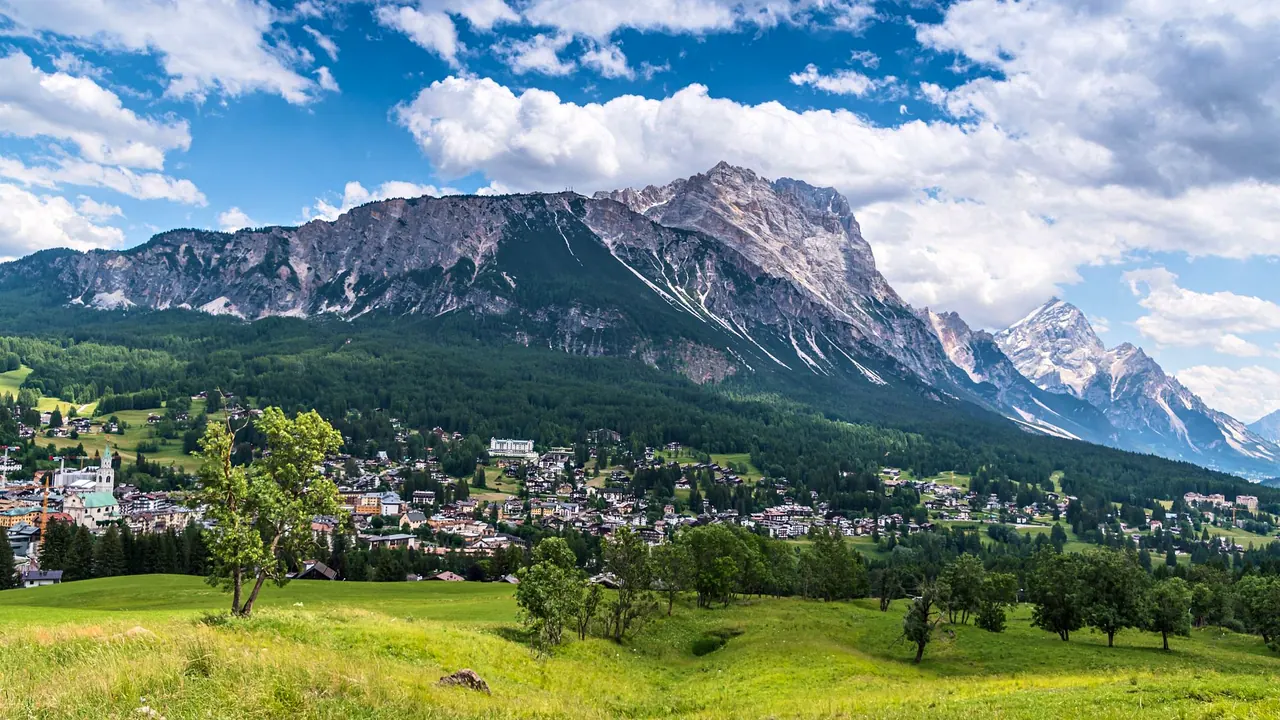
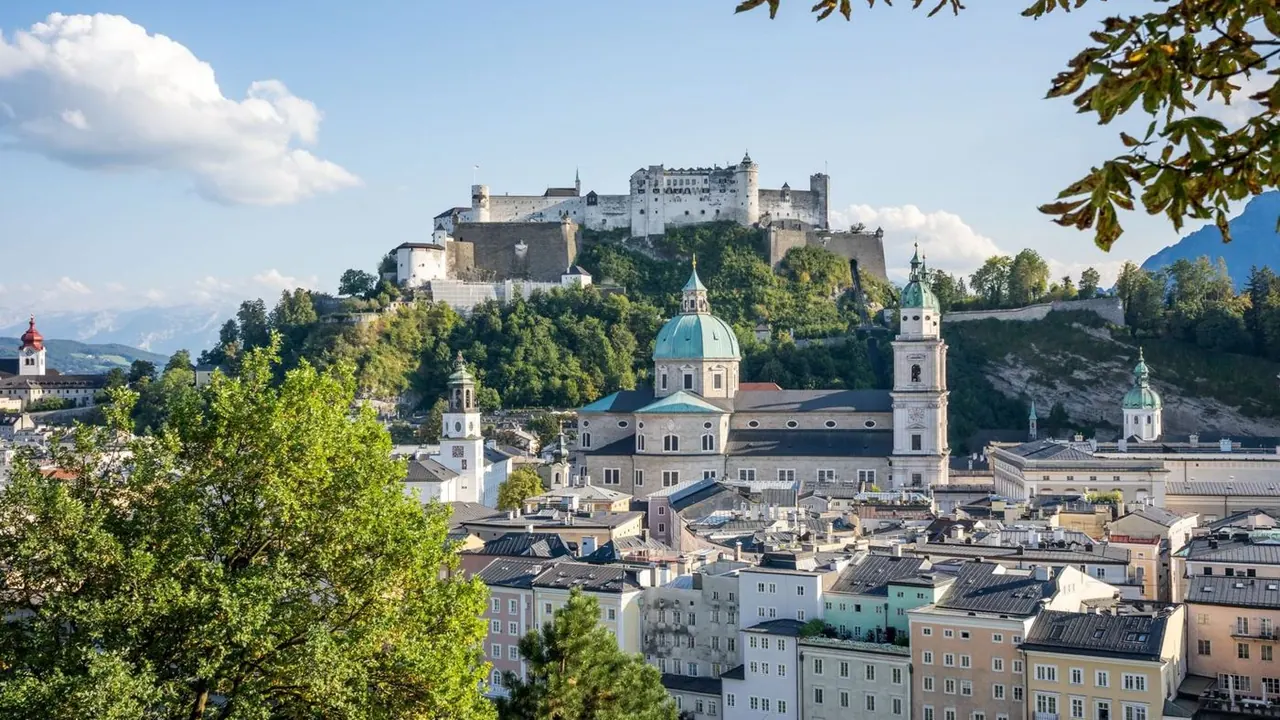
Photos: Cortina d'Ampezzo by Andreas Neubauer, Pexels License; Salzburg by Leonhard Niederwimmer, Pexels License.
Cortina d'Ampezzo or Salzburg?
Our verdict in twelve categories, each scored against the same fixed benchmark cities, and the climate month by month, so you can choose for your trip.
Choose Cortina d'Ampezzo for
- nature and the outdoors
Cortina d'Ampezzo is for travellers who come for the mountains themselves. The Dolomites rise straight from the edge of town, lifts carry you onto the peaks, and in winter the Dolomiti Superski area opens up a huge network of runs. Choose it for a ski week, hut-to-hut hiking or via ferrata, and accept that evenings are quiet, sights are few and the bills are steep.
Choose Salzburg for
- live music and the arts
- culture and sights
- day trips
Salzburg suits a broader trip that mixes a Baroque old town, serious music and easy outings. Its cathedral, fortress and Mozart houses all sit within a short walk, the festival halls carry one of Europe's great music programmes, and trains and buses reach Hallstatt, the salt mines and Munich. The Alps are close enough for a day on the Untersberg or around the lakes, though they frame the trip rather than run it.
Scoreboard
Twelve categories on one fixed scale from 0 to 100. The shaded stretch is the gap between the two.
Your match
Pick a travel style or drag the sliders, and both match scores follow your weighting.
Wins on nature and the outdoors with your weighting.
Wins on live music and the arts and culture and sights with your weighting.
What matters to you?
Category by category
What the scores mean for a trip.
Beaches & swimming
Neither is a beach destination, but Salzburg gives you real summer swimming and Cortina barely does. The lakes at Ghedina and Pianozes are fed by snowmelt and suit a walk more than a swim, so in Cortina swimming mostly means the hotel pool.
From Salzburg, Fuschlsee, Wolfgangsee and Mondsee are within forty-five minutes and warm up to pleasant summer temperatures. You swim from lawns and wooden jetties rather than sand, and only between June and early September.
Food & drink
The two eat equally well but in different settings. Cortina's best meals are Ampezzan mountain cooking with a Venetian accent, such as casunziei with poppy seeds or polenta with game, often eaten on a rifugio terrace among the peaks, with a few ambitious kitchens back in the valley.
Salzburg's strengths are its coffee houses, Salzburger Nockerl and the monastery brewery in Mülln, where beer is poured from wooden barrels in the chestnut garden. In both places the choice is narrow and international food is scarce.
Culture & sights
Salzburg is far richer here. Its UNESCO-listed old town brings together the cathedral, the Residenz, Hohensalzburg, Mirabell and the Mozart houses, with St Peter's catacombs and Hellbrunn close by, and together they make two or three full days.
Cortina's centre offers a basilica, painted houses, the 1956 Olympic ice stadium and the Rimoldi art collection, which is enough for a wet afternoon. Its most powerful history is the First World War front on Lagazuoi and the Cinque Torri, and reaching it takes a day in the mountains.
Nightlife
Both go quiet early, and neither is worth choosing for nights out. Cortina's evenings run from après-ski to the passeggiata on the Corso Italia and long dinners, and only in peak winter do a few smart bars and clubs stay open late for a glamorous crowd. Salzburg's best evenings are spent at the long tables of its beer halls, with student pubs along Rudolfskai at weekends in term, and Munich is the place to go for clubs.
Nature & outdoors
Both sit in the Alps, but Cortina is in the heart of the mountains while Salzburg sits at their edge. In Cortina the pale Dolomite walls ring the town, the Fanes-Sennes-Braies park starts at the valley edge, and both the Dolomiti Superski runs and the classic via ferrata routes are on the doorstep.
Salzburg's outdoors is gentler and more varied. You can walk wooded ridges in the city itself, take the cable car up the Untersberg, sail and paddle on the Salzkammergut lakes or visit the Königssee in Berchtesgaden. The bigger ski areas are about an hour's drive away.
Day trips
Salzburg has far more within easy reach. Hallstatt, the lakeside villages of St Wolfgang and St Gilgen, the salt mine at Hallein, the clifftop fortress at Werfen and Berchtesgaden are all close, and Munich is a simple train ride away.
From Cortina, most outings lead into the mountains. The towns of South Tyrol, such as Brunico and Bolzano with its Iceman, are pleasant drives, while Venice means a long coach journey each way.
Good for families
Salzburg works better with children who are not on skis. The trick fountains at Hellbrunn, the zoo next door, the hands-on Haus der Natur, the marionettes and the miners' slides in nearby salt mines give it plenty for wet and dry days alike.
Cortina suits families who ski or hike, with ski schools, beginner slopes at Socrepes, public skating and gentle walks to huts. It has little else built for children, though, so rainy days drag and the costs mount quickly.
Getting around
Salzburg is much easier to reach and to move around. It has a mainline station with trains to Munich and Vienna, a pedestrianised centre, trolleybuses out to Hellbrunn and the Untersberg, and flat riverside cycle paths. A car only helps for the lake villages.
Cortina's centre takes minutes to cross, and in winter ski buses link it to the slopes. The town has had no railway since 1964, though, mountain buses are infrequent, and most visitors end up hiring a car for the wider Dolomites.
Shopping & style
Shopping is limited in both, and Salzburg has a slight edge in variety. Cortina's offer is concentrated on the Corso Italia, with luxury fashion, furriers, upmarket ski wear and the Cooperativa, a department store dating from 1893. Salzburg has little luxury but more character: made-to-measure dirndls and loden on Getreidegasse, farmers' stalls at the Andräkirche and Universitätsplatz, and a long-established Advent market on Domplatz.
Affordability
Both are expensive, but Cortina is in a pricier league altogether. In the ski peak and in August, hotels and restaurants charge luxury-resort rates, lift passes come on top, and many budget travellers sleep in cheaper valleys and drive in. The rifugi and the shoulder months of June and September soften the cost a little.
Salzburg's old-town hotels and restaurants are still costly, especially during the festival and in Advent. Staying across the river, eating in outer-district inns and using a city card keeps the bill more manageable.
Live music & performing arts
This is where the two differ most. Salzburg fills the Grosses Festspielhaus and the Felsenreitschule every summer for its festival, adds Mozart Week and the Easter Festival, and keeps the Mozarteum, the Landestheater and the Marionette Theatre busy the rest of the year.
Cortina has no theatre season and no regular venue. Summer chamber festivals in its churches and the occasional concert at New Year are all the town offers.
Wellness & relaxation
Salzburg offers a little more for a restful stay. Its gardens, ridge paths and coffee houses are calm once the day-trippers leave, the Paracelsus Bad is a public sauna and pool, and real spa traditions lie nearby in brine-fed Bad Reichenhall and the radon springs of Gastein.
Cortina has no bathing tradition of its own, so wellness means Alpine hotel spas with hay baths and saunas, plus the clear air and slow afternoons of June and September.
When should you go?
Pick your month. The climate figures are measured averages, not a forecast.
Cortina d'Ampezzo in July
Salzburg in July
Daytime high, °C
Rainfall in the month, mm
Temperature and rainfall are climate normals, averaged over the years shown. Cortina d'Ampezzo: 1991-2020 normals, Dobbiaco (22.5 km from centre). Salzburg: 1991-2020 normals, Salzburg (3.4 km from centre).
Cortina has two clear seasons. From December to February daytime highs stay at or just above freezing, around 0°C in January, which is the ski season. By March the days are noticeably milder. Summer runs from June to September, with highs around 22°C in July and August that suit long days on the trails, but this is also when most of the year's rain falls, with July the wettest month. June and September are the gentlest months for hiking, while April, May, October and November fall between the two seasons and suit neither.
Salzburg is a few degrees warmer all year, reaching about 25°C in July and August, which is warm enough for the Salzkammergut lakes. It is also much wetter, with up to 168mm in June, so summer sightseeing needs an umbrella, even though July and August are also the sunniest months. May and September are the most comfortable months for walking the old town. Winters are cold and grey but milder than in the Dolomites, so a city visit works in any month, which is not true of Cortina's in-between seasons.
Which traveller are you?
On an outdoors trip, Cortina is the clear choice. The Tofane, Cristallo and Cinque Torri are reached by lift from town, the Alta Via 1 and old via ferrata routes start nearby, and the Tre Cime lies under an hour away.
For a culture and arts trip, Salzburg wins easily. The prince-archbishops' Baroque old town, Hohensalzburg and the Mozart museums fill two or three days, and the Festival, Mozart Week and the Mozarteum give evenings a programme Cortina cannot come close to.
For a short city break, Salzburg is far easier. Trains arrive from Munich and Vienna, and the main sights are within fifteen minutes' walk. Cortina has no railway, takes a long coach or drive to reach, and has little to fill a couple of days off the slopes.
Before you go
| Measure | Cortina d'Ampezzo | Salzburg |
|---|---|---|
| Official language | Italian | German, Austrian Sign Language |
| Currency | Euro (EUR) | Euro (EUR) |
| Sockets | CFL230 V, 50 Hz | CF230 V, 50 Hz |
| Driving side | Right | Right |
| Time zone | UTC+1, UTC+2 in summer | UTC+1, UTC+2 in summer |
| Emergency number | 112 | 112 |
| Elevation | 1,224 m | 424 m |
| Main airport | Venice Marco Polo Airport (VCE)116 km from centre103 non-stop destinations | Salzburg Airport (SZG)3 km from centre64 non-stop destinations |
| Public holidays this year | 13 days | 16 days |
By the numbers
| Measure | Cortina d'Ampezzo | Salzburg |
|---|---|---|
| City population | 5,546 | 155,021 |
| People per km² | 22 | 2,360 |
| Museums within 10 km | 3 | 38 |
| UNESCO World Heritage sites within 50 km | 1 | 3 |
Where else could you go?
Every comparison below shares a destination with this one, so you can follow Cortina d'Ampezzo or Salzburg somewhere new.
- Hallstattvs Salzburg
- Innsbruckvs Cortina d'Ampezzo
- Munichvs Salzburg
- Venicevs Cortina d'Ampezzo
- Innsbruckvs Salzburg
- Veronavs Cortina d'Ampezzo