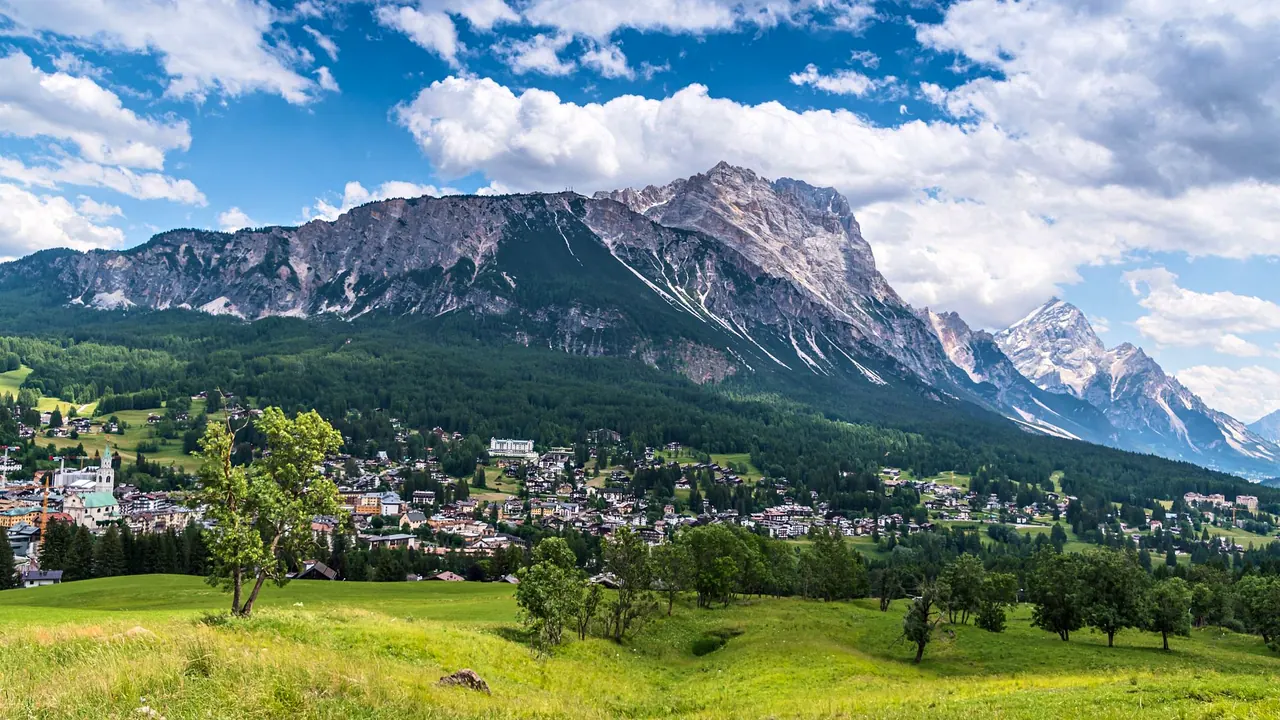
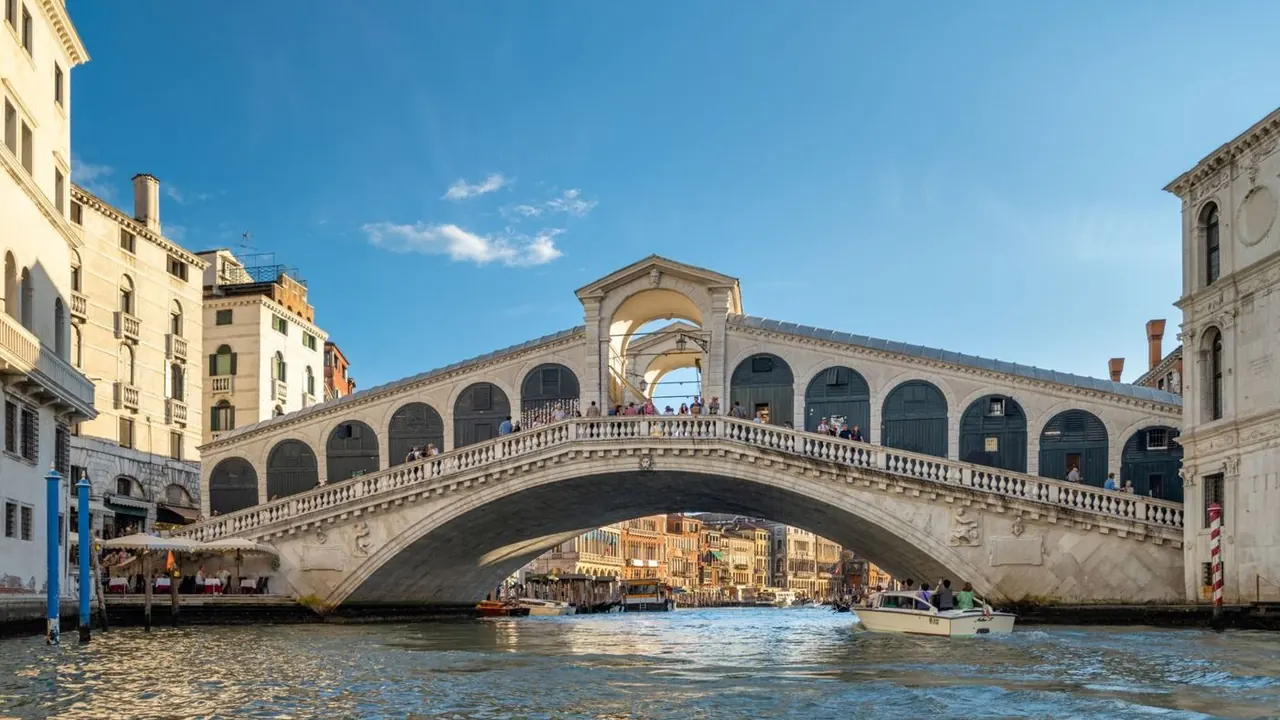
Photos: Cortina d'Ampezzo by Andreas Neubauer, Pexels License; Venice by David Vives, Pexels License.
Cortina d'Ampezzo or Venice?
Our verdict in twelve categories, each scored against the same fixed benchmark cities, and the climate month by month, so you can choose for your trip.
Choose Cortina d'Ampezzo for
- nature and the outdoors
- families
- wellness
Cortina d'Ampezzo is the choice when the mountains are the point of the trip. The ring of pale Dolomite peaks, lifts rising from the edge of town, the Superski slopes in winter and hut-to-hut trails in summer give it an outdoor setting that Venice cannot come close to. Evenings there mean a long dinner and an early night.
Choose Venice for
- culture and sights
- beaches
- live music and the arts
For art, architecture and a night at the opera, Venice wins comfortably. Its palaces, churches and galleries, La Fenice and the fast trains to Padua and Verona make it a richer and easier base for a city trip, and the Lido adds a sandy afternoon in summer. Neither place is cheap, but Venice is a little kinder to a careful budget.
Scoreboard
Twelve categories on one fixed scale from 0 to 100. The shaded stretch is the gap between the two.
Your match
Pick a travel style or drag the sliders, and both match scores follow your weighting.
Wins on nature and the outdoors and families with your weighting.
Wins on culture and sights and beaches with your weighting.
What matters to you?
Category by category
What the scores mean for a trip.
Beaches & swimming
Cortina's nearest sea is the Adriatic, more than two hours' drive away. Its lakes, Ghedina and Pianozes, are for walking round rather than swimming, because snowmelt keeps them cold, so swimming there usually means a hotel pool.
Venice has the only real beach of the two. The Lido is a short vaporetto ride from San Marco, with fine sand and shallow water that is warm enough for bathing in high summer. Pellestrina and the Jesolo strip are further options.
Food & drink
Cortina eats like a well-heeled mountain resort: casunziei with poppy seeds, polenta with game, speck and barley soup, and the best meals on rifugio terraces among the peaks. The food is satisfying but the range is narrow, with little street food and nothing cheap.
Venice offers more variety and more ways to eat. Cicchetti at bacari counters around the Rialto and in Cannaregio, lagoon seafood from the Rialto market and black cuttlefish risotto make for better grazing, as long as you avoid the picture-menu places around San Marco.
Culture & sights
The gap here is about as wide as it gets. Cortina has a handsome bell tower, painted houses, the 1956 Olympic ice stadium and the Rimoldi collection of modern Italian art. That fills a rainy afternoon, and the First World War trenches on Lagazuoi are there for anyone willing to hike.
In Venice the city itself is the monument: San Marco, the Doge's Palace and the palazzi of the Grand Canal, then the Accademia, the Frari and San Rocco, with the Biennale in the Arsenale and Giardini. Here culture is a reason to come, not something to fall back on in bad weather.
Nightlife
Neither town is built for late nights, but Venice has a little more going on. Cortina's evenings revolve around après-ski and the passeggiata on the Corso Italia. A few smart bars and a club stay open late only in the peak winter weeks, and outside them the valley is quiet by late evening.
Venice's best hour is the aperitivo, with spritzes along the Fondamenta della Misericordia. Afterwards Campo Santa Margherita keeps its student bars busy a while longer, but there is no club district.
Nature & outdoors
Here Cortina is far ahead. The Tofane, Cristallo and Cinque Torri ring the valley, and the Tre Cime and Lago di Misurina are under an hour away. The town reaches the Sella Ronda in winter, and in summer it has hut-to-hut hiking, climbing and paragliding.
Venice's nature is flat and watery: the salt marshes of the northern lagoon around Torcello, with herons and flamingos, seen by kayak or from a Venetian rowing boat, and cycling along the sea walls of Pellestrina. The Dolomites are more than two hours away.
Day trips
Venice is the far better base for day trips. Fast trains reach Padua in about half an hour and Verona in about an hour and a quarter, with Vicenza in between. Murano, Burano and Torcello need only a boat.
From Cortina, most outings go up into the mountains. The towns within reach, such as San Candido, Brunico and Bolzano with its Iceman, are pleasant but spread out along mountain roads, and Venice itself is a long day by coach.
Good for families
Both work for families, but in different ways. Cortina suits children who ski or hike, with ski schools, beginner slopes at Socrepes, public skating at the Olympic stadium and gentle trails to huts with meadows to run around in. Rainy days can drag, because there is little built for children indoors.
Venice catches young imaginations with boats instead of buses and glass-blowing on Murano, and the Lido is gentle for paddling. The stepped bridges defeat pushchairs, though, and the summer heat and crowds mean short stays with older children work best.
Getting around
Cortina's centre takes only minutes to cross, and in winter lifts and ski buses serve the slopes. Beyond that a car is close to essential, because the railway closed in 1964 and buses to the passes are infrequent.
Venice is easier. Trains end at Santa Lucia, the centre is walkable and vaporetti reach the Lido and the islands. The catch is the hundreds of stepped bridges, which are hard work with luggage.
Shopping & style
Cortina's shopping is one short street, the Corso Italia, with luxury fashion, furriers and ski wear. It is anchored by the Cooperativa di Cortina, founded in 1893, and there is some local wood carving and filigree.
Venice has more to discover: Murano glass, Burano lace, papier-mâché masks and marbled paper from working studios in Dorsoduro and Castello, with the big fashion names on Calle Larga XXII Marzo. The challenge is telling real craft from the imported copies sold along the main routes.
Affordability
Both are among Italy's most expensive places to stay, and Cortina is the harder on the wallet. Hotels and restaurants charge luxury-resort rates in winter and August, and lift passes and equipment hire add more. Rifugio lunches and early-summer rates help, and many budget travellers sleep in cheaper valleys nearby.
Venice leaves a little more room to save. Eating cicchetti at a counter, staying in a quieter sestiere or in Mestre, and visiting in late autumn all bring costs down, though entry fees and water transport soon add up.
Live music & performing arts
Cortina's evenings of music are mostly a summer thing: chamber and classical concerts in churches and halls, sometimes out in the mountains, with little else through the year.
Venice has La Fenice, where Verdi and Rossini premiered works, with a full season of opera, ballet and symphonic concerts, plus drama at the Teatro Goldoni and the Biennale festivals. Even a routine Vivaldi concert in a church means something in the city where he worked.
Wellness & relaxation
Neither place has a bathing tradition, so both rely on hotel spas, and the difference lies in the kind of calm. Cortina's Alpine spas offer saunas, hay baths and massages after the slopes. In June and September, an afternoon on a hut terrace in clear mountain air is restful in itself.
Venice's quiet comes from having no traffic, so early mornings in Castello, Cannaregio or on Giudecca are hushed. Real thermal pools are about an hour away at Abano Terme. Crowds unsettle both: Cortina in its peak weeks, and Venice around San Marco by day.
When should you go?
Pick your month. The climate figures are measured averages, not a forecast.
Cortina d'Ampezzo in July
Venice in July
Daytime high, °C
Rainfall in the month, mm
Temperature and rainfall are climate normals, averaged over the years shown. Cortina d'Ampezzo: 1991-2020 normals, Dobbiaco (22.5 km from centre). Venice: 1991-2020 (sunshine 1971-2000, rainfall 1981-2010) normals, Venezia / Tessera (6.7 km from centre).
Cortina has two main seasons. From December to February daytime highs hover near freezing, around 0°C in January, which is weather for skiing rather than strolling. March is noticeably milder, though still cool. Summer is mild, with highs near 22°C in July and August, which is ideal for hiking. These are also the wettest months, though, with about 130mm of rain in July. June and September are a little cooler and still good for walking, and September is clearly drier. April and late autumn fall between the two seasons.
Venice is much warmer all year. July reaches about 29°C, which feels hot and humid in the narrow alleys. The sea at the Lido peaks near 26°C in August, and that is the only real swimming either place offers. May, June and September are the most comfortable months for sightseeing, and October and November bring the most rain. Winter is cool and grey, with little sunshine, but still far milder than in the mountains.
Which traveller are you?
For a culture and arts trip, Venice is the obvious pick. The Accademia, Titian in the Frari, Tintoretto at San Rocco, the Biennale and an evening at La Fenice can fill a week. Cortina offers a small art collection and wartime tunnels high on Lagazuoi.
On an outdoors trip, Cortina is in another league. Lifts climb from town onto the Tofane and Cristallo, the Alta Via 1 and some of the oldest via ferrata routes start nearby, and winter brings the Dolomiti Superski. Venice offers lagoon kayaking and flat cycling.
For a short city break, Venice works far better. Trains run straight into Santa Lucia, the centre is walkable, and two or three days of churches, cicchetti and canal rides feel complete. Cortina has no railway, needs a long transfer and rewards a longer stay.
Before you go
| Measure | Cortina d'Ampezzo | Venice |
|---|---|---|
| Official language | Italian | Italian |
| Currency | Euro (EUR) | Euro (EUR) |
| Sockets | CFL230 V, 50 Hz | CFL230 V, 50 Hz |
| Driving side | Right | Right |
| Time zone | UTC+1, UTC+2 in summer | UTC+1, UTC+2 in summer |
| Emergency number | 112 | 112 |
| Elevation | 1,224 m | 2 m |
| Main airport | Venice Marco Polo Airport (VCE)116 km from centre103 non-stop destinations | Venice Marco Polo Airport (VCE)7 km from centre103 non-stop destinations |
| Public holidays this year | 13 days | 13 days |
By the numbers
| Measure | Cortina d'Ampezzo | Venice |
|---|---|---|
| City population | 5,546 | 250,369 |
| People per km² | 22 | 602 |
| Museums within 10 km | 3 | 52 |
| UNESCO World Heritage sites within 50 km | 1 | 5 |
| Swim season, months above 21 °C | - | 4 months |
Where else could you go?
Every comparison below shares a destination with this one, so you can follow Cortina d'Ampezzo or Venice somewhere new.
- Innsbruckvs Cortina d'Ampezzo
- Veronavs Venice
- Rovinjvs Venice
- Triestevs Venice
- Bolognavs Venice
- Veronavs Cortina d'Ampezzo