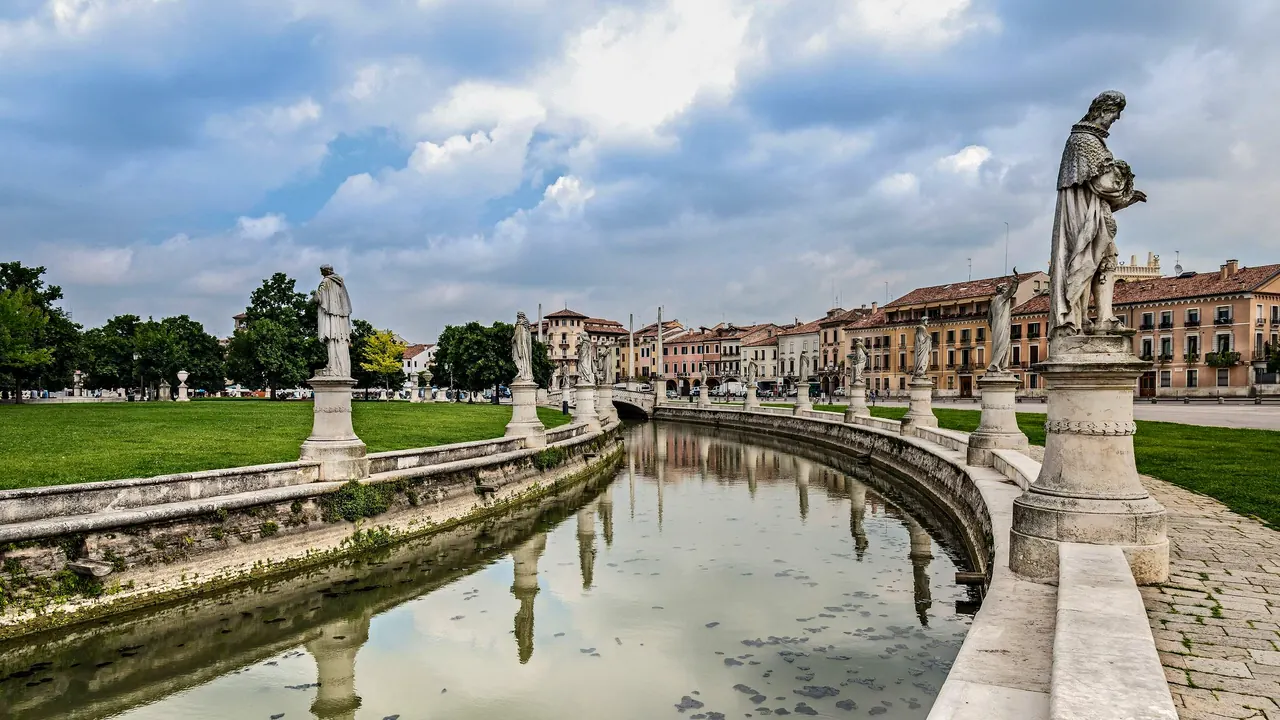
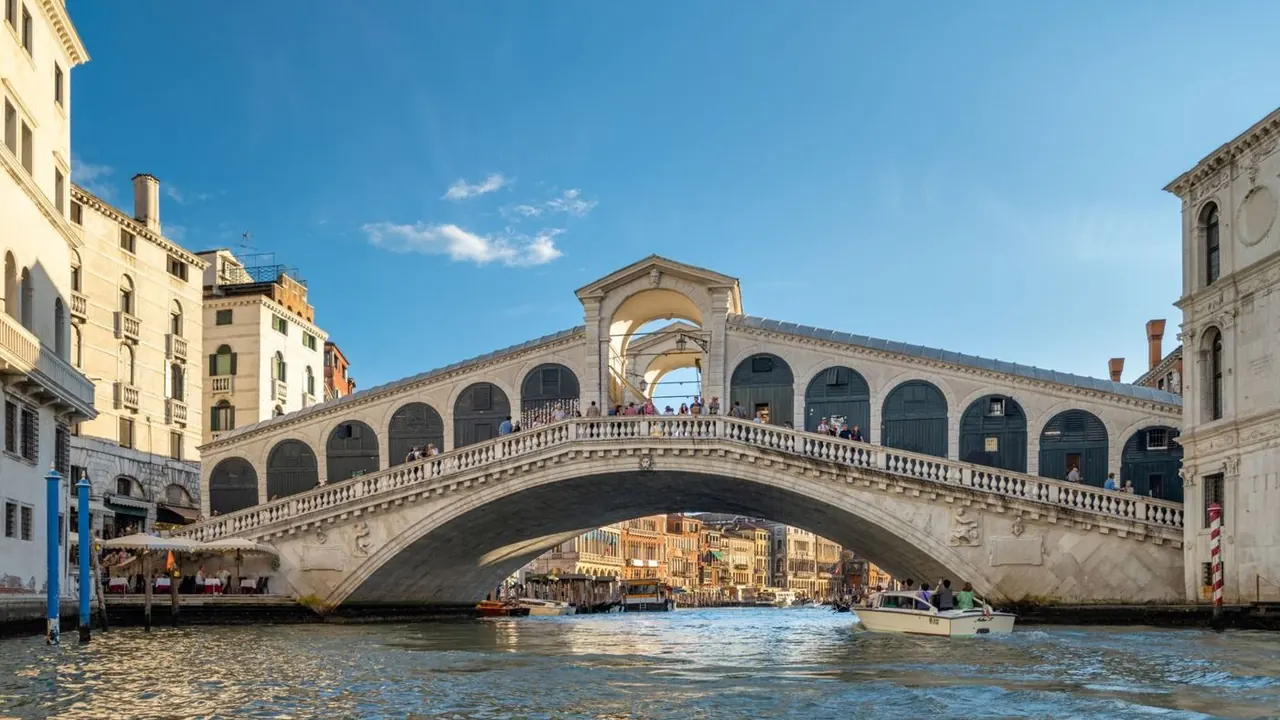
Photos: Padua by Didier Descouens, CC BY-SA 4.0, cropped; Venice by David Vives, Pexels License.
Padua or Venice?
Our verdict in twelve categories, each scored against the same fixed benchmark cities, and the climate month by month, so you can choose for your trip.
Choose Padua for
- prices
- wellness
- nightlife
Padua suits the traveller who wants the whole Veneto rather than a single city. It sits where the main rail lines meet, with Venice, Vicenza and Verona all easy to reach, and its beds cost less. Its squares fill with students at aperitivo time, Giotto's chapel is in the centre and the thermal pools of Abano are just outside town. Choose it for a week of day trips, a spa stay or a trip where the budget matters.
Choose Venice for
- beaches
- live music and the arts
- culture and sights
Venice is for those who come for the city itself. No other place has so much art and architecture standing on water, from San Marco and the Accademia to Tintoretto's canvases in San Rocco, with La Fenice in the evening and Lido sand a boat ride away. It costs far more, goes quiet early and is hard work with luggage, so it suits travellers happy to spend their days looking, listening and walking.
Scoreboard
Twelve categories on one fixed scale from 0 to 100. The shaded stretch is the gap between the two.
Your match
Pick a travel style or drag the sliders, and both match scores follow your weighting.
Too close to call, 2 points apart
Wins on prices and wellness with your weighting.
Wins on beaches and live music and the arts with your weighting.
What matters to you?
Category by category
What the scores mean for a trip.
Beaches & swimming
Venice has a proper beach close at hand. The Lido is a short vaporetto ride from San Marco and has kilometres of fine sand facing the open Adriatic, and Pellestrina beyond it is quieter and wilder. From Padua the nearest sand is at Sottomarina or that same Lido, about an hour each way, so a swim means a full day out.
The sea is the same on both coasts: shallow, calm, warm in high summer, good for small children and greenish rather than clear. Neither city is a beach destination, but in Venice you can go for an afternoon, while from Padua it takes a whole day.
Food & drink
The two eat about equally well, but in different ways. Padua's cooking comes from the farmland around it: bigoli with duck, baccalà alla vicentina, boiled meats and the Padovana hen, bought fresh in the twin markets of Piazza delle Erbe and Piazza della Frutta and drunk with Euganean reds. The tourist trade has diluted it less.
Venice cooks from the lagoon, with cuttlefish risotto, sarde in saor and soft-shell crab, and its best meals are cicchetti eaten standing at the counters of bacari around the Rialto and in Cannaregio. The food around San Marco is poor, though, so eating well there takes more searching than it does in Padua.
Culture & sights
Padua has one sight of world rank in Giotto's Scrovegni Chapel. Around it are the UNESCO-listed fresco cycles, Donatello's work at the Basilica of Saint Anthony, the old anatomical theatre and the 1545 botanical garden. It is a rich centre, but two or three days covers it.
Venice is on another scale. The whole city counts as the monument, and inside it are the Basilica of San Marco and the Doge's Palace, the Accademia, the Frari, San Rocco and modern art at the Guggenheim and Punta della Dogana. A week there still leaves things unseen, while Padua's highlights fit easily into a day trip from Venice.
Nightlife
Neither city has much of a club scene, but Padua stays up later. Its university fills Piazza delle Erbe and Piazza dei Signori with spritz drinkers until late on warm nights, and wine bars and small pubs keep the old ghetto busy on weeknights during term, though it goes quiet in the summer break.
Venice's evening peaks at aperitivo along the Fondamenta della Misericordia. After that only a few bars on Campo Santa Margherita stay open, and the canals are silent by midnight. That is lovely for a late walk but means very little going out.
Nature & outdoors
Hills against lagoon sums up the difference, and the hills give Padua the edge. The Euganean Hills, a cluster of old volcanic cones about 15km to the south-west, have marked trails through vineyards and chestnut woods, and level towpaths along the Brenta lead through villa country by bike. Proper mountain walking on Monte Grappa or the Asiago plateau is about an hour and a half away by car.
In Venice the outdoors is the water. The salt marshes around Torcello and Sant'Erasmo hold herons, egrets and flamingos, and you can explore them by kayak or take a lesson in standing Venetian rowing, while the sea walls of the Lido and Pellestrina make long, flat bike rides. Beyond that there is little: the city has few parks, and the Dolomites are more than two hours each way.
Day trips
Both make superb bases, but Padua sits in the middle of the network while Venice is at the end of the line. From Padua, Vicenza is a quarter of an hour, Venice under half an hour and Bologna about an hour, and the walled towns of Este, Monselice and Montagnana and Petrarch's village of Arquà are nearby.
Venice has to send you back across the causeway for most of these, which adds time to every outing. In return it has trips no other city can offer: Murano's glass furnaces, Burano's painted houses and Torcello's lonely cathedral, all reached by boat across the lagoon.
Good for families
Neither city is built around children, and they fall short in different ways. Padua is easy to manage: flat, compact and largely pedestrianised, with Prato della Valle for running about. But its sights are frescoes and churches, so families tend to head out to Gardaland or Lake Garda.
Venice gives children more to enjoy, with boats for buses, Murano glass-blowing, the shallow Lido and dinosaurs at the natural history museum. Its stepped bridges and summer crowds make pushchairs a real struggle, so it suits short stays with older children.
Getting around
Padua is the easier city to get around. Its flat centre puts the main sights within a 20-minute walk under shady arcades, a tram runs from the station, bikes are normal, and the station has fast trains in every direction.
In Venice everything is on foot or by water. Walks take longer through alleys that twist and end at canals, hundreds of bridges have steps that are hard with luggage, and the main vaporetto lines are slow and crowded. A trip along the Grand Canal is a sight in its own right, though.
Shopping & style
Things made in the city itself put Venice ahead, though Padua is the better place to fill a bag with food. Padua's shopping is the everyday kind. Its arcades have Italian fashion and shoe shops, there are bookshops serving the university, and the delicatessens under the Palazzo della Ragione sell cheese and Euganean wine to take home. One Sunday a month a big antiques market fills Prato della Valle.
In Venice the crafts have centuries behind them: Murano glass, Burano lace, papier-mâché masks, marbled paper and velvet furlane slippers. The genuine workshops are in Dorsoduro, Castello and on Murano, away from the stalls of imported copies on the main routes, and the big fashion labels line Calle Larga XXII Marzo.
Affordability
This is where the two differ most. Padua costs what an ordinary northern Italian city does, with fair trattoria meals, cheap standing spritzes and a centre that needs no transport. Venice is one of the most expensive places to stay in Italy, with dear hotel rooms, water transport priced for visitors and entry charges at most churches and sights.
That gap is why so many people sleep in Padua and take the train into Venice. If you stay in Venice, eating cicchetti at the counter and choosing Cannaregio or Castello over San Marco helps keep costs down.
Live music & performing arts
Venice has the far stronger stage. La Fenice, where Verdi and Rossini premiered operas, runs a full season of opera, ballet and concerts, the Goldoni stages drama and the Biennale adds contemporary festivals. Vivaldi concerts in churches are on most nights, though their quality varies.
Padua's programme is smaller but real: prose theatre and some opera at Teatro Verdi, and chamber music in the Sala dei Giganti and the Basilica of Saint Anthony. For grand opera, Padua audiences take the train to La Fenice.
Wellness & relaxation
For a soak in hot mineral water, Padua is far better placed. Abano Terme and Montegrotto Terme lie about 12km away and form one of Europe's largest thermal districts, where mud treatments have been used since Roman times. Many of the spa hotels take day visitors, so you can spend the morning sightseeing and the afternoon in a thermal pool.
Venice offers only hotel spas, in palazzi and on the Lido and Giudecca, and the Euganean springs are an hour away. Rest there comes from the car-free silence of early mornings and the residential streets of Castello and Cannaregio.
When should you go?
Pick your month. The climate figures are measured averages, not a forecast.
Padua in July
Venice in July
Daytime high, °C
Rainfall in the month, mm
Where the figures come from
Padua's temperatures are measured 35 km from the centre, at Treviso / Istrana.
Padua has no rain gauge within 25 km of the centre, so its rainfall comes from a gridded climate dataset read at the city rather than from a gauge further away.
Padua's sunshine is measured 36 km from the centre, at Treviso / S. Angelo.
Temperature and rainfall are climate normals, averaged over the years shown. Padua: 1991-2020 normals, Treviso / Istrana (35.4 km from centre). Venice: 1991-2020 (sunshine 1971-2000, rainfall 1981-2010) normals, Venezia / Tessera (6.7 km from centre).
The two cities share one climate, but Padua runs a little hotter inland, reaching 31°C in July and August against 29°C on the lagoon. That is warm enough for the beach, where the Adriatic peaks around 25°C, but sticky for long days of sightseeing on foot. In both places the sea is pleasant for swimming from June to September, and May, September and early October are the best months for walking the streets.
The rain falls differently. Venice is wettest in June and October, with June bringing 96mm. Padua's rain builds through autumn to a peak in November of 97mm, often with fog lying on the plain. Winters in both are cold, grey and short of sunshine, with days around 8°C. They suit museums and churches, not outdoor plans.
Which traveller are you?
On a culture and arts trip, Venice is the clear choice. The whole city is the sight, its churches and galleries hold Titian, Tintoretto and Bellini, and La Fenice and the Biennale fill the evenings. Padua's Giotto frescoes are only half an hour away by train.
For a trip on a tight budget, Padua works much better. Hotels and meals cost what a normal northern Italian city charges, the compact centre needs no transport, and fast trains let you see Venice by day without paying to sleep there.
On a relaxing and wellness trip, Padua is the place. The thermal pools and mud treatments of Abano and Montegrotto are a short ride away, and the city moves at an unhurried provincial pace. In Venice you only get calm by avoiding the crowds around San Marco.
Before you go
| Measure | Padua | Venice |
|---|---|---|
| Official language | Italian | Italian |
| Currency | Euro (EUR) | Euro (EUR) |
| Sockets | CFL230 V, 50 Hz | CFL230 V, 50 Hz |
| Driving side | Right | Right |
| Time zone | UTC+1, UTC+2 in summer | UTC+1, UTC+2 in summer |
| Emergency number | 112 | 112 |
| Elevation | 12 m | 2 m |
| Main airport | Venice Marco Polo Airport (VCE)39 km from centre103 non-stop destinations | Venice Marco Polo Airport (VCE)7 km from centre103 non-stop destinations |
| Public holidays this year | 13 days | 13 days |
By the numbers
| Measure | Padua | Venice |
|---|---|---|
| City population | 206,496 | 250,369 |
| People per km² | 2,220 | 602 |
| Museums within 10 km | 29 | 52 |
| UNESCO World Heritage sites within 50 km | 5 | 5 |
| Swim season, months above 21 °C | 4 months | 4 months |
Where else could you go?
Every comparison below shares a destination with this one, so you can follow Padua or Venice somewhere new.