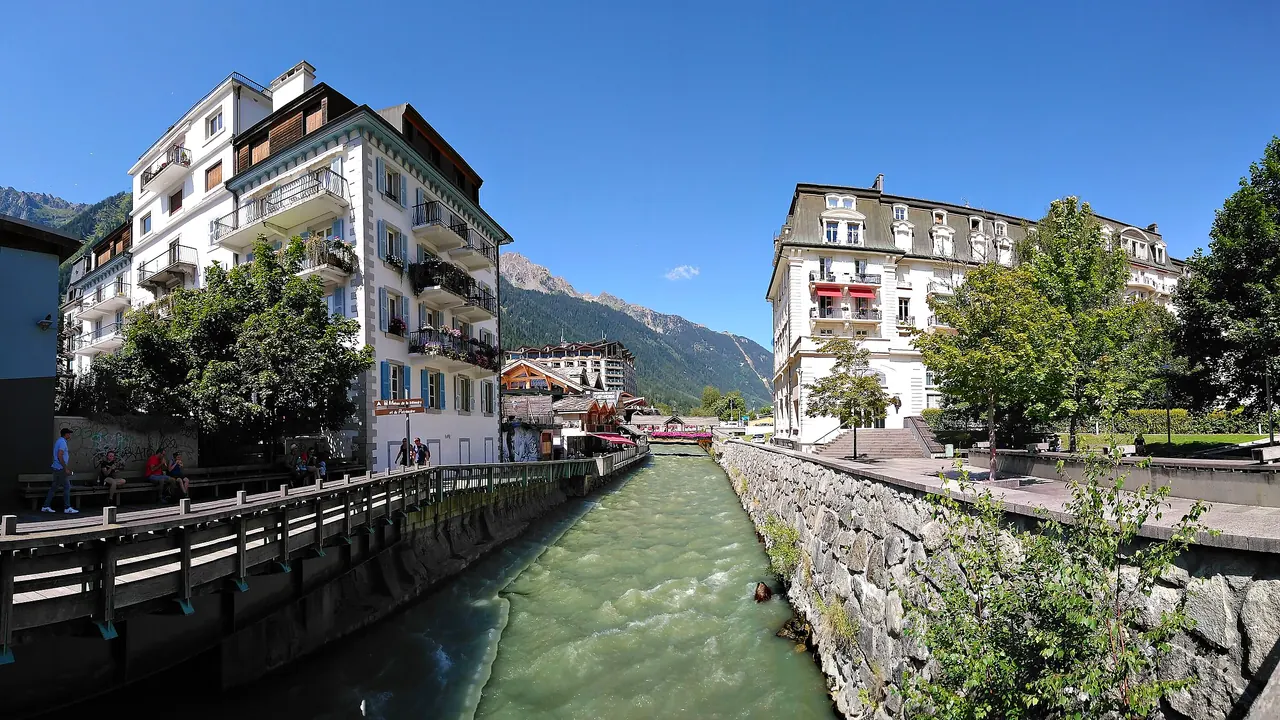
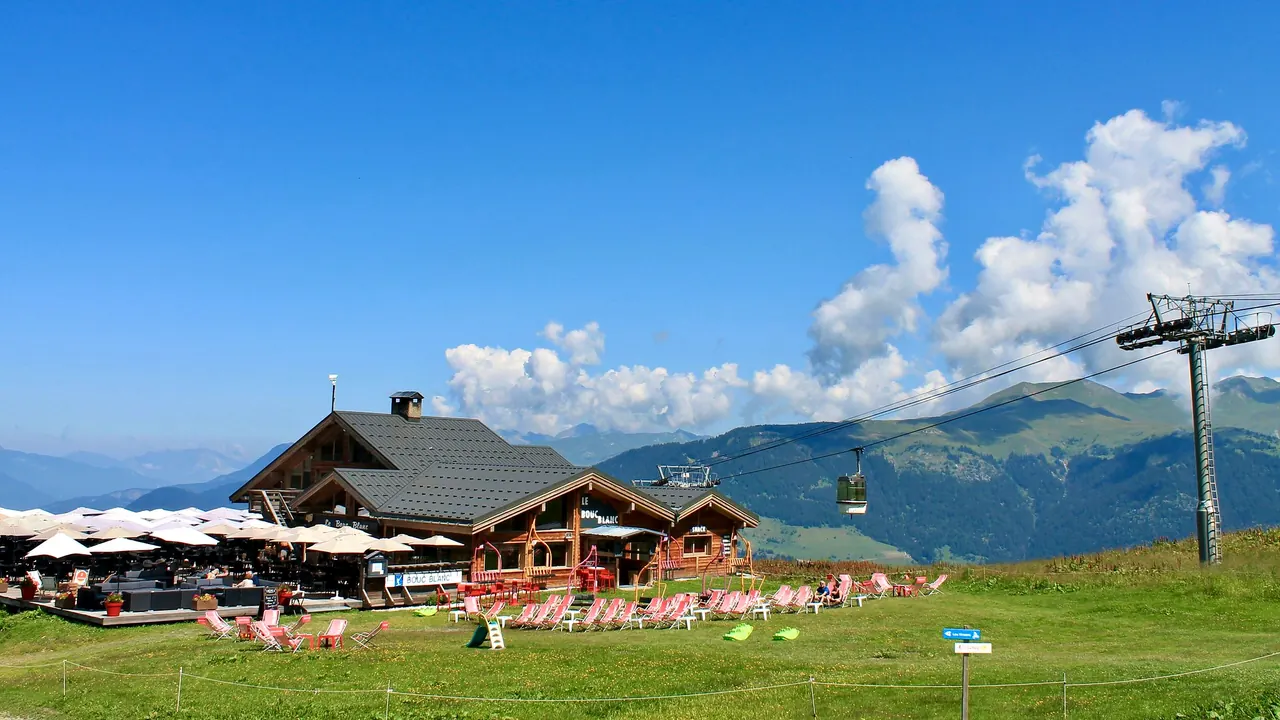
Photos: Chamonix by Tiia Monto, CC BY-SA 3.0, cropped; Courchevel by B. Brassoud, CC BY-SA 4.0, cropped.
Chamonix or Courchevel?
Our verdict in twelve categories, each scored against the same fixed benchmark cities, and the climate month by month, so you can choose for your trip.
Choose Chamonix for
- day trips
- prices
- getting around
Chamonix suits travellers who come for the mountains themselves, in summer as much as in winter. You can ride a cable car into glacier country, climb with a guide, walk the Tour du Mont Blanc or ski steep terrain. At the end of the day you are back in a real town that is easy to reach from Geneva, with Italy, Switzerland and Annecy close enough for a day out. It is expensive, but less so than its rival, and it rewards people who are active from morning to evening.
Choose Courchevel for
- food and drink
- shopping
- families
Courchevel is the better choice for a winter ski week where comfort matters as much as the snow. It is part of Les 3 Vallées, so the linked skiing is enormous and the pistes are groomed with care. Its food, from long lunches on terraces beside the slopes to starred hotel dining rooms, is a level above Chamonix's. It is a place to stay put rather than to explore from, and it is priced for very deep pockets.
Scoreboard
Twelve categories on one fixed scale from 0 to 100. The shaded stretch is the gap between the two.
Your match
Pick a travel style or drag the sliders, and both match scores follow your weighting.
Wins on day trips and prices with your weighting.
Wins on food and drink and shopping with your weighting.
What matters to you?
Category by category
What the scores mean for a trip.
Beaches & swimming
Neither is a place for swimming, but Chamonix gives you more in summer. Lac de Passy, down the Arve valley, gets warm enough to swim in July and August with Mont Blanc straight ahead. The town pool has an outdoor basin, and Lake Annecy is a little over an hour away.
Courchevel's Lac de la Rosière is good for a paddle and lying on the grass, but the water stays mountain-cold. Otherwise swimming means the indoor pools at the aquatic centre or a hotel pool.
Food & drink
Both serve the same Savoyard staples of fondue, raclette, tartiflette and Beaufort, so the difference shows at the top end. Chamonix has a resort's range: bistros, burger and pizza places, a few ambitious kitchens and refuge terraces facing the glaciers, plus good cheese shops and bakeries for a picnic.
Courchevel 1850 has a run of Michelin-starred hotel kitchens that few places in France can match, and lunches on the slopes come with seafood and serious wine lists. What it lacks is anything casual or cheap.
Culture & sights
Neither suits a culture trip, but Chamonix at least has a story to tell. Alpinism was born here and the town hosted the first Winter Olympics. You can see the Musée Alpin in a Belle Époque palace hotel, the Espace Tairraz, the old guides' quarter and the climbers' cemetery, and half a day covers it all.
Courchevel was built after the Second World War. It has the 1992 Olympic ski jumps at Le Praz, modernist chalets at 1850 and a few chapels in the older hamlets, which is less than a morning's looking.
Nightlife
Chamonix goes out in mixed, noisy pubs, Courchevel in clubs built for spending, and neither has more of a night out than the other. In Chamonix the evening moves to a narrow lane in the old town, where a young, English-speaking crowd of guides, seasonal workers and visitors drinks together until late. Two or three small clubs keep going after that, and summer evenings are quieter, on terraces.
In Courchevel 1850 the night revolves around hotel bars and a few glamorous clubs with champagne and big tables. It suits people with money to spend rather than people who want to mix, and outside winter it barely exists.
Nature & outdoors
Both are among the great mountain destinations, and Chamonix edges ahead with greater drama and a fuller year. Cable cars lift you from the town straight into glaciated high-mountain terrain, the rack railway runs to the Mer de Glace, and in winter the Vallée Blanche offers a descent across the glacier itself. In summer there is mountaineering, climbing and the Tour du Mont Blanc, all starting from the valley floor.
Courchevel's strength is the sheer size of its linked skiing across Les 3 Vallées, about 600km of well-groomed piste. It also has the Vanoise National Park for summer walks among lakes and ibex. Its summer is shorter, though, and it has nothing to match the ice and granite of the Mont Blanc massif.
Day trips
Chamonix is far better placed for days out. Courmayeur and the Aosta valley, with its Roman town and castles, are just through the Mont Blanc Tunnel. Geneva and Annecy are each a little over an hour away, and the Mont Blanc Express climbs over to Martigny in Switzerland.
From Courchevel every outing starts with the winding drive down to Moûtiers. Conflans and Beaufort take about an hour and Annecy close to two, so these make a fine rest-day outing, but the resort is no base for exploring.
Good for families
Chamonix makes the better summer trip with children, and Courchevel the easier winter ski week. In Chamonix children can visit the Merlet animal park, ride the summer luge, try the treetop courses and take the little red train to the Mer de Glace. However, its highest cable cars are unsuitable for young children, and there is little to do on a rainy day.
Courchevel has sunny beginner slopes at Moriond and Courchevel Village, free beginner lifts, large ski school programmes and an aquatic centre with slides. Away from the snow it offers children much less, and 1850 is built around adults.
Getting around
Chamonix is easier both to reach and to get around. Shuttles run from Geneva airport, the flat centre is easy to walk, and the guest card makes the valley buses and the Mont Blanc Express free, though ski buses get packed in winter.
Courchevel runs smoothly once you have arrived, with free shuttles, a gondola between the villages and ski-in, ski-out chalets. Getting there is harder: a train to Moûtiers, then a long climb up hairpin bends, with snow chains needed in winter.
Shopping & style
Both are strong on technical ski and climbing equipment. Chamonix's outdoor shops, some run by the same families for generations, are where climbers save up their big gear purchases. Courchevel 1850 adds something Chamonix lacks: a short stretch of luxury fashion houses, jewellers and watchmakers, open through the winter season.
Beyond that, both come down to Savoyard cheese and charcuterie, with rock crystals and génépi in Chamonix. From Chamonix, anyone wanting a wider choice heads to Geneva or Annecy.
Affordability
Both are expensive, but Chamonix gives you more ways to manage the cost. Valley transport is free with the guest card, self-catering apartments are easy to find, many trails start without a lift, and spring and autumn are noticeably cheaper.
Courchevel is among the costliest destinations anywhere, with 1850 priced for the very wealthy. Staying in Le Praz, Courchevel Village or La Tania softens the bill a little, but even these are high by any standard.
Live music & performing arts
Neither town offers much in the way of concerts or theatre, and Chamonix visitors who want opera or an orchestra go to Geneva. What Chamonix does have is a long-running summer jazz festival with some sets high in the mountains, plus church concerts and mountain film evenings. Courchevel's live music is mostly bands at après-ski and the odd seasonal concert.
Wellness & relaxation
The two are much the same for unwinding, but the setting differs. Chamonix has a large day spa on the Italian thermal model, with hot outdoor pools and saunas looking up at the glaciers, and Saint-Gervais-les-Bains, about 25 minutes down the valley, adds warm springs in a wooded gorge. The town itself is crowded in high season, summer as well as winter, so for the quietest stay come in the shoulder seasons or stay in the hamlets further up the valley.
In Courchevel, relaxing means a luxury hotel spa. These are among the most lavish in the mountains, with pools under timber roofs and hammams, and many of them take non-residents. The aquatic centre in Courchevel Village costs less. A ski week here runs on early starts and tired legs, and summer, with its quiet meadows, is the calmer time.
When should you go?
Pick your month. The climate figures are measured averages, not a forecast.
Chamonix in July
Courchevel in July
Daytime high, °C
Rainfall in the month, mm
Where the figures come from
Chamonix's temperatures are measured 35 km from the centre, at Bourg-St-Maurice.
Chamonix has no rain gauge within 25 km of the centre, so its rainfall comes from a gridded climate dataset read at the destination rather than from a gauge further away.
Courchevel has no weather station within reach, so its figures come from a gridded climate model rather than a measured record, and read a broad area rather than one spot.
Temperature and rainfall are climate normals, averaged over the years shown. Chamonix: 1999-2020 (rainfall 1991-2020) normals, Bourg-St-Maurice (34.9 km from centre). Courchevel: 2001-2020 normals, NASA POWER reanalysis grid, no weather station within 90 km.
Chamonix is much the warmer of the two in these figures. Valley afternoons reach about 27°C in July, so July and August are warm enough for a swim at Lac de Passy, and June to September is the season for long days on the trails. It is also wet all year, with rain or snow in every month, heaviest in November, December and May and peaking at 169mm in December. In winter the valley stays a little above freezing while the snow lies higher up.
Courchevel is far colder. Daytime highs stay below freezing from December to February, around -4°C in January, which keeps its snow reliable. Its summer is short and fresh, peaking at about 18°C in July, pleasant for walking but too cool for more than a paddle in the lake. It is drier than Chamonix in every month, getting roughly half the rain or snow in winter but only a little less in summer, and May is its wettest month.
Which traveller are you?
On a trip on a tight budget, Chamonix is the less painful choice, though neither is cheap. The guest card makes valley buses and trains free, many trails start without a lift, and picnics and self-catering come easily. Courchevel's cheaper villages are still dear.
For a food and nightlife trip, Courchevel wins at the table, with starred kitchens in the 1850 palace hotels and long lunches on terraces beside the slopes. The two are close for going out, but Courchevel means champagne and late clubs, while Chamonix means pubs and loud après-ski.
On an outdoors trip, Chamonix has more to offer across the whole year. There are cable cars into glacier terrain, mountaineering with the oldest guiding company in the world, via ferrata, trail running and the Tour du Mont Blanc. Courchevel is superb for skiing on piste but much quieter once the snow goes.
Before you go
| Measure | Chamonix | Courchevel |
|---|---|---|
| Official language | French | French |
| Currency | Euro (EUR) | Euro (EUR) |
| Sockets | CE230 V, 50 Hz | CE230 V, 50 Hz |
| Driving side | Right | Right |
| Time zone | UTC+1, UTC+2 in summer | UTC+1, UTC+2 in summer |
| Emergency number | 112 | 112 |
| Elevation | 995 m | 1,757 m |
| Main airport | Geneva International Airport (GVA)68 km from centre150 non-stop destinations | Geneva International Airport (GVA)100 km from centre150 non-stop destinations |
| Public holidays this year | 11 days | 11 days |
By the numbers
| Measure | Chamonix | Courchevel |
|---|---|---|
| Population | 8,705 | - |
| People per km² | 75 | - |
| Museums within 10 km | 3 | 0 |
| UNESCO World Heritage sites within 50 km | 0 | 0 |
Where else could you go?
Every comparison below shares a destination with this one, so you can follow Chamonix or Courchevel somewhere new.
- Méribelvs Courchevel
- La Plagnevs Courchevel
- Saint-Gervais-les-Bainsvs Chamonix
- Les Menuiresvs Courchevel
- Val Thorensvs Courchevel
- Flainevs Chamonix