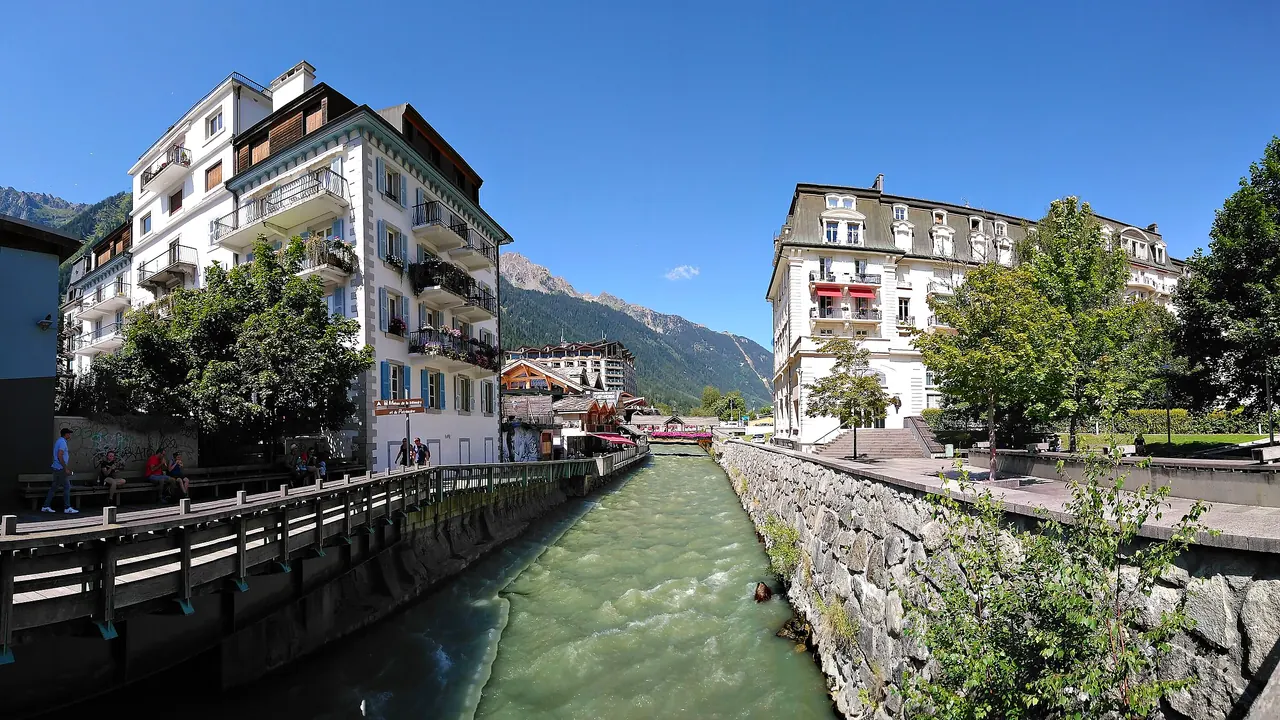
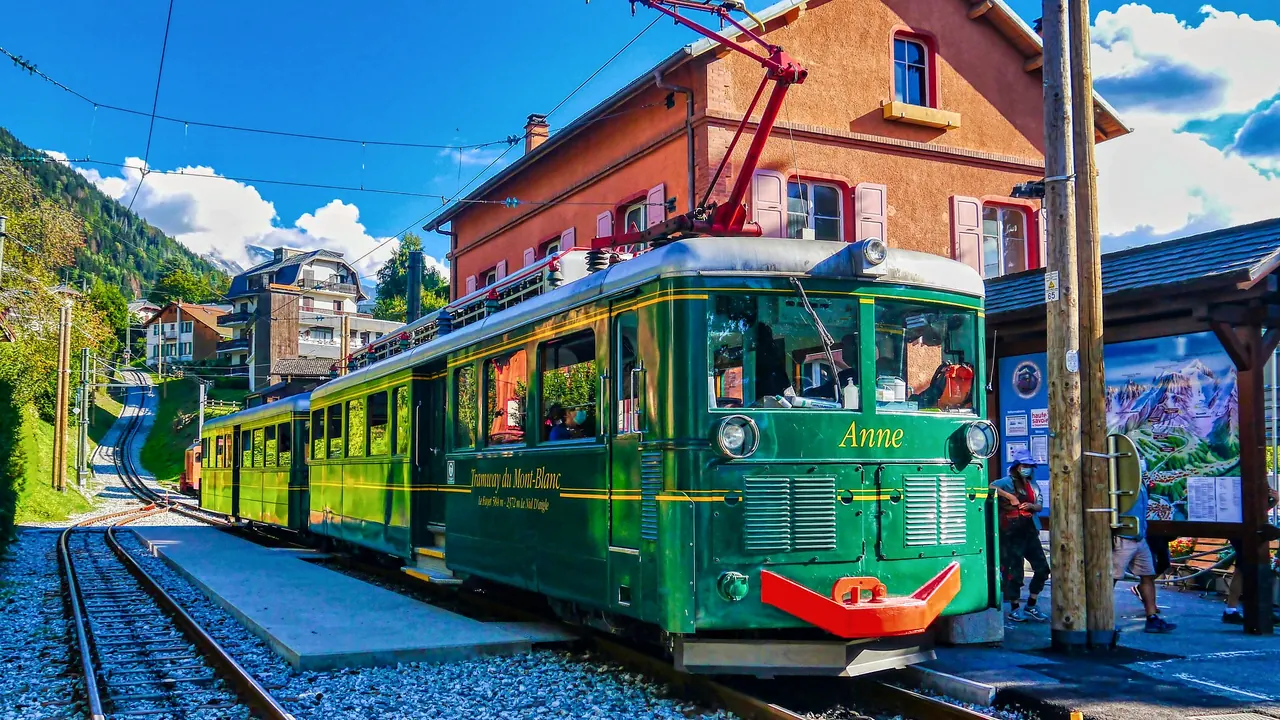
Photos: Chamonix by Tiia Monto, CC BY-SA 3.0, cropped; Saint-Gervais-les-Bains by Zairon, CC BY-SA 4.0, cropped.
Chamonix or Saint-Gervais-les-Bains?
Our verdict in twelve categories, each scored against the same fixed benchmark cities, and the climate month by month, so you can choose for your trip.
Choose Chamonix for
- getting around
- nightlife
- shopping
Chamonix is the choice for travellers who want the mountains with a town wrapped around them. Its cable cars start in the centre, free valley buses and trains reach every hamlet, and after dark there are more restaurants, bars and gear shops than anywhere else nearby. It suits climbers, keen skiers, groups of friends and anyone who would rather not drive, as long as they accept resort prices.
Choose Saint-Gervais-les-Bains for
- prices
- wellness
- beaches
For a calmer and somewhat cheaper base below the same massif, Saint-Gervais-les-Bains makes more sense. The thermal baths at Le Fayet, the rack railway to the Bionnassay glacier and evenings that end soon after dinner suit couples, families who self-cater and anyone who wants to slow down. The catch is the steep split between the station and the old village, so most visitors find a car useful here.
Scoreboard
Twelve categories on one fixed scale from 0 to 100. The shaded stretch is the gap between the two.
Your match
Pick a travel style or drag the sliders, and both match scores follow your weighting.
Wins on getting around and nightlife with your weighting.
Wins on prices and wellness with your weighting.
What matters to you?
Category by category
What the scores mean for a trip.
Beaches & swimming
Neither town is a swimming destination, and both send bathers to the same place, Lac de Passy on the valley floor, with Lake Annecy about an hour away for a fuller lake day. Saint-Gervais has the slight edge simply because it is closer to Passy and to the lawns along the valley lakes.
Chamonix makes up for this a little with its municipal pool, which has an outdoor basin in summer, right in town. In both places a swim is a July or August afternoon off, not part of the plan.
Food & drink
Both kitchens are built on the same Savoyard staples of Reblochon, Beaufort and tartiflette, but Chamonix offers a good deal more around them. Its international crowd supports bistros, pizza and burger places and some serious cooking in the grand old hotels, and mountain restaurants on the slopes face the glaciers.
Saint-Gervais has a narrower range: chalet restaurants, mountain huts and a weekly market that is the best way to taste the local cheeses. For a more refined dinner, people drive over to Megève.
Culture & sights
Neither town takes long to see, but the sights are different. Chamonix tells the story of alpinism, with the Musée Alpin in a former palace hotel, the statues of the first Mont Blanc climbers and the climbers' cemetery, all fitting into half a day.
Saint-Gervais is more about churches and art just outside town. The baroque chapel of Notre-Dame-de-la-Gorge and the modernist church on the Plateau d'Assy, decorated by Chagall, Matisse and Léger, are the stronger draw for anyone interested in art rather than mountaineering history.
Nightlife
Chamonix is the only one of the two with a proper night out. Après-ski runs from late afternoon, then guides, seasonal workers and visitors fill the pubs along a narrow old-town lane, and two or three small clubs keep going on busy nights.
Saint-Gervais is a family and spa resort, with a few bars by the lifts and little else. Its own late-night crowd drives the half-hour to Chamonix.
Nature & outdoors
Both sit right under Mont Blanc and are among the best mountain bases anywhere, so the difference is in how you reach the heights. Chamonix lifts you straight into glacier country from town, with the Aiguille du Midi at 3,842m, the Montenvers train to the Mer de Glace and the steep, serious ski areas spread along the valley.
Saint-Gervais does it by rack railway, climbing to the Nid d'Aigle beside the Bionnassay glacier on the classic route to the summit. Its winter skiing links with Megève on gentler, wooded runs, and the Montjoie valley opens up quieter trails.
Day trips
The two share almost the same list: Annecy and Geneva about an hour by road, Courmayeur and Aosta through the Mont Blanc Tunnel, and Martigny by the scenic railway into Switzerland. Chamonix is closer to the tunnel, which makes a day in Italy quick.
Saint-Gervais is slightly better placed for the rest, with Megève just over the ridge and Chamonix itself half an hour away by train. It also counts Chamonix as one of its outings, which is a day out Chamonix visitors already have on their doorstep.
Good for families
Both work for outdoor families with ski schools and easy summer walks, and Chamonix has a little more aimed at children. The Merlet animal park with ibex and marmots, the summer luge, treetop courses and the little red train to the Mer de Glace all help, and its flat centre is easy with a pushchair.
Saint-Gervais is calmer and cheaper, and its rack railway and lakeside lawns are a hit, but it has nothing built just for children. The steep climb from Le Fayet to the village is hard work with small ones.
Getting around
Chamonix is far easier without a car. Its centre is flat and compact, the main lift stations are in town, and buses and the Mont Blanc Express run the length of the valley free with the guest card, though winter ski buses get packed.
Saint-Gervais is split between Le Fayet below and the old village above, connected by bus or a stiff climb. Trains and the rack railway cover some ground, but Megève, the Montjoie valley and many trailheads are awkward to reach, so most visitors drive.
Shopping & style
Chamonix's pedestrian streets are lined with long-established climbing and ski shops whose technical stock draws climbers to save their big purchases for a visit. Add rock crystals from the massif and a few mountain chic boutiques, and it is worth some browsing.
Saint-Gervais only covers the practical side, with gear shops, delicatessens and the weekly market. For boutiques its visitors go to Megève.
Affordability
Saint-Gervais is the more reasonable of the two. Its family hotels and self-catering apartments keep a stay well below Chamonix, even though lift passes and mountain restaurants still cost what they do in any resort.
Chamonix is expensive at peak times, with the big cable cars, guides and paragliding adding up fast. The free valley transport, picnics and trails that start from the valley floor help, and the shoulder seasons are noticeably cheaper.
Live music & performing arts
Neither has a theatre or concert season, and both send opera and orchestra lovers to Geneva. The difference is that Chamonix has a long-running summer jazz festival, with some sets played high in the mountains, plus mountain film evenings. Saint-Gervais has only occasional open-air concerts and church recitals.
Wellness & relaxation
Both towns end an active day in hot water, but they get there differently. Chamonix relies on a large modern day spa in the Italian style and on the saunas found in many of its chalets and hotels, so a warm pool after skiing is never far off. It is a place to recover between big days rather than to rest, and anyone who wants real spring water goes down the valley to Saint-Gervais.
Saint-Gervais has the genuine article: mineral water rising at Le Fayet feeds every pool, steam room and treatment room of its thermal baths, set in a wooded park at the foot of the mountain. People come for full medical cures as well as for an afternoon's soak, and lying in an outdoor pool with snow on the slopes above is the high point. The weakness is that it all depends on that one establishment, with hotel spas making up the rest.
When should you go?
Pick your month. The climate figures are measured averages, not a forecast.
Chamonix in July
Saint-Gervais-les-Bains in July
Daytime high, °C
Rainfall in the month, mm
Where the figures come from
Chamonix's temperatures are measured 35 km from the centre, at Bourg-St-Maurice.
Chamonix has no rain gauge within 25 km of the centre, so its rainfall comes from a gridded climate dataset read at the destination rather than from a gauge further away.
Saint-Gervais-les-Bains's temperatures are measured 60 km from the centre, at Geneve-Cointrin.
Saint-Gervais-les-Bains's station stands 151 m below the city centre, so the centre is likely a little cooler than the figures say.
Saint-Gervais-les-Bains has no rain gauge within 25 km of the centre, so its rainfall comes from a gridded climate dataset read at the destination rather than from a gauge further away.
Temperature and rainfall are climate normals, averaged over the years shown. Chamonix: 1999-2020 (rainfall 1991-2020) normals, Bourg-St-Maurice (34.9 km from centre). Saint-Gervais-les-Bains: 1991-2020 normals, Geneve-Cointrin (59.8 km from centre).
The two towns share almost the same temperatures, since they sit in the same valley system half an hour apart. Summer peaks in July at about 27°C, which is the only stretch when Lac de Passy is warm enough to swim, and June and September are the best months for long walks without the heat. From December to February valley highs sit around 5°C, so winter is about the slopes rather than strolling through town.
The real difference is rain. Chamonix is noticeably wetter all year, with the heaviest months in early winter at up to 169mm, while Saint-Gervais gets less in every month and only about 89mm in midsummer. Saint-Gervais's own records show the light too, from around 266 hours of sunshine in July down to very little in December, so late spring and summer give the longest, clearest days on the trails.
Which traveller are you?
For a food and nightlife trip, Chamonix wins clearly. Beyond the fondue and raclette it has bistros and a few ambitious kitchens, and après-ski spills into a lane of late bars and small clubs. Saint-Gervais mostly goes to sleep after dinner.
On a relaxing and wellness trip, Saint-Gervais-les-Bains suits better. Thermal springs rise in its wooded park at Le Fayet, the baths have used them since the early nineteenth century, and quiet evenings let the pace drop in a way busy, early-rising Chamonix rarely allows.
On a tight budget, Saint-Gervais-les-Bains is the easier base. It has more family hotels and self-catering apartments and fewer premium prices than famous Chamonix, though lift passes and peak-week rooms are still not cheap, so the quieter months between seasons help either way.
Before you go
| Measure | Chamonix | Saint-Gervais-les-Bains |
|---|---|---|
| Official language | French | French |
| Currency | Euro (EUR) | Euro (EUR) |
| Sockets | CE230 V, 50 Hz | CE230 V, 50 Hz |
| Driving side | Right | Right |
| Time zone | UTC+1, UTC+2 in summer | UTC+1, UTC+2 in summer |
| Emergency number | 112 | 112 |
| Elevation | 995 m | 571 m |
| Main airport | Geneva International Airport (GVA)68 km from centre150 non-stop destinations | Geneva International Airport (GVA)60 km from centre150 non-stop destinations |
| Public holidays this year | 11 days | 11 days |
By the numbers
| Measure | Chamonix | Saint-Gervais-les-Bains |
|---|---|---|
| Population | 8,705 | 5,755 |
| People per km² | 75 | 90 |
| Museums within 10 km | 3 | 2 |
| UNESCO World Heritage sites within 50 km | 0 | 1 |
Where else could you go?
Every comparison below shares a destination with this one, so you can follow Chamonix or Saint-Gervais-les-Bains somewhere new.
- Megèvevs Saint-Gervais-les-Bains
- Flainevs Saint-Gervais-les-Bains
- Flainevs Chamonix
- Megèvevs Chamonix
- Samoënsvs Chamonix
- Samoënsvs Saint-Gervais-les-Bains