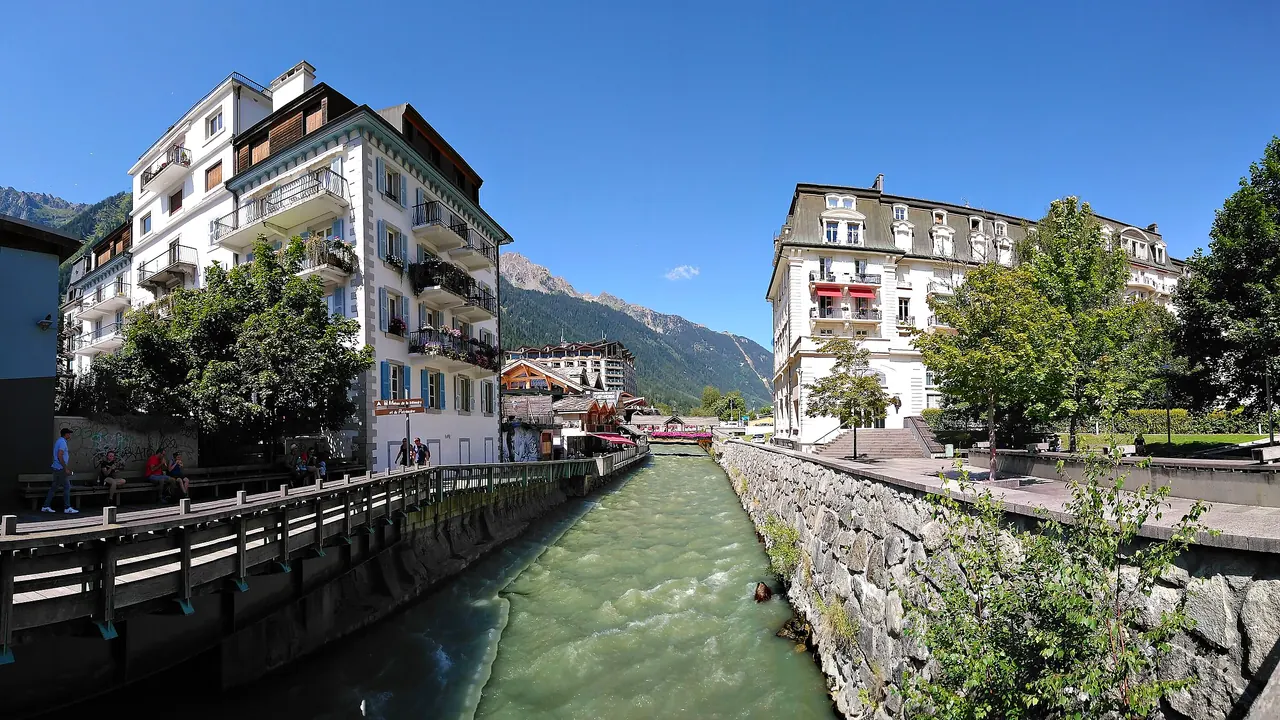
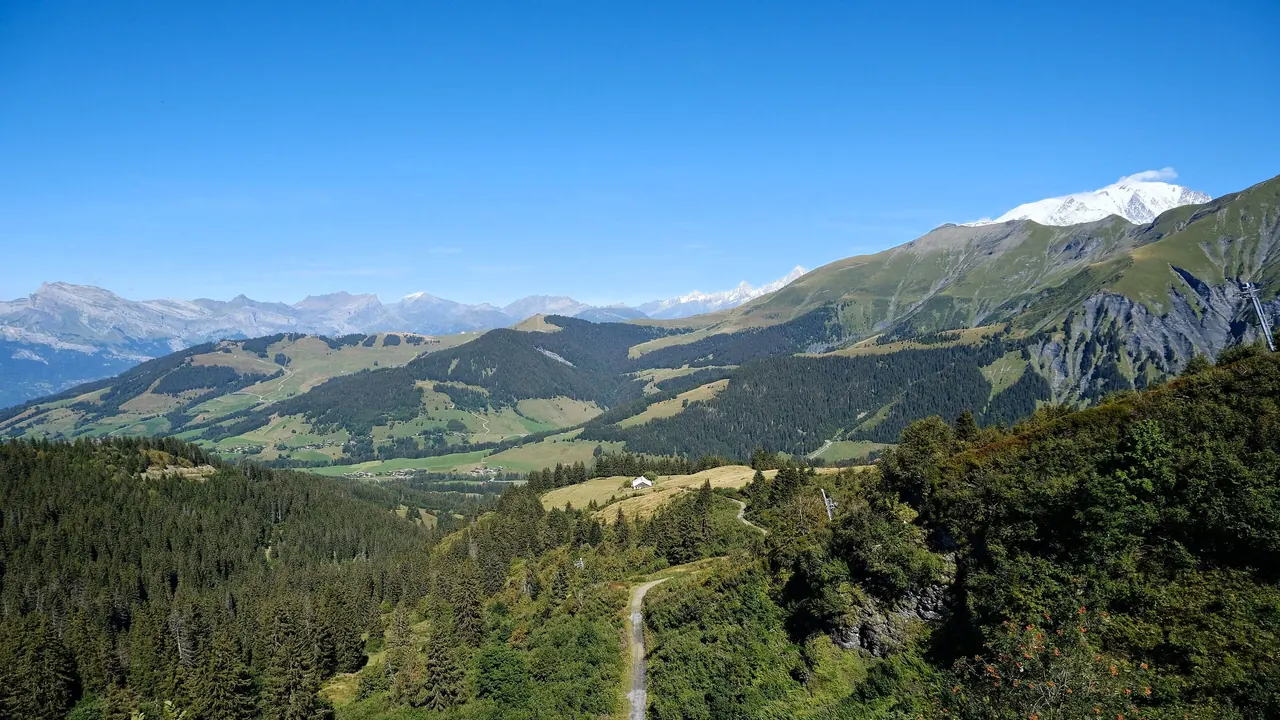
Photos: Chamonix by Tiia Monto, CC BY-SA 3.0, cropped; Megève by Guilhem Vellut, CC BY 2.0, cropped.
Chamonix or Megève?
Our verdict in twelve categories, each scored against the same fixed benchmark cities, and the climate month by month, so you can choose for your trip.
Choose Chamonix for
- getting around
- prices
- nature and the outdoors
Chamonix is for travellers who want to be up in the high mountains, not just looking at them. Cable cars from the edge of town reach glacier terrain, the trails to Lac Blanc and the Tour du Mont Blanc start in town, and climbing, ski touring and the Vallée Blanche make it a base for serious effort. It is also easier without a car, with a train and buses running along the valley, and its evenings are louder and younger.
Choose Megève for
- food and drink
- shopping
- day trips
Megève suits a slower, more polished stay. Its wide wooded pistes favour intermediate skiers, its cobbled car-free centre is made for strolling between boutiques, and its starred kitchens and hotel spas make long lunches and quiet evenings the point of the day. It is the more expensive of the two and works best with a car, which also puts Annecy, Geneva and the baroque churches of the neighbouring villages within easy reach.
Scoreboard
Twelve categories on one fixed scale from 0 to 100. The shaded stretch is the gap between the two.
Your match
Pick a travel style or drag the sliders, and both match scores follow your weighting.
Too close to call, level with your weighting
Wins on getting around and prices with your weighting.
Wins on food and drink and shopping with your weighting.
What matters to you?
Category by category
What the scores mean for a trip.
Beaches & swimming
Swimming is a side note in both, and Lake Annecy, about an hour's drive from either, is the real summer lake day. Closer to home, Chamonix has Lac de Passy down the Arve valley, with a sandy strip and Mont Blanc straight ahead, plus a municipal pool with an outdoor basin. Megève has small bathing ponds in the neighbouring valleys and both indoor and outdoor pools at the Palais sports centre.
Food & drink
Both kitchens are built on the same Savoyard base of fondue, tartiflette, diots and Reblochon, but Megève eats better. Its fine-dining tier is rare in the Alps: several starred kitchens in the village and on Mont d'Arbois, one of them among the most decorated in France, plus farmhouse auberges in the side valleys in summer.
Chamonix gives you more variety and less polish. Its international crowd keeps bistros, burger and pizza places going alongside a few ambitious hotel kitchens, and its cheese shops and bakeries are made for picnic lunches. Megève has very little that is cheap or casual.
Culture & sights
Neither has much for a sightseer, and you can see either in half a day at most, but they tell different stories. Chamonix's story is mountaineering, from the first ascent of Mont Blanc in 1786 to the first Winter Olympics. The Musée Alpin, in a former palace hotel, and the climbers' cemetery tell that story.
Megève's interest lies in the village and its buildings. The medieval street plan around Saint-Jean-Baptiste survives, and the Calvaire path of chapels climbs the hill above. Then there are the elegant interwar chalets by Henry Jacques Le Même, which made the village the model of the stylish Alpine resort.
Nightlife
Chamonix is the livelier night out. Après-ski runs into a lane of pubs and bars in the old town where guides, seasonal workers and visitors mix until late, and a few small clubs keep going on busy nights. The crowd is young and largely English-speaking.
Megève's evenings are dressier and quieter: hotel bars with open fires, piano and wine bars in the cobbled centre, and long dinners rather than dancing, with an older, wealthier crowd. Both go quiet in the shoulder seasons.
Nature & outdoors
Both face Mont Blanc, but Chamonix sits right under it, and that is the difference. Lifts reach high-mountain terrain at 3,842m, the skiing is steep, and glacier descents, mountaineering, via ferrata and the Tour du Mont Blanc start from the valley floor.
Megève's mountains are gentler and sunnier. The Évasion Mont-Blanc area is mostly wide, wooded cruising pistes loved by intermediates, though the lower slopes mean snow at the bottom varies. In summer there are meadow hikes up Mont Joly and golf on Mont d'Arbois, and Chamonix's glaciers are less than an hour's drive away.
Day trips
Chamonix's best trips go straight across borders. Courmayeur is minutes away through the Mont Blanc Tunnel, with Aosta's Roman walls and theatre beyond, and the Mont Blanc Express climbs to Martigny in Switzerland without a car. After those, most nearby places are other resorts.
Megève sits more centrally and has more to choose from. Chamonix itself is about forty minutes away, and Annecy and Geneva are each about an hour. Nearer still are the baroque churches of Saint-Gervais, Combloux and Cordon and the Beaufort cheese country, though almost all of it needs a car.
Good for families
Both are small, safe and good for outdoor families, but they suit children in different ways. Chamonix has more for summer: the Merlet animal park with ibex and marmots, the little red train to the Mer de Glace, a luge and treetop courses, although the highest cable cars are no place for toddlers.
Megève is built around young skiers, with ski-school kindergartens, gentle lower slopes, sleigh rides, an ice rink and a car-free centre. In summer there are pony rides and walks to farms. In both, a rainy day leaves little to do.
Getting around
Chamonix is much easier without a car. Its flat centre has the main lift stations, and a valley railway and buses, free with the guest card, run from Les Houches to Vallorcine, though winter ski buses get packed.
Megève's pedestrian centre is just as easy on foot, and winter shuttles link the lifts, but it has no railway station. The nearest is down at Sallanches, many chalets sit up steep hillside roads, summer shuttles are thin, and most visitors end up renting a car.
Shopping & style
Megève is the better place to shop for style. Its cobbled lanes have designer ski-wear, cashmere, jewellers and Alpine interior galleries full of antler lamps and sheepskin, and a ski-wear house founded in the village in the 1920s is the local landmark.
Chamonix shops for function. Its outdoor shops, some run by the same families for generations, carry technical climbing and ski gear and the expert advice that goes with it. For anything beyond mountain fashion or kit, both send you to Geneva or Annecy.
Affordability
Both are expensive, but Megève is the steeper bill. It is priced for a wealthy crowd at every turn, from chalets to mountain lunches, a cheap bite is hard to find, and budget visitors often stay in the valley towns and drive up.
Chamonix gives you more ways to save. Valley transport is free with the guest card, apartments and supermarkets make self-catering easy, and many trails start without a lift. Its big costs are the high cable cars, guides and paragliding flights.
Live music & performing arts
Neither has a theatre or concert season, and opera or an orchestra means a trip to Geneva. What exists is jazz in both, in different forms. Chamonix has a summer festival with some sets played high in the mountains, plus mountain film evenings. Megève's jazz lives in cellars and piano bars in the centre during the season, with a few open-air and church concerts in summer.
Wellness & relaxation
Megève is the more restful stay. Its grand hotels and chalets compete on their spas, the Palais has a public wellness area, and the slow rhythm of sleigh rides and quiet snowy evenings in a car-free centre does much of the work.
Chamonix has one standout, a large day spa in the Italian thermal style with hot outdoor pools looking up at the glaciers, but the town around it starts early and stays busy. Both are a short drive from the thermal springs at Saint-Gervais.
When should you go?
Pick your month. The climate figures are measured averages, not a forecast.
Chamonix in July
Megève in July
Daytime high, °C
Rainfall in the month, mm
Where the figures come from
Chamonix's temperatures are measured 35 km from the centre, at Bourg-St-Maurice.
Chamonix has no rain gauge within 25 km of the centre, so its rainfall comes from a gridded climate dataset read at the destination rather than from a gauge further away.
Megève's temperatures are measured 29 km from the centre, at Bourg-St-Maurice.
Megève's station stands 162 m below the city centre, so the centre is likely a little cooler than the figures say.
Megève has no rain gauge within 25 km of the centre, so its rainfall comes from a gridded climate dataset read at the destination rather than from a gauge further away.
Temperature and rainfall are climate normals, averaged over the years shown. Chamonix: 1999-2020 (rainfall 1991-2020) normals, Bourg-St-Maurice (34.9 km from centre). Megève: 1999-2020 (rainfall 1991-2020) normals, Bourg-St-Maurice (29.1 km from centre).
Temperatures in the two are almost identical through the year. Daytime highs are around 5°C in January and climb to 27°C in July, so winter from December to March is the snow season and June to September is the time for hiking, biking and the odd lake swim. The lakes are only warm enough to swim in July and August. Midsummer stays pleasant for walking, and April, October and November fall between the two seasons, when it is too cool for summer activities and usually too early or too late for good snow.
The real difference is rain. Chamonix, deeper in the valley under the massif, is wetter every month, peaking at 169mm in December against Megève's 140mm. Megève is driest in spring and summer, with April down to 81mm, so for a summer walking stay with fewer washed-out days it has a slight edge.
Which traveller are you?
On an outdoors trip, Chamonix gives you the support as well as the scenery. The world's oldest guiding company can take beginners onto real climbs, gear shops run by the same families for generations kit you out, and the valley train reaches trailheads from Les Houches to Vallorcine.
For a relaxing and wellness trip, Megève is the calmer choice. Hotel hammams and Alpine-themed treatments fill the afternoons, snowshoe routes and cross-country trails give gentle exercise on a sunny saddle facing Mont Blanc, and evenings are spent over dinner rather than in noisy bars.
On a tight budget, Chamonix makes the money go further. An airport shuttle replaces the hire car Megève usually needs, and late spring, early summer and autumn are noticeably cheaper, even if some lifts close. Megève eases only a little, in summer and the quieter weeks of January and March.
Before you go
| Measure | Chamonix | Megève |
|---|---|---|
| Official language | French | French |
| Currency | Euro (EUR) | Euro (EUR) |
| Sockets | CE230 V, 50 Hz | CE230 V, 50 Hz |
| Driving side | Right | Right |
| Time zone | UTC+1, UTC+2 in summer | UTC+1, UTC+2 in summer |
| Emergency number | 112 | 112 |
| Elevation | 995 m | 1,027 m |
| Main airport | Geneva International Airport (GVA)68 km from centre150 non-stop destinations | Geneva International Airport (GVA)58 km from centre150 non-stop destinations |
| Public holidays this year | 11 days | 11 days |
By the numbers
| Measure | Chamonix | Megève |
|---|---|---|
| Population | 8,705 | 2,893 |
| People per km² | 75 | 66 |
| Museums within 10 km | 3 | 2 |
| UNESCO World Heritage sites within 50 km | 0 | 1 |
Where else could you go?
Every comparison below shares a destination with this one, so you can follow Chamonix or Megève somewhere new.
- Saint-Gervais-les-Bainsvs Megève
- Saint-Gervais-les-Bainsvs Chamonix
- La Clusazvs Megève
- Flainevs Chamonix
- Le Grand-Bornandvs Megève
- Flainevs Megève