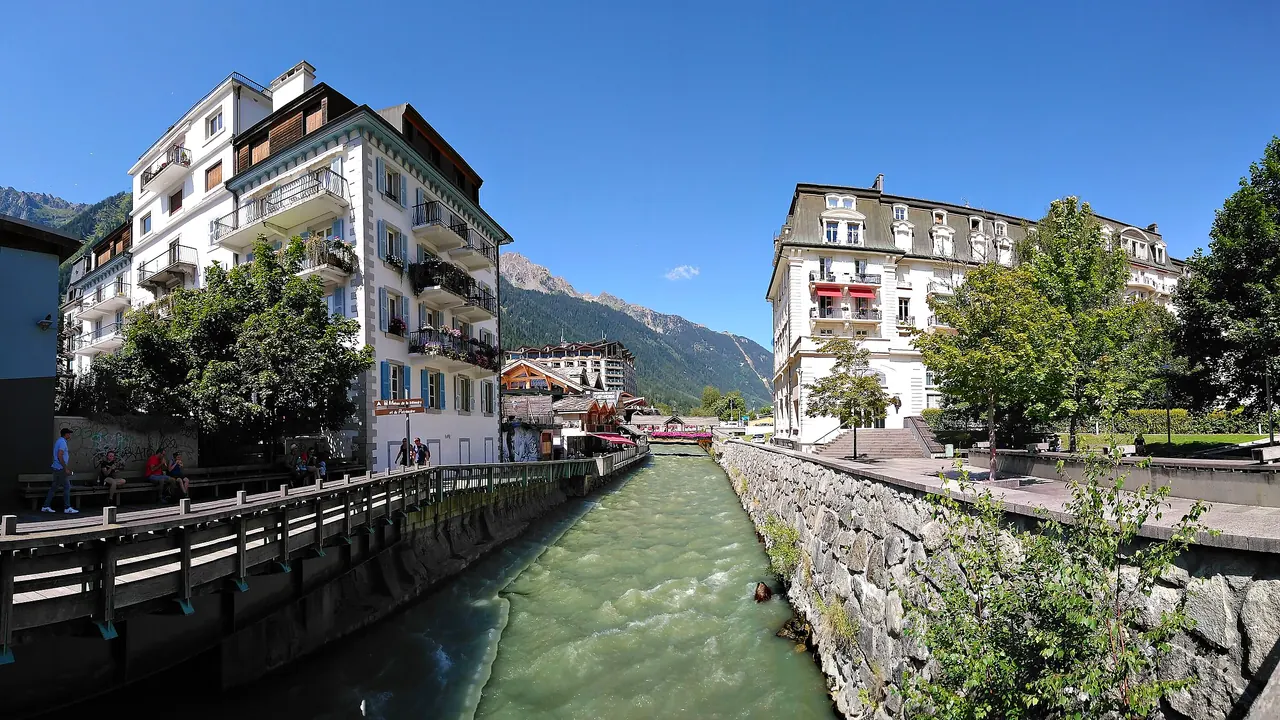
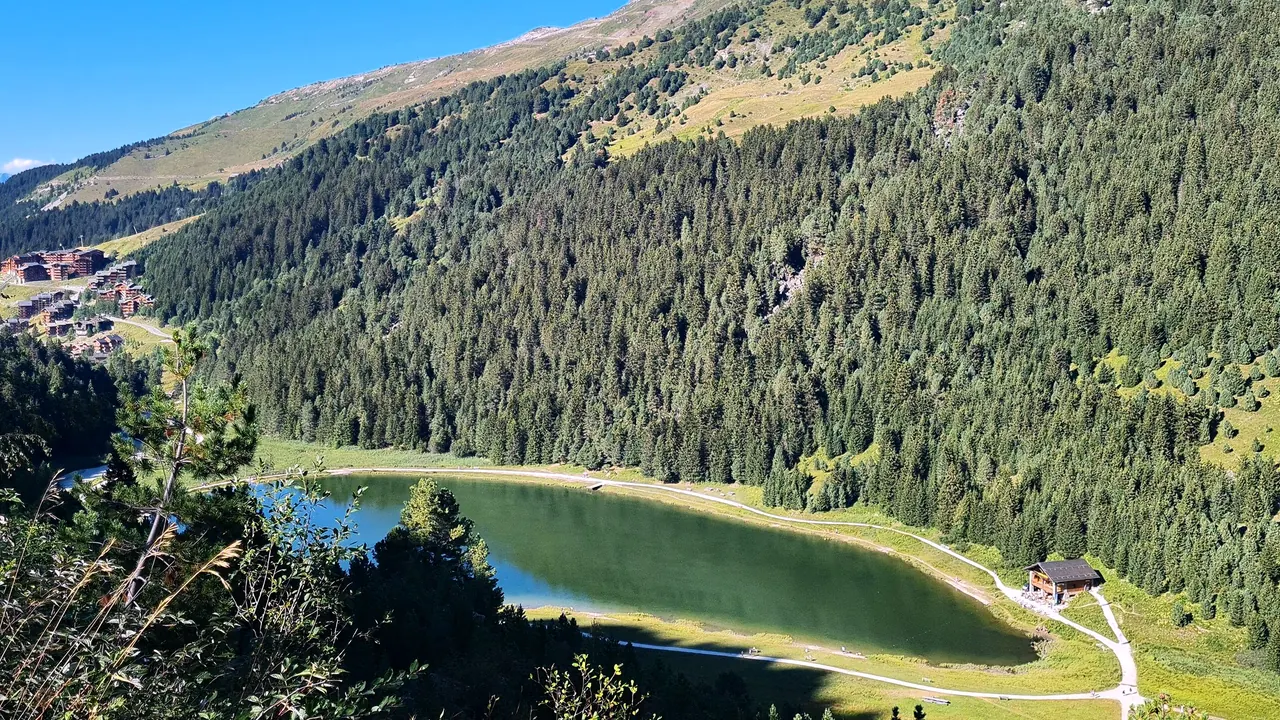
Photos: Chamonix by Tiia Monto, CC BY-SA 3.0, cropped; Méribel by Augustin Cléchet, CC BY-SA 3.0, cropped.
Chamonix or Méribel?
Our verdict in twelve categories, each scored against the same fixed benchmark cities, and the climate month by month, so you can choose for your trip.
Choose Chamonix for
- getting around
- day trips
- shopping
Chamonix suits travellers who want the mountains in every season and a real town around them. It has the glaciers, the mountaineering and the views of Mont Blanc, as well as a flat centre you can walk around, a climbing history worth an afternoon, and easy trips into Italy and Switzerland. In summer it is the warmer choice with more to do, and it is a little easier on the budget.
Choose Méribel for
- nightlife
For a ski week where the skiing is the whole point, Méribel makes more sense. It sits in the middle of the 3 Vallées, so you can cover huge distances on linked pistes, and the chalet stays, terrace lunches and lively après-ski all revolve around that. Away from the snow it has much less to offer.
Scoreboard
Twelve categories on one fixed scale from 0 to 100. The shaded stretch is the gap between the two.
Your match
Pick a travel style or drag the sliders, and both match scores follow your weighting.
Wins on getting around and day trips with your weighting.
Wins on nightlife with your weighting.
What matters to you?
Category by category
What the scores mean for a trip.
Beaches & swimming
Neither is a place to swim, but Chamonix at least has some choice. Lac de Passy, lower down the Arve valley, gets warm enough in July and August for a swim facing Mont Blanc, the town pool has an outdoor basin in summer, and Lake Annecy is a little over an hour away.
Méribel's mountain lakes are for walking around, not swimming in. That leaves the pool at the Olympic Park or a hotel pool, and a proper lake swim means a drive of well over an hour.
Food & drink
The two kitchens are close cousins: both serve fondue, raclette, tartiflette and diots, made with Beaufort and the other Savoie cheeses. What differs is where you eat. In Méribel the best meal is often lunch on a terrace by the pistes, in anything from simple huts to white-tablecloth places with long wine lists, and much of the evening cooking happens in catered chalets.
Chamonix is a bigger town and gives a little more choice of bistros, pizza and burger places. Its cheese shops, charcuteries and bakeries also make it easy to pack a picnic for the trails. In both, many places close outside the winter and summer seasons.
Culture & sights
Chamonix has a story to tell, and Méribel largely does not. Alpinism began in Chamonix, and the town hosted the first Winter Olympics in 1924. The Musée Alpin, the Espace Tairraz on glaciers and crystals, the old guides' quarter and the climbers' cemetery make a rewarding half day.
Méribel's main sight is the resort itself, a village of timber and stone chalets built to a strict style from the 1930s. Beyond that there is a small chapel and a few reminders of the Albertville Winter Games. Neither will satisfy a museum lover, but only Chamonix lets you visit the people and history behind its mountains.
Nightlife
Both towns go out mainly in winter, the two scenes are about the same size, and both have a large English-speaking crowd. Méribel's is the more party-minded: après-ski starts with dancing on tables at the mountain bars as the lifts close, then moves down to the village pubs.
In Chamonix, visitors mix with guides and seasonal workers along a lane of bars in the old town. The terraces stay busy on summer evenings, while Méribel goes very quiet once the snow has gone.
Nature & outdoors
Both are world-class mountain destinations, but they use their mountains in different ways. Chamonix puts you beneath the Mont Blanc massif. Cable cars lift you to the Aiguille du Midi, high among the glaciers and granite needles, a rack railway climbs to the Mer de Glace, and the Tour du Mont Blanc starts on the doorstep. Mountaineering, climbing and the Vallée Blanche descent are there for anyone who wants glaciers and summits.
Méribel's strength is linked skiing: the 3 Vallées run from Courchevel to Val Thorens without taking your skis off, and much of the area lies above 2,000m. Summer there is gentler, with the Tueda reserve, Vanoise trails where you often see ibex and marmots, and lift-served bike trails.
Day trips
Chamonix has the wider range of day trips because it sits close to two borders. Courmayeur and the Roman town of Aosta lie through the Mont Blanc Tunnel, the Mont Blanc Express crosses into Switzerland to Martigny, and Geneva and Annecy are each a little over an hour away by car.
From Méribel every trip starts with the winding road down to Moûtiers. The best outings, to Annecy, the castle of the Dukes of Savoy in Chambéry, Conflans and Aix-les-Bains, take up to about two hours each way. In winter, few guests make the effort.
Good for families
Both suit active families equally well, but they shine at different times of year. Méribel is built for children who ski, with snow gardens, ski schools that take young beginners and childcare in many chalets, plus an ice rink and pool at the Olympic Park. The drawback is the steep hillside layout, with icy roads between chalets and lifts.
Chamonix has more for children in summer: the red train to the Mer de Glace, the Merlet animal park, a summer luge and easy walks to mountain lakes, all from a flat town that is easy to walk around. The highest cable cars, though, are not suitable for small children.
Getting around
Chamonix is the easier place to manage without a car. The centre is flat and easy to walk, two of the main cable car and rack railway stations are in town, and buses and the Mont Blanc Express run along the valley, free with the guest card. Shuttles come in from Geneva airport. In winter the ski buses get packed.
In Méribel the lifts and free shuttle buses do the work, but walking is hard: the village climbs a steep hillside, pavements ice over and many chalets are a bus ride from the centre. The nearest railway station is at Moûtiers, about half an hour below.
Shopping & style
Neither is a shopping destination, but serious climbers and skiers often save their big gear purchases for Chamonix. Its pedestrian streets are lined with climbing, ski and outdoor shops, some run for generations, with specialist knowledge few towns can match. There are also rock crystals from the massif and génépi to take home.
Méribel's shops cover ski hire, smart ski wear, chalet homeware and Beaufort cheese. For fashion or department stores, Geneva and Annecy are easier to reach from Chamonix.
Affordability
Both are expensive, but Méribel costs more, especially in winter, when chalets, lift passes, lessons and mountain lunches are at the top end of Alpine prices. Chamonix offers more ways to save: free valley transport, supermarkets and picnic lunches, and trails that start from the valley floor without a lift.
In Méribel the usual savings come from self-catering in Mottaret or staying lower down at Brides-les-Bains. Both are noticeably cheaper outside the school vacation weeks, Méribel especially in summer.
Live music & performing arts
Neither has a theatre or concert season, so for opera or orchestral music you go to Geneva from Chamonix, or to Chambéry or Annecy from Méribel. The difference is in kind. Chamonix's long-running summer jazz festival, with some sets played high in the mountains, gives it one real music event, while live music in Méribel is mostly cover bands and DJs in the après-ski bars.
Wellness & relaxation
In both resorts you relax after a day on the mountain, and many chalets and hotels have saunas and hot tubs. Chamonix's large day spa has hot outdoor pools facing the glaciers, and the warm springs of Saint-Gervais, in a wooded gorge, are about 25 minutes down the valley.
Méribel's thermal spa is at Brides-les-Bains, reached directly by the Olympe gondola, and the Olympic Park has a wellness area closer to hand. For real quiet, avoid the winter peak in both, choosing the shoulder seasons in Chamonix and early summer or September in Méribel.
When should you go?
Pick your month. The climate figures are measured averages, not a forecast.
Chamonix in July
Méribel in July
Daytime high, °C
Rainfall in the month, mm
Where the figures come from
Chamonix's temperatures are measured 35 km from the centre, at Bourg-St-Maurice.
Chamonix has no rain gauge within 25 km of the centre, so its rainfall comes from a gridded climate dataset read at the destination rather than from a gauge further away.
Méribel has no weather station within reach, so its figures come from a gridded climate model rather than a measured record, and read a broad area rather than one spot.
Temperature and rainfall are climate normals, averaged over the years shown. Chamonix: 1999-2020 (rainfall 1991-2020) normals, Bourg-St-Maurice (34.9 km from centre). Méribel: 1991-2020 normals, TerraClimate 4 km grid at the town, no weather station within 90 km.
Chamonix's valley floor is much the warmer of the two. Summer highs reach about 27°C in July, which is warm enough to swim at Lac de Passy in July and August and pleasant for walking in town. Spring and autumn are mild, and winter days stay cold but not severe. It rains all year, with the wettest months in late autumn and December, which brings about 169mm.
Méribel sits higher and stays cold for longer. Daytime highs hover around 1°C from December to February, which suits the snow. Even in August they only reach about 20°C, fresh weather for hiking and biking but not for swimming. It is a little drier than Chamonix all year, with July the driest month at about 82mm.
Which traveller are you?
On a culture and arts trip, Chamonix is the clear choice. You can spend half a day on the Musée Alpin, the guides' quarter and the story of the first ascent of Mont Blanc, and Geneva and Aosta's Roman remains are within reach. Méribel offers its chalet architecture and little else.
On a trip on a tight budget, Chamonix gives you more room to choose your timing. Late spring, early summer and autumn cost noticeably less than the peak weeks, and the hills still give full days on foot. Méribel's cheaper summer season is short and has less to fill the days.
For skiers who want to cover as much ground as possible, Méribel wins. It sits at the centre of the 3 Vallées and is linked on skis to Courchevel and Val Thorens, where the snow is reliable. Chamonix's ski areas are spread along the valley and you reach them by bus.
Before you go
| Measure | Chamonix | Méribel |
|---|---|---|
| Official language | French | French |
| Currency | Euro (EUR) | Euro (EUR) |
| Sockets | CE230 V, 50 Hz | CE230 V, 50 Hz |
| Driving side | Right | Right |
| Time zone | UTC+1, UTC+2 in summer | UTC+1, UTC+2 in summer |
| Emergency number | 112 | 112 |
| Elevation | 995 m | 1,447 m |
| Main airport | Geneva International Airport (GVA)68 km from centre150 non-stop destinations | Geneva International Airport (GVA)100 km from centre150 non-stop destinations |
| Public holidays this year | 11 days | 11 days |
By the numbers
| Measure | Chamonix | Méribel |
|---|---|---|
| Population | 8,705 | - |
| People per km² | 75 | - |
| Museums within 10 km | 3 | 0 |
| UNESCO World Heritage sites within 50 km | 0 | 0 |
Where else could you go?
Every comparison below shares a destination with this one, so you can follow Chamonix or Méribel somewhere new.
- Courchevelvs Méribel
- Les Menuiresvs Méribel
- Val Thorensvs Méribel
- Saint-Gervais-les-Bainsvs Chamonix
- La Plagnevs Méribel
- Flainevs Chamonix