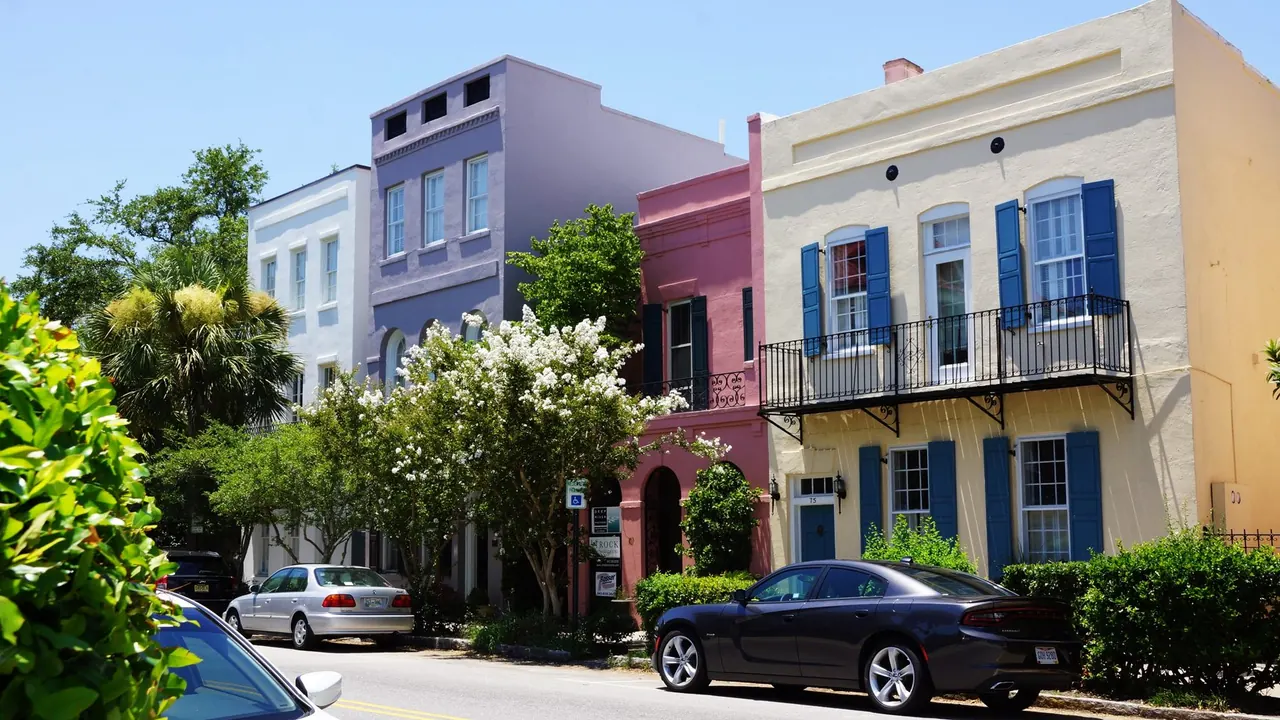
Photos: Charleston by NealVickers, CC BY-SA 4.0, cropped.
Charleston or Marco Island?
Our verdict in twelve categories, each scored against the same fixed benchmark cities, and the climate month by month, so you can choose for your trip.
Choose Charleston for
- culture and sights
- food and drink
- nightlife
Charleston suits travellers who want a town to explore as much as a beach to lie on. The historic peninsula, Lowcountry cooking, an evening on upper King Street and outings to the plantations or Savannah give it far more to do over several days. The barrier-island beaches are a pleasant half-day extra rather than the main event.
Choose Marco Island for
- nature and the outdoors
- beaches
- wellness
Choose Marco Island when the sand and the water are the whole point. Its calm, shallow Gulf crescent, the mangrove channels and the Everglades close by make it a place to swim, paddle, fish and do very little, especially in the dry, warm winter when Charleston is cool. Expect few sights, quiet evenings and a car for everything off the island.
Scoreboard
Twelve categories on one fixed scale from 0 to 100. The shaded stretch is the gap between the two.
Your match
Pick a travel style or drag the sliders, and both match scores follow your weighting.
Wins on culture and sights and food and drink with your weighting.
Wins on nature and the outdoors and beaches with your weighting.
What matters to you?
Category by category
What the scores mean for a trip.
Beaches & swimming
On Marco Island the beach is the vacation itself. In Charleston it is a half-day trip out from the old town. Charleston's three barrier islands each have their own character: surfy Folly with its pier, residential Sullivan's with old forts behind the dunes, and resort-like Isle of Palms. The Atlantic there is tidal and greenish, rip currents turn up some days, and you need a car to reach any of them.
Marco's western shore is one long sweep of fine pale sand, often right outside the hotel, with shallow water and no real surf. Wading on the Tigertail sandbar and shelling at low tide are easy, and the warmer Gulf keeps the sea swimmable for more of the year.
Food & drink
Charleston eats like a much bigger city. Its Lowcountry cooking draws on Gullah Geechee and West African roots, from shrimp and grits to Carolina Gold rice and winter oyster roasts, and is served everywhere from townhouse dining rooms to whole-hog barbecue joints. Biscuit breakfasts and craft breweries round it out.
Marco Island does one thing well, Gulf seafood by the water: grouper sandwiches, stone crab claws in the cooler months, and fish platters eaten outdoors on Goodland's docks. Beyond that the choice is narrow, and for an ambitious dinner people drive to Naples.
Culture & sights
This is where the two differ most. In Charleston the historic peninsula is the sight itself, with piazza-fronted single houses, Rainbow Row, the Battery and house museums like the Aiken-Rhett that show both the grandeur and the slavery behind it. Add Fort Sumter in the harbour and the Old Slave Mart Museum and you have two or three full days.
Marco Island was built mostly from the 1960s on. Its one real cultural stop is the historical museum, which covers the Calusa people and the carved wooden figures found in the 1890s, and a morning is enough for it.
Nightlife
Neither is a club destination, but Charleston at least gives you a night out: rooftop bars, cocktail rooms and oyster bars along upper King Street, busy with students and weekend groups, plus quieter taverns in the French Quarter. Marco's evenings end with sunset drinks on a waterfront deck and dinner. Goodland's dockside bars are mostly a winter weekend afternoon affair, and the crowd is older and mellow.
Nature & outdoors
Both are flat tidal coastlines where kayakers meet bottlenose dolphins, but Marco Island has the wilder setting. It sits on the edge of the Ten Thousand Islands, with mangrove channels, manatees in the canals and some of Florida's best inshore fishing for tarpon and snook. Everglades National Park, Big Cypress and the Fakahatchee Strand are all within an hour, with airboats, alligators and cypress boardwalks.
Charleston's Lowcountry is gentler: spartina marsh, live oaks hung with Spanish moss, and quiet trails in the Francis Marion forest and the ACE Basin. The seasons differ too. Charleston is best outdoors in spring and autumn, Marco in the dry winter months.
Day trips
Charleston has the stronger list. The Ashley River plantations, including Middleton Place, Magnolia and Drayton Hall, are half an hour away, McLeod Plantation tells the history of the enslaved people in full, and Savannah's squares and the Gullah sea islands around Beaufort each make a rewarding day.
From Marco Island the outings are pleasant rather than memorable: Naples' pier and gallery streets, the Edison and Ford Winter Estates in Fort Myers, the shell beaches of Sanibel, and the old trading post at Chokoloskee. Its best days out lead into the swamps rather than to towns. Both places assume you have a car.
Good for families
Both work well with children, in different ways. Charleston offers more variety: the aquarium and children's museum on the waterfront, an aircraft carrier to climb through at Patriots Point, the boat to Fort Sumter and beach days on the islands.
Marco Island keeps things simple, with soft sand, a calm, shallow sea that suits toddlers, resort pools with children's programmes and dolphin-spotting boat trips, plus the Naples zoo for a change. Neither has a theme park, and summer afternoons are hard going in both.
Getting around
Charleston's historic peninsula is compact and flat enough to cover on foot, with a free shuttle and pedicabs to fill the gaps, so you only need a car for beaches and plantations. Marco Island has cycle paths linking the beach, shops and restaurants, which are pleasant in the cooler months, but almost everything else, including the airport three quarters of an hour away, means driving.
Shopping & style
King Street gives Charleston a proper shopping street, with antiques at the lower end and independent boutiques at the top, and the sweetgrass baskets woven by Gullah artisans at the City Market are a craft worth taking home. Marco Island has a few plazas of resort wear and shell souvenirs. Its serious shopping is half an hour away, on Fifth Avenue South in Naples.
Affordability
Neither is cheap, but Marco Island is the harder of the two on a budget. From January to April beachfront rooms are in high demand, eating out is expensive across the board, and a hire car is unavoidable.
Charleston's peninsula inns and well-known restaurants also charge big-city prices, but walking the old streets and the Battery costs nothing, and on town days you can do without a car. The ways to save differ too: in Charleston, stay across the bridge in Mount Pleasant; on Marco, come in summer or take a weekly condo with a kitchen.
Live music & performing arts
Charleston has Spoleto Festival USA, more than two weeks of opera, chamber music, dance and jazz each late spring. For the rest of the year there are the Dock Street Theatre, the symphony at the Gaillard Center and the distinctive Gullah storytelling and song. On Marco Island it comes down to a community theatre and resort-bar musicians in winter. The philharmonic means a drive to Naples, and outside the season there is little on.
Wellness & relaxation
For a week of doing very little, Marco Island has the edge. Charleston's calm comes from its old town: shaded gardens, quiet church courtyards, porches and long evenings by the water at White Point Garden. Spa time means a hotel spa in town or a drive out to the resorts on Kiawah Island, and the streets and sights are always there to pull you back into sightseeing.
Marco Island is built around the slow day itself. The beachfront resorts have full-service spas and pools looking out over the Gulf, and the island's plazas have yoga classes and day spas, so rest takes no planning. If you want thermal baths or a public bathhouse, you won't find them in either place.
When should you go?
Pick your month. The climate figures are measured averages, not a forecast.
Charleston in July
Marco Island in July
Daytime high, °C
Rainfall in the month, mm
Where the figures come from
Marco Island has no rain gauge within 25 km of the centre, so its rainfall comes from a gridded climate dataset read at the destination rather than from a gauge further away.
Temperature and rainfall are climate normals, averaged over the years shown. Charleston: 1991-2020 (sunshine 1981-2010) normals, Charleston Airport (16.1 km from centre). Marco Island: 2012-2025 (rainfall 1991-2020) normals, Marco Island / Old Marco Junction (7.5 km from centre).
Charleston has real seasons. Winter days are cool, around 16°C in January, which is fine for walking the old streets but far too cold for the sea. Spring is the best stretch, sunny and fairly dry, and warm enough for the beach by May. Summer is hot and humid, and from June to September heavy rain arrives at around 170mm a month, while the Atlantic warms to 28°C. October is a second good window, with comfortable walking weather and water still fine for a swim.
Marco Island is warm all year, and its best season is the reverse of Charleston's. From November to April the days are dry and warm and the Gulf sits around 21°C in midwinter, which some swimmers find cool. June to September is the wet season, with heavy afternoon storms and a very warm sea of 30°C. For escaping winter Marco is the clear choice, and for strolling a city in spring or autumn Charleston is.
Which traveller are you?
On a beach and sun trip, Marco Island is the better choice. Its long crescent of soft sand faces a calm, shallow Gulf, with Tigertail's sandbar and Keewaydin's undeveloped shore nearby, and winter warmth lets you swim when Charleston's Atlantic is cold.
For a culture and arts trip, Charleston wins easily. The antebellum streets south of Broad, house museums that show the enslaved people's quarters, Fort Sumter and the International African American Museum fill several days, and Spoleto adds opera and dance in late spring.
On a food and nightlife trip, Charleston is the place. Lowcountry cooking, from she-crab soup to whole-hog barbecue, leads into rooftop and cocktail bars on upper King Street. Marco offers seafood grills with a sunset view, and then the island goes quiet.
Before you go
| Measure | Charleston | Marco Island |
|---|---|---|
| Currency | US Dollar (USD) | US Dollar (USD) |
| Sockets | AB120 V, 60 Hz | AB120 V, 60 Hz |
| Driving side | Right | Right |
| Time zone | UTC-5, UTC-4 in summer | UTC-5, UTC-4 in summer |
| Emergency number | 911 | 911 |
| Elevation | 6 m | 0 m |
| Main airport | Charleston International Airport (CHS)16 km from centre56 non-stop destinations | Southwest Florida International Airport (RSW)66 km from centre79 non-stop destinations |
| Public holidays this year | 12 days | 11 days |
By the numbers
| Measure | Charleston | Marco Island |
|---|---|---|
| Population | 150,227 | 15,760 |
| People per km² | 532 | 267 |
| Museums within 10 km | 19 | 1 |
| UNESCO World Heritage sites within 50 km | 0 | 0 |
| Swim season, months above 21 °C | 6 months | 10 months |
Where else could you go?
Every comparison below shares a destination with this one, so you can follow Charleston or Marco Island somewhere new.
- Naples, Floridavs Marco Island
- Sanibelvs Marco Island
- Fort Myersvs Marco Island
- Savannahvs Charleston
- Myrtle Beachvs Charleston
- Miamivs Marco Island