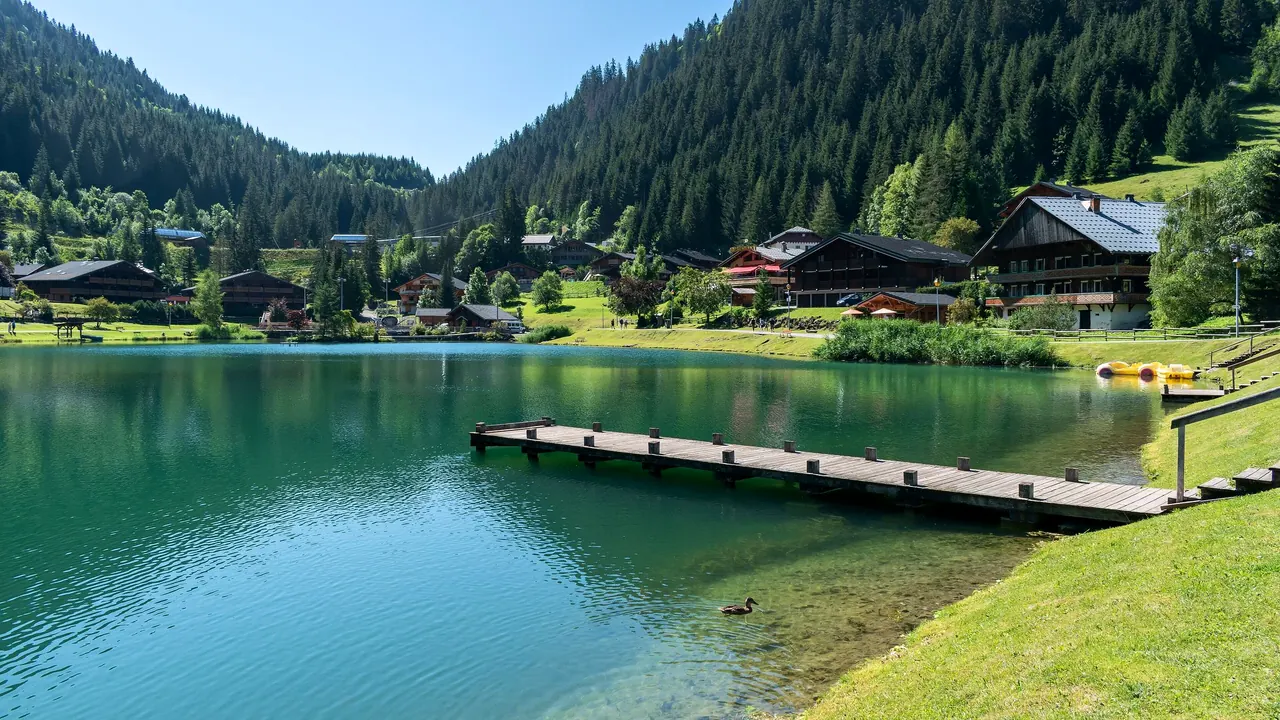
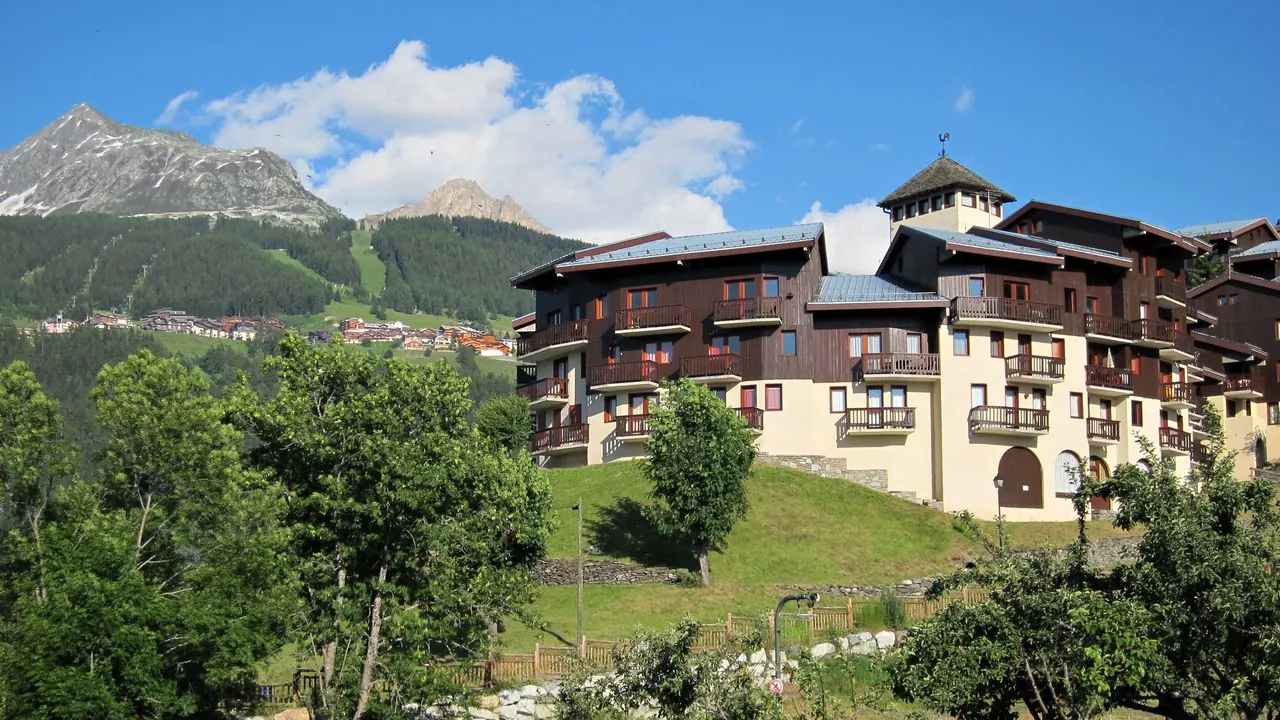
Photos: Châtel by Krzysztof Golik, CC BY-SA 4.0, cropped; La Plagne by Henk Monster, CC BY 3.0, cropped.
Châtel or La Plagne?
Our verdict in twelve categories, each scored against the same fixed benchmark cities, and the climate month by month, so you can choose for your trip.
Choose Châtel for
- day trips
- beaches
- prices
Châtel suits travellers who want a mountain base with the lowlands within reach. Lake Geneva, Évian, Thonon, Yvoire and the ferry to Lausanne are all a drive away, and summers are warm enough to combine mountain biking with an afternoon in the lake. It is also easier on the wallet: an old farming village where Abondance cheese is made on the doorstep, not a resort built for the purpose.
Choose La Plagne for
- getting around
- nightlife
- nature and the outdoors
If the plan is to stay on the snow, La Plagne is the better pick. Its villages sit higher, many are car-free with skiing from the door, and the Paradiski runs climb to the Bellecôte glacier, so winters are colder and the skiing feels more high-Alpine. It costs more and there is less to do once you leave the mountain. For a week of skiing straight from the apartment, with or without young children, it is the simpler stay.
Scoreboard
Twelve categories on one fixed scale from 0 to 100. The shaded stretch is the gap between the two.
Your match
Pick a travel style or drag the sliders, and both match scores follow your weighting.
Too close to call, 2 points apart
Wins on day trips and beaches with your weighting.
Wins on getting around and nightlife with your weighting.
What matters to you?
Category by category
What the scores mean for a trip.
Beaches & swimming
Neither place is for swimmers, but Châtel has a real way out. The pebbly lidos and grassy lakeside beaches of Évian and Thonon are under an hour's drive, and in high summer Lake Geneva is warm enough for a proper swim. Nearer home, Lac de Vonnes is for paddleboards rather than bathing.
La Plagne has nothing similar. Its mountain lakes are cold and better for a picnic, so swimming means the pools at the resort's leisure centres.
Food & drink
The two kitchens are close cousins. Both serve fondue, raclette and tartiflette, with crêperies and pizzerias, a few more ambitious dining rooms, and most places shut between seasons. Châtel's best food comes from the valley's farms, where Abondance cheese is made from the milk of the local red-and-white cattle and sold straight from the dairy.
In La Plagne the high point is lunch on a sunny chalet terrace between runs, with Beaufort and Reblochon on the menu. In the evenings many visitors cook in their apartments with cheese from the resort counters.
Culture & sights
Neither has much to see, and what each has is very different. Châtel is an old farming village with wooden chalets under deep roofs, a parish church and La Vieille Douane, the former customs post that tells the story of the smugglers who carried salt and cheese over the passes into Switzerland. La Plagne has no history before the 1960s, and its interest lies in the architecture of that era: the liner-like block of Aime 2000, the towers of Plagne Centre and the bobsleigh track left behind by the Winter Olympics.
Nightlife
In both, the evening means après-ski followed by an early night, and summer evenings are very quiet. Châtel's drinking happens in the village centre and by the lift bases, with a few pubs staying open late in winter. La Plagne spreads its late bars and a small club or two between Plagne Centre and Belle Plagne, so in peak weeks it stays a little livelier after dinner.
Nature & outdoors
Both are major mountain destinations, and the difference is altitude and character. Châtel, at about 1,200m, is a gateway to the Portes du Soleil, where a ski day can cross into Switzerland under the Cornettes de Bise. In summer it is one of Europe's best-known places for downhill and enduro biking.
La Plagne sits higher, with Paradiski runs rising to the Bellecôte glacier above 3,000m and linked to Les Arcs by the Vanoise Express. Its summers lead into the Vanoise National Park through Champagny-le-Haut, where ibex and marmots are a common sight.
Day trips
Châtel is much the better base for outings. Abondance Abbey's cloister is just down the valley, and Évian, Thonon and medieval Yvoire line the Lake Geneva shore. From Évian a ferry crosses to Lausanne, and Montreux and the Château de Chillon are over the pass.
From La Plagne every trip starts with the long road down, and in winter most people simply stay up on the slopes. The Romanesque basilica at Aime and walled Conflans are close. Chambéry and Annecy are long drives, and the Beaufortain and Italy's Aosta Valley only open up once the summer passes clear.
Good for families
Both were made for families, and they suit them in different seasons. La Plagne is strongest in winter, with car-free villages such as Belle Plagne set on the snow, big children's ski programmes, and a padded bob-raft run down the Olympic track for older children.
Châtel has more for summer: a zip line across the valley, pony rides, an aquatic centre and paddleboarding at Lac de Vonnes. Its lower altitude is easier on very young children, but traffic on the through road needs watching.
Getting around
La Plagne is easier to get around once you arrive. Most beds are ski-in and ski-out, the villages are compact, free shuttles link them, and a small cable car runs between Plagne Centre and Aime 2000. It also has a railway station at Aime in the valley, with buses up the hill.
Châtel stretches along its valley road, with hamlets and lift stations spread across the hillsides, so you rely more on the seasonal shuttles. There is no railway, only buses down to Thonon, and outside the village a car is close to essential.
Shopping & style
Shopping in these resorts happens at the cheese counter rather than the boutique, and beyond that it is ski and bike hire and outdoor gear. In Châtel the edible souvenirs are Abondance cheese from the farms, Savoyard sausages and liqueurs, and Geneva or the lakeside towns are near enough for a proper shopping day. In La Plagne you take home Beaufort, génépi and honey from the produce counters, and there is no fashion or design shopping at all.
Affordability
Châtel is the more reasonable of the two. As a village resort rather than a high-end purpose-built one, it has chalets and apartments that keep a family week within reach, though lift passes and ski school still add up in the school-vacation weeks.
A winter week in La Plagne costs noticeably more, and groceries and drinks are dearer up in the resort than in the valley. Its many self-catering apartments soften the bill. Both are much cheaper in summer.
Live music & performing arts
Neither has a theatre or a regular concert season, so live music means après-ski bands in both. Châtel adds alpine folk traditions, such as the festivities when the cows come down from the high pastures, and Montreux is within reach for more. La Plagne's evening events are torchlight descents and a few open-air summer concerts, and for theatre or classical music you have to go as far as Chambéry.
Wellness & relaxation
Here the two are close, and both leave their serious bathing about an hour's drive down the mountain. From Châtel you head to the lakeside spa towns of Évian and Thonon, from La Plagne to Brides-les-Bains and La Léchère in the Tarentaise valley. Up in the resorts, both rely on hotel saunas, hot tubs and an aquatic centre to ease legs after a day outdoors.
Châtel is slightly the more restful. It is a farming village rather than a ski station, so once the busy winter weeks are over it goes back to the rhythm of the valley, and walks at its lower altitude are gentle rather than demanding. La Plagne is built around the ski day, which tends to leave you tired rather than rested, and its calm comes mainly in summer, when the villages empty.
When should you go?
Pick your month. The climate figures are measured averages, not a forecast.
Châtel in July
La Plagne in July
Daytime high, °C
Rainfall in the month, mm
Where the figures come from
Châtel's temperatures are measured 72 km from the centre, at Bourg-St-Maurice.
Châtel's station stands 188 m below the city centre, so the centre is likely a little cooler than the figures say.
Châtel has no rain gauge within 25 km of the centre, so its rainfall comes from a gridded climate dataset read at the destination rather than from a gauge further away.
La Plagne has no weather station within reach, so its figures come from a gridded climate model rather than a measured record, and read a broad area rather than one spot.
Temperature and rainfall are climate normals, averaged over the years shown. Châtel: 1999-2020 (rainfall 1991-2020) normals, Bourg-St-Maurice (72.3 km from centre). La Plagne: 2001-2020 normals, NASA POWER reanalysis grid, no weather station within 90 km.
These are two quite different mountain climates. Châtel has mild summers, reaching 27°C in July, so June to August suits hiking, biking and a drive down to swim in Lake Geneva. It is also wet in every month, with rain or snow peaking at 167mm in December, and in winter its daytime highs stay a few degrees above freezing.
La Plagne is much colder. Daytime highs stay below freezing from December to February, which keeps the snow in good condition for the ski season. Summer peaks at around 18°C in July, cool and pleasant for walking in the high pastures but never warm enough for an outdoor swim. It also gets far less rain than Châtel, with the wettest stretch in late spring.
Which traveller are you?
On a trip on a tight budget, Châtel is the kinder choice. As a village resort with plenty of self-catering chalets it keeps a week more manageable. In La Plagne, lift passes, mountain lunches and resort grocery prices add up faster in winter.
For a beach and sun trip, neither is an obvious answer, but Châtel comes closer. Its summer afternoons are properly warm and the lidos of Évian and Thonon are under an hour away. La Plagne's high lakes stay too cold for more than a paddle.
On a family trip with young children learning to ski, La Plagne makes daily life easier. In Belle Plagne and the other car-free villages children walk straight onto gentle slopes, and free shuttles and lifts mean the car can stay parked all week.
Before you go
| Measure | Châtel | La Plagne |
|---|---|---|
| Official language | French | French |
| Currency | Euro (EUR) | Euro (EUR) |
| Sockets | CE230 V, 50 Hz | CE230 V, 50 Hz |
| Driving side | Right | Right |
| Time zone | UTC+1, UTC+2 in summer | UTC+1, UTC+2 in summer |
| Emergency number | 112 | 112 |
| Elevation | 1,053 m | 1,974 m |
| Main airport | Geneva International Airport (GVA)56 km from centre150 non-stop destinations | Geneva International Airport (GVA)92 km from centre150 non-stop destinations |
| Public holidays this year | 11 days | 11 days |
By the numbers
| Measure | Châtel | La Plagne |
|---|---|---|
| Population | 1,174 | - |
| People per km² | 36 | - |
| Museums within 10 km | 0 | 2 |
| UNESCO World Heritage sites within 50 km | 3 | 0 |
Where else could you go?
Every comparison below shares a destination with this one, so you can follow Châtel or La Plagne somewhere new.
- Avoriazvs Châtel
- Courchevelvs La Plagne
- Les Arcsvs La Plagne
- Morzinevs Châtel
- Méribelvs La Plagne
- Les Getsvs Châtel