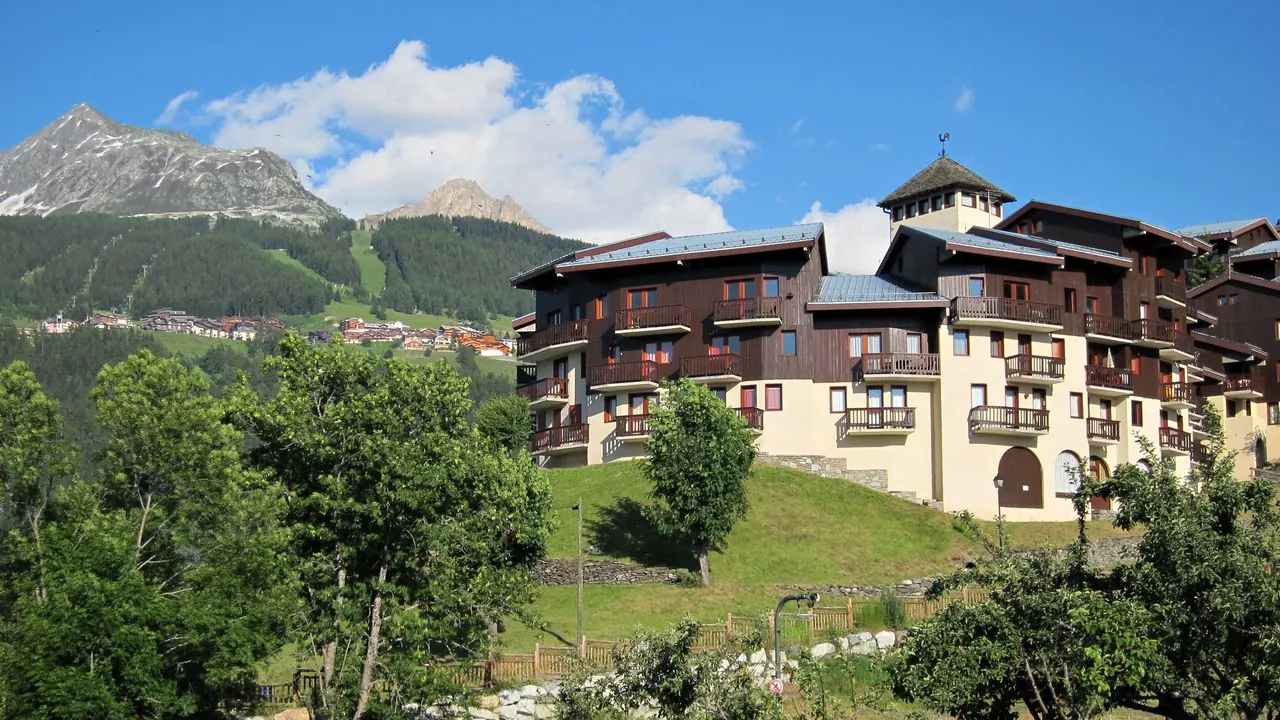
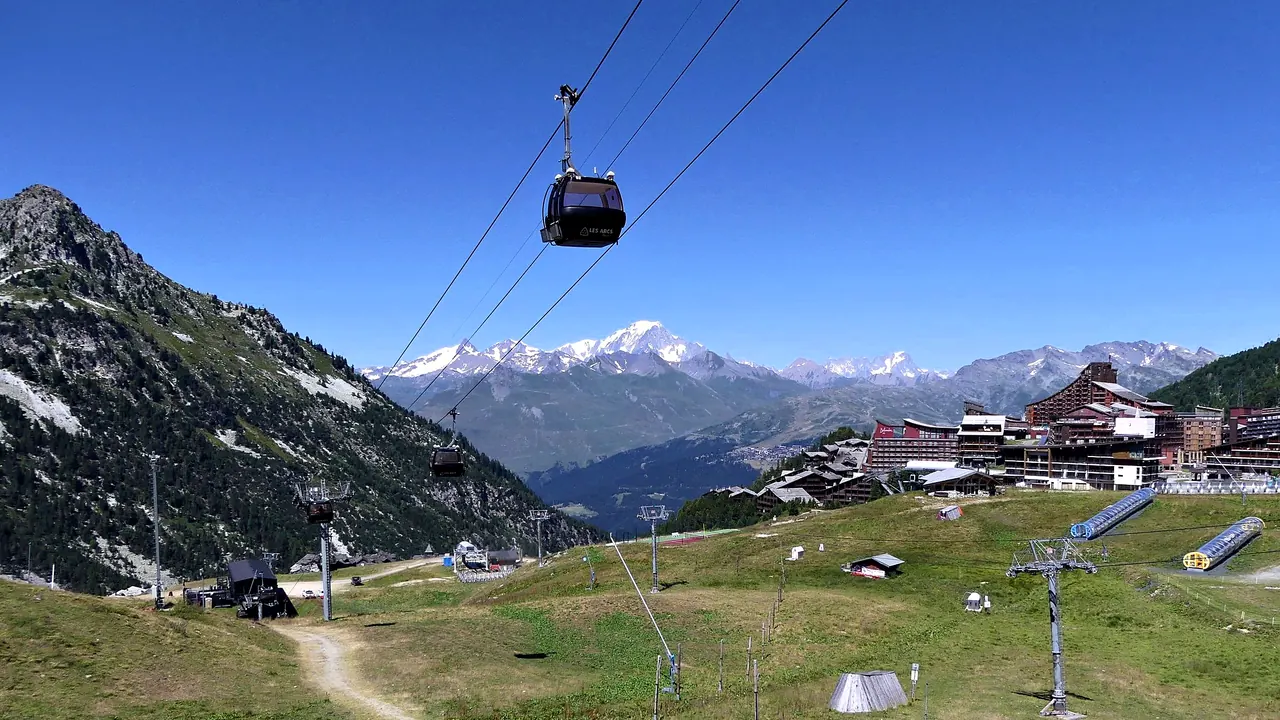
Photos: La Plagne by Henk Monster, CC BY 3.0, cropped; Les Arcs by Florian Pépellin, CC BY-SA 4.0, cropped.
La Plagne or Les Arcs?
Our verdict in twelve categories, each scored against the same fixed benchmark cities, and the climate month by month, so you can choose for your trip.
Choose La Plagne for
- nightlife
- wellness
- prices
La Plagne suits families who want the gentlest possible start on skis. In car-free Belle Plagne children step out of the door onto easy slopes, the wide sunny pistes are made for nervous intermediates, and the padded bob-raft on the Olympic track gives older children a day to remember. Its summer is milder and drier too, so July walks across the high pastures towards Champagny-le-Haut are more comfortable. Bring a car if you can, because the long climb from the valley is its weak point.
Choose Les Arcs for
- getting around
- live music and the arts
- culture and sights
Travellers arriving by train, and anyone curious about more than the pistes, should lean towards Les Arcs. A funicular lifts you from the station at Bourg-Saint-Maurice into the resort within minutes. Arc 1600 and Arc 1800 are a working showcase of Charlotte Perriand's mountain architecture, and in July a chamber music festival fills the resort's halls and chapels. Skiers who like long descents from glacier height down to the valley floor will also find more of them on this side of Paradiski.
Scoreboard
Twelve categories on one fixed scale from 0 to 100. The shaded stretch is the gap between the two.
Your match
Pick a travel style or drag the sliders, and both match scores follow your weighting.
Too close to call, 2 points apart
Wins on nightlife and wellness with your weighting.
Wins on getting around and live music and the arts with your weighting.
What matters to you?
Category by category
What the scores mean for a trip.
Beaches & swimming
Neither resort is a place to swim, and the difference lies only in what passes for water. La Plagne's summer mountain lakes are too cold for more than a paddle and suit a picnic better, so most swimming happens in the leisure centre pools. Les Arcs relies on heated outdoor pools at its residences, and for a proper lake swim you face a drive of about two hours to Annecy or the Lac du Bourget.
Food & drink
The two share the same Savoyard table of fondue, raclette, tartiflette and Beaufort, and on both sides the best meals are long lunches on sunny terraces between runs. La Plagne keeps things simple, with chalet restaurants on the slopes, a few more ambitious dining rooms and resort cheese counters for self-caterers.
Les Arcs adds diots sausages to the menus and serves some of its lunches in old farm buildings turned into mountain huts. Its funicular also makes it easy to go down to the Beaufort cooperative and the markets of Bourg-Saint-Maurice for better local produce.
Culture & sights
Neither resort has any old heritage, since both were purpose-built for skiing in the second half of the twentieth century, but Les Arcs makes more of its modern buildings. Charlotte Perriand's stepped blocks and compact interiors in its two oldest villages carry France's label for remarkable twentieth-century architecture and deserve a deliberate look.
La Plagne's period pieces are curiosities more than attractions: the liner-like hulk of Aime 2000, the high-rise Plagne Centre and the Olympic bobsleigh track. In both cases the churches and stone villages lie down in the valley, with the Romanesque basilica at Aime on La Plagne's side and baroque Tarentaise chapels below Les Arcs.
Nightlife
Evenings in both are après-ski first and early nights second, and the real difference is in tone. La Plagne leans towards pubs and late bars in Plagne Centre and Belle Plagne. Les Arcs is rowdier at its peak, with DJs and table-dancing on the terraces of Arc 1800 and Arc 2000, and the first of those two villages holds most of its late bars. Out of the winter season both go very quiet.
Nature & outdoors
These are two halves of the same Paradiski ski area, joined by the double-decker Vanoise Express, so on a full pass you ski the same mountains from either base. What differs is the home terrain. La Plagne has wide, sunny intermediate slopes rising to the Bellecôte glacier, plus tree-lined runs down to Montchavin and Champagny for days of poor visibility.
Les Arcs is known for the long descent from the Aiguille Rouge, above 3,200m, all the way to the valley floor. It also offers cross-country loops, snowshoeing and ski touring. In summer both open trails into the Vanoise National Park, with Champagny-le-Haut the gateway from La Plagne and a dedicated bike park the draw at Les Arcs.
Day trips
Day trips work much the same from both. You go down first, and in winter few people bother. From La Plagne the obvious outings are the basilica at Aime and the walled village of Conflans under an hour away, with Chambéry closer than it is from Les Arcs.
Les Arcs looks the other way, up the valley, to the market town of Bourg-Saint-Maurice at its foot and to Val d'Isère and Tignes. In summer both can cross the Little St Bernard Pass into the Aosta Valley, which is a shorter run from Les Arcs.
Good for families
Both were planned around family ski weeks, with car-free villages, apartments opening onto the snow and ski schools that take very young children. La Plagne's standout is Belle Plagne's doorstep beginner slopes and the bob-raft on the Olympic track. Les Arcs fills the afternoons off skis with sledging, ice skating, pools and themed fun slopes, and in summer it offers mountain-bike lessons for children.
Getting around
Getting there is where Les Arcs pulls clearly ahead. Long-distance trains stop at Bourg-Saint-Maurice, and a funicular climbs to Arc 1600 in a few minutes. At La Plagne you leave the train at Aime and take a bus up a long winding road, where snow chains are often needed, so a car makes life much easier.
Inside the resorts the picture flips slightly. La Plagne's villages are compact, linked by free shuttles and a small cable car between Plagne Centre and Aime 2000. The four Arcs villages are strung far apart along their road, so moving between them means the shuttle or the lifts.
Shopping & style
Shopping in both is mostly ski hire, outdoor clothing and groceries, with nothing in fashion or design. The things to take home are the same: Beaufort, cured sausages and génépi. La Plagne sells these at resort cheese and produce counters, while Les Arcs adds a few gift shops, and its best food buying is a funicular ride away in Bourg-Saint-Maurice.
Affordability
Both are expensive in winter, and the costs come from the same things: a Paradiski lift pass, equipment hire, ski school and lunches on the mountain. In both, self-catering apartments are the main way to save. At La Plagne the cheaper valley supermarkets really need a car. At Les Arcs the trick is avoiding the French school vacation weeks in favour of January or late March. Summer is noticeably cheaper at either.
Live music & performing arts
Les Arcs has the one real musical draw of the pair. Its classical festival, held each July since the 1970s, fills halls and chapels with chamber music for a few weeks and runs a music academy alongside.
At La Plagne, entertainment stops at torchlight descents, the odd open-air concert and bands in the après-ski bars. Theatre or orchestral music means a trip to Chambéry. In winter the two are much alike.
Wellness & relaxation
Neither is a restful winter choice, and both offer much the same end-of-day comforts. La Plagne has public aquatic centres alongside the hotel spas. In Les Arcs, the pool, sauna or hammam usually comes with the residence itself. For real thermal bathing, both send you about an hour down the valley, La Plagne to Brides-les-Bains or La Léchère and Les Arcs to Brides-les-Bains or Salins-les-Thermes. Summer is the calmer season at either.
When should you go?
Pick your month. The climate figures are measured averages, not a forecast.
La Plagne in July
Les Arcs in July
Daytime high, °C
Rainfall in the month, mm
Where the figures come from
La Plagne has no weather station within reach, so its figures come from a gridded climate model rather than a measured record, and read a broad area rather than one spot.
Les Arcs's temperatures are measured 43 km from the centre, at Grand St. Bernard / Grand Saint Bernard.
Les Arcs's station stands 199 m above the city centre, so the centre is likely a little warmer than the figures say.
Les Arcs has no rain gauge within 25 km of the centre, so its rainfall comes from a gridded climate dataset read at the destination rather than from a gauge further away.
Temperature and rainfall are climate normals, averaged over the years shown. La Plagne: 2001-2020 normals, NASA POWER reanalysis grid, no weather station within 90 km. Les Arcs: 1991-2020 normals, Grand St. Bernard / Grand Saint Bernard (43.4 km from centre).
Both resorts are snow country from December to March, when daytime highs at La Plagne sit around or below freezing. La Plagne warms faster in spring, reaching about 6°C in April, and May is its wettest month, so late-season snow there softens early. Les Arcs stays at or below freezing from November right through April, which makes it the surer choice for late skiing. It also gets far more precipitation, peaking at 193mm in November, and much of that falls as snow at altitude. Its December is very dim, with less than an hour of sun a day. The light returns properly from February, and March and May are both well lit.
In summer La Plagne is the milder resort, reaching around 18°C in July, which is comfortable for walking and biking across the high pastures. Les Arcs peaks near 12°C, but July is its sunniest and driest month, so walks are bright but cool and a fleece belongs in the daypack. Neither is ever warm enough for outdoor swimming. October and November turn cold and wet at both, and at Les Arcs the shortest, dimmest days of the year follow straight after.
Which traveller are you?
On a relaxing and wellness trip, La Plagne is the gentler base. Its public aquatic centres are made for soaking tired legs, the mineral springs of La Léchère lie down the valley, and evenings run to quiet pubs rather than table-dancing terraces.
For a culture and arts trip, Les Arcs gives you more to see off the slopes. The baroque chapels and stone hamlets of the Tarentaise lie just below it, and in summer the pass opens to Aosta's Roman remains. La Plagne's sights stop at its concrete period pieces.
For an outdoors trip beyond the groomed pistes, Les Arcs offers more variety. Winter adds cross-country loops, snowshoe routes and ski touring, and in summer a dedicated bike park and kayaking on the Isère join the hiking trails into the Vanoise.
Before you go
| Measure | La Plagne | Les Arcs |
|---|---|---|
| Official language | French | French |
| Currency | Euro (EUR) | Euro (EUR) |
| Sockets | CE230 V, 50 Hz | CE230 V, 50 Hz |
| Driving side | Right | Right |
| Time zone | UTC+1, UTC+2 in summer | UTC+1, UTC+2 in summer |
| Emergency number | 112 | 112 |
| Elevation | 1,974 m | 2,273 m |
| Main airport | Geneva International Airport (GVA)92 km from centre150 non-stop destinations | Geneva International Airport (GVA)92 km from centre150 non-stop destinations |
| Public holidays this year | 11 days | 11 days |
By the numbers
| Measure | La Plagne | Les Arcs |
|---|---|---|
| Museums within 10 km | 2 | 0 |
| UNESCO World Heritage sites within 50 km | 0 | 0 |
Where else could you go?
Every comparison below shares a destination with this one, so you can follow La Plagne or Les Arcs somewhere new.
- La Rosièrevs Les Arcs
- Courchevelvs La Plagne
- Tignesvs Les Arcs
- Méribelvs La Plagne
- Tignesvs La Plagne
- La Rosièrevs La Plagne